The Legislative Branch What institutions comprise the legislative branch?  What are duties and responsibilities of Congress? How does Congress preserve democracy?
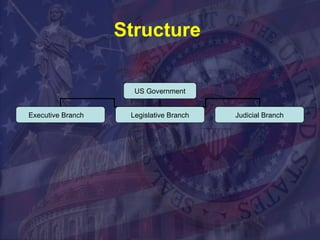
Structure  US Government Executive Branch Legislative Branch Judicial Branch
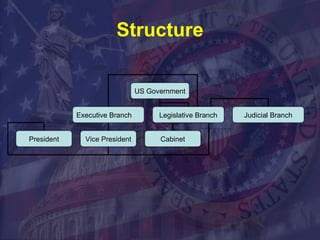
Structure US Government Executive Branch Legislative Branch Judicial Branch President Vice President Cabinet
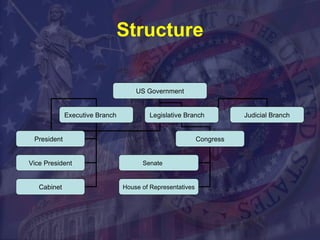
Structure US Government Executive Branch Legislative Branch Judicial Branch President Vice President Cabinet Congress Senate House of Representatives
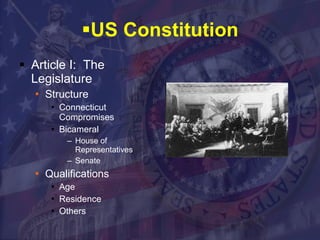
US Constitution Article I:  The Legislature Structure Connecticut Compromises Bicameral House of Representatives  Senate Qualifications Age Residence Others
Constituents Apportionment Senate is based on statehood 50 states X 2 senators in each =100 House: Contingent on population size Every state gets at least one regardless to the population Based on the 2000 census, for every 646,952 people, the state receives one House of Representative member
Voter Behavior The Power of Incumbency “You have to win the open seats by a rather substantial proportion because, unless you have a nationalized race, the incumbents are going to win”  John Samples, director of the Center for Representative Government at the Cato Institute. Name recognition, fund-raising, pork barrel
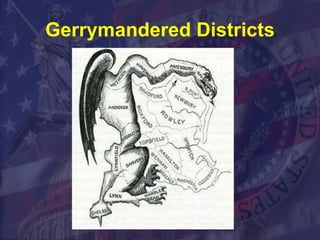
Manipulating Congressional Distribution  Gerrymandering A controversial form of redistricting in which electoral district boundaries are manipulated for an electoral advantage.  The term was used in the early 1800 to described the appearance of a strange electoral district Elbridge Gerry created in order to disadvantage his electoral opponents.
Gerrymandered Districts
Powers and Duties Senate (Upper House) Ratify treaties Confirm federal judges, ambassadors, Cabinet members Try and remove the president though impeachment Oversight House of Representatives (Lower House) Propose apportionment bills Impeach the president Oversight
Powers and Duties Both chambers together Make law Power of the purse Declare war Override a veto with 2/3 vote Amend the Constitution with 2/3 vote
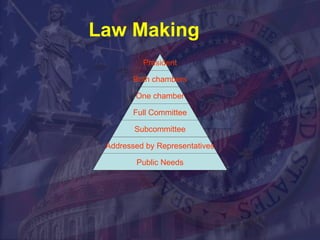
Law Making President Both   chambers One chamber Full Committee Subcommittee Addressed by Representatives Public Needs
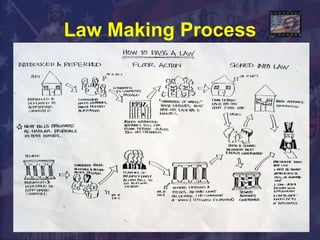
Law Making Process
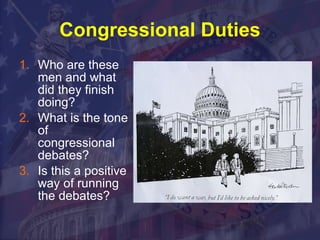
Congressional Duties Who are these men and what did they finish doing? What is the tone of  congressional debates? Is this a positive way of running the debates?
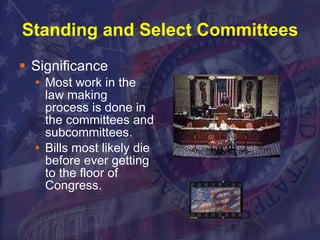
Standing and Select Committees Significance Most work in the law making process is done in the committees and subcommittees. Bills most likely die before ever getting to the floor of Congress.
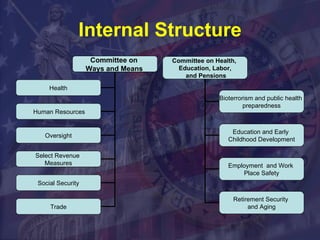
Internal Structure Committee on  Ways and Means   Health Human Resources Oversight Select Revenue  Measures Social Security Trade Committee on Health,  Education, Labor, and Pensions Bioterrorism and public health  preparedness Education and Early  Childhood Development Employment  and Work  Place Safety Retirement Security  and Aging
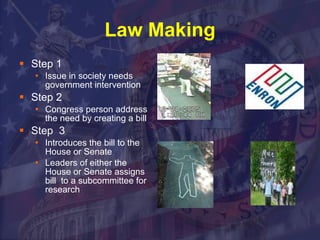
Law Making Step 1 Issue in society needs government intervention Step 2 Congress person address the need by creating a bill Step  3 Introduces the bill to the House or Senate Leaders of either the House or Senate assigns bill  to a subcommittee for research
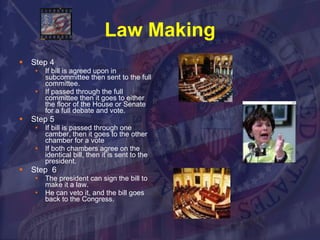
Law Making Step 4 If bill is agreed upon in subcommittee then sent to the full committee. If passed through the full committee then it goes to either the floor of the House or Senate for a full debate and vote. Step 5 If bill is passed through one camber, then it goes to the other chamber for a vote If both chambers agree on the identical bill, then it is sent to the president.  Step  6 The president can sign the bill to make it a law. He can veto it, and the bill goes back to the Congress.
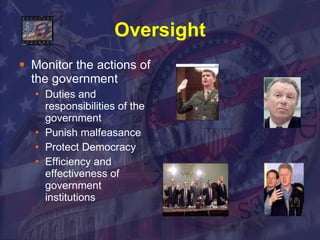
Oversight Monitor the actions of the government Duties and responsibilities of the government Punish malfeasance Protect Democracy  Efficiency and effectiveness of government institutions
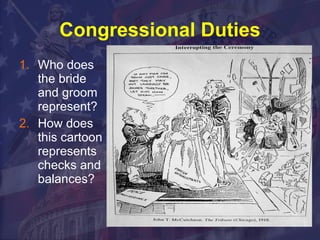
Congressional Duties Who does the bride and groom represent? How does this cartoon represents  checks and balances?
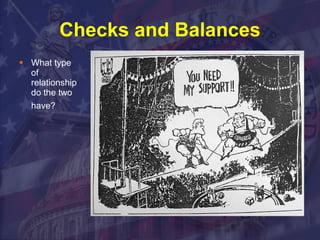
Checks and Balances What type of relationship do the two have?
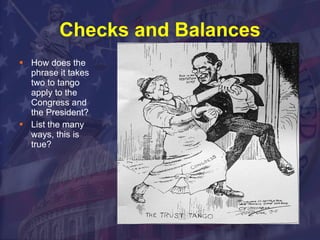
Checks and Balances How does the phrase it takes two to tango apply to the Congress and the President?  List the many ways, this is true?
Checks and Balances Presidential Powers Commander and Chief Appoint judges, ambassadors, and the Cabinet Sign to become a law or Veto it Negotiate treaties Congressional Checks Declare and Fund War Confirmation of these officials Creates bills Ratify treaties
Quiz How is Congress roles central to democracy?  Provide at least 2 specific examples.
Key Vocabulary Bicameral Committees Quorum Simple Majority Super Majority Filibuster Pork Barrel  Constituents Incumbent Gerrymandering Apportionment Caucus Lobbyist Speaker of the House President Pro Tempore Bill and Law Oversight Legislation

The Legislative Branch New

  • 1.
    The Legislative BranchWhat institutions comprise the legislative branch? What are duties and responsibilities of Congress? How does Congress preserve democracy?
  • 2.
    Structure USGovernment Executive Branch Legislative Branch Judicial Branch
  • 3.
    Structure US GovernmentExecutive Branch Legislative Branch Judicial Branch President Vice President Cabinet
  • 4.
    Structure US GovernmentExecutive Branch Legislative Branch Judicial Branch President Vice President Cabinet Congress Senate House of Representatives
  • 5.
    US Constitution ArticleI: The Legislature Structure Connecticut Compromises Bicameral House of Representatives Senate Qualifications Age Residence Others
  • 6.
    Constituents Apportionment Senateis based on statehood 50 states X 2 senators in each =100 House: Contingent on population size Every state gets at least one regardless to the population Based on the 2000 census, for every 646,952 people, the state receives one House of Representative member
  • 7.
    Voter Behavior ThePower of Incumbency “You have to win the open seats by a rather substantial proportion because, unless you have a nationalized race, the incumbents are going to win” John Samples, director of the Center for Representative Government at the Cato Institute. Name recognition, fund-raising, pork barrel
  • 8.
    Manipulating Congressional Distribution Gerrymandering A controversial form of redistricting in which electoral district boundaries are manipulated for an electoral advantage. The term was used in the early 1800 to described the appearance of a strange electoral district Elbridge Gerry created in order to disadvantage his electoral opponents.
  • 9.
  • 10.
    Powers and DutiesSenate (Upper House) Ratify treaties Confirm federal judges, ambassadors, Cabinet members Try and remove the president though impeachment Oversight House of Representatives (Lower House) Propose apportionment bills Impeach the president Oversight
  • 11.
    Powers and DutiesBoth chambers together Make law Power of the purse Declare war Override a veto with 2/3 vote Amend the Constitution with 2/3 vote
  • 12.
    Law Making PresidentBoth chambers One chamber Full Committee Subcommittee Addressed by Representatives Public Needs
  • 13.
  • 14.
    Congressional Duties Whoare these men and what did they finish doing? What is the tone of congressional debates? Is this a positive way of running the debates?
  • 15.
    Standing and SelectCommittees Significance Most work in the law making process is done in the committees and subcommittees. Bills most likely die before ever getting to the floor of Congress.
  • 16.
    Internal Structure Committeeon Ways and Means Health Human Resources Oversight Select Revenue Measures Social Security Trade Committee on Health, Education, Labor, and Pensions Bioterrorism and public health preparedness Education and Early Childhood Development Employment and Work Place Safety Retirement Security and Aging
  • 17.
    Law Making Step1 Issue in society needs government intervention Step 2 Congress person address the need by creating a bill Step 3 Introduces the bill to the House or Senate Leaders of either the House or Senate assigns bill to a subcommittee for research
  • 18.
    Law Making Step4 If bill is agreed upon in subcommittee then sent to the full committee. If passed through the full committee then it goes to either the floor of the House or Senate for a full debate and vote. Step 5 If bill is passed through one camber, then it goes to the other chamber for a vote If both chambers agree on the identical bill, then it is sent to the president. Step 6 The president can sign the bill to make it a law. He can veto it, and the bill goes back to the Congress.
  • 19.
    Oversight Monitor theactions of the government Duties and responsibilities of the government Punish malfeasance Protect Democracy Efficiency and effectiveness of government institutions
  • 20.
    Congressional Duties Whodoes the bride and groom represent? How does this cartoon represents checks and balances?
  • 21.
    Checks and BalancesWhat type of relationship do the two have?
  • 22.
    Checks and BalancesHow does the phrase it takes two to tango apply to the Congress and the President? List the many ways, this is true?
  • 23.
    Checks and BalancesPresidential Powers Commander and Chief Appoint judges, ambassadors, and the Cabinet Sign to become a law or Veto it Negotiate treaties Congressional Checks Declare and Fund War Confirmation of these officials Creates bills Ratify treaties
  • 24.
    Quiz How isCongress roles central to democracy? Provide at least 2 specific examples.
  • 25.
    Key Vocabulary BicameralCommittees Quorum Simple Majority Super Majority Filibuster Pork Barrel Constituents Incumbent Gerrymandering Apportionment Caucus Lobbyist Speaker of the House President Pro Tempore Bill and Law Oversight Legislation