Now You See Me, Now You Don’t: 
Chasing Evasive Malware 
Giovanni Vigna 
CTO @ Lastline, Inc. 
and 
Professor @ Department of Computer Science 
University of California Santa Barbara
Who am I? 
• Co-founder and CTO at Lastline, Inc. 
– Lastline offers protection against zero-day threats and advanced 
malware 
• Professor of Computer Science at the University of California in 
Santa Barbara 
– Many system security papers in academic conferences 
– Started malware research around 2004, focusing on evasive malware 
– Built and made available to the public practical systems (Anubis, 
Wepawet, Revolver, …) 
– Lead Shellphish, the longest-running hacking team at DefCon’s CTF
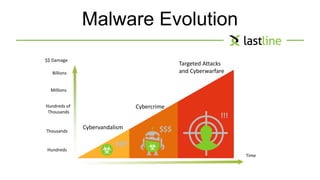
Malware Evolution 
Targeted Attacks 
and Cyberwarfare 
!!! 
Time 
$$ Damage 
Billions 
Millions 
Hundreds of 
Thousands 
Thousands 
Hundreds 
Cybercrime 
Cybervandalism $$$ 
#@!
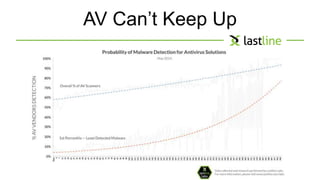
AV Can’t Keep Up
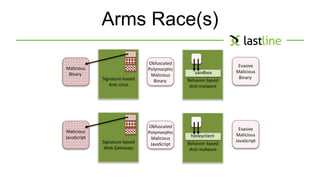
Arms Race(s) 
Malicious 
Binary 
Obfuscated 
Polymorphic 
Malicious 
sandbox 
Binary Behavior-based 
Anti-malware 
Evasive 
Malicious 
Signature-based Binary 
Anti-virus 
Malicious 
JavaScript 
Obfuscated 
Polymorphic 
Malicious 
honeyclient 
JavaScript Behavior-based 
Anti-malware 
Evasive 
Malicious 
Signature-based JavaScript 
Web Gateways
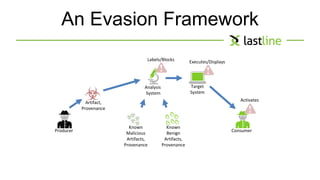
An Evasion Framework 
Artifact, 
Provenance 
Labels/Blocks Executes/Displays 
Analysis 
System 
Target 
System 
Known 
Malicious 
Artifacts, 
Provenance 
Known 
Benign 
Artifacts, 
Provenance 
Activates 
Producer Consumer
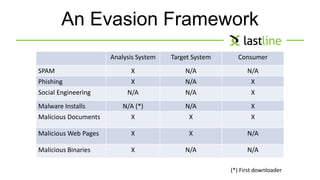
An Evasion Framework 
Analysis System Target System Consumer 
SPAM X N/A N/A 
Phishing X N/A X 
Social Engineering N/A N/A X 
Malware Installs N/A (*) N/A X 
Malicious Documents X X X 
Malicious Web Pages X X N/A 
Malicious Binaries X N/A N/A 
(*) First downloader
Evading Static Analysis 
• Static analysis techniques can be evaded by making the (relevant) 
code unavailable 
– Packing/encrypting 
– Delaying the inclusion of code 
• Static analysis techniques can be evaded by exploiting differences 
in the parsing capabilities of the target system vs. analysis system 
– Parsing the executable (the target is the OS) 
– Parsing the document (the target is the Office application) 
• Static analysis techniques can be foiled by making certain 
operations depend on values known only at run-time 
– Table lookups based on user-provided input
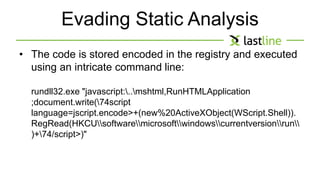
Evading Static Analysis 
• The code is stored encoded in the registry and executed 
using an intricate command line: 
rundll32.exe "javascript:..mshtml,RunHTMLApplication 
;document.write(74script 
language=jscript.encode>+(new%20ActiveXObject(WScript.Shell)). 
RegRead(HKCUsoftwaremicrosoftwindowscurrentversionrun 
)+74/script>)"
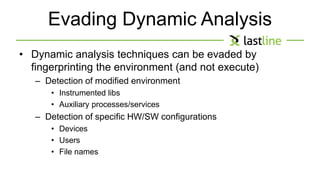
Evading Dynamic Analysis 
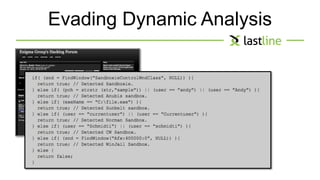
• Dynamic analysis techniques can be evaded by 
fingerprinting the environment (and not execute) 
– Detection of modified environment 
• Instrumented libs 
• Auxiliary processes/services 
– Detection of specific HW/SW configurations 
• Devices 
• Users 
• File names
Evading Dynamic Analysis
Evading Dynamic Analysis 
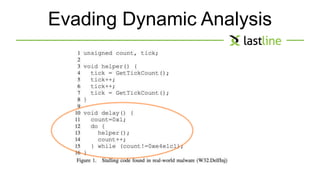
• Dynamic analysis techniques can be evaded by 
exploiting differences in the execution capabilities of the 
target system vs. analysis system 
– Semantics (virtualization/emulation introduces differences) 
– Speed (analysis systems are usually slower) 
– Available resources (analysis has a finite, limited time) 
• Sleeping 
• Stalling loops
Evading Dynamic Analysis
Evading Dynamic Analysis 
• Dynamic analysis can be evaded by checking for the 
presence of a human (“reverse Turing test”) 
– Keyboard/mouse is attached 
– Mouse moves 
• These activities cannot be too obvious or the user will 
become suspicious
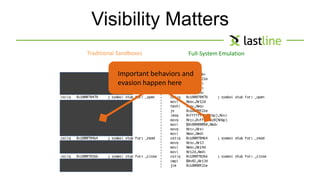
Visibility Matters 
Traditional Sandboxes 
Full-System Emulation 
Important behaviors and 
evasion happen here
What Needs to Be Done (Now) 
• Use the evasive behavior as a signal for detection 
– Detect fingerprinting 
– Detect failures to execute 
• Rely on binary-level program analysis techniques to 
identify stalling 
– Characterize program evolution 
– Identify loops and push through
What’s Next? (Threat-wise) 
• As evasion detection improves, cybercriminals will be 
forced into mimicry 
• Mimicry is the process of creating malware that mimics 
the behavior of benign applications (until the analysis is 
completed)
What’s Next? (Protection-wise) 
• The next approach is eliciting 
– Elicit: verb 
evoke or draw out (a reaction, answer, or fact) from someone. 
"I tried to elicit a smile from Joanna” 
synonyms: 
obtain, bring out, draw out, extract, evoke, bring about, bring 
forth, induce, excite, give rise to, call forth, prompt, generate, 
engender, spark off, trigger, kindle; 
• Identify dormant code 
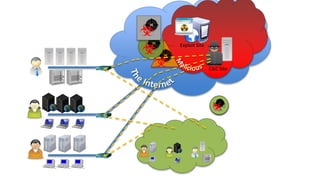
• Introduce the honey-user
C&C Site 
Exploit Site
Conclusions 
• Malware is (and will always be) in continuous evolution 
• Evasion is a process, not a phase 
• It is important to create countermeasures that require 
major efforts/resources from the attacker 
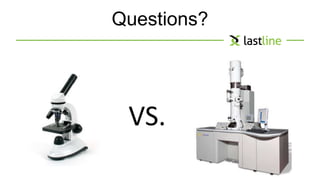
• Visibility is key 
– Traditional anti-malware is based on simple microscopes 
– We need electronic (malware) microscopes
Questions? 
VS.
Backup Slides
The Golden Standard: Bare 
Metal 
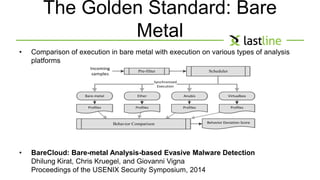
• Comparison of execution in bare metal with execution on various types of analysis 
platforms 
Pre-filter 
Synchronized 
Execution 
Bare-metal Ether Anubis Virtualbox 
Behavior Comparison 
Incoming 
samples 
• BareCloud: Bare-metal Analysis-based Evasive Malware Detection 
Dhilung Kirat, Chris Kruegel, and Giovanni Vigna 
Proceedings of the USENIX Security Symposium, 2014 
Scheduler 
Profiles Profiles Profiles Profiles 
Behavior Deviation Score
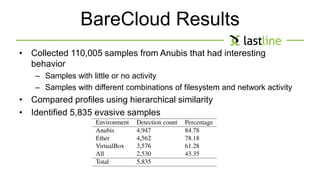
BareCloud Results 
• Collected 110,005 samples from Anubis that had interesting 
behavior 
– Samples with little or no activity 
– Samples with different combinations of filesystem and network activity 
• Compared profiles using hierarchical similarity 
• Identified 5,835 evasive samples
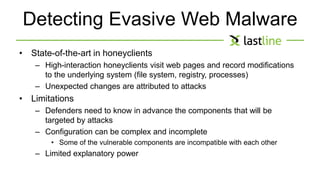
Detecting Evasive Web Malware 
• State-of-the-art in honeyclients 
– High-interaction honeyclients visit web pages and record modifications 
to the underlying system (file system, registry, processes) 
– Unexpected changes are attributed to attacks 
• Limitations 
– Defenders need to know in advance the components that will be 
targeted by attacks 
– Configuration can be complex and incomplete 
• Some of the vulnerable components are incompatible with each other 
– Limited explanatory power
Revolver: Detecting Evasions 
in Web-based Malware 
• Providing an oracle available to the public has drawbacks 
– Malware can be tested before deployment 
• Exploitation of discrepancies leads to failed detection 
• Can we use this against the bad guys? 
– Revolver: An Automated Approach to the Detection of Evasive Web-based 
Malware 
A. Kapravelos, Y. Shoshitaishvili, M. Cova, C. Kruegel, G. Vigna in 
Proceedings of the USENIX Security Symposium Washington, D.C. 
August 2013
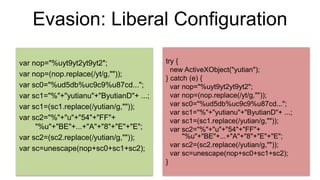
Evasion: Liberal Configuration 
var nop="%uyt9yt2yt9yt2"; 
var nop=(nop.replace(/yt/g,"")); 
var sc0="%ud5db%uc9c9%u87cd..."; 
var sc1="%"+"yutianu"+"ByutianD"+ ...; 
var sc1=(sc1.replace(/yutian/g,"")); 
var sc2="%"+"u"+"54"+"FF"+ 
"%u"+"BE"+...+"A"+"8"+"E"+"E"; 
var sc2=(sc2.replace(/yutian/g,"")); 
var sc=unescape(nop+sc0+sc1+sc2); 
try { 
new ActiveXObject("yutian"); 
} catch (e) { 
var nop="%uyt9yt2yt9yt2"; 
var nop=(nop.replace(/yt/g,"")); 
var sc0="%ud5db%uc9c9%u87cd..."; 
var sc1="%"+"yutianu"+"ByutianD"+ ...; 
var sc1=(sc1.replace(/yutian/g,"")); 
var sc2="%"+"u"+"54"+"FF"+ 
"%u"+"BE"+...+"A"+"8"+"E"+"E"; 
var sc2=(sc2.replace(/yutian/g,"")); 
var sc=unescape(nop+sc0+sc1+sc2); 
}
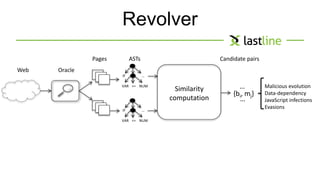
Revolver 
IF 
… 
VAR <= NUM 
Web Oracle 
IF 
… 
VAR <= NUM 
Similarity 
computation 
{bi, mj} 
Malicious evolution 
Data-dependency 
JavaScript infections 
Evasions 
Pages ASTs Candidate pairs 
… 
…
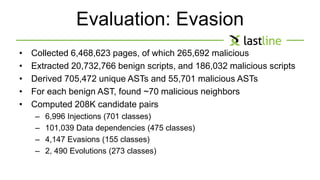
Evaluation: Evasion 
• Collected 6,468,623 pages, of which 265,692 malicious 
• Extracted 20,732,766 benign scripts, and 186,032 malicious scripts 
• Derived 705,472 unique ASTs and 55,701 malicious ASTs 
• For each benign AST, found ~70 malicious neighbors 
• Computed 208K candidate pairs 
– 6,996 Injections (701 classes) 
– 101,039 Data dependencies (475 classes) 
– 4,147 Evasions (155 classes) 
– 2, 490 Evolutions (273 classes)
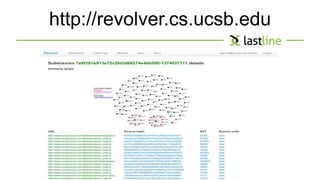
http://revolver.cs.ucsb.edu

Now you see me, now you don't: chasing evasive malware - Giovanni Vigna

  • 1.
    Now You SeeMe, Now You Don’t: Chasing Evasive Malware Giovanni Vigna CTO @ Lastline, Inc. and Professor @ Department of Computer Science University of California Santa Barbara
  • 2.
    Who am I? • Co-founder and CTO at Lastline, Inc. – Lastline offers protection against zero-day threats and advanced malware • Professor of Computer Science at the University of California in Santa Barbara – Many system security papers in academic conferences – Started malware research around 2004, focusing on evasive malware – Built and made available to the public practical systems (Anubis, Wepawet, Revolver, …) – Lead Shellphish, the longest-running hacking team at DefCon’s CTF
  • 3.
    Malware Evolution TargetedAttacks and Cyberwarfare !!! Time $$ Damage Billions Millions Hundreds of Thousands Thousands Hundreds Cybercrime Cybervandalism $$$ #@!
  • 4.
  • 5.
    Arms Race(s) Malicious Binary Obfuscated Polymorphic Malicious sandbox Binary Behavior-based Anti-malware Evasive Malicious Signature-based Binary Anti-virus Malicious JavaScript Obfuscated Polymorphic Malicious honeyclient JavaScript Behavior-based Anti-malware Evasive Malicious Signature-based JavaScript Web Gateways
  • 6.
    An Evasion Framework Artifact, Provenance Labels/Blocks Executes/Displays Analysis System Target System Known Malicious Artifacts, Provenance Known Benign Artifacts, Provenance Activates Producer Consumer
  • 7.
    An Evasion Framework Analysis System Target System Consumer SPAM X N/A N/A Phishing X N/A X Social Engineering N/A N/A X Malware Installs N/A (*) N/A X Malicious Documents X X X Malicious Web Pages X X N/A Malicious Binaries X N/A N/A (*) First downloader
  • 8.
    Evading Static Analysis • Static analysis techniques can be evaded by making the (relevant) code unavailable – Packing/encrypting – Delaying the inclusion of code • Static analysis techniques can be evaded by exploiting differences in the parsing capabilities of the target system vs. analysis system – Parsing the executable (the target is the OS) – Parsing the document (the target is the Office application) • Static analysis techniques can be foiled by making certain operations depend on values known only at run-time – Table lookups based on user-provided input
  • 9.
    Evading Static Analysis • The code is stored encoded in the registry and executed using an intricate command line: rundll32.exe "javascript:..mshtml,RunHTMLApplication ;document.write(74script language=jscript.encode>+(new%20ActiveXObject(WScript.Shell)). RegRead(HKCUsoftwaremicrosoftwindowscurrentversionrun )+74/script>)"
  • 10.
    Evading Dynamic Analysis • Dynamic analysis techniques can be evaded by fingerprinting the environment (and not execute) – Detection of modified environment • Instrumented libs • Auxiliary processes/services – Detection of specific HW/SW configurations • Devices • Users • File names
  • 11.
  • 12.
    Evading Dynamic Analysis • Dynamic analysis techniques can be evaded by exploiting differences in the execution capabilities of the target system vs. analysis system – Semantics (virtualization/emulation introduces differences) – Speed (analysis systems are usually slower) – Available resources (analysis has a finite, limited time) • Sleeping • Stalling loops
  • 13.
  • 14.
    Evading Dynamic Analysis • Dynamic analysis can be evaded by checking for the presence of a human (“reverse Turing test”) – Keyboard/mouse is attached – Mouse moves • These activities cannot be too obvious or the user will become suspicious
  • 15.
    Visibility Matters TraditionalSandboxes Full-System Emulation Important behaviors and evasion happen here
  • 16.
    What Needs toBe Done (Now) • Use the evasive behavior as a signal for detection – Detect fingerprinting – Detect failures to execute • Rely on binary-level program analysis techniques to identify stalling – Characterize program evolution – Identify loops and push through
  • 17.
    What’s Next? (Threat-wise) • As evasion detection improves, cybercriminals will be forced into mimicry • Mimicry is the process of creating malware that mimics the behavior of benign applications (until the analysis is completed)
  • 18.
    What’s Next? (Protection-wise) • The next approach is eliciting – Elicit: verb evoke or draw out (a reaction, answer, or fact) from someone. "I tried to elicit a smile from Joanna” synonyms: obtain, bring out, draw out, extract, evoke, bring about, bring forth, induce, excite, give rise to, call forth, prompt, generate, engender, spark off, trigger, kindle; • Identify dormant code • Introduce the honey-user
  • 19.
  • 20.
    Conclusions • Malwareis (and will always be) in continuous evolution • Evasion is a process, not a phase • It is important to create countermeasures that require major efforts/resources from the attacker • Visibility is key – Traditional anti-malware is based on simple microscopes – We need electronic (malware) microscopes
  • 21.
  • 22.
  • 23.
    The Golden Standard:Bare Metal • Comparison of execution in bare metal with execution on various types of analysis platforms Pre-filter Synchronized Execution Bare-metal Ether Anubis Virtualbox Behavior Comparison Incoming samples • BareCloud: Bare-metal Analysis-based Evasive Malware Detection Dhilung Kirat, Chris Kruegel, and Giovanni Vigna Proceedings of the USENIX Security Symposium, 2014 Scheduler Profiles Profiles Profiles Profiles Behavior Deviation Score
  • 24.
    BareCloud Results •Collected 110,005 samples from Anubis that had interesting behavior – Samples with little or no activity – Samples with different combinations of filesystem and network activity • Compared profiles using hierarchical similarity • Identified 5,835 evasive samples
  • 25.
    Detecting Evasive WebMalware • State-of-the-art in honeyclients – High-interaction honeyclients visit web pages and record modifications to the underlying system (file system, registry, processes) – Unexpected changes are attributed to attacks • Limitations – Defenders need to know in advance the components that will be targeted by attacks – Configuration can be complex and incomplete • Some of the vulnerable components are incompatible with each other – Limited explanatory power
  • 26.
    Revolver: Detecting Evasions in Web-based Malware • Providing an oracle available to the public has drawbacks – Malware can be tested before deployment • Exploitation of discrepancies leads to failed detection • Can we use this against the bad guys? – Revolver: An Automated Approach to the Detection of Evasive Web-based Malware A. Kapravelos, Y. Shoshitaishvili, M. Cova, C. Kruegel, G. Vigna in Proceedings of the USENIX Security Symposium Washington, D.C. August 2013
  • 27.
    Evasion: Liberal Configuration var nop="%uyt9yt2yt9yt2"; var nop=(nop.replace(/yt/g,"")); var sc0="%ud5db%uc9c9%u87cd..."; var sc1="%"+"yutianu"+"ByutianD"+ ...; var sc1=(sc1.replace(/yutian/g,"")); var sc2="%"+"u"+"54"+"FF"+ "%u"+"BE"+...+"A"+"8"+"E"+"E"; var sc2=(sc2.replace(/yutian/g,"")); var sc=unescape(nop+sc0+sc1+sc2); try { new ActiveXObject("yutian"); } catch (e) { var nop="%uyt9yt2yt9yt2"; var nop=(nop.replace(/yt/g,"")); var sc0="%ud5db%uc9c9%u87cd..."; var sc1="%"+"yutianu"+"ByutianD"+ ...; var sc1=(sc1.replace(/yutian/g,"")); var sc2="%"+"u"+"54"+"FF"+ "%u"+"BE"+...+"A"+"8"+"E"+"E"; var sc2=(sc2.replace(/yutian/g,"")); var sc=unescape(nop+sc0+sc1+sc2); }
  • 28.
    Revolver IF … VAR <= NUM Web Oracle IF … VAR <= NUM Similarity computation {bi, mj} Malicious evolution Data-dependency JavaScript infections Evasions Pages ASTs Candidate pairs … …
  • 29.
    Evaluation: Evasion •Collected 6,468,623 pages, of which 265,692 malicious • Extracted 20,732,766 benign scripts, and 186,032 malicious scripts • Derived 705,472 unique ASTs and 55,701 malicious ASTs • For each benign AST, found ~70 malicious neighbors • Computed 208K candidate pairs – 6,996 Injections (701 classes) – 101,039 Data dependencies (475 classes) – 4,147 Evasions (155 classes) – 2, 490 Evolutions (273 classes)
  • 30.

Editor's Notes

  • #5 On Day 0, only 51% of antivirus scanners detected new malware samples When none of the antivirus scanners detected a malware sample on the first day, it took an average of two days for at least one antivirus scanner to detect it After two weeks, there was a notable bump in detection rates (up to 61%), indicating a common lag time for antivirus vendors Over the course of 365 days, no single antivirus scanner had a perfect day - a day in which it caught every new malware sample After a year, there are samples that 10% of the scanners still do not detect