Presentor : Dr.Kumar
Moderator: Dr.Vamsidhar
History
 term shock (Fr, choke) was first used by French
physician Le Pran in 1773 todescribe the clinical
characteristics of patients after severe gunshot
trauma.
Definitions:
 Shock is a state in which failure of the circulatory
system to maintain adequate cellular perfusion
results in wide spread reduction in delivery of
oxygen and other nutrients to tissues.
( OR )
 Shock is a syndrome of failure of heart to pump
blood in sufficient quantity or under sufficient
pressure to maintain pressure flow relationship
necessary for adequate tissue perfusion
( OR )
 Shock denotes circulatory failure leading to
inadequate vital organ perfusion ,oxygen delivery
and other tissues
Stages of Shock
Compensated
 15-25% of fluid loss from the vessels
 Signs are subtle
 Patient may show signs of an adrenaline rush
Decompensated
 25-35% of fluid loss from the vessels
 The body cells are profoundly hypoxic
 Classic signs of shock
Irreversible
 > 35% fluid loss from the vessels
 Body cells die
 All vital signs bottom out
Compensatory ( Reversible )
 SYMPATHOADRENAL STIMULATION
 PRE CAPILLARY SPINCTER CONSTRUCTION
 CAPPILARY HYDROSTATIC
PRESSURE.(Increase )
 FLUID MOVES INTO INTRAVASCULAR SPACE
IRREVERSIBLE
IF HYPOPERFUSION CONTINUES
HYPOXIA – ANAEROBIC METABOLISM
INCREASE IN LACTIC ACID + INCREASE [H+]
DECREASE IN CAP. HYDR. PRES
INCREASE IN POST CAP. SPHINCTER TONE
WEAKENING OF PRE CAP SPHINCTER TONE
FLUID MOVES INTO EXTRA VASCULAR SPACE
 Fluid loss into extra vascular space.
 Adhesion of activated leukocytes to endothelial
cells – increase in cap. Permeability
 obstruction to micro vessels
 Accumulation of micro thrombi because of
activation of coagulation system with fibrin
deposition.
Types of Shock
 Cardiogenic (intracardiac vs extracardiac)
 Hypovolemic
 Distributive
 sepsis****
 neurogenic (spinal shock)
 adrenal insufficiency
 anaphylaxis
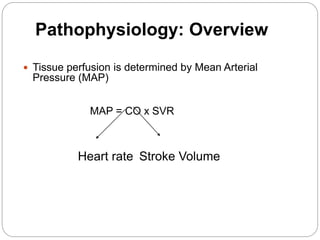
Pathophysiology: Overview
 Tissue perfusion is determined by Mean Arterial
Pressure (MAP)
MAP = CO x SVR
Heart rate Stroke Volume
Cardiogenic Shock:
Pathophysiology
 Heart fails to pump blood out
MAP = CO x SVR
HR Stroke Volume
 as a consequence of cardiac pump failure, resulting in decreased
cardiac output (CO).
 Pump failure can occur both as a result of an abnormality of the
Heart rate or the Stroke volume
Cardiogenic Shock: Causes
↓MAP = ↓ CO (HR x Stroke Volume) x ↑SVR
 Decreased Contractility (Myocardial Infarction,
myocarditis, cardiomyopathy, Post resuscitation
syndrome following cardiac arrest)
 Mechanical Dysfunction – (Papillary muscle rupture
post-MI, Severe Aortic Stenosis, rupture of ventricular
aneurysms etc)
 Arrhythmia – (Heart block, ventricular tachycardia,
SVT, atrial fibrillation etc.)
 Cardiotoxicity (B blocker and Calcium Channel
Obstructive Shock:
Pathophysiology
 Heart pumps well, but the output is decreased
due to an obstruction (in or out of the heart)
MAP = CO x SVR
HR x Stroke volume
If the blood outflow from the heart is decreased
because there is decreased return to the heart (due
to an obstruction) or “obstructed” as the blood leaves
the heart the stroke volume diminishes, with the
overall effect of decreasing the cardiac output
Obstructive Shock: Causes
↓MAP = ↓ CO (HR x Stroke Volume) x ↑SVR
 Heart is working but there is a block to the
outflow
 Massive pulmonary embolism
 Aortic dissection
 Cardiac tamponade
 Tension pneumothorax
 Obstruction of venous return to heart
 Vena cava syndrome - eg. neoplasms, granulomatous
disease
 Sickle cell splenic sequestration
Hypovolemic Shock:
Pathophysiology
 Heart pumps well, but not enough blood volume
to pump
MAP = CO x SVR
HR x Stroke volume
 Hypovolemic shock is a consequence of
decreased preload due to intravascular volume
loss.
 -The decreased preload diminishes stroke
volume, resulting in decreased cardiac output
(CO).
Hypovolemic Shock: Causes
↓MAP = ↓ CO (HR x Stroke Volume) x ↑SVR
 Decreased Intravascular volume (Preload)
leads to Decreased Stroke Volume
 Hemorrhagic - trauma, GI bleed, AAA rupture,
ectopic pregnancy
 Hypovolemic - burns, GI losses, dehydration,
third spacing (e.g. pancreatitis, bowel
obstruction), Adesonian crisis, Diabetic
Ketoacidosis
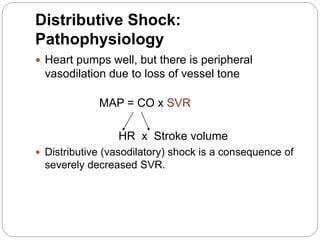
Distributive Shock:
Pathophysiology
 Heart pumps well, but there is peripheral
vasodilation due to loss of vessel tone
MAP = CO x SVR
HR x Stroke volume
 Distributive (vasodilatory) shock is a consequence of
severely decreased SVR.
Distributive Shock: Causes
↓MAP = ↑CO (HR x SV) x ↓ SVR
 Loss of Vessel tone
 Inflammatory cascade
 Sepsis and Toxic Shock Syndrome
 Anaphylaxis
 Post resuscitation syndrome following cardiac arrest
 Decreased sympathetic nervous system function
 Neurogenic - C spine or upper thoracic cord injuries
 Toxins
 Due to cellular poisons -Carbon monoxide,
methemoglobinemia, cyanide
 Drug overdose (a1 antagonists)
To Summarize
Type of
Shock
Insult Physiologic
Effect
Compensation
Cardiogenic Heart fails to pump
blood out
↓CO BaroRc
↑SVR
Obstructive Heart pumps well, but
the outflow is obstructed
↓CO BaroRc
↑SVR
Hemorrhagic Heart pumps well, but
not enough blood
volume to pump
↓CO BaroRc
↑SVR
Distributive Heart pumps well, but
there is peripheral
vasodilation
↓SVR ↑CO
Type of
Shock
Insult Physio
logic
Effect
Compen
sation
Compensation
Heart Rate
Compensation
Contractility
Cardiogenic Heart fails to
pump blood
out
↓CO BaroRc
↑SVR
↑ ↑
Obstructive Heart pumps
well, but the
outflow is
obstructed
↓CO BaroRc
↑SVR
↑ ↑
Hemorrhagic Heart pumps
well, but not
enough blood
volume to
pump
↓CO BaroRc
↑SVR
↑ ↑
Distributive Heart pumps
well, but
there is
peripheral
vasodilation
↓SVR ↑CO ↑
No Change -
in neurogenic
shock
↑
No Change -
in neurogenic
shock
Additional Compensatory
Mechanisms
 Renin-Angiotensin-Aldosterone Mechanism
 AII components lead to vasoconstriction
 Aldosterone leads to water conservation
 ADH leads to water retention and thirst
 Inflammatory cascade
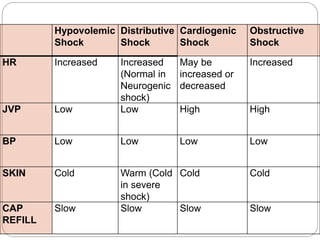
Hypovolemic
Shock
Distributive
Shock
Cardiogenic
Shock
Obstructive
Shock
HR Increased Increased
(Normal in
Neurogenic
shock)
May be
increased or
decreased
Increased
JVP Low Low High High
BP Low Low Low Low
SKIN Cold Warm (Cold
in severe
shock)
Cold Cold
CAP
REFILL
Slow Slow Slow Slow
Symptoms and Signs of Shock
 Level of consciousness
 Initially may show few symptoms
 Continuum starts with
 Anxiety
 Agitation
 Confusion and Delirium
 Obtundation and Coma
 In infants
 Poor tone
 Unfocused gaze
 Weak cry
 Lethargy/Coma
 (Sunken or bulging fontanelle)
Symptoms and Signs of Shock
 Pulse
 Tachycardia HR > 100
 Rapid, weak, thready distal pulses
 Respirations
 Tachypnea
 Shallow, irregular, labored
 Blood Pressure
 May be normal!
 Definition of hypotension
 Systolic < 90 mmHg
 MAP < 65 mmHg
 40 mmHg drop systolic BP from from baseline
 Children
 Systolic BP < 1 month = < 60 mmHg
 Systolic BP 1 month - 10 years = < 70 mmHg + (2 x age in years)
 In children hypotension develops late, late, late
 A pre-terminal event
Symptoms and Signs of Shock
 Skin
 Cold, clammy (Cardiogenic, Obstructive,
Hemorrhagic)
 Warm (Distributive shock)
 Mottled appearance in children
 Look for petechia
 Dry Mucous membranes
 Low urine output <0.5 ml/kg/hr
Empiric Criteria for Shock
4 out of 6 criteria have to be met
 Ill appearance or altered mental status
 Heart rate >100
 Respiratory rate > 22 (or PaCO2 < 32 mmHg)
 Urine output < 0.5 ml/kg/hr
 Arterial hypotension > 20 minutes duration
 Lactate > 4
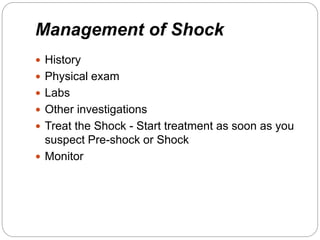
Management of Shock
 History
 Physical exam
 Labs
 Other investigations
 Treat the Shock - Start treatment as soon as you
suspect Pre-shock or Shock
 Monitor
Historical Features
 Trauma?
 Pregnant?
 Acute abdominal pain?
 Vomiting or Diarrhea?
 Hematochezia or hematemesis?
 Fever? Focus of infection?
 Chest pain?
Physical Exam
 Vitals - HR, BP, Temperature, Respiratory rate,
Oxygen Saturation
 Capillary blood sugar
 Weight in children
Physical Exam
 In a patient with normal level of
consciousness - Physical exam can be
directed to the history
Physical Exam
 In a patient with abnormal level of
consciousness
 Primary survey
 Cardiovascular (murmers, JVP, muffled
heart sounds)
 Respiratory exam (crackles, wheezes),
 Abdominal exam
 Rectal and vaginal exam
 Skin and mucous membranes
 Neurologic examination
Laboratory Tests
 CBC, Electrolytes, Creatinine/BUN, glucose
 +/- Lactate
 +/- Capillary blood sugar
 +/- Cardiac Enzymes
 Blood Cultures - from two different sites
 Beta HCG
 +/- Cross Match
Other investigations
 ECG
 Urinalysis
 CXR
 +/- Echo
 +/- FAST(focused abdominal sonography for
trauma)
• Do you remember how to
quickly estimate blood
pressure by pulse?
60
80
70
90
• If you palpate a pulse,
you know SBP is at
least this number
Goals of Treatment
• ABCDE
• Airway
• control work of Breathing
• optimize Circulation
• assure adequate oxygen Delivery
• achieve End points of resuscitation
Airway
• Determine need for intubation but
remember: intubation can worsen
hypotension
• Sedatives can lower blood pressure
• Positive pressure ventilation decreases
preload
• May need volume resuscitation
prior to intubation to avoid
hemodynamic collapse
Control Work of Breathing
• Respiratory muscles consume a significant
amount of oxygen
• Tachypnea can contribute to lactic acidosis
• Mechanical ventilation and sedation
decrease WOB and improves survival
Optimizing Circulation
• Isotonic crystalloids
• Titrated to:
• CVP 8-12 mm Hg
• Urine output 0.5 ml/kg/hr (30 ml/hr)
• Improving heart rate
• May require 4-6 L of fluids
• No outcome benefit from colloids
Maintaining Oxygen Delivery
• Decrease oxygen demands
• Provide analgesia and anxiolytics to relax
muscles and avoid shivering
• Maintain arterial oxygen
saturation/content
• Give supplemental oxygen
• Maintain Hemoglobin > 10 g/dL
• Serial lactate levels or central venous
End Points of Resuscitation
• Goal of resuscitation is to maximize
survival and minimize morbidity
• Use objective hemodynamic and
physiologic values to guide therapy
• Goal directed approach
• Urine output > 0.5 mL/kg/hr
• CVP 8-12 mmHg
• MAP 65 to 90 mmHg
• Central venous oxygen concentration > 70%
Persistent Hypotension
• Inadequate volume resuscitation
• Pneumothorax
• Cardiac tamponade
• Hidden bleeding
• Adrenal insufficiency
• Medication allergy
Management of hypovolemic
shock:
 AIM: To restore cardiac filling pressure promptly and
adequately without inducing pulmonary edema.
Measures:
 1. Arresting ongoing blood loss.
 2. Restoration of blood volume.
 3. Correction of metabolic acidosis
Arresting ongoing blood loss:
 External haemorrage by pressure elevation and tourniquet.
 Internal haemorrhage by immediate surgical exploration.
Restoration of circulating blood volume:
Start two large bore I.V. cannula,
 Debate still exists over the type, amount and rate of infusion
of fluids.
 Fluid challenge test is the guideline for rate of infusion.
End point of resuscitation should be based on factors
reflecting adequacy of perfusion
1. Establishing urine output > 0.5 ml/kg/Hr.
2. Reappearance of peripheral pulses.
3. Correction of hypothermia, with reduction of core to
peripheral temp gradient to< 10C.
4. Improvement of mental status.
5. Return of B.P. to normal
6. Capillary refill < 3 sec
7. Correction of metabolic acidosis (blood lactate
level <1.5 mmol/l) with normalization of pH.
Management of cardiogenic
shock:
 Three steps:
 1. Initial stabilization
 2. Evaluation of the patient
 3. Definitive therapy
 Initial stabilization:
 1. Establishment of ventilation and oxygenation to
maintain PaO2> 70 mm Hg.
 2. Restore MAP > 70 mm Hg with volume
correction and vasopressors.
 3. Treatment of pain, arrhythmias and acid base
abnormality.
 Evaluation of the patient:
 Brief history, physical examination and
investigations.
 ECG-look for ischemic changes, cardiac enzymes
 Cardiac filling pressure – CVP, PCWP, LVEDP
 Chest x-ray, ABG
 2D echo for ventricular function
 Arterial O2 saturation
 Starling function curve.
 Definitive therapy
 Goals of treatment
1. CI -4.5 l/min/ m2 (N – 3.0 – 3.4 l/min /m2).
2. DO2- 600 ml/min/ m2 (N – 480 – 600 ml/min
/m2)
3. VO2 – 140 – 180 ml/min /m2 (N – 130 – 160
ml/min/ m2)
Achieved by,
 1. Pharmacological support and / or
 2. Surgical intervention
 1) Pharmacological support:
 Aimed at – increase C.O., improving coronary blood flow and
decrease transudation of fluid into the lung.
 Done by – modifying preload, after load and by increase inotropic
function of the myocardium.
Reduction in preload (diuretics):
 Decrease volume where excusive preload exists.
 Over use may result in organ hypoperfusion and renal failure.
 Loop diuretics
Improving myocardial contractility (inotropes):
 Inotropes are indicated where preload is optimal but low cardiac
output and
 hypotension exists.
 Sympathomimetic amines are potent inotropes which act via a and b
adrenergic
 Epinephrine:
 Powerful cardiac stimulant
 Increase HR, shortens systole.
 Increase cardiac work and O2 consumption.
1-2 mcg / min - b stimulation
2-10 mcg/min – mixed a and b stimulation
10 mcg / min - a stimulation.
Dopamine: (3-4 di-hydroxy phenyl ethylamine)
1-5 mg/kg/min – dopaminergic receptors – renal and
mesenteric vasodilation.
5-10 mg/kg/min - b action, receptor positive inotropic and
positive chronotropic effects on heart.
10 mg/kg/min - a receptor– vasoconstriction.
 Dobutamine: synthetic sympathomimetic
amine
 Acts mainly on b1 receptor with little effects on b2
/ a
 Useful in cardiogenic shock due to MI with
tachycardia.
 Increase CO without increasing infarct size or
causing malignant arrhythmias.
 Dose – 5-20 mg/kg/min.
 Reduction in after load (vasodilators):
 Vasodilators decrease after load by decrease
SVR and decrease PVR which improves cardiac
output.
 Useful in patient with
 Normal / increase preload-PCWP > 15 mm Hg.
 Adequate perfusion pressure SBP > 110 mm Hg.
 High vascular resistance
 Low cardiac output
SNP:
 Both arteriolar and Venodilators
 Onset of action within 2 mins
 Rapidly metabolized to Thiocyanate and cyanide
 Dose 1-10 mg/kg/min (20-500 mg/min)
NTG:
 ·Venodilators, + coronary vasodilator treatment
myocardial ischemia
 Onset within sec
 ½ life – 4 mins
 Dose 1-10 mg/kg/min (10-400 mg/min)
 II. Surgical intervention:
 IABP
 Angioplasty
 CABG
 Cardiac transplant.
The Sepsis Continuum
 A clinical response
arising from a
nonspecific insult, with
2 of the following:
 T >38oC or <36oC
 HR >90 beats/min
 RR >20/min
 WBC >12,000/mm3 or
<4,000/mm3 or >10%
bands
SIRS = systemic inflammatory
response syndrome
SIRS with a
presumed
or confirmed
infectious
process
SepsisSIRS
Severe
Sepsis
Septic
Shock
Sepsis with
organ failure
Refractory
hypotension
Are any 2 of the following SIRS criteria present and new to
your patient?
Obs: Temperature >38.3 or <36 0C Respiratory rate >20 min-1
Heart rate >90 bpm Acutely altered mental
state
Bloods: White cells <4x10⁹/l or >12x109/l Glucose>7.7mmol/l
(if patient is not
diabetic)
If yes,
patient has SIRS
Severe Sepsis Screening Tool
Is this likely to be due to an infection?
For example
Cough/ sputum/ chest pain Dysuria
Abdo pain/ diarrhoea/ distension Headache with neck stiffness
Line infection Cellulitis/wound infection/septic arthritis
Endocarditis
If yes,
patient has SEPSIS
Start SEPSIS BUNDLE
Severe Sepsis
Check for SEVERE SEPSIS
BP SBP< 90 / Mean < 65 mmHg
(after initial fluid challenge)
Lactate > 4 mmol/l
Urine output < 0.5 ml/kg/hr for 2 hrs
INR > 1.5
aPTT > 60 s
Bilirubin > 34 μmol/l
O2 Needed to keep SpO2 > 90%
Platelets < 100 x 109/l
Creatinine > 177 μmol/l or UO < 0.5 ml/kg/hr
What is a Bundle?
 Specifically selected care elements
From evidence based guidelines
Implemented together provide improved
outcomes compared to individual elements
alone
6 Hour Resuscitation
Bundle
 Early Identification
 Early Antibiotics and
Cultures
 Early Goal Directed
Therapy
6 - hour Severe Sepsis/
Septic Shock Bundle
 Early Detection:
 Obtain serum lactate level.
 Early Blood Cx/Antibiotics:
 within 3 hours of
presentation.
 Early EGDT:
 Hypotension (SBP < 90, MAP
< 65) or lactate > 4 mmol/L:
 initial fluid bolus 20-40 ml of
crystalloid (or colloid equivalent)
per kg of body weight.
• Vasopressors:
– Hypotension not responding to
fluid
– Titrate to MAP > 65 mmHg.
• Septic shock or lactate > 4
mmol/L:
– CVP and ScvO2 measured.
– CVP maintained >8 mmHg.
– MAP maintain > 65 mmHg.
• ScvO2<70%with CVP > 8 mmHg,
MAP > 65 mmHg:
– PRBCs if hematocrit < 30%.
– Inotropes.
Rivers et al 2001, NEJM; 345, 1368-1377
EGDT
Call for specialist support
Crystalloid
Colloid
CVP line
< 8mmHg
< 65 or <90 mmHg
MAP Vasoactive Drugs
>8
mmHg
ScvO2
Transfuse red cells
until Hb > 10 g/dl
YES
Goals
Achieved
ScvO2
>70%
< 70%
Inotropic agents
NO
>65 &
>90mmHg
>70%
Activated protein C
 Known inflammatory and procoagulant host
responses to infection.
 TNF-alpha, IL-1, IL-6, thrombin
 Diffuse endovascular injury, multiorgan dysfunction
and death.
 Activated Protein C
 anticoagulant, modulates the inflammatory response
 reduced levels of protein C found in majority of patients with
sepsis and are associated with increased risk of death.
STEROIDS
 IVcorticosteroids (hydrocortisone
200-300 mg/day,
 for 7 days in three or four divided
doses or by continuous infusion)
who, despite adequate fluid
replacement, require vasopressor
therapy to maintain adequate blood
pressure.
Blood Product Administration
 PRBC transfusion if Hb <7.0 g/dL ; target 7.0-
9.0 g/dL.
 Erythropoietin only accepted reasons for
administration of erythropoietin such as renal
failure induced anemia.
 No Routine use of fresh frozen plasma to
correct laboratory clotting abnormal
 Platelets administered <5,000/mm3 (5 x
109/L) regardless of apparent bleeding.
 Higher platelet counts (>50,000/mm3 [50 x
109/L])for surgery or invasive procedures
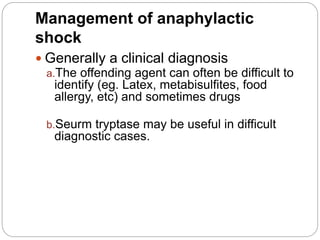
Management of anaphylactic
shock
 Generally a clinical diagnosis
a.The offending agent can often be difficult to
identify (eg. Latex, metabisulfites, food
allergy, etc) and sometimes drugs
b.Seurm tryptase may be useful in difficult
diagnostic cases.
Initial Therapy
1. Maintain Adequate Ventilation
a) Oxygen
b) Establish an airway if needed
2. Stop absorption
3. Epinephrine
a) This remains the most important pharmacological
management of anaphylaxis (J All Clin Innunol, 1994;
94:666-8)
b) 0.3 – 0.5 mg IV or SQ
a) Use 0.3 – 0.5 ml of 1:1,000 dilution SQ
b) Use 3 – 5 ml of 1:10,000 dilution IV
4. Inhaled beta-agonists
5. Establish Adequate Venous Access
Secondary Therapy
1. Antihistamines (H1 & H2 blockers)
a) 25-50mg hydroxyzine or diphenhydramine Q6 hours
b) Cimetidine 300mg every 8-12 hours
2. Corticosteroids (may shorten protracted
reactions but do not provide immediate benefit)
a) 250 mg hydrocortisone Q6 hours IV
3. Aminophylline (probably not as useful as
inhaled b-agonists)
a) Load with 6 mg/kg/hr IV
b) Maintain with 0.3 – 0.6 mg/kg/hr IV
4. Observation in the hospital for at least 24 hours
(for relapse)
5. Glucagon (1 mg IV) can be useful in patients
which anaphylactic shock on beta-blockers as
these patients may be resistent to epinephrine
shock

shock

  • 1.
  • 2.
    History  term shock(Fr, choke) was first used by French physician Le Pran in 1773 todescribe the clinical characteristics of patients after severe gunshot trauma.
  • 3.
    Definitions:  Shock isa state in which failure of the circulatory system to maintain adequate cellular perfusion results in wide spread reduction in delivery of oxygen and other nutrients to tissues. ( OR )  Shock is a syndrome of failure of heart to pump blood in sufficient quantity or under sufficient pressure to maintain pressure flow relationship necessary for adequate tissue perfusion ( OR )  Shock denotes circulatory failure leading to inadequate vital organ perfusion ,oxygen delivery and other tissues
  • 4.
    Stages of Shock Compensated 15-25% of fluid loss from the vessels  Signs are subtle  Patient may show signs of an adrenaline rush Decompensated  25-35% of fluid loss from the vessels  The body cells are profoundly hypoxic  Classic signs of shock Irreversible  > 35% fluid loss from the vessels  Body cells die  All vital signs bottom out
  • 5.
    Compensatory ( Reversible)  SYMPATHOADRENAL STIMULATION  PRE CAPILLARY SPINCTER CONSTRUCTION  CAPPILARY HYDROSTATIC PRESSURE.(Increase )  FLUID MOVES INTO INTRAVASCULAR SPACE
  • 6.
    IRREVERSIBLE IF HYPOPERFUSION CONTINUES HYPOXIA– ANAEROBIC METABOLISM INCREASE IN LACTIC ACID + INCREASE [H+] DECREASE IN CAP. HYDR. PRES INCREASE IN POST CAP. SPHINCTER TONE WEAKENING OF PRE CAP SPHINCTER TONE FLUID MOVES INTO EXTRA VASCULAR SPACE
  • 7.
     Fluid lossinto extra vascular space.  Adhesion of activated leukocytes to endothelial cells – increase in cap. Permeability  obstruction to micro vessels  Accumulation of micro thrombi because of activation of coagulation system with fibrin deposition.
  • 8.
    Types of Shock Cardiogenic (intracardiac vs extracardiac)  Hypovolemic  Distributive  sepsis****  neurogenic (spinal shock)  adrenal insufficiency  anaphylaxis
  • 9.
    Pathophysiology: Overview  Tissueperfusion is determined by Mean Arterial Pressure (MAP) MAP = CO x SVR Heart rate Stroke Volume
  • 10.
    Cardiogenic Shock: Pathophysiology  Heartfails to pump blood out MAP = CO x SVR HR Stroke Volume  as a consequence of cardiac pump failure, resulting in decreased cardiac output (CO).  Pump failure can occur both as a result of an abnormality of the Heart rate or the Stroke volume
  • 11.
    Cardiogenic Shock: Causes ↓MAP= ↓ CO (HR x Stroke Volume) x ↑SVR  Decreased Contractility (Myocardial Infarction, myocarditis, cardiomyopathy, Post resuscitation syndrome following cardiac arrest)  Mechanical Dysfunction – (Papillary muscle rupture post-MI, Severe Aortic Stenosis, rupture of ventricular aneurysms etc)  Arrhythmia – (Heart block, ventricular tachycardia, SVT, atrial fibrillation etc.)  Cardiotoxicity (B blocker and Calcium Channel
  • 12.
    Obstructive Shock: Pathophysiology  Heartpumps well, but the output is decreased due to an obstruction (in or out of the heart) MAP = CO x SVR HR x Stroke volume If the blood outflow from the heart is decreased because there is decreased return to the heart (due to an obstruction) or “obstructed” as the blood leaves the heart the stroke volume diminishes, with the overall effect of decreasing the cardiac output
  • 13.
    Obstructive Shock: Causes ↓MAP= ↓ CO (HR x Stroke Volume) x ↑SVR  Heart is working but there is a block to the outflow  Massive pulmonary embolism  Aortic dissection  Cardiac tamponade  Tension pneumothorax  Obstruction of venous return to heart  Vena cava syndrome - eg. neoplasms, granulomatous disease  Sickle cell splenic sequestration
  • 14.
    Hypovolemic Shock: Pathophysiology  Heartpumps well, but not enough blood volume to pump MAP = CO x SVR HR x Stroke volume  Hypovolemic shock is a consequence of decreased preload due to intravascular volume loss.  -The decreased preload diminishes stroke volume, resulting in decreased cardiac output (CO).
  • 15.
    Hypovolemic Shock: Causes ↓MAP= ↓ CO (HR x Stroke Volume) x ↑SVR  Decreased Intravascular volume (Preload) leads to Decreased Stroke Volume  Hemorrhagic - trauma, GI bleed, AAA rupture, ectopic pregnancy  Hypovolemic - burns, GI losses, dehydration, third spacing (e.g. pancreatitis, bowel obstruction), Adesonian crisis, Diabetic Ketoacidosis
  • 17.
    Distributive Shock: Pathophysiology  Heartpumps well, but there is peripheral vasodilation due to loss of vessel tone MAP = CO x SVR HR x Stroke volume  Distributive (vasodilatory) shock is a consequence of severely decreased SVR.
  • 18.
    Distributive Shock: Causes ↓MAP= ↑CO (HR x SV) x ↓ SVR  Loss of Vessel tone  Inflammatory cascade  Sepsis and Toxic Shock Syndrome  Anaphylaxis  Post resuscitation syndrome following cardiac arrest  Decreased sympathetic nervous system function  Neurogenic - C spine or upper thoracic cord injuries  Toxins  Due to cellular poisons -Carbon monoxide, methemoglobinemia, cyanide  Drug overdose (a1 antagonists)
  • 19.
    To Summarize Type of Shock InsultPhysiologic Effect Compensation Cardiogenic Heart fails to pump blood out ↓CO BaroRc ↑SVR Obstructive Heart pumps well, but the outflow is obstructed ↓CO BaroRc ↑SVR Hemorrhagic Heart pumps well, but not enough blood volume to pump ↓CO BaroRc ↑SVR Distributive Heart pumps well, but there is peripheral vasodilation ↓SVR ↑CO
  • 20.
    Type of Shock Insult Physio logic Effect Compen sation Compensation HeartRate Compensation Contractility Cardiogenic Heart fails to pump blood out ↓CO BaroRc ↑SVR ↑ ↑ Obstructive Heart pumps well, but the outflow is obstructed ↓CO BaroRc ↑SVR ↑ ↑ Hemorrhagic Heart pumps well, but not enough blood volume to pump ↓CO BaroRc ↑SVR ↑ ↑ Distributive Heart pumps well, but there is peripheral vasodilation ↓SVR ↑CO ↑ No Change - in neurogenic shock ↑ No Change - in neurogenic shock
  • 21.
    Additional Compensatory Mechanisms  Renin-Angiotensin-AldosteroneMechanism  AII components lead to vasoconstriction  Aldosterone leads to water conservation  ADH leads to water retention and thirst  Inflammatory cascade
  • 22.
    Hypovolemic Shock Distributive Shock Cardiogenic Shock Obstructive Shock HR Increased Increased (Normalin Neurogenic shock) May be increased or decreased Increased JVP Low Low High High BP Low Low Low Low SKIN Cold Warm (Cold in severe shock) Cold Cold CAP REFILL Slow Slow Slow Slow
  • 23.
    Symptoms and Signsof Shock  Level of consciousness  Initially may show few symptoms  Continuum starts with  Anxiety  Agitation  Confusion and Delirium  Obtundation and Coma  In infants  Poor tone  Unfocused gaze  Weak cry  Lethargy/Coma  (Sunken or bulging fontanelle)
  • 24.
    Symptoms and Signsof Shock  Pulse  Tachycardia HR > 100  Rapid, weak, thready distal pulses  Respirations  Tachypnea  Shallow, irregular, labored
  • 25.
     Blood Pressure May be normal!  Definition of hypotension  Systolic < 90 mmHg  MAP < 65 mmHg  40 mmHg drop systolic BP from from baseline  Children  Systolic BP < 1 month = < 60 mmHg  Systolic BP 1 month - 10 years = < 70 mmHg + (2 x age in years)  In children hypotension develops late, late, late  A pre-terminal event Symptoms and Signs of Shock
  • 26.
    Symptoms and Signsof Shock  Skin  Cold, clammy (Cardiogenic, Obstructive, Hemorrhagic)  Warm (Distributive shock)  Mottled appearance in children  Look for petechia  Dry Mucous membranes  Low urine output <0.5 ml/kg/hr
  • 27.
    Empiric Criteria forShock 4 out of 6 criteria have to be met  Ill appearance or altered mental status  Heart rate >100  Respiratory rate > 22 (or PaCO2 < 32 mmHg)  Urine output < 0.5 ml/kg/hr  Arterial hypotension > 20 minutes duration  Lactate > 4
  • 28.
    Management of Shock History  Physical exam  Labs  Other investigations  Treat the Shock - Start treatment as soon as you suspect Pre-shock or Shock  Monitor
  • 29.
    Historical Features  Trauma? Pregnant?  Acute abdominal pain?  Vomiting or Diarrhea?  Hematochezia or hematemesis?  Fever? Focus of infection?  Chest pain?
  • 30.
    Physical Exam  Vitals- HR, BP, Temperature, Respiratory rate, Oxygen Saturation  Capillary blood sugar  Weight in children
  • 31.
    Physical Exam  Ina patient with normal level of consciousness - Physical exam can be directed to the history
  • 32.
    Physical Exam  Ina patient with abnormal level of consciousness  Primary survey  Cardiovascular (murmers, JVP, muffled heart sounds)  Respiratory exam (crackles, wheezes),  Abdominal exam  Rectal and vaginal exam  Skin and mucous membranes  Neurologic examination
  • 33.
    Laboratory Tests  CBC,Electrolytes, Creatinine/BUN, glucose  +/- Lactate  +/- Capillary blood sugar  +/- Cardiac Enzymes  Blood Cultures - from two different sites  Beta HCG  +/- Cross Match
  • 34.
    Other investigations  ECG Urinalysis  CXR  +/- Echo  +/- FAST(focused abdominal sonography for trauma)
  • 35.
    • Do youremember how to quickly estimate blood pressure by pulse? 60 80 70 90 • If you palpate a pulse, you know SBP is at least this number
  • 36.
    Goals of Treatment •ABCDE • Airway • control work of Breathing • optimize Circulation • assure adequate oxygen Delivery • achieve End points of resuscitation
  • 37.
    Airway • Determine needfor intubation but remember: intubation can worsen hypotension • Sedatives can lower blood pressure • Positive pressure ventilation decreases preload • May need volume resuscitation prior to intubation to avoid hemodynamic collapse
  • 38.
    Control Work ofBreathing • Respiratory muscles consume a significant amount of oxygen • Tachypnea can contribute to lactic acidosis • Mechanical ventilation and sedation decrease WOB and improves survival
  • 39.
    Optimizing Circulation • Isotoniccrystalloids • Titrated to: • CVP 8-12 mm Hg • Urine output 0.5 ml/kg/hr (30 ml/hr) • Improving heart rate • May require 4-6 L of fluids • No outcome benefit from colloids
  • 40.
    Maintaining Oxygen Delivery •Decrease oxygen demands • Provide analgesia and anxiolytics to relax muscles and avoid shivering • Maintain arterial oxygen saturation/content • Give supplemental oxygen • Maintain Hemoglobin > 10 g/dL • Serial lactate levels or central venous
  • 41.
    End Points ofResuscitation • Goal of resuscitation is to maximize survival and minimize morbidity • Use objective hemodynamic and physiologic values to guide therapy • Goal directed approach • Urine output > 0.5 mL/kg/hr • CVP 8-12 mmHg • MAP 65 to 90 mmHg • Central venous oxygen concentration > 70%
  • 42.
    Persistent Hypotension • Inadequatevolume resuscitation • Pneumothorax • Cardiac tamponade • Hidden bleeding • Adrenal insufficiency • Medication allergy
  • 43.
    Management of hypovolemic shock: AIM: To restore cardiac filling pressure promptly and adequately without inducing pulmonary edema. Measures:  1. Arresting ongoing blood loss.  2. Restoration of blood volume.  3. Correction of metabolic acidosis Arresting ongoing blood loss:  External haemorrage by pressure elevation and tourniquet.  Internal haemorrhage by immediate surgical exploration. Restoration of circulating blood volume: Start two large bore I.V. cannula,  Debate still exists over the type, amount and rate of infusion of fluids.  Fluid challenge test is the guideline for rate of infusion.
  • 46.
    End point ofresuscitation should be based on factors reflecting adequacy of perfusion 1. Establishing urine output > 0.5 ml/kg/Hr. 2. Reappearance of peripheral pulses. 3. Correction of hypothermia, with reduction of core to peripheral temp gradient to< 10C. 4. Improvement of mental status. 5. Return of B.P. to normal 6. Capillary refill < 3 sec 7. Correction of metabolic acidosis (blood lactate level <1.5 mmol/l) with normalization of pH.
  • 47.
    Management of cardiogenic shock: Three steps:  1. Initial stabilization  2. Evaluation of the patient  3. Definitive therapy
  • 48.
     Initial stabilization: 1. Establishment of ventilation and oxygenation to maintain PaO2> 70 mm Hg.  2. Restore MAP > 70 mm Hg with volume correction and vasopressors.  3. Treatment of pain, arrhythmias and acid base abnormality.
  • 49.
     Evaluation ofthe patient:  Brief history, physical examination and investigations.  ECG-look for ischemic changes, cardiac enzymes  Cardiac filling pressure – CVP, PCWP, LVEDP  Chest x-ray, ABG  2D echo for ventricular function  Arterial O2 saturation  Starling function curve.
  • 50.
     Definitive therapy Goals of treatment 1. CI -4.5 l/min/ m2 (N – 3.0 – 3.4 l/min /m2). 2. DO2- 600 ml/min/ m2 (N – 480 – 600 ml/min /m2) 3. VO2 – 140 – 180 ml/min /m2 (N – 130 – 160 ml/min/ m2) Achieved by,  1. Pharmacological support and / or  2. Surgical intervention
  • 51.
     1) Pharmacologicalsupport:  Aimed at – increase C.O., improving coronary blood flow and decrease transudation of fluid into the lung.  Done by – modifying preload, after load and by increase inotropic function of the myocardium. Reduction in preload (diuretics):  Decrease volume where excusive preload exists.  Over use may result in organ hypoperfusion and renal failure.  Loop diuretics Improving myocardial contractility (inotropes):  Inotropes are indicated where preload is optimal but low cardiac output and  hypotension exists.  Sympathomimetic amines are potent inotropes which act via a and b adrenergic
  • 52.
     Epinephrine:  Powerfulcardiac stimulant  Increase HR, shortens systole.  Increase cardiac work and O2 consumption. 1-2 mcg / min - b stimulation 2-10 mcg/min – mixed a and b stimulation 10 mcg / min - a stimulation. Dopamine: (3-4 di-hydroxy phenyl ethylamine) 1-5 mg/kg/min – dopaminergic receptors – renal and mesenteric vasodilation. 5-10 mg/kg/min - b action, receptor positive inotropic and positive chronotropic effects on heart. 10 mg/kg/min - a receptor– vasoconstriction.
  • 53.
     Dobutamine: syntheticsympathomimetic amine  Acts mainly on b1 receptor with little effects on b2 / a  Useful in cardiogenic shock due to MI with tachycardia.  Increase CO without increasing infarct size or causing malignant arrhythmias.  Dose – 5-20 mg/kg/min.
  • 54.
     Reduction inafter load (vasodilators):  Vasodilators decrease after load by decrease SVR and decrease PVR which improves cardiac output.  Useful in patient with  Normal / increase preload-PCWP > 15 mm Hg.  Adequate perfusion pressure SBP > 110 mm Hg.  High vascular resistance  Low cardiac output
  • 55.
    SNP:  Both arteriolarand Venodilators  Onset of action within 2 mins  Rapidly metabolized to Thiocyanate and cyanide  Dose 1-10 mg/kg/min (20-500 mg/min) NTG:  ·Venodilators, + coronary vasodilator treatment myocardial ischemia  Onset within sec  ½ life – 4 mins  Dose 1-10 mg/kg/min (10-400 mg/min)
  • 56.
     II. Surgicalintervention:  IABP  Angioplasty  CABG  Cardiac transplant.
  • 57.
    The Sepsis Continuum A clinical response arising from a nonspecific insult, with 2 of the following:  T >38oC or <36oC  HR >90 beats/min  RR >20/min  WBC >12,000/mm3 or <4,000/mm3 or >10% bands SIRS = systemic inflammatory response syndrome SIRS with a presumed or confirmed infectious process SepsisSIRS Severe Sepsis Septic Shock Sepsis with organ failure Refractory hypotension
  • 58.
    Are any 2of the following SIRS criteria present and new to your patient? Obs: Temperature >38.3 or <36 0C Respiratory rate >20 min-1 Heart rate >90 bpm Acutely altered mental state Bloods: White cells <4x10⁹/l or >12x109/l Glucose>7.7mmol/l (if patient is not diabetic) If yes, patient has SIRS Severe Sepsis Screening Tool
  • 59.
    Is this likelyto be due to an infection? For example Cough/ sputum/ chest pain Dysuria Abdo pain/ diarrhoea/ distension Headache with neck stiffness Line infection Cellulitis/wound infection/septic arthritis Endocarditis If yes, patient has SEPSIS Start SEPSIS BUNDLE
  • 60.
    Severe Sepsis Check forSEVERE SEPSIS BP SBP< 90 / Mean < 65 mmHg (after initial fluid challenge) Lactate > 4 mmol/l Urine output < 0.5 ml/kg/hr for 2 hrs INR > 1.5 aPTT > 60 s Bilirubin > 34 μmol/l O2 Needed to keep SpO2 > 90% Platelets < 100 x 109/l Creatinine > 177 μmol/l or UO < 0.5 ml/kg/hr
  • 61.
    What is aBundle?  Specifically selected care elements From evidence based guidelines Implemented together provide improved outcomes compared to individual elements alone
  • 62.
    6 Hour Resuscitation Bundle Early Identification  Early Antibiotics and Cultures  Early Goal Directed Therapy
  • 63.
    6 - hourSevere Sepsis/ Septic Shock Bundle  Early Detection:  Obtain serum lactate level.  Early Blood Cx/Antibiotics:  within 3 hours of presentation.  Early EGDT:  Hypotension (SBP < 90, MAP < 65) or lactate > 4 mmol/L:  initial fluid bolus 20-40 ml of crystalloid (or colloid equivalent) per kg of body weight. • Vasopressors: – Hypotension not responding to fluid – Titrate to MAP > 65 mmHg. • Septic shock or lactate > 4 mmol/L: – CVP and ScvO2 measured. – CVP maintained >8 mmHg. – MAP maintain > 65 mmHg. • ScvO2<70%with CVP > 8 mmHg, MAP > 65 mmHg: – PRBCs if hematocrit < 30%. – Inotropes.
  • 64.
    Rivers et al2001, NEJM; 345, 1368-1377 EGDT Call for specialist support Crystalloid Colloid CVP line < 8mmHg < 65 or <90 mmHg MAP Vasoactive Drugs >8 mmHg ScvO2 Transfuse red cells until Hb > 10 g/dl YES Goals Achieved ScvO2 >70% < 70% Inotropic agents NO >65 & >90mmHg >70%
  • 65.
    Activated protein C Known inflammatory and procoagulant host responses to infection.  TNF-alpha, IL-1, IL-6, thrombin  Diffuse endovascular injury, multiorgan dysfunction and death.  Activated Protein C  anticoagulant, modulates the inflammatory response  reduced levels of protein C found in majority of patients with sepsis and are associated with increased risk of death.
  • 66.
    STEROIDS  IVcorticosteroids (hydrocortisone 200-300mg/day,  for 7 days in three or four divided doses or by continuous infusion) who, despite adequate fluid replacement, require vasopressor therapy to maintain adequate blood pressure.
  • 67.
    Blood Product Administration PRBC transfusion if Hb <7.0 g/dL ; target 7.0- 9.0 g/dL.  Erythropoietin only accepted reasons for administration of erythropoietin such as renal failure induced anemia.  No Routine use of fresh frozen plasma to correct laboratory clotting abnormal  Platelets administered <5,000/mm3 (5 x 10⁹/L) regardless of apparent bleeding.  Higher platelet counts (>50,000/mm3 [50 x 109/L])for surgery or invasive procedures
  • 68.
    Management of anaphylactic shock Generally a clinical diagnosis a.The offending agent can often be difficult to identify (eg. Latex, metabisulfites, food allergy, etc) and sometimes drugs b.Seurm tryptase may be useful in difficult diagnostic cases.
  • 69.
    Initial Therapy 1. MaintainAdequate Ventilation a) Oxygen b) Establish an airway if needed 2. Stop absorption 3. Epinephrine a) This remains the most important pharmacological management of anaphylaxis (J All Clin Innunol, 1994; 94:666-8) b) 0.3 – 0.5 mg IV or SQ a) Use 0.3 – 0.5 ml of 1:1,000 dilution SQ b) Use 3 – 5 ml of 1:10,000 dilution IV 4. Inhaled beta-agonists 5. Establish Adequate Venous Access
  • 70.
    Secondary Therapy 1. Antihistamines(H1 & H2 blockers) a) 25-50mg hydroxyzine or diphenhydramine Q6 hours b) Cimetidine 300mg every 8-12 hours 2. Corticosteroids (may shorten protracted reactions but do not provide immediate benefit) a) 250 mg hydrocortisone Q6 hours IV 3. Aminophylline (probably not as useful as inhaled b-agonists) a) Load with 6 mg/kg/hr IV b) Maintain with 0.3 – 0.6 mg/kg/hr IV 4. Observation in the hospital for at least 24 hours (for relapse) 5. Glucagon (1 mg IV) can be useful in patients which anaphylactic shock on beta-blockers as these patients may be resistent to epinephrine