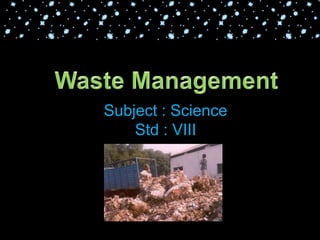

Waste ManagementSubject : ScienceStd : VIII1/12/2010Free template from www.brainybetty.com
Created by,M.Kohila,M.A.,M.Phil.(Tam),B.A.(Eng),B,Ed.Secondary Grade Teacher,S.M.R.V.H.S.S.,Vadasery,Nagercoil,Kanyakumary District-629001
Objectives Make the students to get the awareness on  waste management. To know about the different types of waste    management. Make them to understand the content easily.
 Create the interest to work towards waste  management.
Strategies Survey
 Field trip
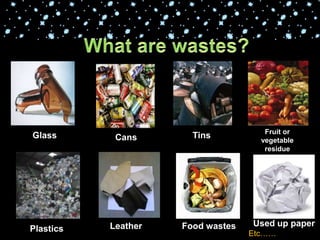
 Power point PresentationWhat are wastes?Fruit or vegetable residueTinsGlassCansUsed up paperFood wastesLeatherPlasticsEtc……
Types of wastesDegradable wastes
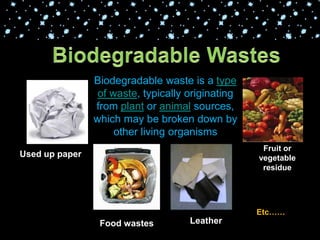
Non-degradable wastesBiodegradable WastesBiodegradable waste is a type of waste, typically originating from plant or animal sources, which may be broken down by other living organismsFruit or vegetable residueUsed up paperEtc……LeatherFood wastes
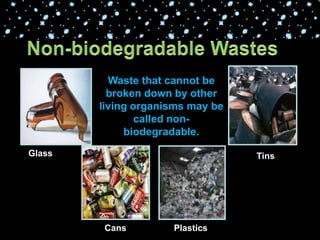
Non-biodegradable WastesWaste that cannot be broken down by other living organisms may be called non-biodegradable.GlassTinsPlasticsCans
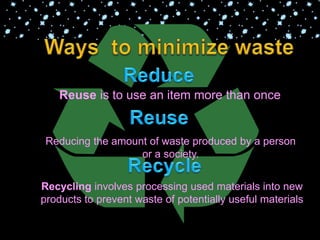
Ways  to minimize wasteReduceReuse is to use an item more than onceReuseReducing the amount of waste produced by a person or a society.RecycleRecycling involves processing used materials into new products to prevent waste of potentially useful materials
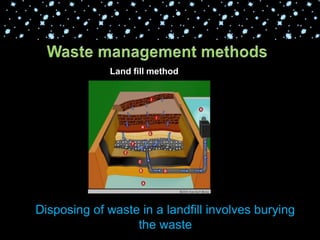
Waste management methodsLand fill methodDisposing of waste in a landfill involves burying the waste
IncinerationIncineration is a disposal method that involves combustion of waste material. Incineration and other high temperature waste treatment systems are sometimes described as "thermal treatment". Incinerators convert waste materials into heat, gas, steam, and ash.Spittelau incineration plant in Vienna.
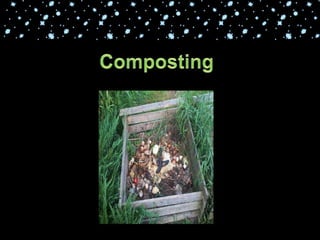
Composting
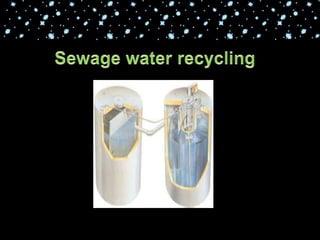
Sewage water recycling
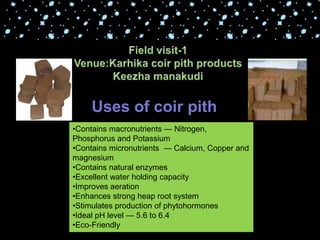
Field visit-1Venue:Karhika coir pith productsKeezhamanakudiUses of coir pithContains macronutrients — Nitrogen, Phosphorus and Potassium
Contains micronutrients  — Calcium, Copper and magnesium
Contains natural enzymes
Excellent water holding capacity

Waste management