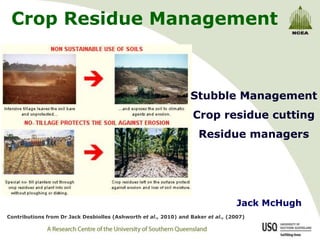
Crop Residue ManagementStubble ManagementCrop residue cuttingResidue managersJack McHughContributions from Dr Jack Desbiolles (Ashworth et al., 2010) and Baker et al., (2007)
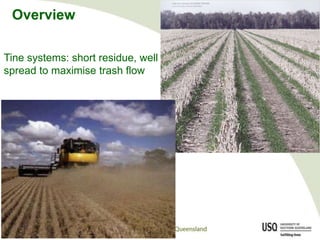
OverviewTine systems: short residue, well spread to maximise trash flow
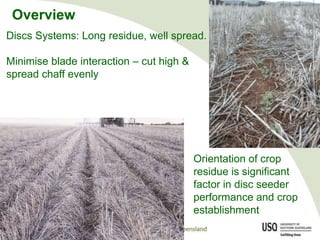
OverviewDiscs Systems: Long residue, well spread.Minimise blade interaction – cut high & spread chaff evenly Orientation of crop residue is significant factor in disc seeder performance and crop establishment
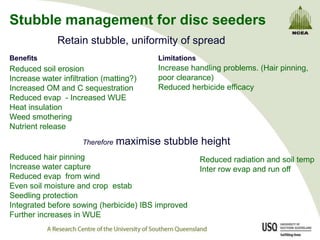
Stubble management for disc seedersRetain stubble, uniformity of spreadBenefitsLimitationsIncrease handling problems. (Hair pinning, poor clearance)Reduced herbicide efficacyReduced soil erosionIncrease water infiltration (matting?)Increased OM and C sequestrationReduced evap  - Increased WUEHeat insulationWeed smotheringNutrient releaseThereforemaximise stubble heightReduced hair pinningIncrease water capture Reduced evap  from windEven soil moisture and crop  estabSeedling protectionIntegrated before sowing (herbicide) IBS improvedFurther increases in WUEReduced radiation and soil tempInter row evap and run off
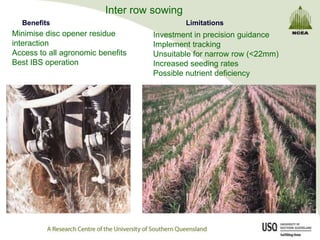
Inter row sowingBenefitsLimitationsMinimise disc opener residue interactionAccess to all agronomic benefitsBest IBS operationInvestment in precision guidanceImplement trackingUnsuitable for narrow row (<22mm)Increased seeding ratesPossible nutrient deficiency
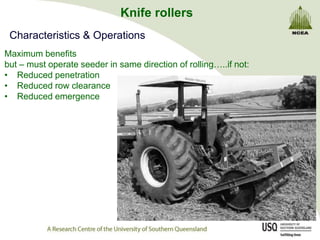
Knife rollersCharacteristics & OperationsMaximum benefitsbut – must operate seeder in same direction of rolling…..if not:Reduced penetration
Reduced row clearance
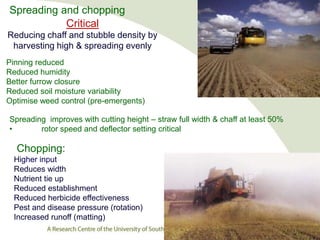
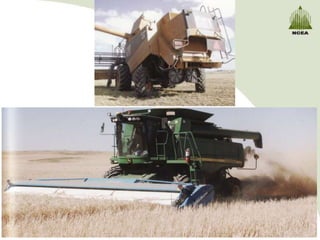
Reduced emergence Spreading and choppingCriticalReducing chaff and stubble density by harvesting high & spreading evenlyPinning reduced Reduced humidityBetter furrow closureReduced soil moisture variabilityOptimise weed control (pre-emergents)Spreading  improves with cutting height – straw full width & chaff at least 50%	rotor speed and deflector setting criticalChopping: Higher inputReduces widthNutrient tie upReduced establishmentReduced herbicide effectivenessPest and disease pressure (rotation)Increased runoff (matting)
Crop Residue CuttingCutting – application of sliding and wedging forcesHigh disc speed improves sliding (Bubble, ripple, turbo + sweep angle to increase speed ratio)Strong soil backing maximises wedgingOther factors:Disc size (Larger is best but Increased draft)Disc sweep angle (drive, self sharpen, disturbance)Depth (Deeper is best but pinning can occur)Notch & tooth features (Deeper, drive, shear & sliding action, lower vertical forces)Sharpness and fineness (improved wedging action – maintenance critical)Avoid the residue (inter row, directional rolling) CA Transplanter video
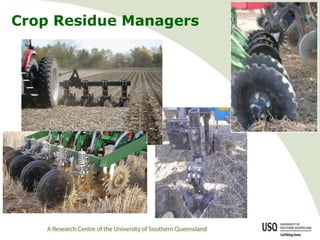
Crop Residue Managers
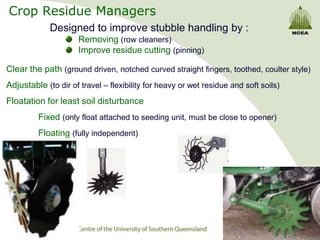
Crop Residue ManagersDesigned to improve stubble handling by :Removing (row cleaners)Improve residue cutting (pinning)Clear the path (ground driven, notched curved straight fingers, toothed, coulter style)Adjustable (to dir of travel – flexibility for heavy or wet residue and soft soils)Floatation for least soil disturbance	Fixed (only float attached to seeding unit, must be close to opener)	Floating (fully independent)
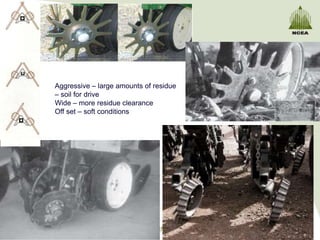
Aggressive – large amounts of residue – soil for driveWide – more residue clearanceOff set – soft conditions

Crop residue management

  • 1.
    Crop Residue ManagementStubbleManagementCrop residue cuttingResidue managersJack McHughContributions from Dr Jack Desbiolles (Ashworth et al., 2010) and Baker et al., (2007)
  • 2.
    OverviewTine systems: shortresidue, well spread to maximise trash flow
  • 3.
    OverviewDiscs Systems: Longresidue, well spread.Minimise blade interaction – cut high & spread chaff evenly Orientation of crop residue is significant factor in disc seeder performance and crop establishment
  • 4.
    Stubble management fordisc seedersRetain stubble, uniformity of spreadBenefitsLimitationsIncrease handling problems. (Hair pinning, poor clearance)Reduced herbicide efficacyReduced soil erosionIncrease water infiltration (matting?)Increased OM and C sequestrationReduced evap - Increased WUEHeat insulationWeed smotheringNutrient releaseThereforemaximise stubble heightReduced hair pinningIncrease water capture Reduced evap from windEven soil moisture and crop estabSeedling protectionIntegrated before sowing (herbicide) IBS improvedFurther increases in WUEReduced radiation and soil tempInter row evap and run off
  • 5.
    Inter row sowingBenefitsLimitationsMinimisedisc opener residue interactionAccess to all agronomic benefitsBest IBS operationInvestment in precision guidanceImplement trackingUnsuitable for narrow row (<22mm)Increased seeding ratesPossible nutrient deficiency
  • 6.
    Knife rollersCharacteristics &OperationsMaximum benefitsbut – must operate seeder in same direction of rolling…..if not:Reduced penetration
  • 7.
  • 8.
    Reduced emergence Spreadingand choppingCriticalReducing chaff and stubble density by harvesting high & spreading evenlyPinning reduced Reduced humidityBetter furrow closureReduced soil moisture variabilityOptimise weed control (pre-emergents)Spreading improves with cutting height – straw full width & chaff at least 50% rotor speed and deflector setting criticalChopping: Higher inputReduces widthNutrient tie upReduced establishmentReduced herbicide effectivenessPest and disease pressure (rotation)Increased runoff (matting)
  • 10.
    Crop Residue CuttingCutting– application of sliding and wedging forcesHigh disc speed improves sliding (Bubble, ripple, turbo + sweep angle to increase speed ratio)Strong soil backing maximises wedgingOther factors:Disc size (Larger is best but Increased draft)Disc sweep angle (drive, self sharpen, disturbance)Depth (Deeper is best but pinning can occur)Notch & tooth features (Deeper, drive, shear & sliding action, lower vertical forces)Sharpness and fineness (improved wedging action – maintenance critical)Avoid the residue (inter row, directional rolling) CA Transplanter video
  • 11.
  • 12.
    Crop Residue ManagersDesignedto improve stubble handling by :Removing (row cleaners)Improve residue cutting (pinning)Clear the path (ground driven, notched curved straight fingers, toothed, coulter style)Adjustable (to dir of travel – flexibility for heavy or wet residue and soft soils)Floatation for least soil disturbance Fixed (only float attached to seeding unit, must be close to opener) Floating (fully independent)
  • 13.
    Aggressive – largeamounts of residue – soil for driveWide – more residue clearanceOff set – soft conditions