CLASS 2
5/28/2019 1
Dr.De
vi
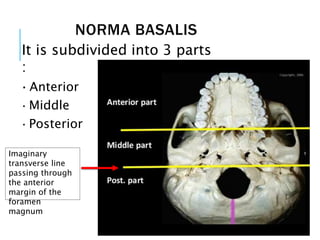
NORMA BASALIS
2
It is subdivided into 3 parts
:
Anterior
Middle
Posterior
Imaginary
transverse line
passing through
the anterior
margin of the
foramen
magnum
3
ANTERIOR PART OF THE
NORMA BASALIS
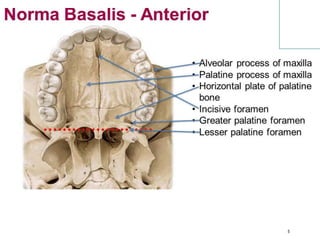
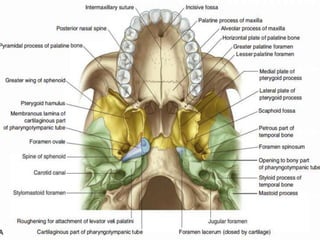
• Alveolar arch
• Hard palate
• Incisive fossa
• Greater palatine foramen
• Lesser palatine foramen
• Posterior nasal spine
4
5
6
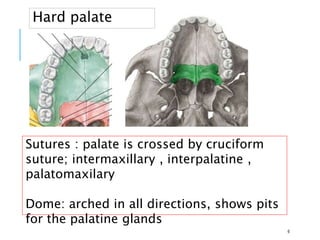
Hard palate
Sutures : palate is crossed by cruciform
suture; intermaxillary , interpalatine ,
palatomaxilary
Dome: arched in all directions, shows pits
for the palatine glands
7
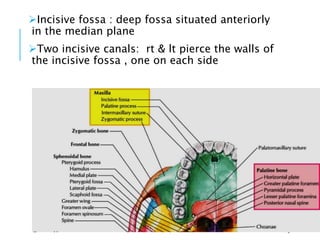
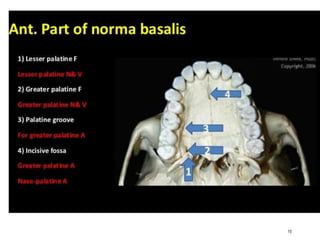
Incisive fossa : deep fossa situated anteriorly
in the median plane
Two incisive canals: rt & lt pierce the walls of
the incisive fossa , one on each side
8
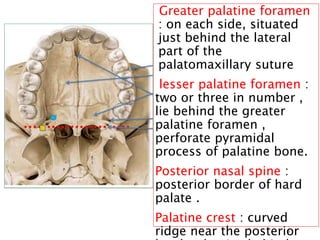
Greater palatine foramen
: on each side, situated
just behind the lateral
part of the
palatomaxillary suture
lesser palatine foramen :
two or three in number ,
lie behind the greater
palatine foramen ,
perforate pyramidal
process of palatine bone.
Posterior nasal spine :
posterior border of hard
palate .
Palatine crest : curved
ridge near the posterior9
10
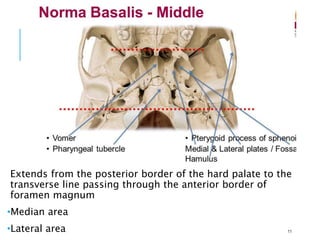
Extends from the posterior border of the hard palate to the
transverse line passing through the anterior border of
foramen magnum
•Median area
•Lateral area 11
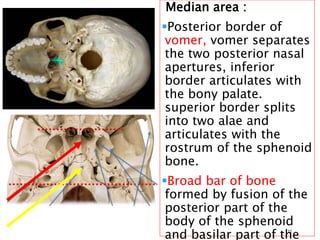
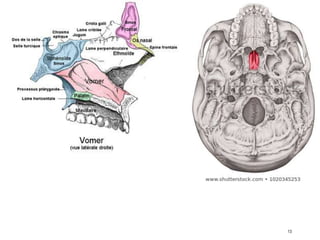
Median area :
Posterior border of
vomer, vomer separates
the two posterior nasal
apertures, inferior
border articulates with
the bony palate.
superior border splits
into two alae and
articulates with the
rostrum of the sphenoid
bone.
Broad bar of bone
formed by fusion of the
posterior part of the
body of the sphenoid
and basilar part of the12
13
14
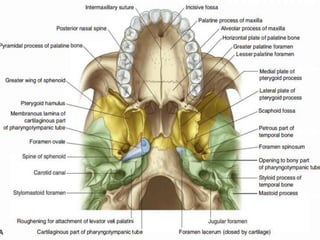
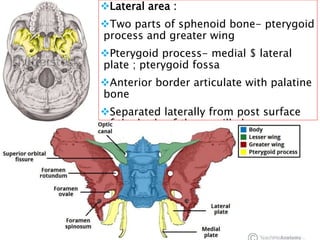
Lateral area :
Two parts of sphenoid bone- pterygoid
process and greater wing
Pterygoid process- medial $ lateral
plate ; pterygoid fossa
Anterior border articulate with palatine
bone
Separated laterally from post surface
of the body of the maxilla by
pterygomaxillary fissure
15
16
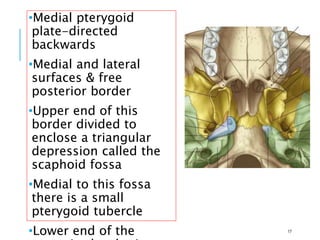
•Medial pterygoid
plate-directed
backwards
•Medial and lateral
surfaces & free
posterior border
•Upper end of this
border divided to
enclose a triangular
depression called the
scaphoid fossa
•Medial to this fossa
there is a small
pterygoid tubercle
•Lower end of the 17
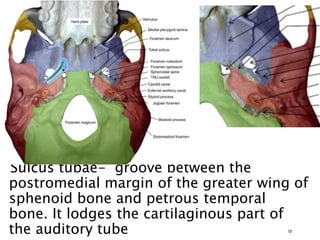
Sulcus tubae- groove between the
postromedial margin of the greater wing of
sphenoid bone and petrous temporal
bone. It lodges the cartilaginous part of
the auditory tube 18
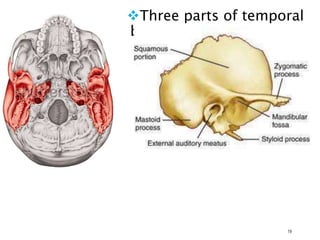
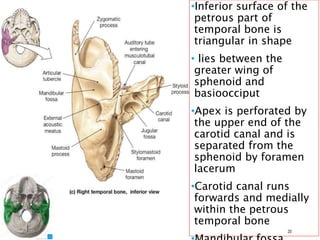
Three parts of temporal
bone :
19
•Inferior surface of the
petrous part of
temporal bone is
triangular in shape
• lies between the
greater wing of
sphenoid and
basioocciput
•Apex is perforated by
the upper end of the
carotid canal and is
separated from the
sphenoid by foramen
lacerum
•Carotid canal runs
forwards and medially
within the petrous
temporal bone
20
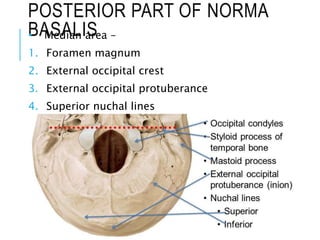
POSTERIOR PART OF NORMA
BASALIS• Median area –
1. Foramen magnum
2. External occipital crest
3. External occipital protuberance
4. Superior nuchal lines
21
22
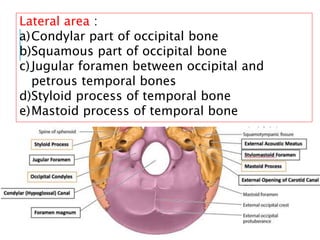
Lateral area :
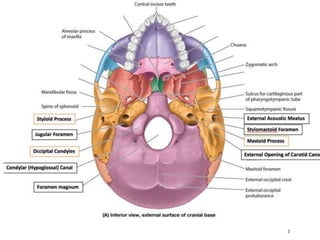
a)Condylar part of occipital bone
b)Squamous part of occipital bone
c)Jugular foramen between occipital and
petrous temporal bones
d)Styloid process of temporal bone
e)Mastoid process of temporal bone
23
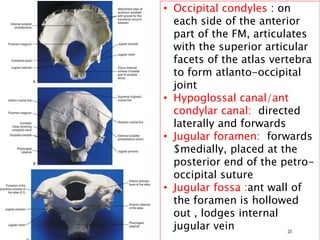
• Occipital condyles : on
each side of the anterior
part of the FM, articulates
with the superior articular
facets of the atlas vertebra
to form atlanto-occipital
joint
• Hypoglossal canal/ant
condylar canal: directed
laterally and forwards
• Jugular foramen: forwards
$medially, placed at the
posterior end of the petro-
occipital suture
• Jugular fossa :ant wall of
the foramen is hollowed
out , lodges internal
jugular vein
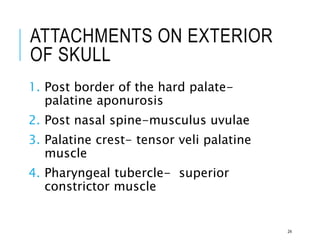
ATTACHMENTS ON EXTERIOR
OF SKULL
1. Post border of the hard palate-
palatine aponurosis
2. Post nasal spine-musculus uvulae
3. Palatine crest- tensor veli palatine
muscle
4. Pharyngeal tubercle- superior
constrictor muscle
24
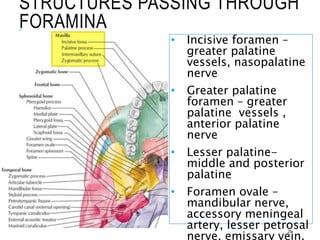
STRUCTURES PASSING THROUGH
FORAMINA
• Incisive foramen –
greater palatine
vessels, nasopalatine
nerve
• Greater palatine
foramen – greater
palatine vessels ,
anterior palatine
nerve
• Lesser palatine-
middle and posterior
palatine
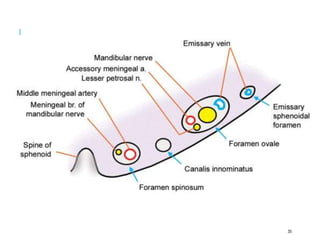
• Foramen ovale –
mandibular nerve,
accessory meningeal
artery, lesser petrosal
nerve, emissary vein,
25
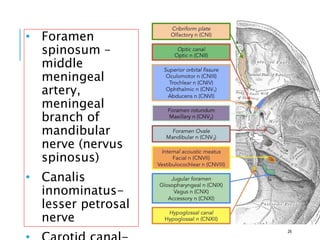
• Foramen
spinosum –
middle
meningeal
artery,
meningeal
branch of
mandibular
nerve (nervus
spinosus)
• Canalis
innominatus-
lesser petrosal
nerve
26
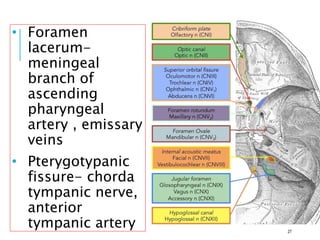
• Foramen
lacerum-
meningeal
branch of
ascending
pharyngeal
artery , emissary
veins
• Pterygotypanic
fissure- chorda
tympanic nerve,
anterior
tympanic artery 27
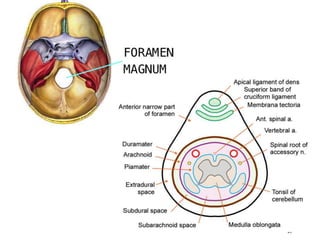
• FORAMEN MAGNUM
• Through wider posterior part
a. Lowest part of medulla oblongata
b. Three meninges
• Through the subarachnoid space
a. Spinal accessory nerves
b. Vertebral artery
c. Sympathetic plexus around the vertebral arteries
d. Posterior spinal arteries
e. Anterior spinal artery
• Through the narrow anterior part
a. Apical ligament of dens
b. Vertical band of cruciate ligament
c. Membrana tectoria
28
29
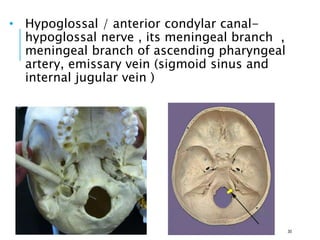
• Hypoglossal / anterior condylar canal-
hypoglossal nerve , its meningeal branch ,
meningeal branch of ascending pharyngeal
artery, emissary vein (sigmoid sinus and
internal jugular vein )
30
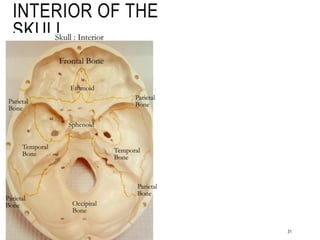
INTERIOR OF THE
SKULL
31
STRUCTURES PASSING THROUGH
FORAMINA
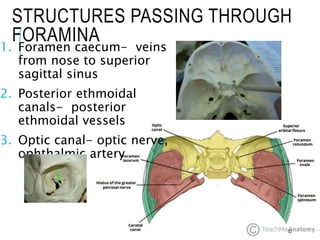
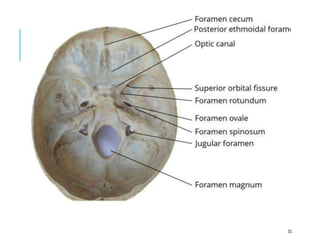
1. Foramen caecum- veins
from nose to superior
sagittal sinus
2. Posterior ethmoidal
canals- posterior
ethmoidal vessels
3. Optic canal- optic nerve,
ophthalmic artery
32
33
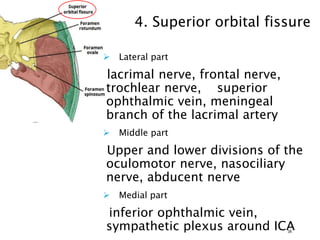
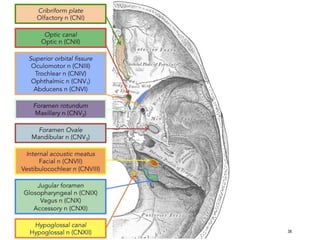
4. Superior orbital fissure
 Lateral part
lacrimal nerve, frontal nerve,
trochlear nerve, superior
ophthalmic vein, meningeal
branch of the lacrimal artery
 Middle part
Upper and lower divisions of the
oculomotor nerve, nasociliary
nerve, abducent nerve
 Medial part
inferior ophthalmic vein,
sympathetic plexus around ICA34
35
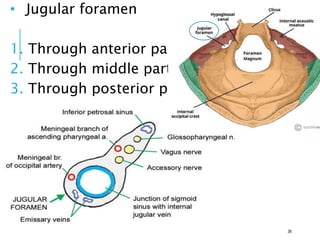
• Jugular foramen
1. Through anterior part
2. Through middle part
3. Through posterior part
36
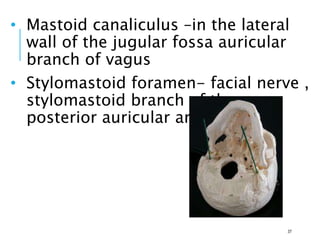
• Mastoid canaliculus –in the lateral
wall of the jugular fossa auricular
branch of vagus
• Stylomastoid foramen- facial nerve ,
stylomastoid branch of the
posterior auricular artery
37
38
FEOTAL SKULL
39
Dimensions
 Larger in proportion to other parts of skeleton
 The facial skeleton is 1/8th of calvaria whereas it
is ½ of calvaria
 Base of skull is short & narrow
 Internal ear is of same size as in adult
Structure of bones :
 Bones in cranial vault are smooth & unilamellar,
 There is no diploe
 Tables and diploe appear by fourth year of age
Bony Prominences
 Frontal & Parietal tubera are prominent
 Glabella, superciliary arches and mastoid
processes are not developed
paranasal air sinuses- rudimentary or
absent
orbits are large- germs of the developing
teeth lies close to the orbital floor
40
41
Ossification of Bones
 Two halves of frontal bone are separated by
metopic suture.
 Mandible is also present in two halves
 Occipital bone is in 4 parts ( (1)squamous, (2)
condylar, and (1) basilar)
 Unossified membranous gap a total of 6
frontanelle at the angles of parietal bones are
present.
POST NATAL GROWTH OF SKULL
42
 It proceeds at different rate and over different
periods
 Growth of calvaria related to - growth of brain
 Grwoth of facial skeleton related to -
development of dentition, muscle of
mastication & tongue
GROWTH OF VAULT
43
Rate – rapid during first yr.
slow upto 7th yr.
Growth in breadth : occurs at saggital suture
sutures bordering greater wings, Occipito
mastoid suture Petro- occipital suture at base
Growth in Height - occurs at
Frontozygomatic suture
Pterion
Squamous suture
Asterion
Growth in Anteroposterior Diameter - occurs at
coronal & lambdoid sutures
44
GROWTH OF BASE
45
It grows in antero-posterior diameter at 3
cartilaginous plates situated between –
Occipital & sphenoid bones
Pre & post sphenoid bones
Sphenoid & ethmoid bones
GROWTH OF FACE
 Growth of orbits and ethmoid is
complete by 7th yr.
 Growth occurs mostly during first
year, although continues till puberty
n even later
46
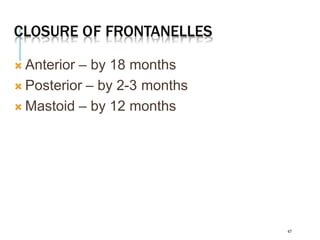
CLOSURE OF FRONTANELLES
47
 Anterior – by 18 months
 Posterior – by 2-3 months
 Mastoid – by 12 months
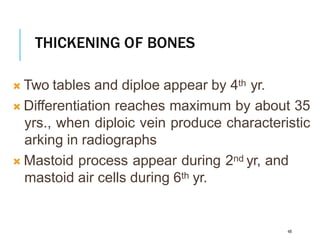
THICKENING OF BONES
48
 Two tables and diploe appear by 4th yr.
 Differentiation reaches maximum by about 35
yrs., when diploic vein produce characteristic
arking in radiographs
 Mastoid process appear during 2nd yr, and
mastoid air cells during 6th yr.
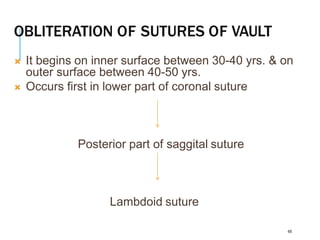
OBLITERATION OF SUTURES OF VAULT
49
 It begins on inner surface between 30-40 yrs. & on
outer surface between 40-50 yrs.
 Occurs first in lower part of coronal suture
Posterior part of saggital suture
Lambdoid suture
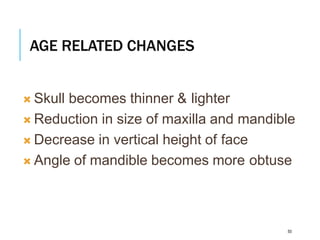
AGE RELATED CHANGES
50
 Skull becomes thinner & lighter
 Reduction in size of maxilla and mandible
 Decrease in vertical height of face
 Angle of mandible becomes more obtuse
CRANIOMETRY
51
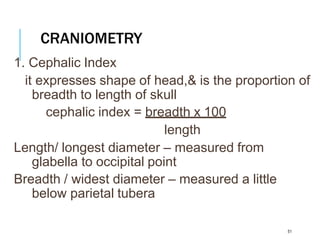
1. Cephalic Index
it expresses shape of head,& is the proportion of
breadth to length of skull
cephalic index = breadth x 100
length
Length/ longest diameter – measured from
glabella to occipital point
Breadth / widest diameter – measured a little
below parietal tubera
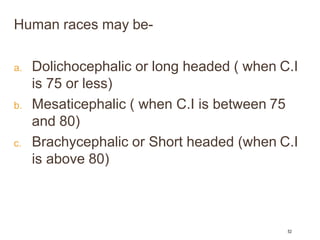
Human races may be-
a. Dolichocephalic or long headed ( when C.I
is 75 or less)
b. Mesaticephalic ( when C.I is between 75
and 80)
c. Brachycephalic or Short headed (when C.I
is above 80)
52
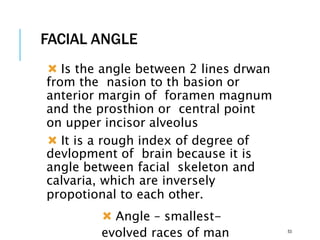
FACIAL ANGLE
 Is the angle between 2 lines drwan
from the nasion to th basion or
anterior margin of foramen magnum
and the prosthion or central point
on upper incisor alveolus
 It is a rough index of degree of
devlopment of brain because it is
angle between facial skeleton and
calvaria, which are inversely
propotional to each other.
 Angle – smallest-
evolved races of man 53
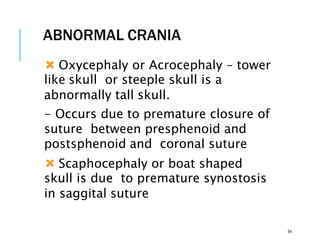
ABNORMAL CRANIA
 Oxycephaly or Acrocephaly – tower
like skull or steeple skull is a
abnormally tall skull.
- Occurs due to premature closure of
suture between presphenoid and
postsphenoid and coronal suture
 Scaphocephaly or boat shaped
skull is due to premature synostosis
in saggital suture
54
55

Norma basalis

  • 1.
  • 2.
    NORMA BASALIS 2 It issubdivided into 3 parts : Anterior Middle Posterior Imaginary transverse line passing through the anterior margin of the foramen magnum
  • 3.
  • 4.
    ANTERIOR PART OFTHE NORMA BASALIS • Alveolar arch • Hard palate • Incisive fossa • Greater palatine foramen • Lesser palatine foramen • Posterior nasal spine 4
  • 5.
  • 6.
    6 Hard palate Sutures :palate is crossed by cruciform suture; intermaxillary , interpalatine , palatomaxilary Dome: arched in all directions, shows pits for the palatine glands
  • 7.
  • 8.
    Incisive fossa :deep fossa situated anteriorly in the median plane Two incisive canals: rt & lt pierce the walls of the incisive fossa , one on each side 8
  • 9.
    Greater palatine foramen :on each side, situated just behind the lateral part of the palatomaxillary suture lesser palatine foramen : two or three in number , lie behind the greater palatine foramen , perforate pyramidal process of palatine bone. Posterior nasal spine : posterior border of hard palate . Palatine crest : curved ridge near the posterior9
  • 10.
  • 11.
    Extends from theposterior border of the hard palate to the transverse line passing through the anterior border of foramen magnum •Median area •Lateral area 11
  • 12.
    Median area : Posteriorborder of vomer, vomer separates the two posterior nasal apertures, inferior border articulates with the bony palate. superior border splits into two alae and articulates with the rostrum of the sphenoid bone. Broad bar of bone formed by fusion of the posterior part of the body of the sphenoid and basilar part of the12
  • 13.
  • 14.
  • 15.
    Lateral area : Twoparts of sphenoid bone- pterygoid process and greater wing Pterygoid process- medial $ lateral plate ; pterygoid fossa Anterior border articulate with palatine bone Separated laterally from post surface of the body of the maxilla by pterygomaxillary fissure 15
  • 16.
  • 17.
    •Medial pterygoid plate-directed backwards •Medial andlateral surfaces & free posterior border •Upper end of this border divided to enclose a triangular depression called the scaphoid fossa •Medial to this fossa there is a small pterygoid tubercle •Lower end of the 17
  • 18.
    Sulcus tubae- groovebetween the postromedial margin of the greater wing of sphenoid bone and petrous temporal bone. It lodges the cartilaginous part of the auditory tube 18
  • 19.
    Three parts oftemporal bone : 19
  • 20.
    •Inferior surface ofthe petrous part of temporal bone is triangular in shape • lies between the greater wing of sphenoid and basioocciput •Apex is perforated by the upper end of the carotid canal and is separated from the sphenoid by foramen lacerum •Carotid canal runs forwards and medially within the petrous temporal bone 20
  • 21.
    POSTERIOR PART OFNORMA BASALIS• Median area – 1. Foramen magnum 2. External occipital crest 3. External occipital protuberance 4. Superior nuchal lines 21
  • 22.
    22 Lateral area : a)Condylarpart of occipital bone b)Squamous part of occipital bone c)Jugular foramen between occipital and petrous temporal bones d)Styloid process of temporal bone e)Mastoid process of temporal bone
  • 23.
    23 • Occipital condyles: on each side of the anterior part of the FM, articulates with the superior articular facets of the atlas vertebra to form atlanto-occipital joint • Hypoglossal canal/ant condylar canal: directed laterally and forwards • Jugular foramen: forwards $medially, placed at the posterior end of the petro- occipital suture • Jugular fossa :ant wall of the foramen is hollowed out , lodges internal jugular vein
  • 24.
    ATTACHMENTS ON EXTERIOR OFSKULL 1. Post border of the hard palate- palatine aponurosis 2. Post nasal spine-musculus uvulae 3. Palatine crest- tensor veli palatine muscle 4. Pharyngeal tubercle- superior constrictor muscle 24
  • 25.
    STRUCTURES PASSING THROUGH FORAMINA •Incisive foramen – greater palatine vessels, nasopalatine nerve • Greater palatine foramen – greater palatine vessels , anterior palatine nerve • Lesser palatine- middle and posterior palatine • Foramen ovale – mandibular nerve, accessory meningeal artery, lesser petrosal nerve, emissary vein, 25
  • 26.
    • Foramen spinosum – middle meningeal artery, meningeal branchof mandibular nerve (nervus spinosus) • Canalis innominatus- lesser petrosal nerve 26
  • 27.
    • Foramen lacerum- meningeal branch of ascending pharyngeal artery, emissary veins • Pterygotypanic fissure- chorda tympanic nerve, anterior tympanic artery 27
  • 28.
    • FORAMEN MAGNUM •Through wider posterior part a. Lowest part of medulla oblongata b. Three meninges • Through the subarachnoid space a. Spinal accessory nerves b. Vertebral artery c. Sympathetic plexus around the vertebral arteries d. Posterior spinal arteries e. Anterior spinal artery • Through the narrow anterior part a. Apical ligament of dens b. Vertical band of cruciate ligament c. Membrana tectoria 28
  • 29.
  • 30.
    • Hypoglossal /anterior condylar canal- hypoglossal nerve , its meningeal branch , meningeal branch of ascending pharyngeal artery, emissary vein (sigmoid sinus and internal jugular vein ) 30
  • 31.
  • 32.
    STRUCTURES PASSING THROUGH FORAMINA 1.Foramen caecum- veins from nose to superior sagittal sinus 2. Posterior ethmoidal canals- posterior ethmoidal vessels 3. Optic canal- optic nerve, ophthalmic artery 32
  • 33.
  • 34.
    4. Superior orbitalfissure  Lateral part lacrimal nerve, frontal nerve, trochlear nerve, superior ophthalmic vein, meningeal branch of the lacrimal artery  Middle part Upper and lower divisions of the oculomotor nerve, nasociliary nerve, abducent nerve  Medial part inferior ophthalmic vein, sympathetic plexus around ICA34
  • 35.
  • 36.
    • Jugular foramen 1.Through anterior part 2. Through middle part 3. Through posterior part 36
  • 37.
    • Mastoid canaliculus–in the lateral wall of the jugular fossa auricular branch of vagus • Stylomastoid foramen- facial nerve , stylomastoid branch of the posterior auricular artery 37
  • 38.
  • 39.
    FEOTAL SKULL 39 Dimensions  Largerin proportion to other parts of skeleton  The facial skeleton is 1/8th of calvaria whereas it is ½ of calvaria  Base of skull is short & narrow  Internal ear is of same size as in adult Structure of bones :  Bones in cranial vault are smooth & unilamellar,  There is no diploe  Tables and diploe appear by fourth year of age
  • 40.
    Bony Prominences  Frontal& Parietal tubera are prominent  Glabella, superciliary arches and mastoid processes are not developed paranasal air sinuses- rudimentary or absent orbits are large- germs of the developing teeth lies close to the orbital floor 40
  • 41.
    41 Ossification of Bones Two halves of frontal bone are separated by metopic suture.  Mandible is also present in two halves  Occipital bone is in 4 parts ( (1)squamous, (2) condylar, and (1) basilar)  Unossified membranous gap a total of 6 frontanelle at the angles of parietal bones are present.
  • 42.
    POST NATAL GROWTHOF SKULL 42  It proceeds at different rate and over different periods  Growth of calvaria related to - growth of brain  Grwoth of facial skeleton related to - development of dentition, muscle of mastication & tongue
  • 43.
    GROWTH OF VAULT 43 Rate– rapid during first yr. slow upto 7th yr. Growth in breadth : occurs at saggital suture sutures bordering greater wings, Occipito mastoid suture Petro- occipital suture at base
  • 44.
    Growth in Height- occurs at Frontozygomatic suture Pterion Squamous suture Asterion Growth in Anteroposterior Diameter - occurs at coronal & lambdoid sutures 44
  • 45.
    GROWTH OF BASE 45 Itgrows in antero-posterior diameter at 3 cartilaginous plates situated between – Occipital & sphenoid bones Pre & post sphenoid bones Sphenoid & ethmoid bones
  • 46.
    GROWTH OF FACE Growth of orbits and ethmoid is complete by 7th yr.  Growth occurs mostly during first year, although continues till puberty n even later 46
  • 47.
    CLOSURE OF FRONTANELLES 47 Anterior – by 18 months  Posterior – by 2-3 months  Mastoid – by 12 months
  • 48.
    THICKENING OF BONES 48 Two tables and diploe appear by 4th yr.  Differentiation reaches maximum by about 35 yrs., when diploic vein produce characteristic arking in radiographs  Mastoid process appear during 2nd yr, and mastoid air cells during 6th yr.
  • 49.
    OBLITERATION OF SUTURESOF VAULT 49  It begins on inner surface between 30-40 yrs. & on outer surface between 40-50 yrs.  Occurs first in lower part of coronal suture Posterior part of saggital suture Lambdoid suture
  • 50.
    AGE RELATED CHANGES 50 Skull becomes thinner & lighter  Reduction in size of maxilla and mandible  Decrease in vertical height of face  Angle of mandible becomes more obtuse
  • 51.
    CRANIOMETRY 51 1. Cephalic Index itexpresses shape of head,& is the proportion of breadth to length of skull cephalic index = breadth x 100 length Length/ longest diameter – measured from glabella to occipital point Breadth / widest diameter – measured a little below parietal tubera
  • 52.
    Human races maybe- a. Dolichocephalic or long headed ( when C.I is 75 or less) b. Mesaticephalic ( when C.I is between 75 and 80) c. Brachycephalic or Short headed (when C.I is above 80) 52
  • 53.
    FACIAL ANGLE  Isthe angle between 2 lines drwan from the nasion to th basion or anterior margin of foramen magnum and the prosthion or central point on upper incisor alveolus  It is a rough index of degree of devlopment of brain because it is angle between facial skeleton and calvaria, which are inversely propotional to each other.  Angle – smallest- evolved races of man 53
  • 54.
    ABNORMAL CRANIA  Oxycephalyor Acrocephaly – tower like skull or steeple skull is a abnormally tall skull. - Occurs due to premature closure of suture between presphenoid and postsphenoid and coronal suture  Scaphocephaly or boat shaped skull is due to premature synostosis in saggital suture 54
  • 55.