Eight Steps of Negotiations Prepare Argue Signal Propose Package Bargain Close Agree
PREPARE Prepare carefully well in advance Prepare for negotiations and not defending Be ready for opportunities Reconsider your preparation items
Five key areas of preparation Objectives Information Concessions Strategy/Style Tasks
Preparation- objectives Define what outcome you want to achieve from the negotiation- ISSUES The realistic expectation against each issues- INTEND Minimum acceptable position on intends- MUST ACHIEVE or AVOID What is the ideal outcome you want – WISH LIST
Step 1-Preparation- Objectives Do the same for your opponent – ISSUES, INTEND, MUST ACHIEVE & WISH LIST As negotiations progress keep your objectives under constant review: are they still realistic? Should your INTEND be boosted by a few WISH LIST items? Should you move on an INTEND to protect a MUST?
Elements of Negotiations  VALUES POSTION NEEDS NEEDS SATISFIERS NEEDS BLOCKERS
VALUES Deeply held preferences that shape our goals  and means to fulfill them. Transmitted through socialization and enduring. Values are shared and often culture specific . Values create needs that we want to fulfill.
POSITIONS  An opening demand that the negotiator believes will satisfy need. Positions can be changed in skillful negotiations
NEEDS Needs are specific in a negotiation , but are derived from the values we hold. They have to be dug out by skillful questioning and then a suitable need satisfiers can be used to move the negotiation forward . If we are not clear about our needs we may bargain away some thing we value
NEED SATISFIERS These bring focus to the negotiation and create a positive environment , which can then be used to change positions
NEED BLOCKERS  They are threatening and do not lead to collaborative negotiations
Tactics of Negotiation ATTACK- creates negative energy EVADE- can be used meaningfully INFORM- clears the environment OPEN- helps in understanding needs UNITE- build rapport – Emphasize common ground- reframe – propose solutions
PREPARATION- Information Research both parties Analyze the basis of power for both Do SWOT for both Prepare questions in advance What is the BATNA of the opponent What is their awareness in regard to your issues and  needs  Brutally admit to assumptions and biases
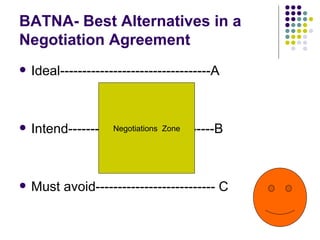
BATNA- Best Alternatives in a Negotiation Agreement  Ideal----------------------------------A Intend---------------------------------B Must avoid--------------------------- C Negotiations  Zone
PREPARATION- Concessions Where can we be flexible? What concessions can we make? What can we give in order to what we want – TRADE What value the concessions have to the other party? What will you ask in return?
PREPARATION-Strategy Keep it SIMPLE and FLEXIBLE Avoid confusing strategy ( means)  with objectives ( objectives) E.g. Take the train ( strategy ) to London  (objectives ). If you meet a “ gate “ adjourn or reconsider .
Understand the preferred styles of each other  DEFERENTIAL- Respect and Hierarchy SUBSTANTIVE- Material issues RELATIONAL- Trust and good faith PROCEDURAL- Agenda and rules
Understand your personal style IMAGINATIVE- creative , intuitive, integrative and inspiring FACTUAL- clear, focused, informed , verify RELATIONAL- solve conflict,listen, encourage, listen and maintain relations , constructive ANALYTICAL- logical and process oriented  EVALUATIVE- weigh , measure and moniter
PREPARATION- Tasks Leader- conducts the negotiation, gives information, expresses opinions, makes proposals, trades concessions.  Summarizer- asks questions to test understanding, draws attention to , clarifies , summarizes to buy thinking time, confirms areas of disagreement and agreement . Does NOT give personal opinions, information's, and concessions, Observer- watches, listens, records and tries to understand the motivation , concerns, priorities, & inhibitions,
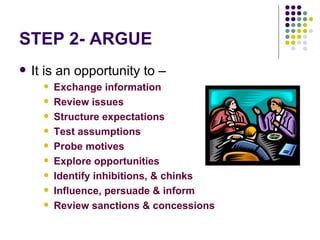
STEP 2- ARGUE It is an opportunity to – Exchange information Review issues Structure expectations Test assumptions Probe motives Explore opportunities Identify inhibitions, & chinks  Influence, persuade & inform Review sanctions & concessions
STEP 4- Signal Signals indicate change in stance They are verbal or non verbal When opponent moves from absolute to qualified statements it is a signal  Listen , reward, expand and confirm signal  Signals  indicate when to make a proposal
What are qualified statements  Can you explain the reasons? Suppose I agree to that what can you offer? Which aspects are you unhappy with? Why is it important?
STEP 5- PROPOSE- ENTRY OFFER Open realistically- entry offer A realistic proposal is based on  facts that  support the proposal Address  the key issues & your intend list Matches the other parties BATNA
Making proposals Propose – Explain – Summarize  Invite response  If you have to modify the proposal the secondary proposal is tentative If there is a grievance suggest a solution
RECIEVING PROPOPSALS Never interrupt Question – clarify – summarize Response could be No- this gives the other party the initiative.  If Yes- Are you missing an opportunity to add some thing from your wish list? Instant counter proposal- leads to haggling and arguments Adjourn- gives time to consult and think Detailed response – encourages repackaging, to make the proposal more acceptable Considered counter proposal- best response TRY TO GIVE THEM WHAT THEY WANT  ON YOUR TERMS
More about proposals If you are asked to concede something from your intend list then add something from your wish list Remember the strengths of your proposal Proposal set the agenda A proposal beats arguments
STEP 6 - Package Packaging adjust the variable without increasing the offer in order to make the proposal more acceptable If you have opened realistically then you may reach a deal without making any adjustment or concessions. In order to do get more out of the other  identify inhibitions and interests and address the package to  them. If you use a competitive stance likelihood of identifying needs about inhibitions are low , so use a cooperative stance Proposals are solutions to needs  Think creatively about all the variables or services while packaging
Styles of Negotiations Co operative Long term relationship  Voluntary relationship Trust Private and informal Tolerance of others views Emotional detachment Skilled negotiations  Win - win Competitive on recurring transactions Mandatory relations hip Suspicion Public and formal Intolerance of others Emotional involvement Poor negotiators Win lose
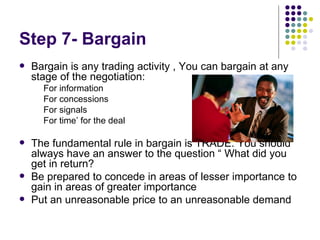
Step 7- Bargain Bargain is any trading activity , You can bargain at any stage of the negotiation: For information For concessions For signals For time’ for the deal The fundamental rule in bargain is TRADE. You should always have an answer to the question “ What did you get in return? Be prepared to concede in areas of lesser importance to gain in areas of greater importance Put an unreasonable price to an unreasonable demand
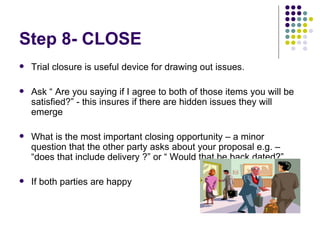
Step 8- CLOSE Trial closure is useful device for drawing out issues. Ask “ Are you saying if I agree to both of those items you will be satisfied?” - this insures if there are hidden issues they will emerge What is the most important closing opportunity – a minor question that the other party asks about your proposal e.g. – “does that include delivery ?” or “ Would that be back dated?” If both parties are happy
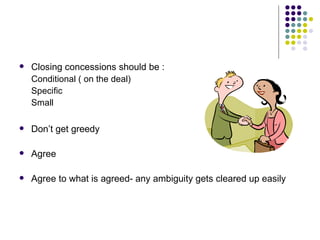
Closing concessions should be : Conditional ( on the deal) Specific Small Don’t get greedy Agree Agree to what is agreed- any ambiguity gets cleared up easily
When to go for adjournment When you feel you need to reconsider your objectives New critical information emerges Your strategy is over taken Stuck in circular argument When you need time to repackage
How to make adjournments Summarize the position the negotiation has reached Withdraw to a private place  and discuss with your team before breaking away Agree on a new meeting date Give home work to the other party

Negotiation steps

  • 1.
    Eight Steps ofNegotiations Prepare Argue Signal Propose Package Bargain Close Agree
  • 2.
    PREPARE Prepare carefullywell in advance Prepare for negotiations and not defending Be ready for opportunities Reconsider your preparation items
  • 3.
    Five key areasof preparation Objectives Information Concessions Strategy/Style Tasks
  • 4.
    Preparation- objectives Definewhat outcome you want to achieve from the negotiation- ISSUES The realistic expectation against each issues- INTEND Minimum acceptable position on intends- MUST ACHIEVE or AVOID What is the ideal outcome you want – WISH LIST
  • 5.
    Step 1-Preparation- ObjectivesDo the same for your opponent – ISSUES, INTEND, MUST ACHIEVE & WISH LIST As negotiations progress keep your objectives under constant review: are they still realistic? Should your INTEND be boosted by a few WISH LIST items? Should you move on an INTEND to protect a MUST?
  • 6.
    Elements of Negotiations VALUES POSTION NEEDS NEEDS SATISFIERS NEEDS BLOCKERS
  • 7.
    VALUES Deeply heldpreferences that shape our goals and means to fulfill them. Transmitted through socialization and enduring. Values are shared and often culture specific . Values create needs that we want to fulfill.
  • 8.
    POSITIONS Anopening demand that the negotiator believes will satisfy need. Positions can be changed in skillful negotiations
  • 9.
    NEEDS Needs arespecific in a negotiation , but are derived from the values we hold. They have to be dug out by skillful questioning and then a suitable need satisfiers can be used to move the negotiation forward . If we are not clear about our needs we may bargain away some thing we value
  • 10.
    NEED SATISFIERS Thesebring focus to the negotiation and create a positive environment , which can then be used to change positions
  • 11.
    NEED BLOCKERS They are threatening and do not lead to collaborative negotiations
  • 12.
    Tactics of NegotiationATTACK- creates negative energy EVADE- can be used meaningfully INFORM- clears the environment OPEN- helps in understanding needs UNITE- build rapport – Emphasize common ground- reframe – propose solutions
  • 13.
    PREPARATION- Information Researchboth parties Analyze the basis of power for both Do SWOT for both Prepare questions in advance What is the BATNA of the opponent What is their awareness in regard to your issues and needs Brutally admit to assumptions and biases
  • 14.
    BATNA- Best Alternativesin a Negotiation Agreement Ideal----------------------------------A Intend---------------------------------B Must avoid--------------------------- C Negotiations Zone
  • 15.
    PREPARATION- Concessions Wherecan we be flexible? What concessions can we make? What can we give in order to what we want – TRADE What value the concessions have to the other party? What will you ask in return?
  • 16.
    PREPARATION-Strategy Keep itSIMPLE and FLEXIBLE Avoid confusing strategy ( means) with objectives ( objectives) E.g. Take the train ( strategy ) to London (objectives ). If you meet a “ gate “ adjourn or reconsider .
  • 17.
    Understand the preferredstyles of each other DEFERENTIAL- Respect and Hierarchy SUBSTANTIVE- Material issues RELATIONAL- Trust and good faith PROCEDURAL- Agenda and rules
  • 18.
    Understand your personalstyle IMAGINATIVE- creative , intuitive, integrative and inspiring FACTUAL- clear, focused, informed , verify RELATIONAL- solve conflict,listen, encourage, listen and maintain relations , constructive ANALYTICAL- logical and process oriented EVALUATIVE- weigh , measure and moniter
  • 19.
    PREPARATION- Tasks Leader-conducts the negotiation, gives information, expresses opinions, makes proposals, trades concessions. Summarizer- asks questions to test understanding, draws attention to , clarifies , summarizes to buy thinking time, confirms areas of disagreement and agreement . Does NOT give personal opinions, information's, and concessions, Observer- watches, listens, records and tries to understand the motivation , concerns, priorities, & inhibitions,
  • 20.
    STEP 2- ARGUEIt is an opportunity to – Exchange information Review issues Structure expectations Test assumptions Probe motives Explore opportunities Identify inhibitions, & chinks Influence, persuade & inform Review sanctions & concessions
  • 21.
    STEP 4- SignalSignals indicate change in stance They are verbal or non verbal When opponent moves from absolute to qualified statements it is a signal Listen , reward, expand and confirm signal Signals indicate when to make a proposal
  • 22.
    What are qualifiedstatements Can you explain the reasons? Suppose I agree to that what can you offer? Which aspects are you unhappy with? Why is it important?
  • 23.
    STEP 5- PROPOSE-ENTRY OFFER Open realistically- entry offer A realistic proposal is based on facts that support the proposal Address the key issues & your intend list Matches the other parties BATNA
  • 24.
    Making proposals Propose– Explain – Summarize Invite response If you have to modify the proposal the secondary proposal is tentative If there is a grievance suggest a solution
  • 25.
    RECIEVING PROPOPSALS Neverinterrupt Question – clarify – summarize Response could be No- this gives the other party the initiative. If Yes- Are you missing an opportunity to add some thing from your wish list? Instant counter proposal- leads to haggling and arguments Adjourn- gives time to consult and think Detailed response – encourages repackaging, to make the proposal more acceptable Considered counter proposal- best response TRY TO GIVE THEM WHAT THEY WANT ON YOUR TERMS
  • 26.
    More about proposalsIf you are asked to concede something from your intend list then add something from your wish list Remember the strengths of your proposal Proposal set the agenda A proposal beats arguments
  • 27.
    STEP 6 -Package Packaging adjust the variable without increasing the offer in order to make the proposal more acceptable If you have opened realistically then you may reach a deal without making any adjustment or concessions. In order to do get more out of the other identify inhibitions and interests and address the package to them. If you use a competitive stance likelihood of identifying needs about inhibitions are low , so use a cooperative stance Proposals are solutions to needs Think creatively about all the variables or services while packaging
  • 28.
    Styles of NegotiationsCo operative Long term relationship Voluntary relationship Trust Private and informal Tolerance of others views Emotional detachment Skilled negotiations Win - win Competitive on recurring transactions Mandatory relations hip Suspicion Public and formal Intolerance of others Emotional involvement Poor negotiators Win lose
  • 29.
    Step 7- BargainBargain is any trading activity , You can bargain at any stage of the negotiation: For information For concessions For signals For time’ for the deal The fundamental rule in bargain is TRADE. You should always have an answer to the question “ What did you get in return? Be prepared to concede in areas of lesser importance to gain in areas of greater importance Put an unreasonable price to an unreasonable demand
  • 30.
    Step 8- CLOSETrial closure is useful device for drawing out issues. Ask “ Are you saying if I agree to both of those items you will be satisfied?” - this insures if there are hidden issues they will emerge What is the most important closing opportunity – a minor question that the other party asks about your proposal e.g. – “does that include delivery ?” or “ Would that be back dated?” If both parties are happy
  • 31.
    Closing concessions shouldbe : Conditional ( on the deal) Specific Small Don’t get greedy Agree Agree to what is agreed- any ambiguity gets cleared up easily
  • 32.
    When to gofor adjournment When you feel you need to reconsider your objectives New critical information emerges Your strategy is over taken Stuck in circular argument When you need time to repackage
  • 33.
    How to makeadjournments Summarize the position the negotiation has reached Withdraw to a private place and discuss with your team before breaking away Agree on a new meeting date Give home work to the other party