EFFECTIVE Negotiation SKILLS
Meaning of negotiation
• “Negotiation involves two or more parties
with competing or conflicting interests or
needs, working towards an agreement on
how they will cooperate.”
Back and forth communication through
which parties which have both common
and dissimilar interests may reach
agreement
2
3
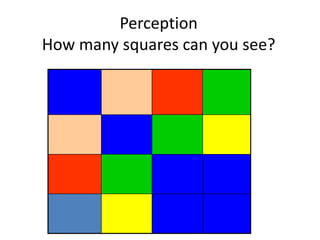
Perception
How many squares can you see?
EXAMPLES OF NEGOTIATIONS
 involving obtaining support and cooperation
 procuring funding,
 approval of budgets,
 formulating and implementing projects
 securing contracts,
 purchasing,
 union and personnel matters,
 trade and tariffs,
 marketing of goods and services,
 engaging consultants,
 community dispute resolution
5
• International/diplomatic matters (which may
be bilateral, regional and multilateral)
• environmental issues
• hostage incidents and crisis management.
• Negotiation occurs in business, non-profit
organizations, government branches, legal
proceedings, among nations and in personal
situations such as marriage, divorce,
parenting, and everyday life.
6
IMPORTANCE OF NEGOTIATION
• Negotiation is an integral activity in
professional and organizational life.
• Effective negotiation skills are becoming
increasingly important in today’s world - a
survival skill for individuals, organisations and
nations.
• It is a daily activity for all professionals,
managers and administrators
7
• Negotiations are not only for the economic
and social development of their respective
organizations and countries, but sometimes
for the survival and development
organizations and nations.
8
A country’s economic competitiveness abroad
faces many obstacles: Protectionism in foreign
markets, unfair trade practices by other
nations, failures in international
9
Approaches to negotiations
Positional vs Interest based
-(purple)Principled/ collaborative/problem
solving
-(red)competitive /contending/ Dominating
-(Blue)Cooperative/ yielding/ accommodating or
obliging
10
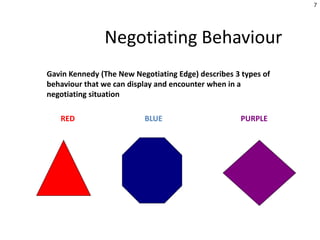
Negotiating Behaviour
Gavin Kennedy (The New Negotiating Edge) describes 3 types of
behaviour that we can display and encounter when in a
negotiating situation
RED BLUE PURPLE
7
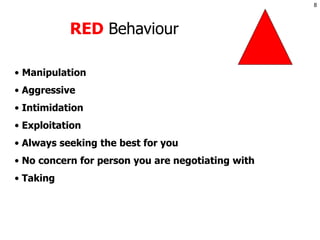
RED Behaviour
• Manipulation
• Aggressive
• Intimidation
• Exploitation
• Always seeking the best for you
• No concern for person you are negotiating with
• Taking
8
BLUE Behaviour
• Cooperation
• Trusting
• Pacifying
• Relational
• Giving
Kennedy talks of a ‘behavioural dilemma’, do you cooperate (blue) or defect
(red)?
Can you trust the other person? And to what extent? Trusting someone
involves risk, on the one hand being too trusting is naïve and on the other,
not trusting at all can create deceitful behaviour.
The answer is to merge blue and red behaviour into purple.
9
PURPLE Behaviour
• Give me some of what I want (red)
• I’ll give you some of what you want (blue)
• Deal with people as they are not how you think they are
• Good intentions
• Two way exchange
• Purple behaviour incites purple behaviour
• Open
• People know where they stand
To the red behaviourist the message is loud and clear, ‘You will get nothing
from me unless and until I get something from you’.
10
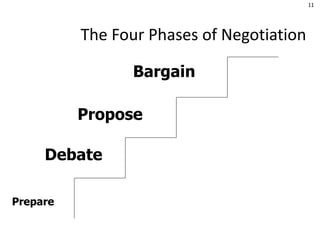
The Four Phases of Negotiation
Prepare
Debate
Propose
Bargain
11
PREPARE
- Prepare carefully well in advance
– Prepare for negotiations and not defending
– Be ready for opportunities
• Five key areas of preparation
– Objectives
– Information
– Concessions
– Strategy/Style
– Tasks
16
Preparation-objectives
– Define what outcome you want to achieve from
the negotiation- ISSUES
– The realistic expectation against each issues-
INTEND
– Minimum acceptable position on intends- MUST
ACHIEVE or AVOID
– What is the ideal outcome you want – WISH LIST
17
Preparation-information
– Research both parties
– Analyze the basis of power for both
– Do SWOT for both
– Prepare questions in advance
– What is the BATNA of the opponent
– What is their awareness in regard to your issues
and needs
18
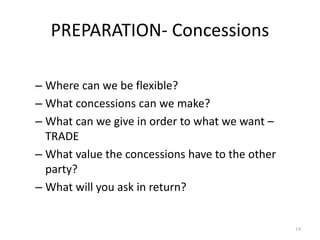
PREPARATION- Concessions
– Where can we be flexible?
– What concessions can we make?
– What can we give in order to what we want –
TRADE
– What value the concessions have to the other
party?
– What will you ask in return?
19
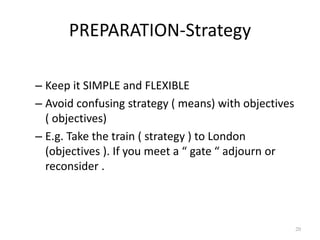
PREPARATION-Strategy
– Keep it SIMPLE and FLEXIBLE
– Avoid confusing strategy ( means) with objectives
( objectives)
– E.g. Take the train ( strategy ) to London
(objectives ). If you meet a “ gate “ adjourn or
reconsider .
20
PREPARATION- Tasks
-Leader- conducts the negotiation, gives
information, expresses opinions, makes proposals,
trades concessions.
– Summarizer- asks questions to test understanding,
draws attention to , clarifies , summarizes to buy
thinking time, confirms areas of disagreement and
agreement . Does NOT give personal opinions,
information's, and concessions,
– Observer- watches, listens, records and tries to
understand the motivation , concerns, priorities, &
inhibitions,
21
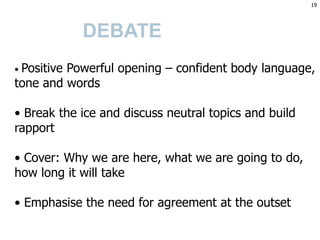
DEBATE
• Positive Powerful opening – confident body language,
tone and words
• Break the ice and discuss neutral topics and build
rapport
• Cover: Why we are here, what we are going to do,
how long it will take
• Emphasise the need for agreement at the outset
19
• Listen to what the other party say and how
they say it
• Observe non-verbal signals
• Sit where you can see everyone
• If you are with one other person sit apart –
so you are 2 voices.
23
 Don’t feel intimidated – both sides are under
pressure. The person under the greatest time
pressure loses – so don’t reveal your deadlines.
 Always maintain walk away power
• Exchange information through statements.
Explain and explore the differences that prompt
the search for a negotiated
24
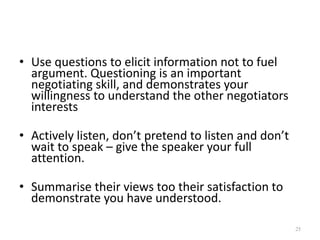
• Use questions to elicit information not to fuel
argument. Questioning is an important
negotiating skill, and demonstrates your
willingness to understand the other negotiators
interests
• Actively listen, don’t pretend to listen and don’t
wait to speak – give the speaker your full
attention.
• Summarise their views too their satisfaction to
demonstrate you have understood.
25
PROPOSE
• Decide whether you will speak your proposal first or
respond to the proposal from the other party.
• Put forward your proposal with as little emotion as possible.
• Leave room for manoeuvre in your proposal
• Full Disclosure – really means 90%. You may not know or
are unwilling to disclose 100% of your position. This can be very
productive – reaching out to the other party can be a strong positive
behaviour builder, however, both parties must want to negotiate towards
agreement.
Be assertive
24
• Avoid – ‘wish’, ‘hope’, ‘would like’ – this is not
assertive
• When you make and consider proposals it means you
are moving towards a jointly agreed solution.
• Proposals consist of 2 elements: the condition plus
the offer and can be best presented with the ‘If
….Then’ technique.
PROPOSE
27
Answer: Specific-Vague.
Specific in the condition, but vague in their offer.
• Being vague in the offer is a sign of proposal.
• It isn’t an exact science and you don’t have to follow a set
pattern, but research shows that effective negotiators do
move from vague to specific in their proposal.
• Being vague gives you some leeway, as you don’t know how
near or far you are from the point of settlement, and prevents
you from getting to an impasse.
PROPOSE
29
• By being vague instant rejection and instant
acceptance is not appropriate. How can you
accept something that isn’t specific?
• Conditions can be vague or specific.
• You can have specific proposals, but beware of
being hasty.
29
• If agreement is hard to find keep looking for a
solution until one is found or, it is clear that
one doesn’t exist.
• You then have to either agree to disagree and
call a halt to negotiations or, if the
consequences or alternatives are not
acceptable then negotiation has to continue.
30
bargaining
Bargain is any trading activity , You can bargain at
any stage of the negotiation:
– For information
– For concessions
– For signals
– For time’ for the deal
– The fundamental rule in bargain is TRADE. You
should always have an answer to the question “
What did you get in return?
– Be prepared to concede in areas of lesser
importance to gain in areas of greater importance
31
BARGAINING
• A bargain can signal the conclusion of the negotiation. In Scotland
solicitors close a negotiation by announcing ‘a bargain is
concluded’.
• Phrases like:
‘So, what you are offering is…’
‘Ok I get the picture…’
‘Let me be clear, you want x for y’
‘Here’s how I see it….’
‘To sum up, in return for x I’ll agree to y’
Show that the two parties are moving towards each other and the
negotiation is coming to agreement.
33
Closing the
Negotiation
Summary Close Summarise the details of the conditions and
the offer, and ask for agreement.
Adjournment Close Useful where there remains some small
differences. It gives both parties time to
consider the final agreement.
Final offer close Make it clear that this is your final offer
by choosing the right words, tone and body
language. Create an atmosphere of
decisiveness, gather your papers together as
though getting ready to leave.
35
CONCLUSION
In an increasingly complex and diverse
world, negotiations are becoming
increasingly important in managing
relationships, and solving conflicts at work,
at home and even in the community.
However, like all good communication skills,
negotiations skills improve with practice.
34

NEGOTIATION.ppt

  • 1.
  • 2.
    Meaning of negotiation •“Negotiation involves two or more parties with competing or conflicting interests or needs, working towards an agreement on how they will cooperate.” Back and forth communication through which parties which have both common and dissimilar interests may reach agreement 2
  • 3.
  • 4.
  • 5.
    EXAMPLES OF NEGOTIATIONS involving obtaining support and cooperation  procuring funding,  approval of budgets,  formulating and implementing projects  securing contracts,  purchasing,  union and personnel matters,  trade and tariffs,  marketing of goods and services,  engaging consultants,  community dispute resolution 5
  • 6.
    • International/diplomatic matters(which may be bilateral, regional and multilateral) • environmental issues • hostage incidents and crisis management. • Negotiation occurs in business, non-profit organizations, government branches, legal proceedings, among nations and in personal situations such as marriage, divorce, parenting, and everyday life. 6
  • 7.
    IMPORTANCE OF NEGOTIATION •Negotiation is an integral activity in professional and organizational life. • Effective negotiation skills are becoming increasingly important in today’s world - a survival skill for individuals, organisations and nations. • It is a daily activity for all professionals, managers and administrators 7
  • 8.
    • Negotiations arenot only for the economic and social development of their respective organizations and countries, but sometimes for the survival and development organizations and nations. 8
  • 9.
    A country’s economiccompetitiveness abroad faces many obstacles: Protectionism in foreign markets, unfair trade practices by other nations, failures in international 9
  • 10.
    Approaches to negotiations Positionalvs Interest based -(purple)Principled/ collaborative/problem solving -(red)competitive /contending/ Dominating -(Blue)Cooperative/ yielding/ accommodating or obliging 10
  • 11.
    Negotiating Behaviour Gavin Kennedy(The New Negotiating Edge) describes 3 types of behaviour that we can display and encounter when in a negotiating situation RED BLUE PURPLE 7
  • 12.
    RED Behaviour • Manipulation •Aggressive • Intimidation • Exploitation • Always seeking the best for you • No concern for person you are negotiating with • Taking 8
  • 13.
    BLUE Behaviour • Cooperation •Trusting • Pacifying • Relational • Giving Kennedy talks of a ‘behavioural dilemma’, do you cooperate (blue) or defect (red)? Can you trust the other person? And to what extent? Trusting someone involves risk, on the one hand being too trusting is naïve and on the other, not trusting at all can create deceitful behaviour. The answer is to merge blue and red behaviour into purple. 9
  • 14.
    PURPLE Behaviour • Giveme some of what I want (red) • I’ll give you some of what you want (blue) • Deal with people as they are not how you think they are • Good intentions • Two way exchange • Purple behaviour incites purple behaviour • Open • People know where they stand To the red behaviourist the message is loud and clear, ‘You will get nothing from me unless and until I get something from you’. 10
  • 15.
    The Four Phasesof Negotiation Prepare Debate Propose Bargain 11
  • 16.
    PREPARE - Prepare carefullywell in advance – Prepare for negotiations and not defending – Be ready for opportunities • Five key areas of preparation – Objectives – Information – Concessions – Strategy/Style – Tasks 16
  • 17.
    Preparation-objectives – Define whatoutcome you want to achieve from the negotiation- ISSUES – The realistic expectation against each issues- INTEND – Minimum acceptable position on intends- MUST ACHIEVE or AVOID – What is the ideal outcome you want – WISH LIST 17
  • 18.
    Preparation-information – Research bothparties – Analyze the basis of power for both – Do SWOT for both – Prepare questions in advance – What is the BATNA of the opponent – What is their awareness in regard to your issues and needs 18
  • 19.
    PREPARATION- Concessions – Wherecan we be flexible? – What concessions can we make? – What can we give in order to what we want – TRADE – What value the concessions have to the other party? – What will you ask in return? 19
  • 20.
    PREPARATION-Strategy – Keep itSIMPLE and FLEXIBLE – Avoid confusing strategy ( means) with objectives ( objectives) – E.g. Take the train ( strategy ) to London (objectives ). If you meet a “ gate “ adjourn or reconsider . 20
  • 21.
    PREPARATION- Tasks -Leader- conductsthe negotiation, gives information, expresses opinions, makes proposals, trades concessions. – Summarizer- asks questions to test understanding, draws attention to , clarifies , summarizes to buy thinking time, confirms areas of disagreement and agreement . Does NOT give personal opinions, information's, and concessions, – Observer- watches, listens, records and tries to understand the motivation , concerns, priorities, & inhibitions, 21
  • 22.
    DEBATE • Positive Powerfulopening – confident body language, tone and words • Break the ice and discuss neutral topics and build rapport • Cover: Why we are here, what we are going to do, how long it will take • Emphasise the need for agreement at the outset 19
  • 23.
    • Listen towhat the other party say and how they say it • Observe non-verbal signals • Sit where you can see everyone • If you are with one other person sit apart – so you are 2 voices. 23
  • 24.
     Don’t feelintimidated – both sides are under pressure. The person under the greatest time pressure loses – so don’t reveal your deadlines.  Always maintain walk away power • Exchange information through statements. Explain and explore the differences that prompt the search for a negotiated 24
  • 25.
    • Use questionsto elicit information not to fuel argument. Questioning is an important negotiating skill, and demonstrates your willingness to understand the other negotiators interests • Actively listen, don’t pretend to listen and don’t wait to speak – give the speaker your full attention. • Summarise their views too their satisfaction to demonstrate you have understood. 25
  • 26.
    PROPOSE • Decide whetheryou will speak your proposal first or respond to the proposal from the other party. • Put forward your proposal with as little emotion as possible. • Leave room for manoeuvre in your proposal • Full Disclosure – really means 90%. You may not know or are unwilling to disclose 100% of your position. This can be very productive – reaching out to the other party can be a strong positive behaviour builder, however, both parties must want to negotiate towards agreement. Be assertive 24
  • 27.
    • Avoid –‘wish’, ‘hope’, ‘would like’ – this is not assertive • When you make and consider proposals it means you are moving towards a jointly agreed solution. • Proposals consist of 2 elements: the condition plus the offer and can be best presented with the ‘If ….Then’ technique. PROPOSE 27
  • 28.
    Answer: Specific-Vague. Specific inthe condition, but vague in their offer. • Being vague in the offer is a sign of proposal. • It isn’t an exact science and you don’t have to follow a set pattern, but research shows that effective negotiators do move from vague to specific in their proposal. • Being vague gives you some leeway, as you don’t know how near or far you are from the point of settlement, and prevents you from getting to an impasse. PROPOSE 29
  • 29.
    • By beingvague instant rejection and instant acceptance is not appropriate. How can you accept something that isn’t specific? • Conditions can be vague or specific. • You can have specific proposals, but beware of being hasty. 29
  • 30.
    • If agreementis hard to find keep looking for a solution until one is found or, it is clear that one doesn’t exist. • You then have to either agree to disagree and call a halt to negotiations or, if the consequences or alternatives are not acceptable then negotiation has to continue. 30
  • 31.
    bargaining Bargain is anytrading activity , You can bargain at any stage of the negotiation: – For information – For concessions – For signals – For time’ for the deal – The fundamental rule in bargain is TRADE. You should always have an answer to the question “ What did you get in return? – Be prepared to concede in areas of lesser importance to gain in areas of greater importance 31
  • 32.
    BARGAINING • A bargaincan signal the conclusion of the negotiation. In Scotland solicitors close a negotiation by announcing ‘a bargain is concluded’. • Phrases like: ‘So, what you are offering is…’ ‘Ok I get the picture…’ ‘Let me be clear, you want x for y’ ‘Here’s how I see it….’ ‘To sum up, in return for x I’ll agree to y’ Show that the two parties are moving towards each other and the negotiation is coming to agreement. 33
  • 33.
    Closing the Negotiation Summary CloseSummarise the details of the conditions and the offer, and ask for agreement. Adjournment Close Useful where there remains some small differences. It gives both parties time to consider the final agreement. Final offer close Make it clear that this is your final offer by choosing the right words, tone and body language. Create an atmosphere of decisiveness, gather your papers together as though getting ready to leave. 35
  • 34.
    CONCLUSION In an increasinglycomplex and diverse world, negotiations are becoming increasingly important in managing relationships, and solving conflicts at work, at home and even in the community. However, like all good communication skills, negotiations skills improve with practice. 34