
SUBMITTED BY:-
RUHANI DAULTANI
BDS THIRD YEAR
(2017-18 BATCH)
GUIDED BY:-
Dr. Bharat Bhusan
Dr. Khushboo Barjatya
Dr. Preene Juneja
Dr. Binti Chand
Dr. Abhilasha M. Tripathi
Dr. Hariom Meena
 Introduction
 Standardization of endodontic file
 Colour Coding of files
 Classification
 Hand operated files
 Conclusion
 Endodontic hand files are manually operated
instrument used for cleaning and shaping of
root canal therapy or any other endodontic
procedures.
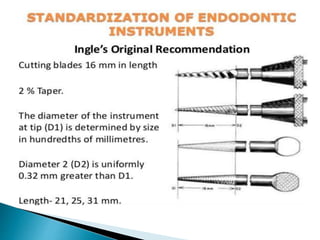
 Ingle and LeVine, were the first to suggest a
definite increment in diameter as the size
progressed while maintaining a constant
taper of all blades regardless of size.
 Instrument must be numbered from 10-100.
 Number to advance by 5 from 10-60 and then by 10 from
60-100.
 In a revised number, 6,8,110,120,130 and 140 is added.
 Each number shall be representative of diameter of
instrument in hundredths of milimeter at the tip.
 Working Blade shall begin at tip, designated as D0 and
shall extend exactly 16 mm shaft terminating, designated
as D16.
 D16 diameter shall be 0.32 mm greater than D0.
 Tip angle shall be 60-100 degree.
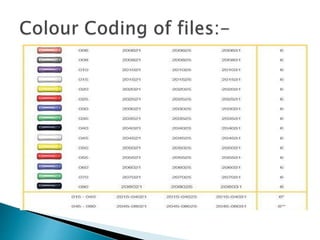
 Instrument handle are colour codedfor easier recognition.
 K-type files
 K-flex files
 Flex-R files
 Hedstroem/H-files
 Safety H files
 Hyflex file
 Unifiles
 S-files
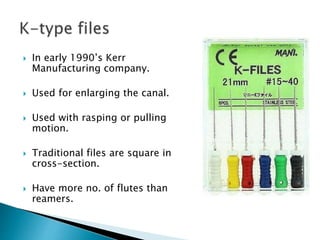
 In early 1990’s Kerr
Manufacturing company.
 Used for enlarging the canal.
 Used with rasping or pulling
motion.
 Traditional files are square in
cross-section.
 Have more no. of flutes than
reamers.
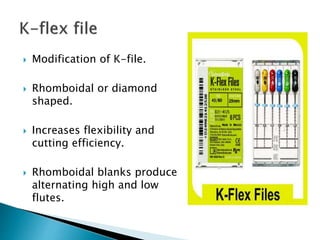
 Modification of K-file.
 Rhomboidal or diamond
shaped.
 Increases flexibility and
cutting efficiency.
 Rhomboidal blanks produce
alternating high and low
flutes.
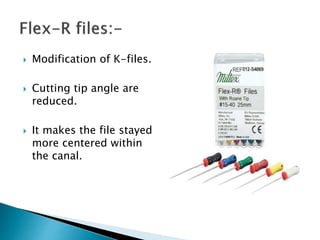
 Modification of K-files.
 Cutting tip angle are
reduced.
 It makes the file stayed
more centered within
the canal.
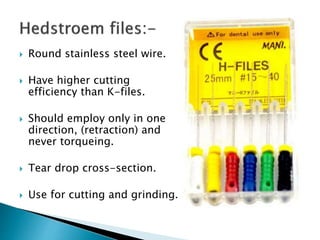
 Round stainless steel wire.
 Have higher cutting
efficiency than K-files.
 Should employ only in one
direction, (retraction) and
never torqueing.
 Tear drop cross-section.
 Use for cutting and grinding.
 Cross section represent ‘s’
shaped
 modification of H files.
 With non cutting side.
 Protect form ledging.
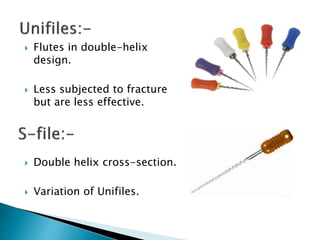
 Double helix cross-section.
 Variation of Unifiles.
 Flutes in double-helix
design.
 Less subjected to fracture
but are less effective.
 Grossman’s Endodontic Practice
 Textbook of endodontics by Nisha
Garg
Endodontic files

Endodontic files

  • 1.
    SUBMITTED BY:- RUHANI DAULTANI BDSTHIRD YEAR (2017-18 BATCH) GUIDED BY:- Dr. Bharat Bhusan Dr. Khushboo Barjatya Dr. Preene Juneja Dr. Binti Chand Dr. Abhilasha M. Tripathi Dr. Hariom Meena
  • 2.
     Introduction  Standardizationof endodontic file  Colour Coding of files  Classification  Hand operated files  Conclusion
  • 3.
     Endodontic handfiles are manually operated instrument used for cleaning and shaping of root canal therapy or any other endodontic procedures.  Ingle and LeVine, were the first to suggest a definite increment in diameter as the size progressed while maintaining a constant taper of all blades regardless of size.
  • 4.
     Instrument mustbe numbered from 10-100.  Number to advance by 5 from 10-60 and then by 10 from 60-100.  In a revised number, 6,8,110,120,130 and 140 is added.  Each number shall be representative of diameter of instrument in hundredths of milimeter at the tip.  Working Blade shall begin at tip, designated as D0 and shall extend exactly 16 mm shaft terminating, designated as D16.  D16 diameter shall be 0.32 mm greater than D0.  Tip angle shall be 60-100 degree.  Instrument handle are colour codedfor easier recognition.
  • 7.
     K-type files K-flex files  Flex-R files  Hedstroem/H-files  Safety H files  Hyflex file  Unifiles  S-files
  • 8.
     In early1990’s Kerr Manufacturing company.  Used for enlarging the canal.  Used with rasping or pulling motion.  Traditional files are square in cross-section.  Have more no. of flutes than reamers.
  • 9.
     Modification ofK-file.  Rhomboidal or diamond shaped.  Increases flexibility and cutting efficiency.  Rhomboidal blanks produce alternating high and low flutes.
  • 10.
     Modification ofK-files.  Cutting tip angle are reduced.  It makes the file stayed more centered within the canal.
  • 11.
     Round stainlesssteel wire.  Have higher cutting efficiency than K-files.  Should employ only in one direction, (retraction) and never torqueing.  Tear drop cross-section.  Use for cutting and grinding.
  • 12.
     Cross sectionrepresent ‘s’ shaped  modification of H files.  With non cutting side.  Protect form ledging.
  • 13.
     Double helixcross-section.  Variation of Unifiles.  Flutes in double-helix design.  Less subjected to fracture but are less effective.
  • 14.
     Grossman’s EndodonticPractice  Textbook of endodontics by Nisha Garg