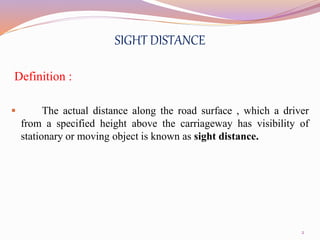
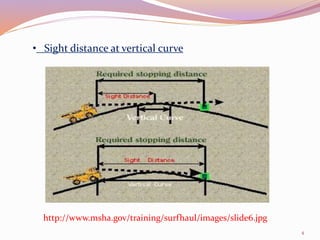
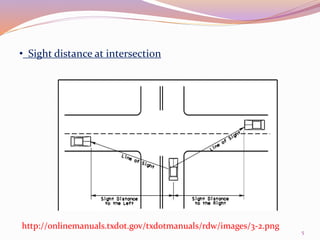
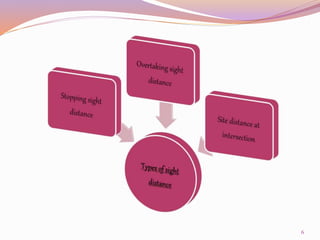
1) Sight distance refers to the distance a driver can see along the roadway to detect stationary or moving objects. Restrictions to sight distance can occur at horizontal and vertical curves as well as intersections.
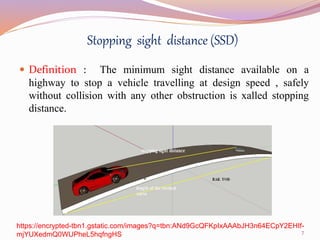
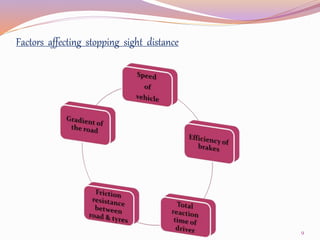
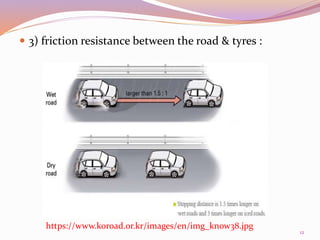
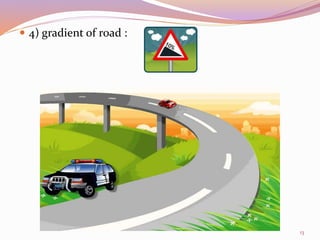
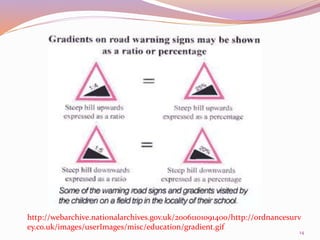
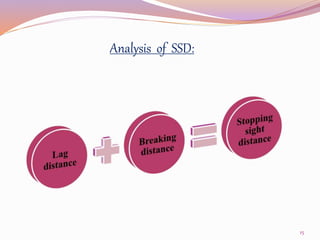
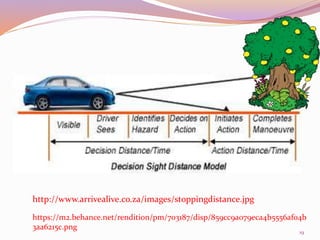
2) Stopping sight distance is the minimum sight distance needed for a vehicle traveling at the design speed to stop safely without colliding with an obstruction. It is affected by the vehicle's speed, the driver's total reaction time, road friction, and gradient.
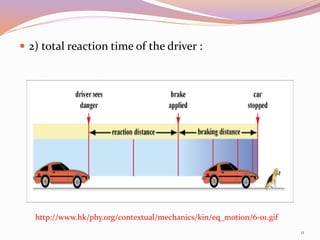
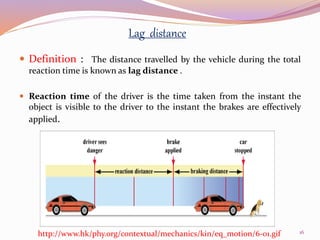
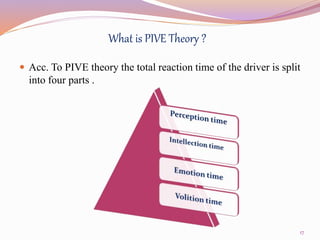
3) The PIVE theory splits a driver's total reaction time into four parts: perception time, intellection time, emotion time, and volition time - the time taken between recognizing an obstacle and applying the brakes. Lag distance

![3) Emotion time :
it is time elapsed during emotional sensations & Disturbance
such as fear , anger ,etc. with reference to the situation .
4) Volition time :
volition time is the time taken for the final action.
20
Lag distance = v * t
Where, v = speed of vehicle in m/s
t = total reaction time (s) [ as per IRC t = 2.5 s ]](https://image.slidesharecdn.com/he-160711103015/85/Highway-engg-20-320.jpg)