Welcome


B a s ic A e r o d y n a m ic s
  a n d F lig h t C o n t r o ls


                                   1
Learning Objectives
At the end of this course, you will be able to…
   v Explain the four basic aerodynamic forces that
     act on aircraft
   v Understand how these forces relate to and
     interact with each other
   v Identify common flight controls on aircraft
   v Explain the affect that each control has on the
     flight of an aircraft
   v Identify hybrid flight controls of advanced
     aircraft


                                                       2
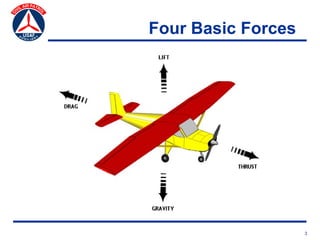
Four Basic Forces


                    3
Four Basic Forces
                                        Lift
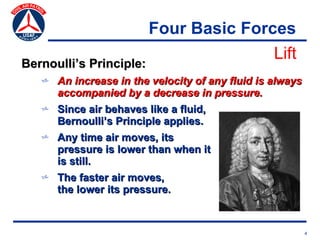
Bernoulli’s Principle:
   v An increase in the velocity of any fluid is always
     accompanied by a decrease in pressure.
   v Since air behaves like a fluid,
     Bernoulli’s Principle applies.
   v Any time air moves, its
     pressure is lower than when it
     is still.
   v The faster air moves,
     the lower its pressure.


                                                          4
Four Basic Forces
                                    Lift
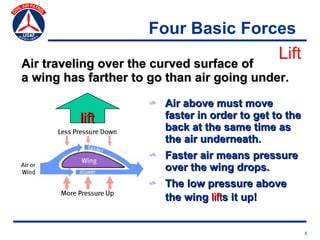
Air traveling over the curved surface of
a wing has farther to go than air going under.
                     v Air above must move
          lift         faster in order to get to the
                       back at the same time as
                       the air underneath.
                     v Faster air means pressure
                       over the wing drops.
                     v The low pressure above
                       the wing lifts it up!


                                                       5
Four Basic Forces
                                 GRAVITY
Gravity / Weight:

   v All objects have mass, but the weight of an
     object is the result of the force of gravity acting
     on the mass.
   v Since the force applied to the aircraft is the
     same, gravity and weight are equivalent for our
     purposes.


                                                           6
Four Basic Forces
                                GRAVITY
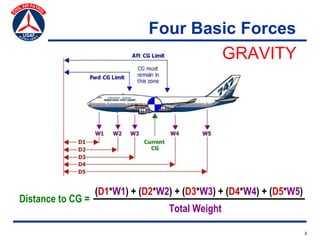
Center of Gravity:
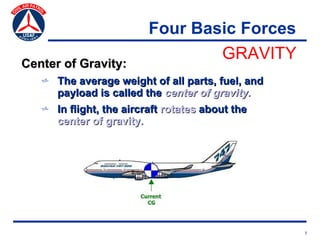
   v The average weight of all parts, fuel, and
     payload is called the center of gravity.
   v In flight, the aircraft rotates about the
     center of gravity.


                                                  7
Four Basic Forces
                                       GRAVITY


                   (D1*W1) + (D2*W2) + (D3*W3) + (D4*W4) + (D5*W5)
Distance to CG =
                                   Total Weight

                                                                     8
Four Basic Forces
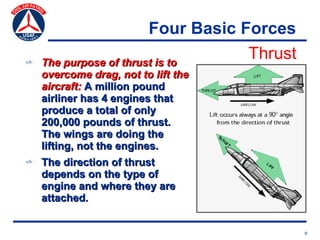
v   The purpose of thrust is to
                                    Thrust
  overcome drag, not to lift the
  aircraft: A million pound
  airliner has 4 engines that
  produce a total of only
  200,000 pounds of thrust.
  The wings are doing the
  lifting, not the engines.
v The direction of thrust
  depends on the type of
  engine and where they are
  attached.


                                             9
Four Basic Forces
                                     drag
Definition of Drag:
   v Drag is a mechanical force generated by a solid
     object moving through a liquid.
   v It results from the difference in velocity between
     the object and the fluid.
   v It can be considered to be aerodynamic friction
     that opposes the movement of the aircraft.
   v In layman’s terms it is often known as wind
     resistance.


                                                       10
Four Basic Forces
                                       drag
Types of Drag:
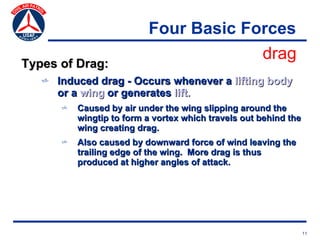
   v Induced drag - Occurs whenever a lifting body
     or a wing or generates lift.
      v   Caused by air under the wing slipping around the
          wingtip to form a vortex which travels out behind the
          wing creating drag.
      v   Also caused by downward force of wind leaving the
          trailing edge of the wing. More drag is thus
          produced at higher angles of attack.


                                                                  11
Four Basic Forces
                                        drag
Types of Drag:
   v Parasitic drag
      v Results from the aircraft pushing air out of the way
        (form drag).
      v Also caused by the friction of air against the actual
        surface of the aircraft (skin friction).
      v Air vortices caused by some surfaces or structures
        on the plane can also cause interference drag.


                                                                12
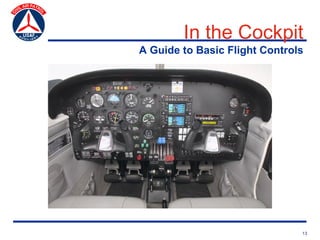
In the Cockpit
A Guide to Basic Flight Controls


                               13
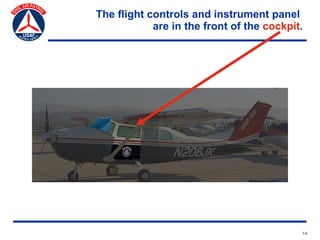
The flight controls and instrument panel
            are in the front of the cockpit.


                                           14
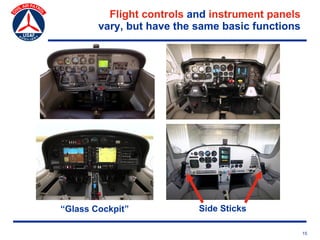
Flight controls and instrument panels
        vary, but have the same basic functions


“Glass Cockpit”            Side Sticks

                                                  15
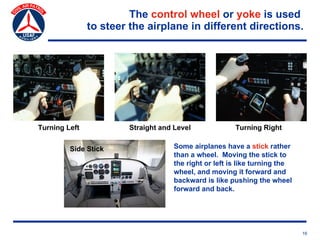
The control wheel or yoke is used
               to steer the airplane in different directions.


Turning Left           Straight and Level              Turning Right


         Side Stick                 Some airplanes have a stick rather
                                    than a wheel. Moving the stick to
                                    the right or left is like turning the
                                    wheel, and moving it forward and
                                    backward is like pushing the wheel
                                    forward and back.


                                                                            16
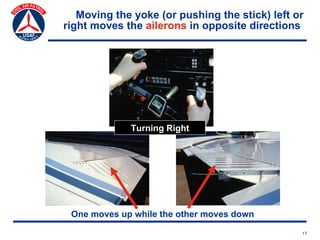
Moving the yoke (or pushing the stick) left or
right moves the ailerons in opposite directions


             Turning Right


 One moves up while the other moves down

                                                17
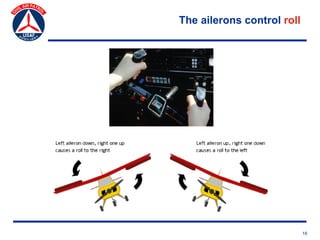
The ailerons control roll


                            18
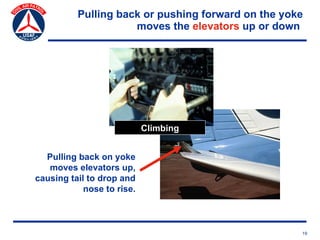
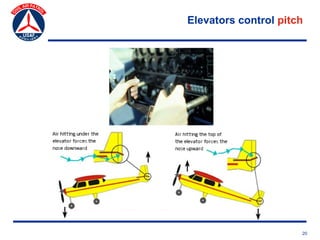
Pulling back or pushing forward on the yoke
                     moves the elevators up or down


                            Climbing


  Pulling back on yoke
   moves elevators up,
causing tail to drop and
            nose to rise.


                                                    19
Elevators control pitch


                      20
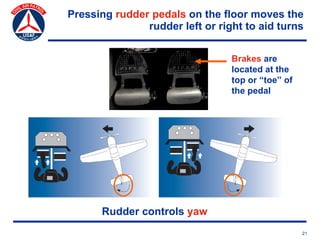
Pressing rudder pedals on the floor moves the
               rudder left or right to aid turns


                                 Brakes are
                                 located at the
                                 top or “toe” of
                                 the pedal


      Rudder controls yaw
                                                   21
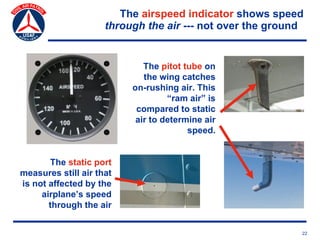
The airspeed indicator shows speed
                     through the air --- not over the ground


                             The pitot tube on
                             the wing catches
                          on-rushing air. This
                                   “ram air” is
                           compared to static
                           air to determine air
                                        speed.


       The static port
measures still air that
is not affected by the
     airplane’s speed
       through the air


                                                           22
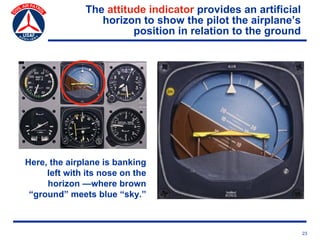
The attitude indicator provides an artificial
                 horizon to show the pilot the airplane’s
                        position in relation to the ground


Here, the airplane is banking
     left with its nose on the
     horizon —where brown
 “ground” meets blue “sky.”


                                                              23
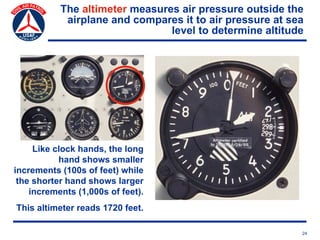
The altimeter measures air pressure outside the
            airplane and compares it to air pressure at sea
                                level to determine altitude


     Like clock hands, the long
           hand shows smaller
increments (100s of feet) while
 the shorter hand shows larger
    increments (1,000s of feet).
This altimeter reads 1720 feet.

                                                          24
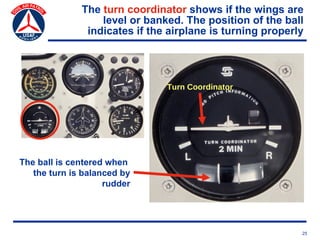
The turn coordinator shows if the wings are
                  level or banked. The position of the ball
               indicates if the airplane is turning properly


                               Turn Coordinator


The ball is centered when
   the turn is balanced by
                    rudder


                                                           25
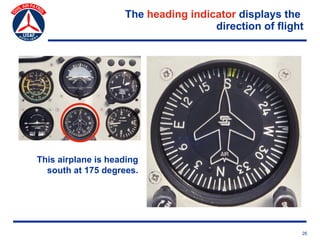
The heading indicator displays the
                                     direction of flight


This airplane is heading
  south at 175 degrees.


                                                       26
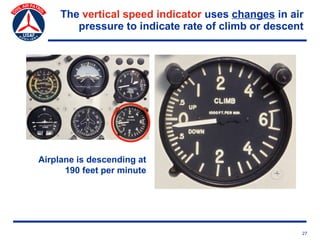
The vertical speed indicator uses changes in air
        pressure to indicate rate of climb or descent


Airplane is descending at
      190 feet per minute


                                                    27
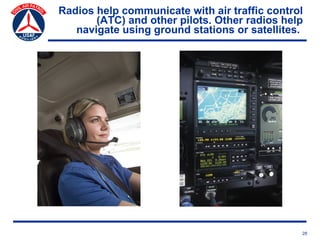
Radios help communicate with air traffic control
       (ATC) and other pilots. Other radios help
   navigate using ground stations or satellites.


                                               28
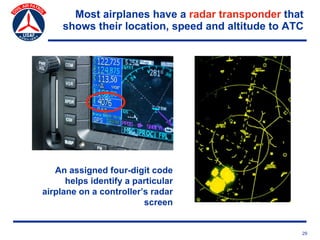
Most airplanes have a radar transponder that
     shows their location, speed and altitude to ATC


   An assigned four-digit code
      helps identify a particular
airplane on a controller’s radar
                         screen


                                                   29
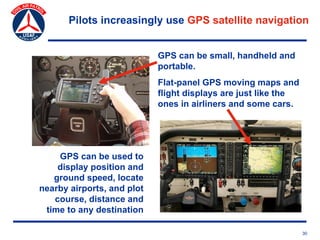
Pilots increasingly use GPS satellite navigation


                            GPS can be small, handheld and
                            portable.
                            Flat-panel GPS moving maps and
                            flight displays are just like the
                            ones in airliners and some cars.


    GPS can be used to
    display position and
   ground speed, locate
nearby airports, and plot
   course, distance and
 time to any destination

                                                                30

Basic Aerodynamics and Flight Controls

  • 1.
    Welcome B a sic A e r o d y n a m ic s a n d F lig h t C o n t r o ls 1
  • 2.
    Learning Objectives At theend of this course, you will be able to… v Explain the four basic aerodynamic forces that act on aircraft v Understand how these forces relate to and interact with each other v Identify common flight controls on aircraft v Explain the affect that each control has on the flight of an aircraft v Identify hybrid flight controls of advanced aircraft 2
  • 3.
  • 4.
    Four Basic Forces Lift Bernoulli’s Principle: v An increase in the velocity of any fluid is always accompanied by a decrease in pressure. v Since air behaves like a fluid, Bernoulli’s Principle applies. v Any time air moves, its pressure is lower than when it is still. v The faster air moves, the lower its pressure. 4
  • 5.
    Four Basic Forces Lift Air traveling over the curved surface of a wing has farther to go than air going under. v Air above must move lift faster in order to get to the back at the same time as the air underneath. v Faster air means pressure over the wing drops. v The low pressure above the wing lifts it up! 5
  • 6.
    Four Basic Forces GRAVITY Gravity / Weight: v All objects have mass, but the weight of an object is the result of the force of gravity acting on the mass. v Since the force applied to the aircraft is the same, gravity and weight are equivalent for our purposes. 6
  • 7.
    Four Basic Forces GRAVITY Center of Gravity: v The average weight of all parts, fuel, and payload is called the center of gravity. v In flight, the aircraft rotates about the center of gravity. 7
  • 8.
    Four Basic Forces GRAVITY (D1*W1) + (D2*W2) + (D3*W3) + (D4*W4) + (D5*W5) Distance to CG = Total Weight 8
  • 9.
    Four Basic Forces v The purpose of thrust is to Thrust overcome drag, not to lift the aircraft: A million pound airliner has 4 engines that produce a total of only 200,000 pounds of thrust. The wings are doing the lifting, not the engines. v The direction of thrust depends on the type of engine and where they are attached. 9
  • 10.
    Four Basic Forces drag Definition of Drag: v Drag is a mechanical force generated by a solid object moving through a liquid. v It results from the difference in velocity between the object and the fluid. v It can be considered to be aerodynamic friction that opposes the movement of the aircraft. v In layman’s terms it is often known as wind resistance. 10
  • 11.
    Four Basic Forces drag Types of Drag: v Induced drag - Occurs whenever a lifting body or a wing or generates lift. v Caused by air under the wing slipping around the wingtip to form a vortex which travels out behind the wing creating drag. v Also caused by downward force of wind leaving the trailing edge of the wing. More drag is thus produced at higher angles of attack. 11
  • 12.
    Four Basic Forces drag Types of Drag: v Parasitic drag v Results from the aircraft pushing air out of the way (form drag). v Also caused by the friction of air against the actual surface of the aircraft (skin friction). v Air vortices caused by some surfaces or structures on the plane can also cause interference drag. 12
  • 13.
    In the Cockpit AGuide to Basic Flight Controls 13
  • 14.
    The flight controlsand instrument panel are in the front of the cockpit. 14
  • 15.
    Flight controls andinstrument panels vary, but have the same basic functions “Glass Cockpit” Side Sticks 15
  • 16.
    The control wheelor yoke is used to steer the airplane in different directions. Turning Left Straight and Level Turning Right Side Stick Some airplanes have a stick rather than a wheel. Moving the stick to the right or left is like turning the wheel, and moving it forward and backward is like pushing the wheel forward and back. 16
  • 17.
    Moving the yoke(or pushing the stick) left or right moves the ailerons in opposite directions Turning Right One moves up while the other moves down 17
  • 18.
  • 19.
    Pulling back orpushing forward on the yoke moves the elevators up or down Climbing Pulling back on yoke moves elevators up, causing tail to drop and nose to rise. 19
  • 20.
  • 21.
    Pressing rudder pedalson the floor moves the rudder left or right to aid turns Brakes are located at the top or “toe” of the pedal Rudder controls yaw 21
  • 22.
    The airspeed indicatorshows speed through the air --- not over the ground The pitot tube on the wing catches on-rushing air. This “ram air” is compared to static air to determine air speed. The static port measures still air that is not affected by the airplane’s speed through the air 22
  • 23.
    The attitude indicatorprovides an artificial horizon to show the pilot the airplane’s position in relation to the ground Here, the airplane is banking left with its nose on the horizon —where brown “ground” meets blue “sky.” 23
  • 24.
    The altimeter measuresair pressure outside the airplane and compares it to air pressure at sea level to determine altitude Like clock hands, the long hand shows smaller increments (100s of feet) while the shorter hand shows larger increments (1,000s of feet). This altimeter reads 1720 feet. 24
  • 25.
    The turn coordinatorshows if the wings are level or banked. The position of the ball indicates if the airplane is turning properly Turn Coordinator The ball is centered when the turn is balanced by rudder 25
  • 26.
    The heading indicatordisplays the direction of flight This airplane is heading south at 175 degrees. 26
  • 27.
    The vertical speedindicator uses changes in air pressure to indicate rate of climb or descent Airplane is descending at 190 feet per minute 27
  • 28.
    Radios help communicatewith air traffic control (ATC) and other pilots. Other radios help navigate using ground stations or satellites. 28
  • 29.
    Most airplanes havea radar transponder that shows their location, speed and altitude to ATC An assigned four-digit code helps identify a particular airplane on a controller’s radar screen 29
  • 30.
    Pilots increasingly useGPS satellite navigation GPS can be small, handheld and portable. Flat-panel GPS moving maps and flight displays are just like the ones in airliners and some cars. GPS can be used to display position and ground speed, locate nearby airports, and plot course, distance and time to any destination 30