K.KAVIYA(14BIT008)
SUBMITTED TO:
Ms.R.MADHUBALA, MCA.,
This file system can be viewed logically
consist of following parts:
 Disk structure
 Disk scheduling
 Disk Management
 Swap-space Management
 Disk provide the bulk of secondary storage
 Magnetic tape was used an early secondary storage
medium
 Modern disk drives are addressed as large one-
dimensional arrays of logical blocks
 The logical blocks is the smallest unit of tranfer.
 The one-dimensional array of logical blocks is
mapped onto the sectors of the disk sequentially.
 It is difficult to perform two reasons
 Most disks have some defective sectors.
 The number of sectors per track is not a
constant on some drives.
 The disk drives has fast access time and disk bandwidth
 The access time has two major components.
 Seek time
 Rotational latency
 The disk bandwidth is the total number of byes
transferred, divided by the total time between the
first request for service and the completion of the last
transfer.
 The request specifies several pieces of information
I. Whether this operation is input or output
II. What the disk address for the transfer is
III. What the memory address for the transfer is
IV. What the number of bytes to the transferred is
The simplest form of disk scheduling is the first
come, first-served(FCFS) algorithm.
The algorithm does not provide the fastest
services.
SSTF Scheduling
 It seems reasonable to service all the requests
close to the current head position, before
moving the head far away to service.
 The assumption is the basis for the shortest-
seek-time-first algorithm
 The SSTF algorithm selects the request with
the minimum seek time from the current head
position
 In the scan algorithm the disk arm starts at one
end of the disk, and moves toward the other end.
 The direction of head movement is reversed, and
servicing continues.
 The scan algorithm is sometimes called the
elevator algorithm
C- SCAN scheduling
 Circular scan scheduling is a variant of SCAN designed
to provide a more wait time
 The C-SCAN scheduling algorithm treats the cylinders
as a circular list that wraps around from the final cylinder
to the first one.
• The scheduling algorithms described the seek
distances for modern disks, the rotational latency
Can be nearly as large as the average seek time.
• But it is difficult for the operating system to
scheduled for improved rotational latency because
modern disks do not disclose the physical location of
logical blocks.
Disk Formatting
• A new magnetic disk is a blank slate.
• It must be divided into sectors that the disk controller
can read and write. This process is called Low level
formatting
• A sector number and an error-correcting code.
• The operating system still needs to record its own data
structures.
• In two steps
• The first step is two partition the disk into one or more
groups of cylinders
• The second step is logical formatting.
• In this step the operating system stores the initial file
system data structures into the disk
 The bootstrap is stored in read only memory
 The full bootstrap program is stored in a partition
called the boot blocks, at a fixed location on the
disk.
 A disk that has a boot partition is called a boot
disk or system disk.
Bad blocks
 Most frequently, one or more sectors become defective.
 Most disks even come form the factory with bad blocks
 This scheme is known as sector sparing or forwarding
Swap-space management is another low-level task of the
operating system
The main goal for the design and implementation of swap
space is to provide the best throughput for the
Virtual memory system
Swap-space use
Swap space is used in various ways by different operating systems,
depending on the implemented memory-management
Algorithms.
Swap-space Location
 A swap space can reside in two places.
 Swap space can be carved out of the normal file system or it can be
in a seperated disk partition.
 Windows 2000 Operating system is a 32-bit
preemptive multitasking operating system for Intel
pentium and later microprocessor.
 In 1980 Microsoft and IBM cooperated to develop
the OS/2 operating system in single processor Intel
80286
 Microsoft developed a portable operating system
that supported both the application system.
 There are four versions of windows 2000
 The professional version intended for desktop use.
 The other three are server version datacenter
version.
 The design goals that Micros0ft has stated for
windows 2000 include Extensibility, portability,
compatibility, performance.
 Extensibility refers to the capacity of the operating
system to keep up advances in computing technology
 Windows 2000 uses a client-server model.
 Mach operating system and supports multiple
processing by remoter procedure call(RPC).
 An operating system is portable and it can be
moved from one hardware architecture to another.
 The architecture of windows 2000 is a layered
system of modules.
 The user-mode subsystems are in two categories
environment subsystems emulate different operating
systems;the subsystems provide security functions.
 One of the chief advantages of the architecture is
the intreactions between modules can be kept simple
remainder of this section describes these layers and
subsytems.
 HAL is the layer of software that hides hardware
differences from the operating system,virtual-machine
interface that is used by the kernel,the exculive and
device drivers.
 One advantage of this approach is that only a single
of each device driver is needed-it can run on all
hardware flatform will porting the driver code.
 The kernal of windows 2000 provides the fundation
for the executive and subsystems.
 kernal uses to sets of objects. The first set
comparises the dispatcher.
 Dispatcher objects control dispatching and
synchoronous the event object is used to record an
event occurances.
 Synchronize the later with some action A semaphore
objects acts as a counter or gate to control the number
that access some resource.
 The thread object is the entity that is run kernal and
is associated with a process object.
 Timer objects are used to keep track of the time
and
and to signal time outs when operations and need to
be interrupted
 The second set of kernal objects comparises the
control objects.
 The power states object to check whether the
power
a process object represents the virtual address
space and control.
 The system uses the profile object to measure the
amount of time used by a amount of code
 Windows 2000 uses the process and threads for
executable code .
 Each process has one or more threads. Each thread
has its own state.
 It includes a priority, processor, affinity, and
accounting information.
 The six possible thread states or ready, stand by ,
running, waiting, and terminated.
 Ready means waiting to run.
 The highest priority thread is moved to the standby
state.
 A thread is running when it is executing on a
processor
 A thread is in the waiting state when it is waiting for
a signal
 A new thread is in the transition state while it is
waiting resourcs necessary for execlution
 A thread enters the terminated state finishes
execution
 Kernal also provides trap handling for exceptions
and interrupts that are used by hardware or software
 windows 2000 defines several architecture
exceptions including memory-access violation integer
overflow or underflow, integer divide by zero, floating-
point by zero , illegal instruction , data misalignment,
privileged instruction, read error , guard-page,
violation, paging files, quote exceeded, debugger, point
and debugger, single step.
 The exeption dispatcher creates and exception that
contains the reason for the exception and finds an
exception handler deal with it.
 The kernal uses an interrupted dispatch table to
bind each interrupt that a service routine
 Windows 2000 takes advantage of this property to
software interrupts to perform system functions
 kernal uses the dispatch interrupt to control thread
context switching to the kernal is running.
 It queues a deferred procedure call(DPC) that
contains the address of the function to be executed
and generates interrupt.
 They cannot modify its memory: create, acquire, or
wait on objects, call system services or page faults.
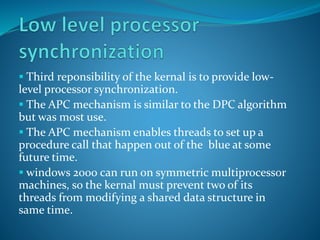
 Third reponsibility of the kernal is to provide low-
level processor synchronization.
 The APC mechanism is similar to the DPC algorithm
but was most use.
 The APC mechanism enables threads to set up a
procedure call that happen out of the blue at some
future time.
 windows 2000 can run on symmetric multiprocessor
machines, so the kernal must prevent two of its
threads from modifying a shared data structure in
same time.
 The fourth and final responsibility of the kernal is
to provide recovery after a failure
 A power fail interrupt which has the second-highest
priority notifies the operating system whenever a
power loss is detected.
 The power notify object provides a way for a device
driver to register a routine that is call on power
restoration and ensures that devices get set to the
proper and recovery
 Object manager
 Virtual- Memory Manager
 process manager
 Local-procedure-call facility
 I/O manager
 Security reference monitor
 Plug-and-play manager
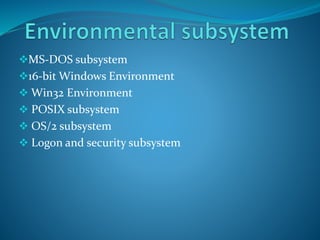
MS-DOS subsystem
16-bit Windows Environment
 Win32 Environment
 POSIX subsystem
 OS/2 subsystem
 Logon and security subsystem
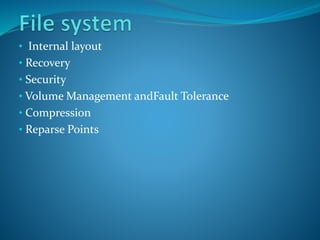
• Internal layout
• Recovery
• Security
• Volume Management andFault Tolerance
• Compression
• Reparse Points
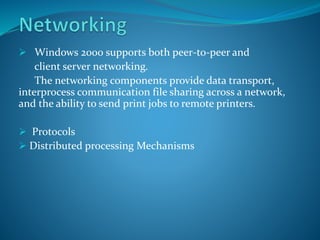
 Windows 2000 supports both peer-to-peer and
client server networking.
The networking components provide data transport,
interprocess communication file sharing across a network,
and the ability to send print jobs to remote printers.
 Protocols
 Distributed processing Mechanisms

Operating system ppt

  • 1.
  • 2.
    This file systemcan be viewed logically consist of following parts:  Disk structure  Disk scheduling  Disk Management  Swap-space Management
  • 3.
     Disk providethe bulk of secondary storage  Magnetic tape was used an early secondary storage medium  Modern disk drives are addressed as large one- dimensional arrays of logical blocks  The logical blocks is the smallest unit of tranfer.  The one-dimensional array of logical blocks is mapped onto the sectors of the disk sequentially.  It is difficult to perform two reasons  Most disks have some defective sectors.  The number of sectors per track is not a constant on some drives.
  • 4.
     The diskdrives has fast access time and disk bandwidth  The access time has two major components.  Seek time  Rotational latency  The disk bandwidth is the total number of byes transferred, divided by the total time between the first request for service and the completion of the last transfer.  The request specifies several pieces of information I. Whether this operation is input or output II. What the disk address for the transfer is III. What the memory address for the transfer is IV. What the number of bytes to the transferred is
  • 5.
    The simplest formof disk scheduling is the first come, first-served(FCFS) algorithm. The algorithm does not provide the fastest services. SSTF Scheduling  It seems reasonable to service all the requests close to the current head position, before moving the head far away to service.  The assumption is the basis for the shortest- seek-time-first algorithm  The SSTF algorithm selects the request with the minimum seek time from the current head position
  • 6.
     In thescan algorithm the disk arm starts at one end of the disk, and moves toward the other end.  The direction of head movement is reversed, and servicing continues.  The scan algorithm is sometimes called the elevator algorithm C- SCAN scheduling  Circular scan scheduling is a variant of SCAN designed to provide a more wait time  The C-SCAN scheduling algorithm treats the cylinders as a circular list that wraps around from the final cylinder to the first one.
  • 7.
    • The schedulingalgorithms described the seek distances for modern disks, the rotational latency Can be nearly as large as the average seek time. • But it is difficult for the operating system to scheduled for improved rotational latency because modern disks do not disclose the physical location of logical blocks.
  • 8.
    Disk Formatting • Anew magnetic disk is a blank slate. • It must be divided into sectors that the disk controller can read and write. This process is called Low level formatting • A sector number and an error-correcting code. • The operating system still needs to record its own data structures. • In two steps • The first step is two partition the disk into one or more groups of cylinders • The second step is logical formatting. • In this step the operating system stores the initial file system data structures into the disk
  • 9.
     The bootstrapis stored in read only memory  The full bootstrap program is stored in a partition called the boot blocks, at a fixed location on the disk.  A disk that has a boot partition is called a boot disk or system disk. Bad blocks  Most frequently, one or more sectors become defective.  Most disks even come form the factory with bad blocks  This scheme is known as sector sparing or forwarding
  • 10.
    Swap-space management isanother low-level task of the operating system The main goal for the design and implementation of swap space is to provide the best throughput for the Virtual memory system Swap-space use Swap space is used in various ways by different operating systems, depending on the implemented memory-management Algorithms. Swap-space Location  A swap space can reside in two places.  Swap space can be carved out of the normal file system or it can be in a seperated disk partition.
  • 12.
     Windows 2000Operating system is a 32-bit preemptive multitasking operating system for Intel pentium and later microprocessor.  In 1980 Microsoft and IBM cooperated to develop the OS/2 operating system in single processor Intel 80286  Microsoft developed a portable operating system that supported both the application system.  There are four versions of windows 2000  The professional version intended for desktop use.  The other three are server version datacenter version.
  • 13.
     The designgoals that Micros0ft has stated for windows 2000 include Extensibility, portability, compatibility, performance.  Extensibility refers to the capacity of the operating system to keep up advances in computing technology  Windows 2000 uses a client-server model.  Mach operating system and supports multiple processing by remoter procedure call(RPC).  An operating system is portable and it can be moved from one hardware architecture to another.
  • 14.
     The architectureof windows 2000 is a layered system of modules.  The user-mode subsystems are in two categories environment subsystems emulate different operating systems;the subsystems provide security functions.  One of the chief advantages of the architecture is the intreactions between modules can be kept simple remainder of this section describes these layers and subsytems.
  • 15.
     HAL isthe layer of software that hides hardware differences from the operating system,virtual-machine interface that is used by the kernel,the exculive and device drivers.  One advantage of this approach is that only a single of each device driver is needed-it can run on all hardware flatform will porting the driver code.
  • 16.
     The kernalof windows 2000 provides the fundation for the executive and subsystems.  kernal uses to sets of objects. The first set comparises the dispatcher.  Dispatcher objects control dispatching and synchoronous the event object is used to record an event occurances.  Synchronize the later with some action A semaphore objects acts as a counter or gate to control the number that access some resource.  The thread object is the entity that is run kernal and is associated with a process object.
  • 17.
     Timer objectsare used to keep track of the time and and to signal time outs when operations and need to be interrupted  The second set of kernal objects comparises the control objects.  The power states object to check whether the power a process object represents the virtual address space and control.  The system uses the profile object to measure the amount of time used by a amount of code
  • 18.
     Windows 2000uses the process and threads for executable code .  Each process has one or more threads. Each thread has its own state.  It includes a priority, processor, affinity, and accounting information.  The six possible thread states or ready, stand by , running, waiting, and terminated.
  • 19.
     Ready meanswaiting to run.  The highest priority thread is moved to the standby state.  A thread is running when it is executing on a processor  A thread is in the waiting state when it is waiting for a signal  A new thread is in the transition state while it is waiting resourcs necessary for execlution  A thread enters the terminated state finishes execution
  • 20.
     Kernal alsoprovides trap handling for exceptions and interrupts that are used by hardware or software  windows 2000 defines several architecture exceptions including memory-access violation integer overflow or underflow, integer divide by zero, floating- point by zero , illegal instruction , data misalignment, privileged instruction, read error , guard-page, violation, paging files, quote exceeded, debugger, point and debugger, single step.  The exeption dispatcher creates and exception that contains the reason for the exception and finds an exception handler deal with it.
  • 21.
     The kernaluses an interrupted dispatch table to bind each interrupt that a service routine  Windows 2000 takes advantage of this property to software interrupts to perform system functions  kernal uses the dispatch interrupt to control thread context switching to the kernal is running.  It queues a deferred procedure call(DPC) that contains the address of the function to be executed and generates interrupt.  They cannot modify its memory: create, acquire, or wait on objects, call system services or page faults.
  • 22.
     Third reponsibilityof the kernal is to provide low- level processor synchronization.  The APC mechanism is similar to the DPC algorithm but was most use.  The APC mechanism enables threads to set up a procedure call that happen out of the blue at some future time.  windows 2000 can run on symmetric multiprocessor machines, so the kernal must prevent two of its threads from modifying a shared data structure in same time.
  • 23.
     The fourthand final responsibility of the kernal is to provide recovery after a failure  A power fail interrupt which has the second-highest priority notifies the operating system whenever a power loss is detected.  The power notify object provides a way for a device driver to register a routine that is call on power restoration and ensures that devices get set to the proper and recovery
  • 24.
     Object manager Virtual- Memory Manager  process manager  Local-procedure-call facility  I/O manager  Security reference monitor  Plug-and-play manager
  • 25.
    MS-DOS subsystem 16-bit WindowsEnvironment  Win32 Environment  POSIX subsystem  OS/2 subsystem  Logon and security subsystem
  • 26.
    • Internal layout •Recovery • Security • Volume Management andFault Tolerance • Compression • Reparse Points
  • 27.
     Windows 2000supports both peer-to-peer and client server networking. The networking components provide data transport, interprocess communication file sharing across a network, and the ability to send print jobs to remote printers.  Protocols  Distributed processing Mechanisms