Requirements
Engineering:
Business Case Analysis	
CECS 542
Dr.	Birgit	Penzenstadler	 1	
Photo	credit:	Joshua	Earle,	Unsplash
Business	Case	Analysis	
•  Why?	
•  What	is	a	business	case?	
•  How	do	I	write	one?	
•  What	are	the	elements?	
•  What	tools	are	available?	
Dr.	Birgit	Penzenstadler	 2
Business	Case	Analysis:	Why?	
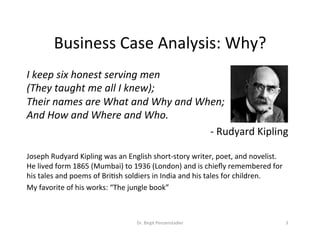
I	keep	six	honest	serving	men	
(They	taught	me	all	I	knew);	
Their	names	are	What	and	Why	and	When;	
And	How	and	Where	and	Who.		
-	Rudyard	Kipling	
	
Joseph	Rudyard	Kipling	was	an	English	short-story	writer,	poet,	and	novelist.		
He	lived	form	1865	(Mumbai)	to	1936	(London)	and	is	chiefly	remembered	for	
his	tales	and	poems	of	BriVsh	soldiers	in	India	and	his	tales	for	children.	
My	favorite	of	his	works:	“The	jungle	book”	
Dr.	Birgit	Penzenstadler	 3
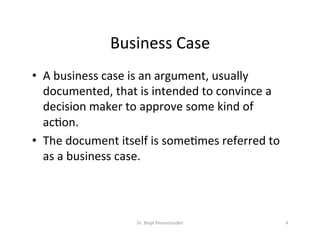
Business	Case	
•  A	business	case	is	an	argument,	usually	
documented,	that	is	intended	to	convince	a	
decision	maker	to	approve	some	kind	of	
acVon.		
•  The	document	itself	is	someVmes	referred	to	
as	a	business	case.	
Dr.	Birgit	Penzenstadler	 4
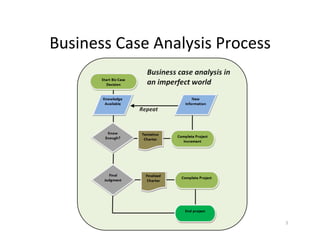
Business	Case	Analysis	Process	
Dr.	Birgit	Penzenstadler	 5
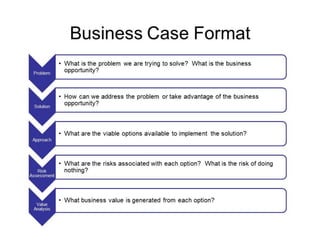
Simple	template	
Cephei,	12.12.2012	 Dr.	Birgit	Penzenstadler	 6
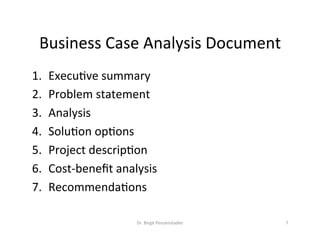
Business	Case	Analysis	Document	
1.  ExecuVve	summary	
2.  Problem	statement	
3.  Analysis	
4.  SoluVon	opVons	
5.  Project	descripVon	
6.  Cost-benefit	analysis	
7.  RecommendaVons		
Dr.	Birgit	Penzenstadler	 7
Business	Case:	1.	ExecuVve	summary	
•  High-level	view	of	the	business	case	document	
•  Representa@on:	Condensed	form	and	plain	language	
•  Content:	the	problem	that	the	proposed	project	is	intended	
to	solve,	the	major	consideraVons,	the	resources	required	
to	complete	the	project,	the	desired	outcome,	the	
predicted	return	on	investment	and	a	projecVon	of	when	
that	ROI	should	be	achieved.	
•  Careful:	Some	stakeholders	may	only	read	the	execuVve	
summary,	so	it's	crucial	to	include	any	informaVon	that	is	
essenVal	to	an	informed	decision.		
•  Order:	Like	the	abstract	of	an	academic	arVcle,	the	
execuVve	summary	is	presented	first	but	wriden	aeer	the	
rest	of	the	document	is	completed.	
Dr.	Birgit	Penzenstadler	 8
Business	Case:	2.	Problem	statement	
•  Straighforward	arVculaVon	of	the	problem	
that	the	project	is	supposed	to	solve.		
•  It	idenVfies	the	area	or	areas	where	there	are	
issues	that	need	to	be	addressed,	such	as	
inefficiencies,	missed	opportuniVes,	
unacceptable	market	performance	or	
unfavorable	consumer	response	to	a	product	
or	service.	
Dr.	Birgit	Penzenstadler	 9
Business	Case:	3.	Analysis	
•  The	situaVon	behind	the	problem	in	more	
detail	and	how	the	situaVon	came	about.		
•  General	projecVons	about	potenVal	events	if	
the	current	situaVon	conVnues.		
•  The	conclusion	of	the	analysis	should	lead	
naturally	to	the	next	secVon.	
Dr.	Birgit	Penzenstadler	 10
Analysis	Tools:	Background	research	
•  Business	informaVon	websites	&	data	services	
–  Security	and	exchange	commission	
–  Hoovers	
–  NASDAQ,	Dow	Jones	
•  News	sites	
–  Wall	Street	Journal,	Business	Week,	Fortune,	Money	
–  CNN,	NY	Vmes,	LA	Vmes,	etc.	
•  Search	engines:	yes,	there	are	alternaVves	
–  Lycos:	highly	customizable	search	with	Boolean	terms	
–  Altavista:	scores	higher	with	keywords	early	in	document	
–  Excite:	matches	synonyms	
–  Yahoo:	catalog	created	from	submissions	by	authors	
•  Company	webpages	
–  News	(that	your	customer	might	have	forgoden	to	tell	you)	
–  Annual	reports	
Dr.	Birgit	Penzenstadler	 11
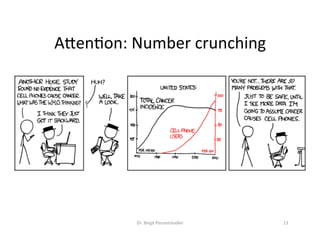
Analysis	Tools:	Number	crunching	
•  Reveal	data	by	background	research	
•  Develop	charts,	tables,	and	graphs	to	support	
your	statements	
•  Careful	with	internet	sources:		
“Do	not	trust	any	staVsVcs	you	did	not	fake	
yourself.”	–	Winston	Churchill	
(Prime	Minister	of	the	United	Kingdom		
from	1940	to	1945	and	again	from	1951	to	1955)	
à	Data	allows	for	different	interpretaVons	
Dr.	Birgit	Penzenstadler	 12
AdenVon:	Number	crunching	
Dr.	Birgit	Penzenstadler	 13
Business	Case:	4.	SoluVon	OpVons	
•  IdenVfy	potenVal	soluVons	to	the	problem	and	
describe	them	in	sufficient	detail	for	the	reader	
to	understand	them.		
•  If,	for	example,	the	soluVon	proposed	is	the	
implementaVon	of	desktop	virtualizaVon,	you	
would	define	the	term	and	discuss	the	use	of	the	
technology	within	your	industry.		
•  For	most	problems,	there	are	mulVple	soluVons	
possible	and	you	should	explore	all	soluVons	that	
are	potenVally	the	best	opVon.		
Dr.	Birgit	Penzenstadler	 14
Business	Case:	5.	Project	descripVon	
•  This	secVon	describes	the	project,	including	all	the	resources	
required	for	its	implementaVon,	the	project	budget	and	a	Vmeline	
with	measurable	goals	for	all	project	milestones.		
•  List	any	assumpVons	that	the	reader	should	be	aware	of,	such	as,	
for	example,	that	government	regulaVons	perVnent	to	the	project	
will	not	change.	You	should	also	list	any	dependencies,	such	as	
compleVon	of	other	projects	or	the	availability	of	key	individuals.	
•  Note	any	risks	involved	with	the	project	and	briefly	sketch	a	plan	
for	dealing	with	them.	In	the	budget	secVon,	include	financial	
projecVons	for	relevant	metrics	such	as	ROI	and	total	cost	of	
ownership	(TCO).	You	should	also	include	a	figure	--	usually	an	
addiVonal	15-20%	of	the	total	--	for	scope	creep.		
•  IdenVfy	and	describe	all	stages	of	the	project,	including	a	post-
project	review.	Include	measurable	criteria	to	determine	the	
success	of	the	project.		
Dr.	Birgit	Penzenstadler	 15
Business	Case:	6.	Cost-benefit	analysis	
•  This	secVon	evaluates	the	costs	and	benefits	for	all	opVons,	
including	the	proposed	soluVon	to	the	problem	and	any	
likely	alternaVves	–	which	include,	of	course,	taking	no	
acVon	at	all.		
•  Illustrate	your	case	with	data	from	similar	projects	and	case	
studies,	if	possible.	Charts	and	graphs	are	oeen	included	in	
this	secVon	or	may	be	in	an	appendix	at	the	end.		
•  In	any	case,	graphs	can	illustrate	points	that	are	hard	to	
extrapolate	from	text-based	data,	so	be	sure	to	include	as	
many	as	will	be	helpful.		
•  This	secVon	should	include	the	projected	financial	benefit	
to	the	company	and	a	projecVon	of	when	that	payoff	is	
expected	as	well	as	major	risks	to	success.	
Dr.	Birgit	Penzenstadler	 16
Business	Case:	7.	RecommendaVons	
•  In	this	secVon,	you	make	your	recommendaVons	for	the	project	
and	how	it	is	to	be	conducted.		
•  The	recommendaVon	for	implementaVon	is	a	brief	restatement	of	
compelling	results	of	the	cost-benefit	analysis	and	a	final	statement	
that	you	believe	the	project	should	go	ahead.		
•  ArVculate	the	circumstances	under	which	it	should	be	undertaken,	
including	key	individuals	and	acVons.		
•  Include	a	recommendaVon	for	scheduled	reexaminaVon	of	the	
project	status.	If	there	is	any	quesVon	as	to	the	availability	of	key	
resources,	make	that	clear.		
•  Include	a	recommendaVon	for	regularly	scheduled	reexaminaVon	
of	the	project	status.		
•  Refer	the	reader	back	to	relevant	document	secVons	and	graphical	
presentaVons	where	it	might	be	helpful.	
Dr.	Birgit	Penzenstadler	 17
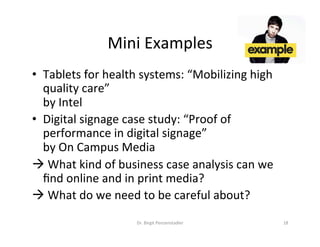
Mini	Examples	
•  Tablets	for	health	systems:	“Mobilizing	high	
quality	care”		
by	Intel	
•  Digital	signage	case	study:	“Proof	of	
performance	in	digital	signage”		
by	On	Campus	Media	
à 	What	kind	of	business	case	analysis	can	we	
find	online	and	in	print	media?		
à 	What	do	we	need	to	be	careful	about?	
Dr.	Birgit	Penzenstadler	 18
Example:	
Tablets	for	
health	
systems	
Dr.	Birgit	Penzenstadler	 19
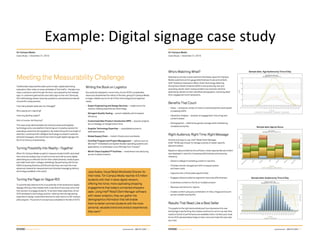
Example:	Digital	signage	case	study	
Dr.	Birgit	Penzenstadler	 20
Example:	Digital	signage	case	study	
•  Tablets	for	health	systems:	“Mobilizing	high	
quality	care”		
by	Intel	
•  Digital	signage	case	study:	“Proof	of	
performance	in	digital	signage”		
by	On	Campus	Media	
à 	What	kind	of	business	case	analysis	can	we	
find	online	and	in	print	media?		
à 	What	do	we	need	to	be	careful	about?	
UCI	winter	2014	 Dr.	Birgit	Penzenstadler	 21
In-class	exercise	
•  Team	up	with	your	neighbor	
•  Develop	a	short	business	case	analysis	for	
your	new	project	“The	CSULB	online	
store”	(yes,	I	know,	the	49er	shop	exists…)	
Dr.	Birgit	Penzenstadler	 22
Business	Case	Analysis		
“The	CSULB	online	store”	
1.  ExecuVve	summary	
2.  Problem	statement	
3.  Analysis	
4.  SoluVon	opVons	
5.  Project	descripVon	
6.  Cost-benefit	analysis	
7.  RecommendaVons		
Dr.	Birgit	Penzenstadler	 23
Business	Case:	Checklist	
Check	your	document	content	to	ensure	that	it's	well-constructed	and	
includes	all	the	key	elements.		
•  Does	your	problem	statement	follow	naturally	from	the	analysis	of	the	
situaVon?	
•  Does	the	problem	statement	clearly	indicate	that	acVon	should	be	taken?	
•  Is	your	list	of	potenVal	soluVons	to	the	problem	adequate?	Does	it	omit	
any	soluVons	that	should	be	included?	
•  Is	your	project	descripVon	detailed	enough?		
•  Are	the	data	and	calculaVons	in	the	budget	secVon	correct?	
•  Do	you	have	enough	supporVng	data	in	your	cost-benefit	analysis?	
•  Have	you	approached	at	least	one	major	stakeholder	for	preliminary	
support?	
•  Does	your	execuVve	summary	include	all	the	essenVal	elements	and	
follow	the	same	order	as	the	complete	document?	
Dr.	Birgit	Penzenstadler	 24
Business	Case	Study	Examples	
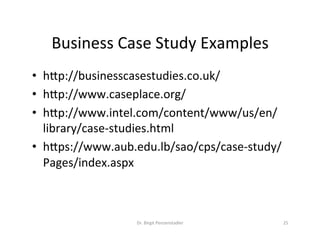
•  hdp://businesscasestudies.co.uk/	
•  hdp://www.caseplace.org/	
•  hdp://www.intel.com/content/www/us/en/
library/case-studies.html	
•  hdps://www.aub.edu.lb/sao/cps/case-study/
Pages/index.aspx	
Dr.	Birgit	Penzenstadler	 25
Business	Case	Study	References	
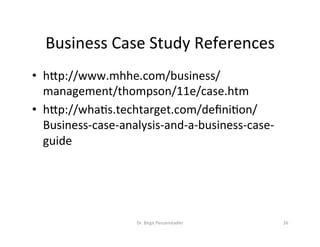
•  hdp://www.mhhe.com/business/
management/thompson/11e/case.htm	
•  hdp://whaVs.techtarget.com/definiVon/
Business-case-analysis-and-a-business-case-
guide	
Dr.	Birgit	Penzenstadler	 26
Aeer	the	business	case:	
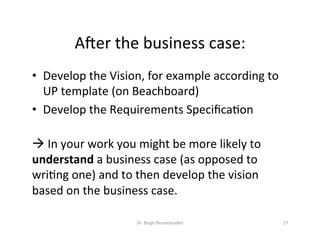
•  Develop	the	Vision,	for	example	according	to	
UP	template	(on	Beachboard)	
•  Develop	the	Requirements	SpecificaVon	
	
à	In	your	work	you	might	be	more	likely	to	
understand	a	business	case	(as	opposed	to	
wriVng	one)	and	to	then	develop	the	vision	
based	on	the	business	case.	
Dr.	Birgit	Penzenstadler	 27
Today	in	Lab:	
•  IREB	pracVce	exam	
•  InternaVonal	requirements	engineering	board	
www.ireb.org	
•  Check	on	how	much	you	can	get	right	aeer	
these	few	intro	weeks	with	the	overview	
lectures	
Dr.	Birgit	Penzenstadler	 28

Requirements Engineering - Business Case Analysis