INTRODUCTION
Crack formation is a typical phenomenon
related to durability.
Percolation of cracks may lead to leakage problems, causing
deterioration of the concrete matrix or corrosion of embedded
steel reinforcement.
In recent years a bacteria-based self-healing concrete is being
developed in order to extend the service life.
A two component healing agent is added to the concrete mixture.
The agent consists of bacteria and an organic mineral precursor
compound.
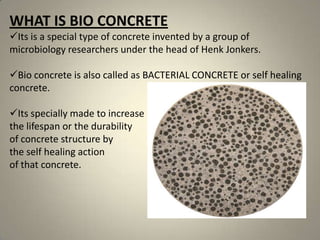
WHAT IS BIO CONCRETE
Its is a special type of concrete invented by a group of
microbiology researchers under the head of Henk Jonkers.
Bio concrete is also called as BACTERIAL CONCRETE or self healing
concrete.
Its specially made to increase
the lifespan or the durability
of concrete structure by
the self healing action
of that concrete.
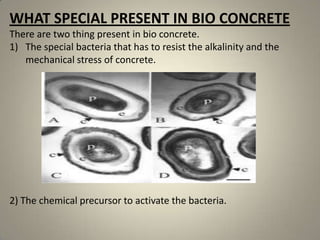
WHAT SPECIAL PRESENT IN BIO CONCRETE
There are two thing present in bio concrete.
1) The special bacteria that has to resist the alkalinity and the
mechanical stress of concrete.
2) The chemical precursor to activate the bacteria.
WHAT BACTERIA IS USED
Most of the bacteria belongs to genus bacillus are fulfilling the
required criteria discussed above. some of the list of bacteria are
B. Pseudofirmus ,
B. Cohnii B. Filla B. Pasteurii…etc
The suitable chemical precursor found to be most suitable is
“calcium lactate” Ca(C3H5O2)2
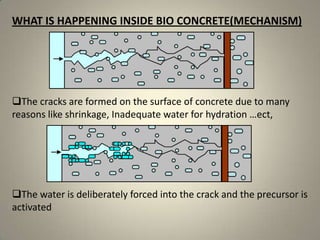
WHAT IS HAPPENING INSIDE BIO CONCRETE(MECHANISM)
The cracks are formed on the surface of concrete due to many
reasons like shrinkage, Inadequate water for hydration …ect,
The water is deliberately forced into the crack and the precursor is
activated
Ca(C3H5O2)2 + 7O2 → CaCO3 + 5CO2 + 5H2O
CO2 + Ca(OH)2 → CaCO3 + H2O
(carbonation)
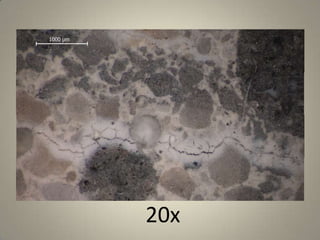
The activated precursor intern induces the bacteria to react with
that precursor and form a base of calcium carbonate called as
limestone, the chemical equation is given above.
BEFORE HEALING AFTER HRALING
20x
40x
HOW THE HEALING AGENTS ARE APPLIED
1)BY DIRECT APPLICATION
The bacteria and the chemical precursor(calcium lactate) are
added directly while making the concrete.
2) ENCAPSULATION LWA
a) The part of the coarse aggregate is replaced by the light
weight aggregate(LWA) , which is impregnated with twice the
calcium lactate solution and the spores of bacteria.
b) After impregnation the clay particles with 6% healing agents
and the concrete is made .
EVALUATION
• The Concrete properties should not be negatively
affected by addition of a healing agent to the
concrete mixture.
• a large amount of bacteria and certain mineral
precursor compounds like calcium lactate do
substantially influence concrete compressive and
tensile strength
• when the healing agent is added, Optimization of
healing agent is necessary so that it wont affect the
characteristics of concrete
CONCLUSION
The spores would be crushed by smaller holes.
No strong spores were detected in a 135-day old
specimen, implying the majority of spores in the cured cement
mixture were available for less than 4 months.
Further research is needed to increase the time period that the
bacterial spores remain in the concrete. It could be possible.
Bio concrete ppt

Bio concrete ppt

  • 2.
    INTRODUCTION Crack formation isa typical phenomenon related to durability. Percolation of cracks may lead to leakage problems, causing deterioration of the concrete matrix or corrosion of embedded steel reinforcement. In recent years a bacteria-based self-healing concrete is being developed in order to extend the service life. A two component healing agent is added to the concrete mixture. The agent consists of bacteria and an organic mineral precursor compound.
  • 3.
    WHAT IS BIOCONCRETE Its is a special type of concrete invented by a group of microbiology researchers under the head of Henk Jonkers. Bio concrete is also called as BACTERIAL CONCRETE or self healing concrete. Its specially made to increase the lifespan or the durability of concrete structure by the self healing action of that concrete.
  • 4.
    WHAT SPECIAL PRESENTIN BIO CONCRETE There are two thing present in bio concrete. 1) The special bacteria that has to resist the alkalinity and the mechanical stress of concrete. 2) The chemical precursor to activate the bacteria.
  • 5.
    WHAT BACTERIA ISUSED Most of the bacteria belongs to genus bacillus are fulfilling the required criteria discussed above. some of the list of bacteria are B. Pseudofirmus , B. Cohnii B. Filla B. Pasteurii…etc The suitable chemical precursor found to be most suitable is “calcium lactate” Ca(C3H5O2)2
  • 6.
    WHAT IS HAPPENINGINSIDE BIO CONCRETE(MECHANISM) The cracks are formed on the surface of concrete due to many reasons like shrinkage, Inadequate water for hydration …ect, The water is deliberately forced into the crack and the precursor is activated
  • 7.
    Ca(C3H5O2)2 + 7O2→ CaCO3 + 5CO2 + 5H2O CO2 + Ca(OH)2 → CaCO3 + H2O (carbonation) The activated precursor intern induces the bacteria to react with that precursor and form a base of calcium carbonate called as limestone, the chemical equation is given above.
  • 9.
  • 10.
  • 11.
  • 13.
    HOW THE HEALINGAGENTS ARE APPLIED 1)BY DIRECT APPLICATION The bacteria and the chemical precursor(calcium lactate) are added directly while making the concrete. 2) ENCAPSULATION LWA a) The part of the coarse aggregate is replaced by the light weight aggregate(LWA) , which is impregnated with twice the calcium lactate solution and the spores of bacteria. b) After impregnation the clay particles with 6% healing agents and the concrete is made .
  • 14.
    EVALUATION • The Concreteproperties should not be negatively affected by addition of a healing agent to the concrete mixture. • a large amount of bacteria and certain mineral precursor compounds like calcium lactate do substantially influence concrete compressive and tensile strength • when the healing agent is added, Optimization of healing agent is necessary so that it wont affect the characteristics of concrete
  • 15.
    CONCLUSION The spores wouldbe crushed by smaller holes. No strong spores were detected in a 135-day old specimen, implying the majority of spores in the cured cement mixture were available for less than 4 months. Further research is needed to increase the time period that the bacterial spores remain in the concrete. It could be possible.