BIO-CONCRETE
AMIT KUMAR
611441521072
Civil Engg
 Concrete is the most widely used material for
construction.
 It has low tensile strength than compressive strength.
 So It is most effective when reinforced by steel bars.
 Concrete is a brittle material with low tolerance for
strain.
 So it forms cracks, leading to
 corrosion
 water ingress
 Decrease in durability
 increasing maintenance cost
 self healing concrete is a solution to all above.
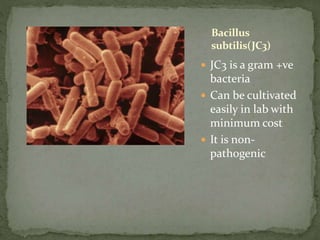
 Here we will induce self healing property using JC3
(Bacillus Subtilis) bacteria.
 JC3 is a gram +ve
bacteria
 Can be cultivated
easily in lab with
minimum cost
 It is non-
pathogenic
Bacillus
subtilis(JC3)
 Objectives
 Experimental procedure
 Chemical reactions
 Experimental results
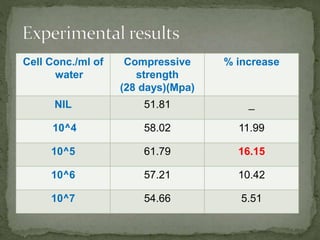
 Analysis of compressive strength with varying
bacterial concentration.
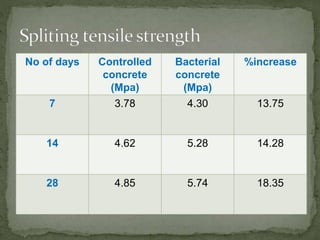
 Analysis of split tensile strength .
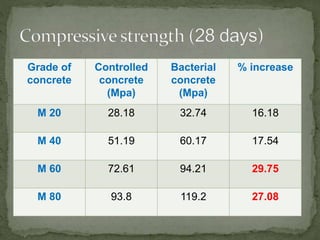
 Effect of bacterial conc. on different grades of concrete
 JC3 bacteria is added to concrete with Calcium lactate
as feeding material.
 The conc. of JC3 bacteria is proportional to H2O conc.
 Calcium lactate & JC3 mixture is added in form of
palates .
 Initially JC3 bacteria spores remain in dormant state
 These spores germinate when come in contact with
H2O in temp around 25deg.
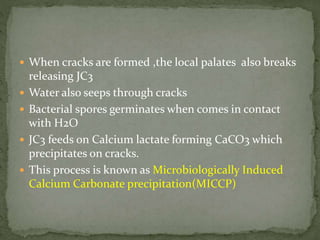
 When cracks are formed ,the local palates also breaks
releasing JC3
 Water also seeps through cracks
 Bacterial spores germinates when comes in contact
with H2O
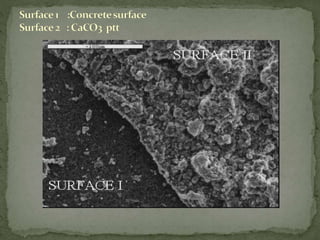
 JC3 feeds on Calcium lactate forming CaCO3 which
precipitates on cracks.
 This process is known as Microbiologically Induced
Calcium Carbonate precipitation(MICCP)
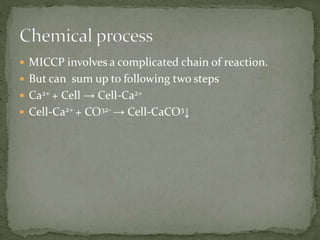
 MICCP involves a complicated chain of reaction.
 But can sum up to following two steps
 Ca2+ + Cell → Cell-Ca2+
 Cell-Ca2+ + CO32- → Cell-CaCO3↓
Cell Conc./ml of
water
Compressive
strength
(28 days)(Mpa)
% increase
NIL 51.81 _
10^4 58.02 11.99
10^5 61.79 16.15
10^6 57.21 10.42
10^7 54.66 5.51
Grade of
concrete
Controlled
concrete
(Mpa)
Bacterial
concrete
(Mpa)
% increase
M 20 28.18 32.74 16.18
M 40 51.19 60.17 17.54
M 60 72.61 94.21 29.75
M 80 93.8 119.2 27.08
No of days Controlled
concrete
(Mpa)
Bacterial
concrete
(Mpa)
%increase
7 3.78 4.30 13.75
14 4.62 5.28 14.28
28 4.85 5.74 18.35
 The use of Self healing concrete has been very
limited world wide .
 The concept is still in developing stage & on the way to
large scale use.
 In India no use of this has been done.
 A group of professors in JNTU are researching on
bacterial concrete.
Based on the present experimental investigations, the
following conclusions are drawn:
 decrease of permeability of water and other liquids in
concrete.
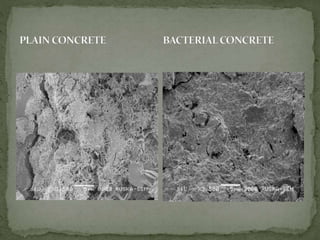
 increases the compressive strength of concrete. The
compressive strength
 Splitting tensile strength is increased
 All over maintenance cost is minimized
 From all above results we can consider non pathogenic
bacteria as a major material for inducing self healing
property in concrete.
 Now self healing concrete can be said to be future
material.
 Wang, J., Van Tittelboom, K., De Belie N., and Verstraete,
W.. "Use of Silica Gel or Polyurethane
Immobilized Bacteria for Self-healing Concrete."
Construction and Building Materials 26.1 (2012): 532-
40.Print.
 Li, V., University of Michigan, “Self-healing concrete for
safer, more durable infrastructure.” Science Daily,22 Apr.
2009. Web. 28 Feb. 2012.
 Jonkers, H. M., A. Thijssen, G. Muyzer, O. Copuroglu, and
Schlangen, E. "Application of Bacteria as Selfhealing Agent
for the Development of Sustainable Concrete." Elsevier.
Elsevier B.V., 30 Dec. 2008. Web. 25Feb. 2012.
 Brownell, Blaine. "Self-Healing Concrete." Architect, The
AIA Magazine (2011): 90-91. Print. O'Driscoll, Cath.
"Bacteria Fill in the Gaps in Concrete." Chemistry &
Industry (2010). Web. 11 Feb. 2012.
 Zwaag, S. Van Der, and Schmets A. J. Self Healing
Materials: An Alternative Approach to 20 Centuries of
Materials Science. Dordrecht, The Netherlands: Springer,
2007. Print.
 Yonkers, H. M., and E. Schlangen. "Crack Repair by
Concrete-immobilized Bacteria." Proc. of First
International Conference on Self Healing Materials, Delft
University of Technology, Noordwijk Aan Zee. Springer,
2007. Print
self healing concrete (based on a bio concrete)

self healing concrete (based on a bio concrete)

  • 1.
  • 2.
     Concrete isthe most widely used material for construction.  It has low tensile strength than compressive strength.  So It is most effective when reinforced by steel bars.  Concrete is a brittle material with low tolerance for strain.
  • 3.
     So itforms cracks, leading to  corrosion  water ingress  Decrease in durability  increasing maintenance cost  self healing concrete is a solution to all above.  Here we will induce self healing property using JC3 (Bacillus Subtilis) bacteria.
  • 4.
     JC3 isa gram +ve bacteria  Can be cultivated easily in lab with minimum cost  It is non- pathogenic Bacillus subtilis(JC3)
  • 5.
     Objectives  Experimentalprocedure  Chemical reactions  Experimental results
  • 6.
     Analysis ofcompressive strength with varying bacterial concentration.  Analysis of split tensile strength .  Effect of bacterial conc. on different grades of concrete
  • 7.
     JC3 bacteriais added to concrete with Calcium lactate as feeding material.  The conc. of JC3 bacteria is proportional to H2O conc.  Calcium lactate & JC3 mixture is added in form of palates .  Initially JC3 bacteria spores remain in dormant state  These spores germinate when come in contact with H2O in temp around 25deg.
  • 8.
     When cracksare formed ,the local palates also breaks releasing JC3  Water also seeps through cracks  Bacterial spores germinates when comes in contact with H2O  JC3 feeds on Calcium lactate forming CaCO3 which precipitates on cracks.  This process is known as Microbiologically Induced Calcium Carbonate precipitation(MICCP)
  • 9.
     MICCP involvesa complicated chain of reaction.  But can sum up to following two steps  Ca2+ + Cell → Cell-Ca2+  Cell-Ca2+ + CO32- → Cell-CaCO3↓
  • 12.
    Cell Conc./ml of water Compressive strength (28days)(Mpa) % increase NIL 51.81 _ 10^4 58.02 11.99 10^5 61.79 16.15 10^6 57.21 10.42 10^7 54.66 5.51
  • 13.
    Grade of concrete Controlled concrete (Mpa) Bacterial concrete (Mpa) % increase M20 28.18 32.74 16.18 M 40 51.19 60.17 17.54 M 60 72.61 94.21 29.75 M 80 93.8 119.2 27.08
  • 14.
    No of daysControlled concrete (Mpa) Bacterial concrete (Mpa) %increase 7 3.78 4.30 13.75 14 4.62 5.28 14.28 28 4.85 5.74 18.35
  • 15.
     The useof Self healing concrete has been very limited world wide .  The concept is still in developing stage & on the way to large scale use.  In India no use of this has been done.  A group of professors in JNTU are researching on bacterial concrete.
  • 16.
    Based on thepresent experimental investigations, the following conclusions are drawn:  decrease of permeability of water and other liquids in concrete.  increases the compressive strength of concrete. The compressive strength  Splitting tensile strength is increased  All over maintenance cost is minimized
  • 17.
     From allabove results we can consider non pathogenic bacteria as a major material for inducing self healing property in concrete.  Now self healing concrete can be said to be future material.
  • 18.
     Wang, J.,Van Tittelboom, K., De Belie N., and Verstraete, W.. "Use of Silica Gel or Polyurethane Immobilized Bacteria for Self-healing Concrete." Construction and Building Materials 26.1 (2012): 532- 40.Print.  Li, V., University of Michigan, “Self-healing concrete for safer, more durable infrastructure.” Science Daily,22 Apr. 2009. Web. 28 Feb. 2012.  Jonkers, H. M., A. Thijssen, G. Muyzer, O. Copuroglu, and Schlangen, E. "Application of Bacteria as Selfhealing Agent for the Development of Sustainable Concrete." Elsevier. Elsevier B.V., 30 Dec. 2008. Web. 25Feb. 2012.
  • 19.
     Brownell, Blaine."Self-Healing Concrete." Architect, The AIA Magazine (2011): 90-91. Print. O'Driscoll, Cath. "Bacteria Fill in the Gaps in Concrete." Chemistry & Industry (2010). Web. 11 Feb. 2012.  Zwaag, S. Van Der, and Schmets A. J. Self Healing Materials: An Alternative Approach to 20 Centuries of Materials Science. Dordrecht, The Netherlands: Springer, 2007. Print.  Yonkers, H. M., and E. Schlangen. "Crack Repair by Concrete-immobilized Bacteria." Proc. of First International Conference on Self Healing Materials, Delft University of Technology, Noordwijk Aan Zee. Springer, 2007. Print