PRESENT BY –
Akshaya R
Mohana priya R
SELF HEALING
CONCRETE
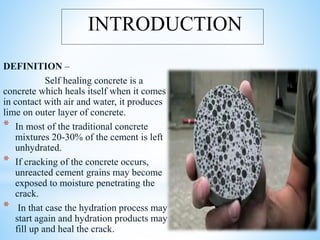
DEFINITION –
Self healing concrete is a
concrete which heals itself when it comes
in contact with air and water, it produces
lime on outer layer of concrete.
* In most of the traditional concrete
mixtures 20-30% of the cement is left
unhydrated.
* If cracking of the concrete occurs,
unreacted cement grains may become
exposed to moisture penetrating the
crack.
* In that case the hydration process may
start again and hydration products may
fill up and heal the crack.
INTRODUCTION
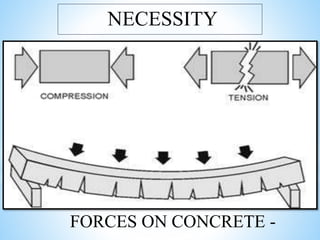
NECESSITY
FORCES ON CONCRETE -
Need of Self-healing
Concrete
1. It provides longer life to the structures.
2.Maintenance and repair are less required.
3. Improvement in compressive strength of concrete.
4. Reduction in permeability of reinforced concrete
5. Good resistance towards freeze-thaw attack reduction.
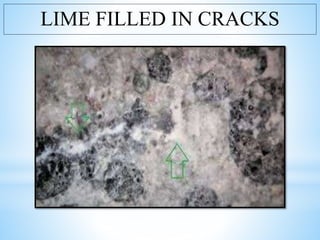
LIME FILLED IN CRACKS
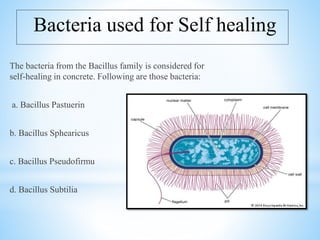
Bacteria used for Self healing
The bacteria from the Bacillus family is considered for
self-healing in concrete. Following are those bacteria:
a. Bacillus Pastuerin
b. Bacillus Sphearicus
c. Bacillus Pseudofirmu
d. Bacillus Subtilia
Characteristics of Bacillus
• Spores are 1-1.2 microns in diameter, round, and terminal to subterminal.
• The colonies are generally circular and glossy, however, the size and opacity
increase from media to media.
• Urea-agar slant shows thin growth i.e. restricted and translucent.
• Urea-milk-agar streak plate shows variable hydrolysis of casein.
WORKING OF SELF HEALING
CONCRETE
1. Self-healing concrete is a substance that will biologically prepare
limestone to heal cracks that comes on the surface of concrete structures.
Ca(C3HSO2)2 + 702 → CaCO3 + 5CO2 + 5H20
(Calcium Lactate) (Lime)
2. Especially chose types of the bacteria genus Bacillus, with a calcium-
based nutrient given as calcium lactate, and nitrogen and phosphorus, are
added to the ingredients of the concrete when it is being mixed.
1. Workability
2. Surface Crack healing
3. Compressive strength
TEST ON SELF HEALING
CONCRETE
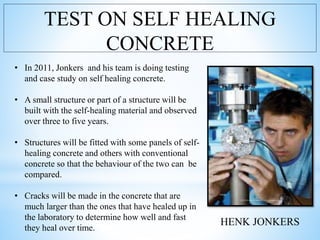
HENK JONKERS
• In 2011, Jonkers and his team is doing testing
and case study on self healing concrete.
• A small structure or part of a structure will be
built with the self-healing material and observed
over three to five years.
• Structures will be fitted with some panels of self-
healing concrete and others with conventional
concrete so that the behaviour of the two can be
compared.
• Cracks will be made in the concrete that are
much larger than the ones that have healed up in
the laboratory to determine how well and fast
they heal over time.
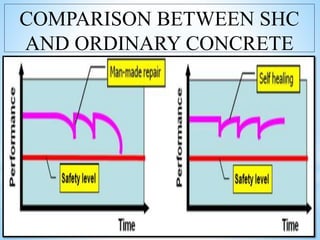
COMPARISON BETWEEN SHC
AND ORDINARY CONCRETE
ADVANTAGES
Advantages of Self healing
Concrete
1. This concrete has comparatively much lower permeability, greater durability,
and stress carrying capacity than conventional concrete.
2. It can be applied to existing buildings in the form of spray which can reduce
the overall repair and maintenance costs of the buildings.
3. This is an environmentally friendly technique because the carbon dioxide
produced is prevented due to the low use of concrete.
4. SHC is a more effective shock absorber that protects during earthquakes
because it has a polymer membrane on its surface.
5. It can operate at internal levels which means that the smallest cracks can be
reached.
Disadvantages of Self healing
Concrete
1. Self-healing concrete cost price is almost 2 times compared to normal
concrete.
2. Growth bacteria can be affected by various environmental conditions.
3. The clay pallets mixed in concrete mostly cover 20 % volume of
concrete and This may result in a shear zone or fault zone in the concrete.
1. Tunnel lining
2. Walls of the building
3. Highway bridges
4. Concrete floors
5. Structural Basement
6. Marines Structures
APPLICATIONS
Highlights of self healing
concrete
•MICP was used to repair concrete cracks with the width of
0.3–0.5 mm.
•Studied the basic and self-healing properties of two kinds of
self-healing concrete.
•Used sensors to monitor the generation of cracks through
strain and temperature.
•The concrete cracks in the engineering application site have
been well repaired.
CONCLUSION
• Hence, self healing concrete is crack resistant.
• Which protects the concrete and reinforcement
from cracks and from corrosion.
• By doing this, it prevents water to percolate into
reinforced steel concrete and hence it does not
comes in contact with reinforcements.
• Thus, it prevents reinforcement from corrosion.
• It is a research project.
SELF-HEALING CONCRETE.pptx

SELF-HEALING CONCRETE.pptx

  • 1.
    PRESENT BY – AkshayaR Mohana priya R SELF HEALING CONCRETE
  • 3.
    DEFINITION – Self healingconcrete is a concrete which heals itself when it comes in contact with air and water, it produces lime on outer layer of concrete. * In most of the traditional concrete mixtures 20-30% of the cement is left unhydrated. * If cracking of the concrete occurs, unreacted cement grains may become exposed to moisture penetrating the crack. * In that case the hydration process may start again and hydration products may fill up and heal the crack. INTRODUCTION
  • 4.
  • 5.
    Need of Self-healing Concrete 1.It provides longer life to the structures. 2.Maintenance and repair are less required. 3. Improvement in compressive strength of concrete. 4. Reduction in permeability of reinforced concrete 5. Good resistance towards freeze-thaw attack reduction.
  • 6.
  • 7.
    Bacteria used forSelf healing The bacteria from the Bacillus family is considered for self-healing in concrete. Following are those bacteria: a. Bacillus Pastuerin b. Bacillus Sphearicus c. Bacillus Pseudofirmu d. Bacillus Subtilia
  • 8.
    Characteristics of Bacillus •Spores are 1-1.2 microns in diameter, round, and terminal to subterminal. • The colonies are generally circular and glossy, however, the size and opacity increase from media to media. • Urea-agar slant shows thin growth i.e. restricted and translucent. • Urea-milk-agar streak plate shows variable hydrolysis of casein.
  • 9.
    WORKING OF SELFHEALING CONCRETE 1. Self-healing concrete is a substance that will biologically prepare limestone to heal cracks that comes on the surface of concrete structures. Ca(C3HSO2)2 + 702 → CaCO3 + 5CO2 + 5H20 (Calcium Lactate) (Lime) 2. Especially chose types of the bacteria genus Bacillus, with a calcium- based nutrient given as calcium lactate, and nitrogen and phosphorus, are added to the ingredients of the concrete when it is being mixed.
  • 10.
    1. Workability 2. SurfaceCrack healing 3. Compressive strength
  • 11.
    TEST ON SELFHEALING CONCRETE HENK JONKERS • In 2011, Jonkers and his team is doing testing and case study on self healing concrete. • A small structure or part of a structure will be built with the self-healing material and observed over three to five years. • Structures will be fitted with some panels of self- healing concrete and others with conventional concrete so that the behaviour of the two can be compared. • Cracks will be made in the concrete that are much larger than the ones that have healed up in the laboratory to determine how well and fast they heal over time.
  • 12.
    COMPARISON BETWEEN SHC ANDORDINARY CONCRETE
  • 13.
  • 14.
    Advantages of Selfhealing Concrete 1. This concrete has comparatively much lower permeability, greater durability, and stress carrying capacity than conventional concrete. 2. It can be applied to existing buildings in the form of spray which can reduce the overall repair and maintenance costs of the buildings. 3. This is an environmentally friendly technique because the carbon dioxide produced is prevented due to the low use of concrete. 4. SHC is a more effective shock absorber that protects during earthquakes because it has a polymer membrane on its surface. 5. It can operate at internal levels which means that the smallest cracks can be reached.
  • 15.
    Disadvantages of Selfhealing Concrete 1. Self-healing concrete cost price is almost 2 times compared to normal concrete. 2. Growth bacteria can be affected by various environmental conditions. 3. The clay pallets mixed in concrete mostly cover 20 % volume of concrete and This may result in a shear zone or fault zone in the concrete.
  • 16.
    1. Tunnel lining 2.Walls of the building 3. Highway bridges 4. Concrete floors 5. Structural Basement 6. Marines Structures APPLICATIONS
  • 17.
    Highlights of selfhealing concrete •MICP was used to repair concrete cracks with the width of 0.3–0.5 mm. •Studied the basic and self-healing properties of two kinds of self-healing concrete. •Used sensors to monitor the generation of cracks through strain and temperature. •The concrete cracks in the engineering application site have been well repaired.
  • 18.
    CONCLUSION • Hence, selfhealing concrete is crack resistant. • Which protects the concrete and reinforcement from cracks and from corrosion. • By doing this, it prevents water to percolate into reinforced steel concrete and hence it does not comes in contact with reinforcements. • Thus, it prevents reinforcement from corrosion. • It is a research project.