SEMINAR
ON
BACTERIAL CONCRETING-A self repairing bio-material
Guided by, Presented by,
Ms. SMITHA M S ABHIJITH SURESH
Assistant Professor S7 CE
Civil Department Roll No: 01
1/28
INTRODUCTION
 Cracking of concrete is an inevitable phenomenon related to
durability.
 repairing of existing cracks has been a subject of research for
many years.
 In recent years, a bacteria based self healing concrete is being
developed to extend the service life.
 Synthetic polymers such as epoxy treatment etc. are currently
being used as filling agents.
 They are neither eco-friendly nor safe for human health.
 Hence the use of a biological repair technique or micro-
biologically induced calcite precipitation technique[MICP] in
concrete is focused,
2/28
OBJECTIVES
 For studying the strength and regaing capacity of concrete with
different bacterial class.
 To study the durability of bacterial concrete.
 It’s resistance towards freeze thaw attack and sulphate attack.
 To study advantages and dis-advantages and possibilities of
application of MICP (Microorganism used for Calcium Carbonate
Precipitation in Concrete) in construction area.
3/28
WHAT
IS
“ BACTERIAL CONCRETE ?”
 It is a special type of concreting.
 by a group of micro-biologically researchers under the head of
henk jonkers.
 It is also called as “ bio-concrete” or “self healing concrete.”
 It is mainly invented to increase the durability or lifespan of the
concrete.
4/28
WHAT IS “MICP- TECHNIQUE?”
 It is a novel technique in remediating cracks and fissures in
concrete.
 It is done by utilizing micro-biologically induced calcite[CaCo3]
in normal concrete.
 It is pollution free and natural.
 It will acts as a microbial sealant through out the concrete.
 It comes under a broader category of science called “bio-
mineralization”.
5/28
BIO-MINERALISATION
 It is a process by which living organisms form inorganic solids.
 “Bacillus pasteruii” is a common soil bacterium can induce the
precipitation of concrete.
6/28
HOW DOES BACTERIA REMEDIATE
CRACKS?
-the chemical reaction process
 The cell surface is negative in charge.
 It draws cations including Ca2+ from the atmosphere to
deposit on the surface.

Thus the calcite is precipitated and eventually plug in the pores of
the concrete.
Ca2++ cell = cell- Ca2+
Cell - Ca2++Co3
2- = cell-CaCo3
7/28
WHAT HAPPENING IN THE BACTERIAL
CONCRETE?
- mechanismof bacterial concrete
 The cracks are formed on the surface of concrete due to many
reasons like shrinkage,inadequate water for hydration etc.
 The water is deliberately forced into the crack and the precursor
is activated.
8/28
 The activated precursor intern induces the bacteria to react with
that precursor and form a base of calcium carbonate called as
lime stone,
Ca2++ cell = cell- Ca2+
Cell - Ca2++Co3
2- = cell-CaCo3
9/28
10/28
 40X
11/28
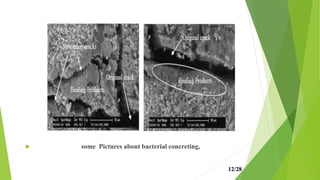
 some Pictures about bacterial concreting,
12/28
TYPES OF BACTERIA USED
They are classified as the following ;
 Bacillus pasturii.
 Bacillus Subtiles.
 Bacillus Sphaericus.
 Bacillus Cohnii.
These can lie dormant within the concrete for several years.
B.Cohnii. B.pasturii. B.Sphaericus B.Subtiles.
. 13/28
PRACTICAL USE
 The use of Self healing concrete has been very limited world
wide .
 The concept is still in developing stage & on the way to large
scale use.
 In India no use of this has been done.
 A group of professors in JNTU are researching on bacterial
concrete.
14/28
FUTURE SCOPE
 Can be used in the construction of aircraft runways, bridges and
dams reducing the maintenance cost.
 Retaining wall construction.
15/28
SCANNING ELECTRON MICROSCOPY
INVESTIGATION
 To give a visual documentation of the extent of mineral
precipitation in various regions with in the cement mortar.
 To characterize the micro-structure relationship relationship of the
precipitates and the filling materials.
 To confirm the elemental composition of the mineral precipitates.
 To identify the microscopic evidence supporting the participation
of bacteria in mineral precipitation.
16/28
XRD ANALYSIS
-xraydiffraction analysis method
 XRD provides most definitive structural information.
 It use monochromatic beam for sample analysis.
 Single crystal diffraction mechanism is adopted in XRD analysis.
 XRD is based on indexing the patterns.
 Most effective in cubic specimens.
17/28
MICRO-STRUCTURE EXAMINATIONS
 It is based on the micrograph obtained by scanning electron
microscopic analysis.
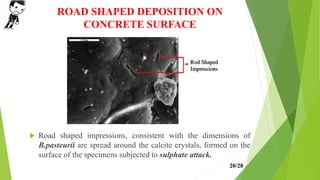
 From the micrograph, it is was investigated the growth of rod
shaped fabulous
deposition in concrete with bacteria.
 It also reveals the calcifying power of the different micro-
organisms and their interaction with concrete.
18/28
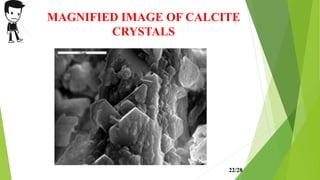
 Magnified image of full grown calcite crystals with distinct and
sharp edges, found in the interior surface of the crack.
19/28
ROAD SHAPED DEPOSITION ON
CONCRETE SURFACE
 Road shaped impressions, consistent with the dimensions of
B.pasteurii are spread around the calcite crystals, formed on the
surface of the specimens subjected to sulphate attack.
20/28
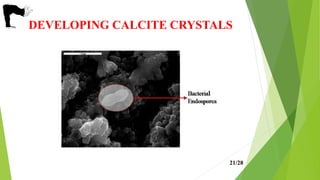
DEVELOPING CALCITE CRYSTALS
21/28
MAGNIFIED IMAGE OF CALCITE
CRYSTALS
22/28
DURABILITY COMPARISON
23/28
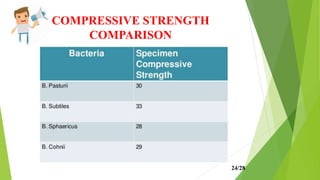
COMPRESSIVE STRENGTH
COMPARISON
24/28
ADVANTAGES
Perpetual and expected cracking that occurs in every
concrete structure due to its brittle nature can be controlled.
Repairs without a human work crew.
Self-healing concrete also prevents the exposure of the
internal reinforcements.
It has made to extend the life span of a concrete structure
of any size, shape.
Material consumption reduced in form of cement.
25/28
CONCLUSION
 It was found that all specimens with bacteria formed a layer of
calcite at the surface.
 There were improvements in impermeability and its resistance to
alkaline environment,sulphate attack, freeze and thaw etc.
 SEM method was used to document the role of bacteria in
improving the durability of concrete.
 B.subtiles was most effective microbiome for the crack
remediation as remediates easily and helps in gaining early
strength.
 Thus it can be concluded that presence of bacteria in concrete can
improve the strength and durability of concrete structure.
26/28
REFERENCE
 Vijeth N Kashyap and Radhakrishna,a study on the effects of
bacteria on cement composites,356-360,2013
 M.V. Seshagiri Rao, V. Srinivasa Reddy, M. Hafsa, P. Veena and P.
Anusha,Bioengineered Concrete - A Sustainable Self-Healing
Construction Material,45-51,2013.
 Mayur Shantilal Vekariya, Prof. Jayeshkumar Pitroda, Bacterial
Concrete: New Era For Construction Industry, Volume 4 Issue 9-
Sep 2013
 www.Google.com
 www.ijret.org
 www.Wikipedia.org
27/28
THANK YOU..
FOR LISTENING….
28

Presentation by abhijith suresh

  • 1.
    SEMINAR ON BACTERIAL CONCRETING-A selfrepairing bio-material Guided by, Presented by, Ms. SMITHA M S ABHIJITH SURESH Assistant Professor S7 CE Civil Department Roll No: 01 1/28
  • 2.
    INTRODUCTION  Cracking ofconcrete is an inevitable phenomenon related to durability.  repairing of existing cracks has been a subject of research for many years.  In recent years, a bacteria based self healing concrete is being developed to extend the service life.  Synthetic polymers such as epoxy treatment etc. are currently being used as filling agents.  They are neither eco-friendly nor safe for human health.  Hence the use of a biological repair technique or micro- biologically induced calcite precipitation technique[MICP] in concrete is focused, 2/28
  • 3.
    OBJECTIVES  For studyingthe strength and regaing capacity of concrete with different bacterial class.  To study the durability of bacterial concrete.  It’s resistance towards freeze thaw attack and sulphate attack.  To study advantages and dis-advantages and possibilities of application of MICP (Microorganism used for Calcium Carbonate Precipitation in Concrete) in construction area. 3/28
  • 4.
    WHAT IS “ BACTERIAL CONCRETE?”  It is a special type of concreting.  by a group of micro-biologically researchers under the head of henk jonkers.  It is also called as “ bio-concrete” or “self healing concrete.”  It is mainly invented to increase the durability or lifespan of the concrete. 4/28
  • 5.
    WHAT IS “MICP-TECHNIQUE?”  It is a novel technique in remediating cracks and fissures in concrete.  It is done by utilizing micro-biologically induced calcite[CaCo3] in normal concrete.  It is pollution free and natural.  It will acts as a microbial sealant through out the concrete.  It comes under a broader category of science called “bio- mineralization”. 5/28
  • 6.
    BIO-MINERALISATION  It isa process by which living organisms form inorganic solids.  “Bacillus pasteruii” is a common soil bacterium can induce the precipitation of concrete. 6/28
  • 7.
    HOW DOES BACTERIAREMEDIATE CRACKS? -the chemical reaction process  The cell surface is negative in charge.  It draws cations including Ca2+ from the atmosphere to deposit on the surface.  Thus the calcite is precipitated and eventually plug in the pores of the concrete. Ca2++ cell = cell- Ca2+ Cell - Ca2++Co3 2- = cell-CaCo3 7/28
  • 8.
    WHAT HAPPENING INTHE BACTERIAL CONCRETE? - mechanismof bacterial concrete  The cracks are formed on the surface of concrete due to many reasons like shrinkage,inadequate water for hydration etc.  The water is deliberately forced into the crack and the precursor is activated. 8/28
  • 9.
     The activatedprecursor intern induces the bacteria to react with that precursor and form a base of calcium carbonate called as lime stone, Ca2++ cell = cell- Ca2+ Cell - Ca2++Co3 2- = cell-CaCo3 9/28
  • 10.
  • 11.
  • 12.
     some Picturesabout bacterial concreting, 12/28
  • 13.
    TYPES OF BACTERIAUSED They are classified as the following ;  Bacillus pasturii.  Bacillus Subtiles.  Bacillus Sphaericus.  Bacillus Cohnii. These can lie dormant within the concrete for several years. B.Cohnii. B.pasturii. B.Sphaericus B.Subtiles. . 13/28
  • 14.
    PRACTICAL USE  Theuse of Self healing concrete has been very limited world wide .  The concept is still in developing stage & on the way to large scale use.  In India no use of this has been done.  A group of professors in JNTU are researching on bacterial concrete. 14/28
  • 15.
    FUTURE SCOPE  Canbe used in the construction of aircraft runways, bridges and dams reducing the maintenance cost.  Retaining wall construction. 15/28
  • 16.
    SCANNING ELECTRON MICROSCOPY INVESTIGATION To give a visual documentation of the extent of mineral precipitation in various regions with in the cement mortar.  To characterize the micro-structure relationship relationship of the precipitates and the filling materials.  To confirm the elemental composition of the mineral precipitates.  To identify the microscopic evidence supporting the participation of bacteria in mineral precipitation. 16/28
  • 17.
    XRD ANALYSIS -xraydiffraction analysismethod  XRD provides most definitive structural information.  It use monochromatic beam for sample analysis.  Single crystal diffraction mechanism is adopted in XRD analysis.  XRD is based on indexing the patterns.  Most effective in cubic specimens. 17/28
  • 18.
    MICRO-STRUCTURE EXAMINATIONS  Itis based on the micrograph obtained by scanning electron microscopic analysis.  From the micrograph, it is was investigated the growth of rod shaped fabulous deposition in concrete with bacteria.  It also reveals the calcifying power of the different micro- organisms and their interaction with concrete. 18/28
  • 19.
     Magnified imageof full grown calcite crystals with distinct and sharp edges, found in the interior surface of the crack. 19/28
  • 20.
    ROAD SHAPED DEPOSITIONON CONCRETE SURFACE  Road shaped impressions, consistent with the dimensions of B.pasteurii are spread around the calcite crystals, formed on the surface of the specimens subjected to sulphate attack. 20/28
  • 21.
  • 22.
    MAGNIFIED IMAGE OFCALCITE CRYSTALS 22/28
  • 23.
  • 24.
  • 25.
    ADVANTAGES Perpetual and expectedcracking that occurs in every concrete structure due to its brittle nature can be controlled. Repairs without a human work crew. Self-healing concrete also prevents the exposure of the internal reinforcements. It has made to extend the life span of a concrete structure of any size, shape. Material consumption reduced in form of cement. 25/28
  • 26.
    CONCLUSION  It wasfound that all specimens with bacteria formed a layer of calcite at the surface.  There were improvements in impermeability and its resistance to alkaline environment,sulphate attack, freeze and thaw etc.  SEM method was used to document the role of bacteria in improving the durability of concrete.  B.subtiles was most effective microbiome for the crack remediation as remediates easily and helps in gaining early strength.  Thus it can be concluded that presence of bacteria in concrete can improve the strength and durability of concrete structure. 26/28
  • 27.
    REFERENCE  Vijeth NKashyap and Radhakrishna,a study on the effects of bacteria on cement composites,356-360,2013  M.V. Seshagiri Rao, V. Srinivasa Reddy, M. Hafsa, P. Veena and P. Anusha,Bioengineered Concrete - A Sustainable Self-Healing Construction Material,45-51,2013.  Mayur Shantilal Vekariya, Prof. Jayeshkumar Pitroda, Bacterial Concrete: New Era For Construction Industry, Volume 4 Issue 9- Sep 2013  www.Google.com  www.ijret.org  www.Wikipedia.org 27/28
  • 28.