



4Mat Models Make An Inspiring Presentation Session A: 4 Mat Model Joan Shi
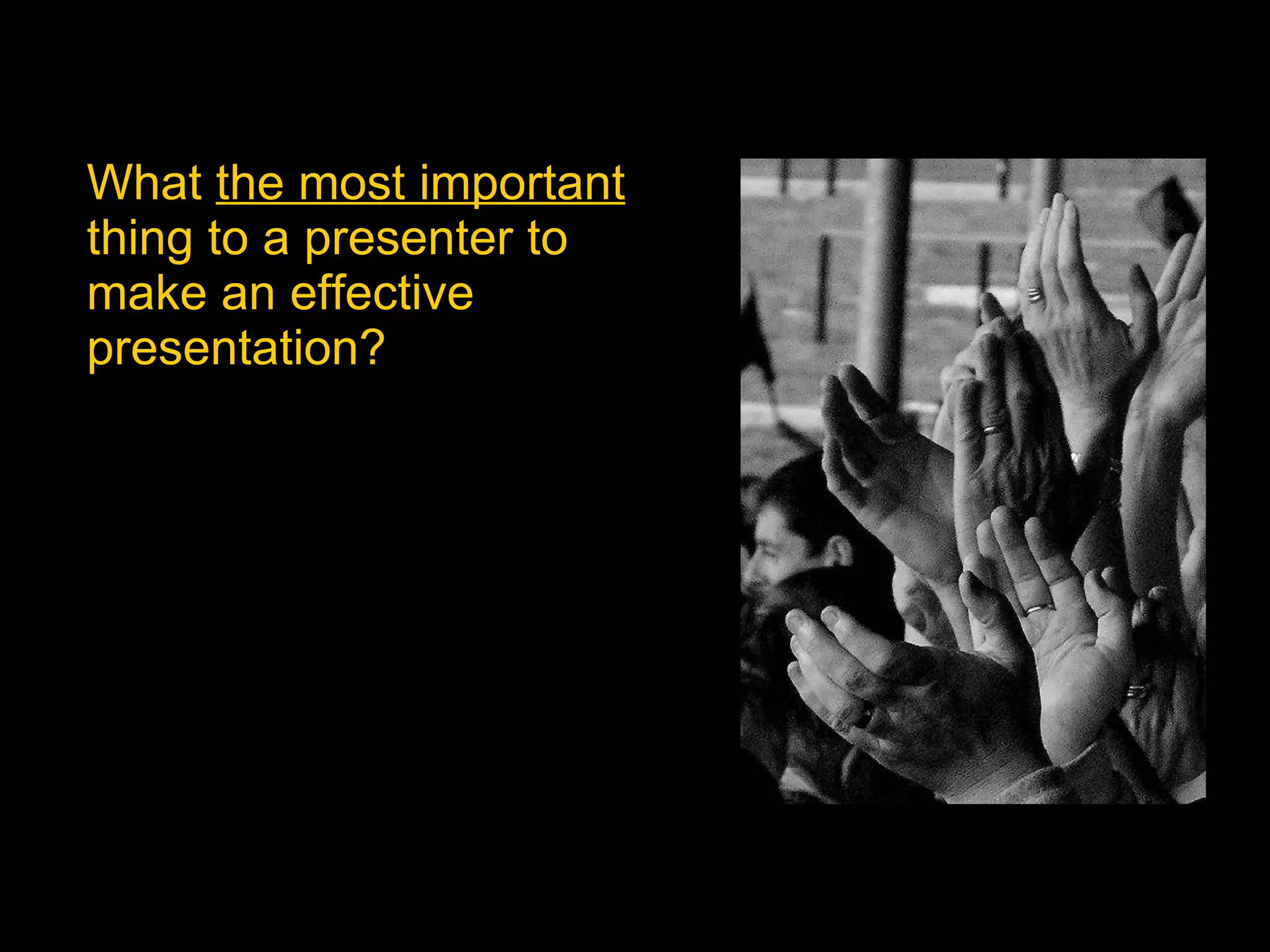
What  the most important  thing to a presenter to make an effective presentation?
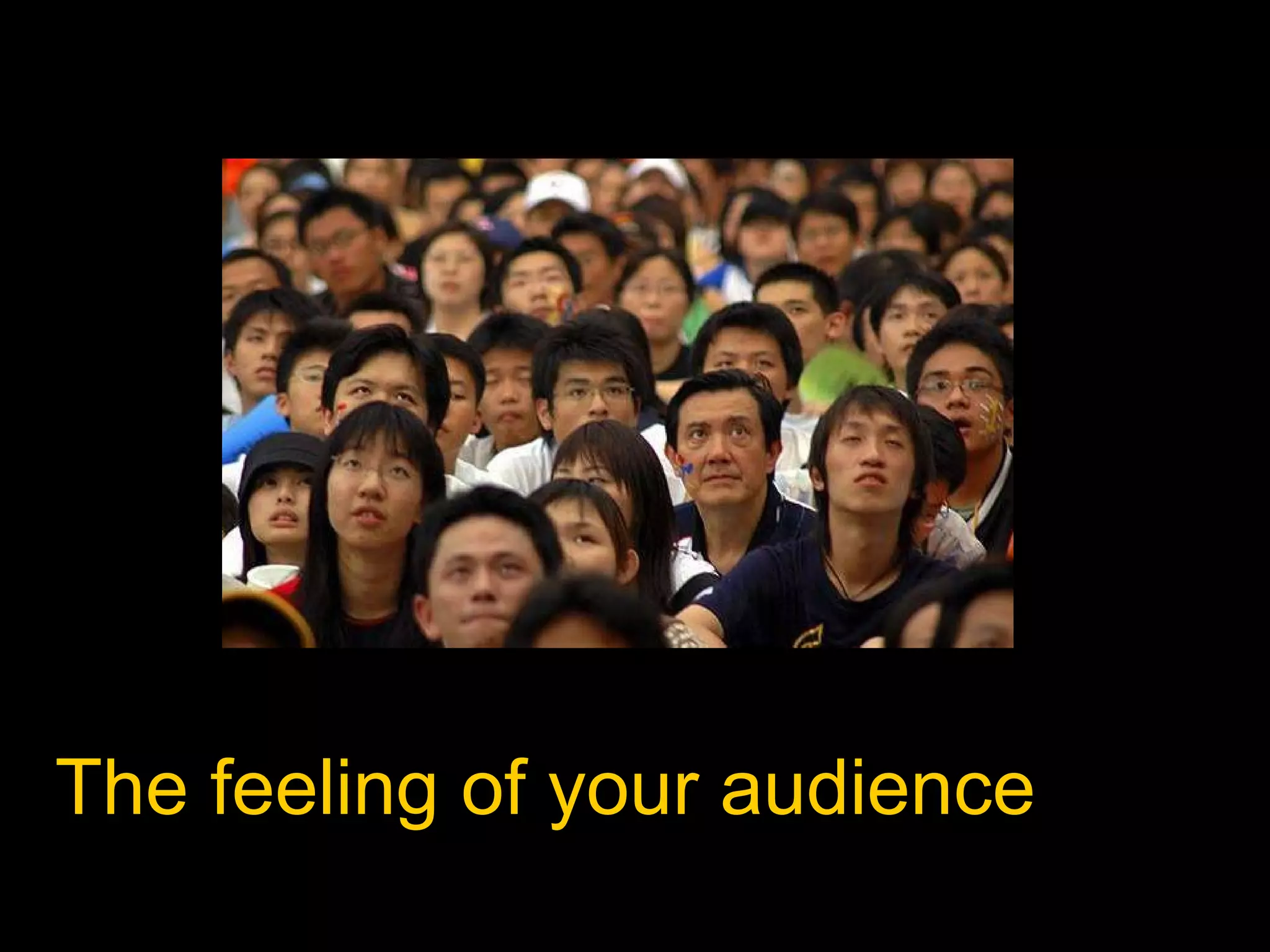
The feeling of your audience
People will forget what you said, People will forget what you did, But people will never forget how you made them feel. -- Maya Angelou
The  4Mat  module is the tool to Identify the learning preferences of your audience Help you to prepare your presentation structure and tailor the content to make an effective presentation  A magic tool to make quiet people bring out an inspiring presentation
We will cover What’s 4Mat module What’s your preferred learning/delivery style  What’s ‘tactics’ to handle different audience
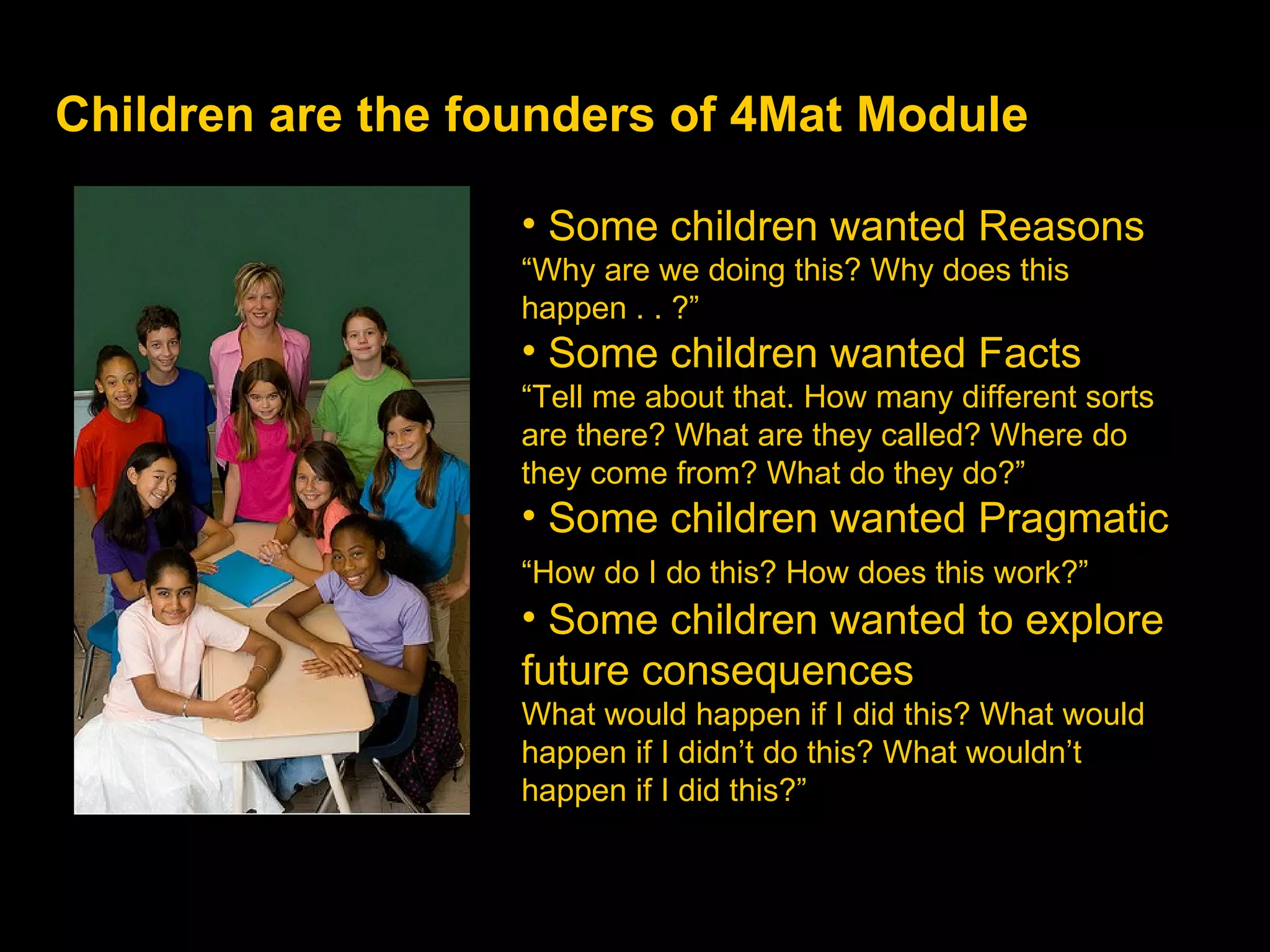
Children are the founders of 4Mat Module Some children wanted Reasons “ Why are we doing this? Why does this happen . . ?” Some children wanted Facts “ Tell me about that. How many different sorts are there? What are they called? Where do they come from? What do they do?” Some children wanted Pragmatic   “ How do I do this? How does this work?”   Some children wanted to explore future consequences   What would happen if I did this? What would happen if I didn’t do this? What wouldn’t happen if I did this?”
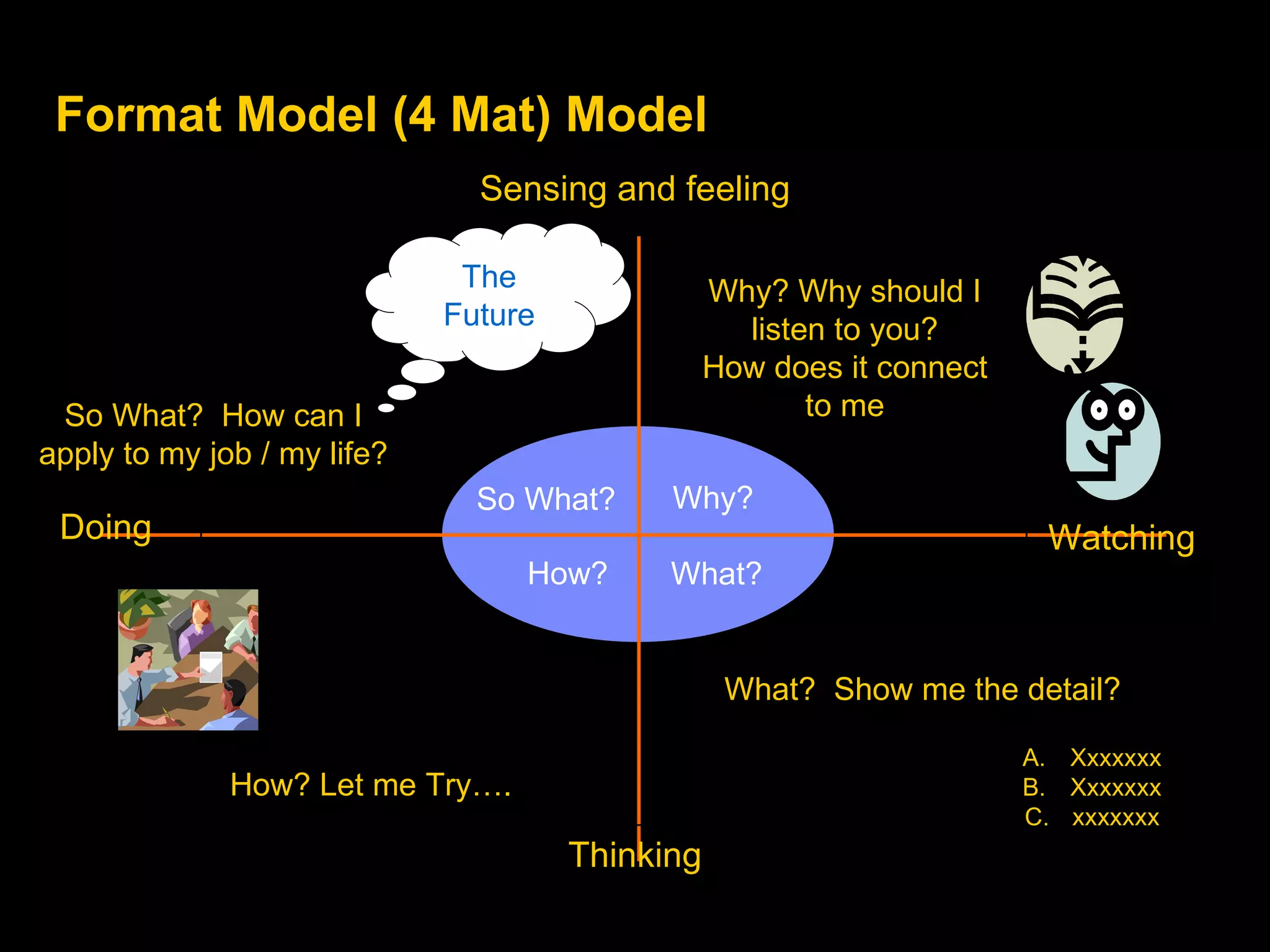
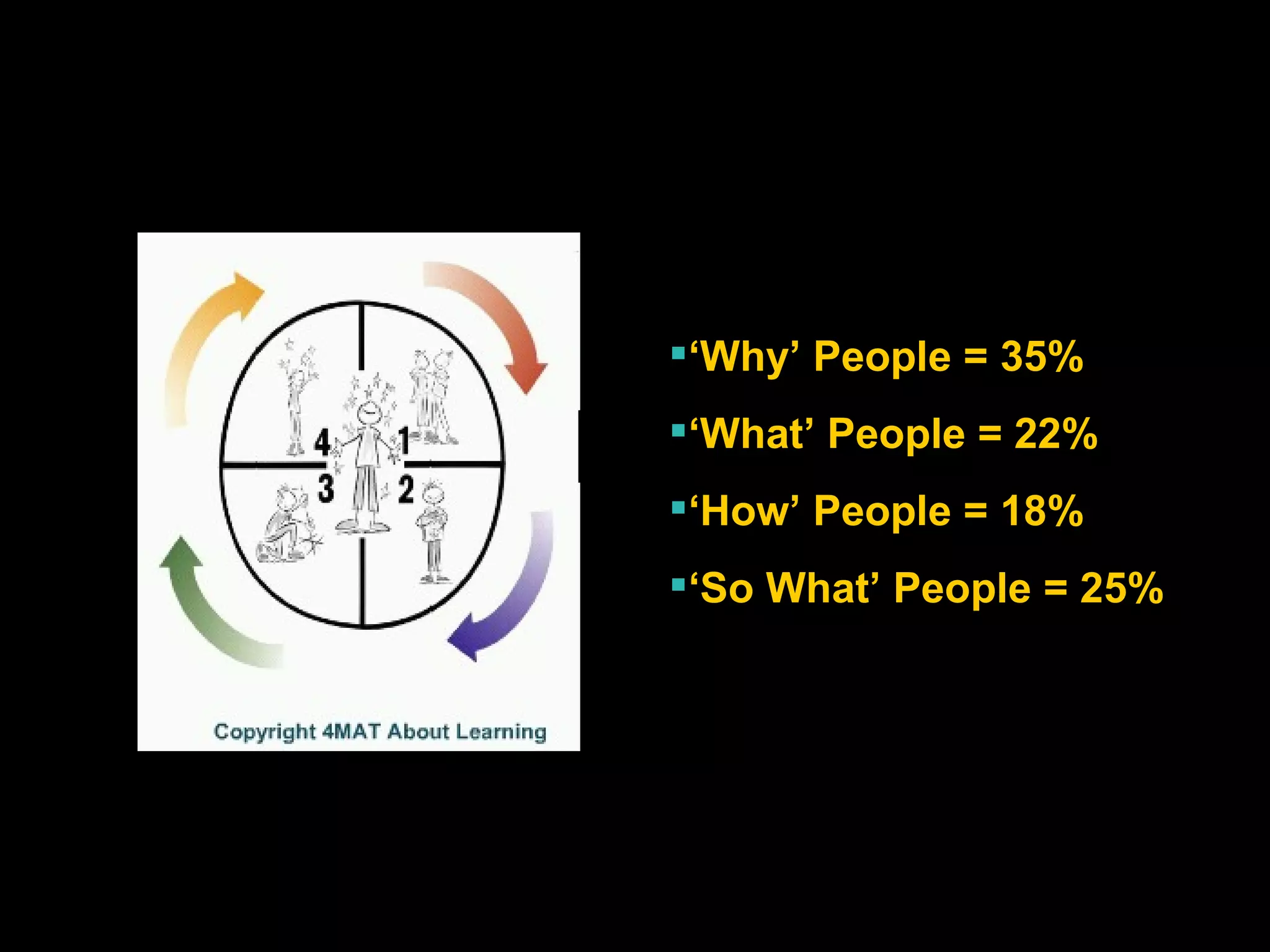
Format Model (4 Mat) Model Why? What? How? So What ? Sensing and feeling Doing Watching Thinking So What?  How can I apply to my job / my life? The Future Why? Why should I listen to you? How does it connect to me How? Let me Try…. What?  Show me the detail? Xxxxxxx Xxxxxxx xxxxxxx
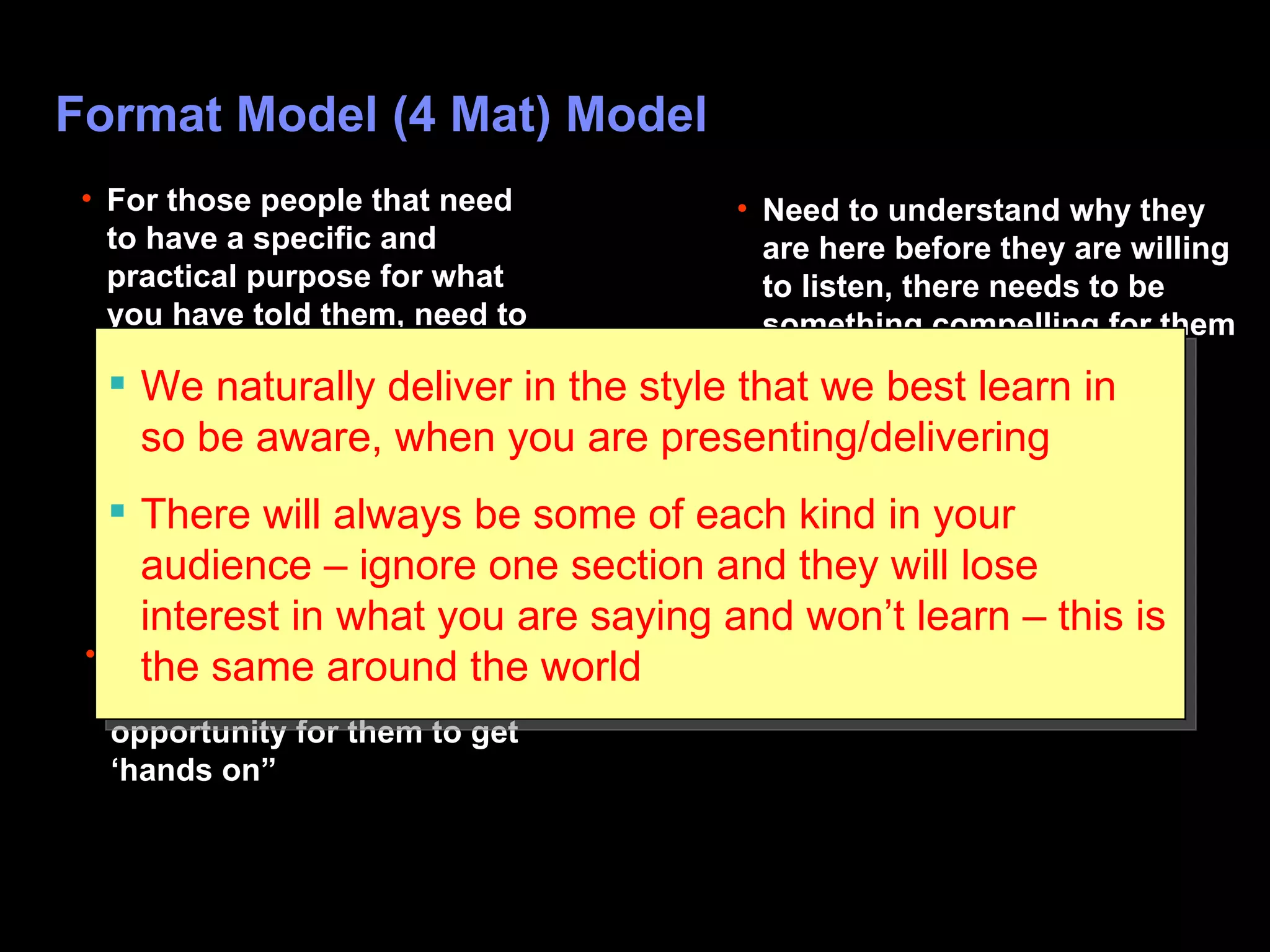
Format Model (4 Mat) Model Why? What? How? So  W hat? Need to understand why they are here before they are willing to listen, there needs to be something compelling for them to learn For those who just want content, data, facts etc For those kinesthetics that will get bored easily if there is no opportunity for them to get ‘hands on” For those people that need to have a specific and practical purpose for what you have told them, need to understand how to apply it in the workplace, where to go to or do next with this knowledge We naturally deliver in the style that we best learn in so be aware, when you are presenting/delivering There will always be some of each kind in your audience – ignore one section and they will lose interest in what you are saying and won’t learn – this is the same around the world
What makes you to decide to attend this training Exercise: Identify your preferred style
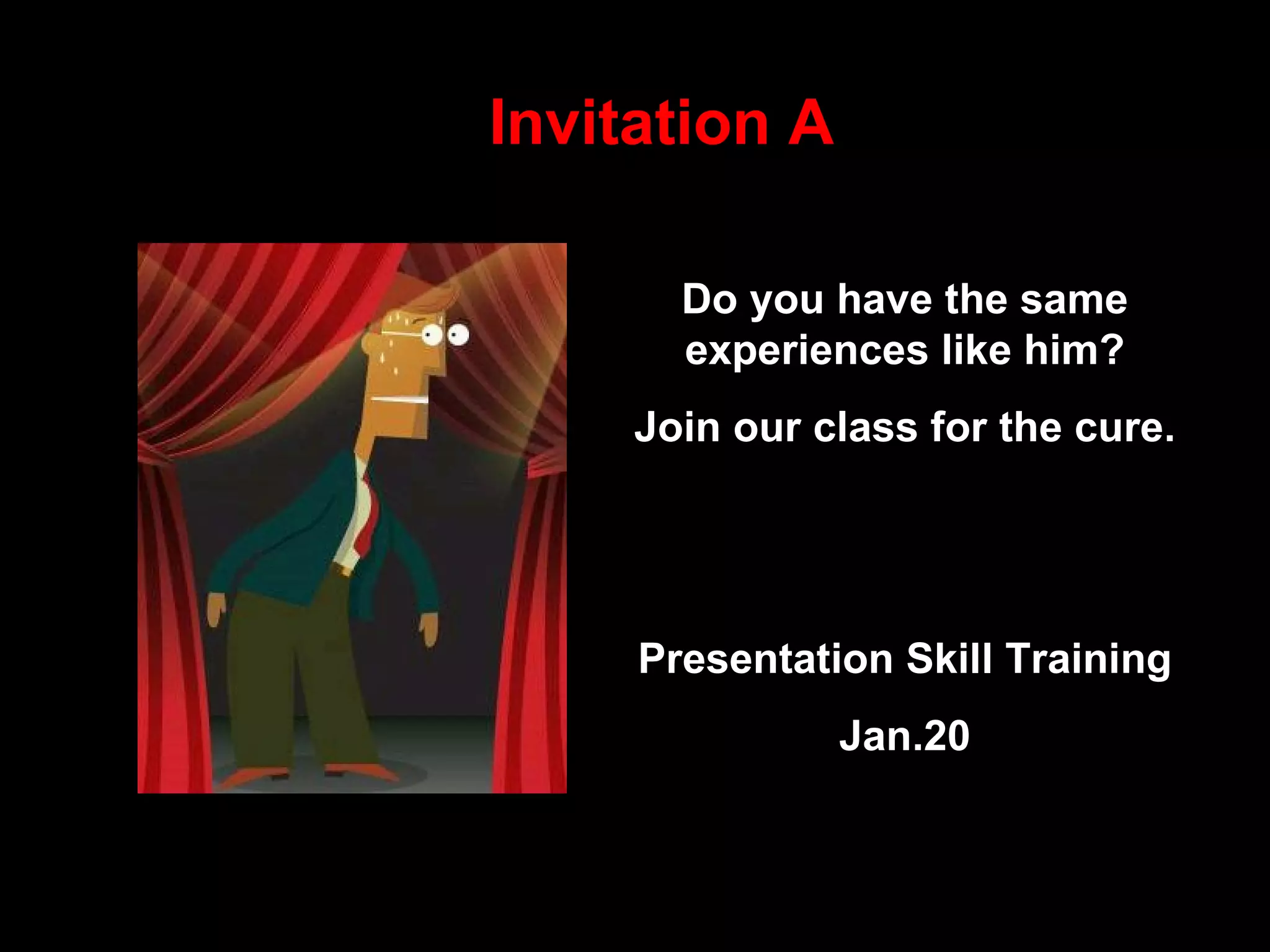
Invitation A Do you have the same experiences like him? Join our class for the cure. Presentation Skill Training Jan.20
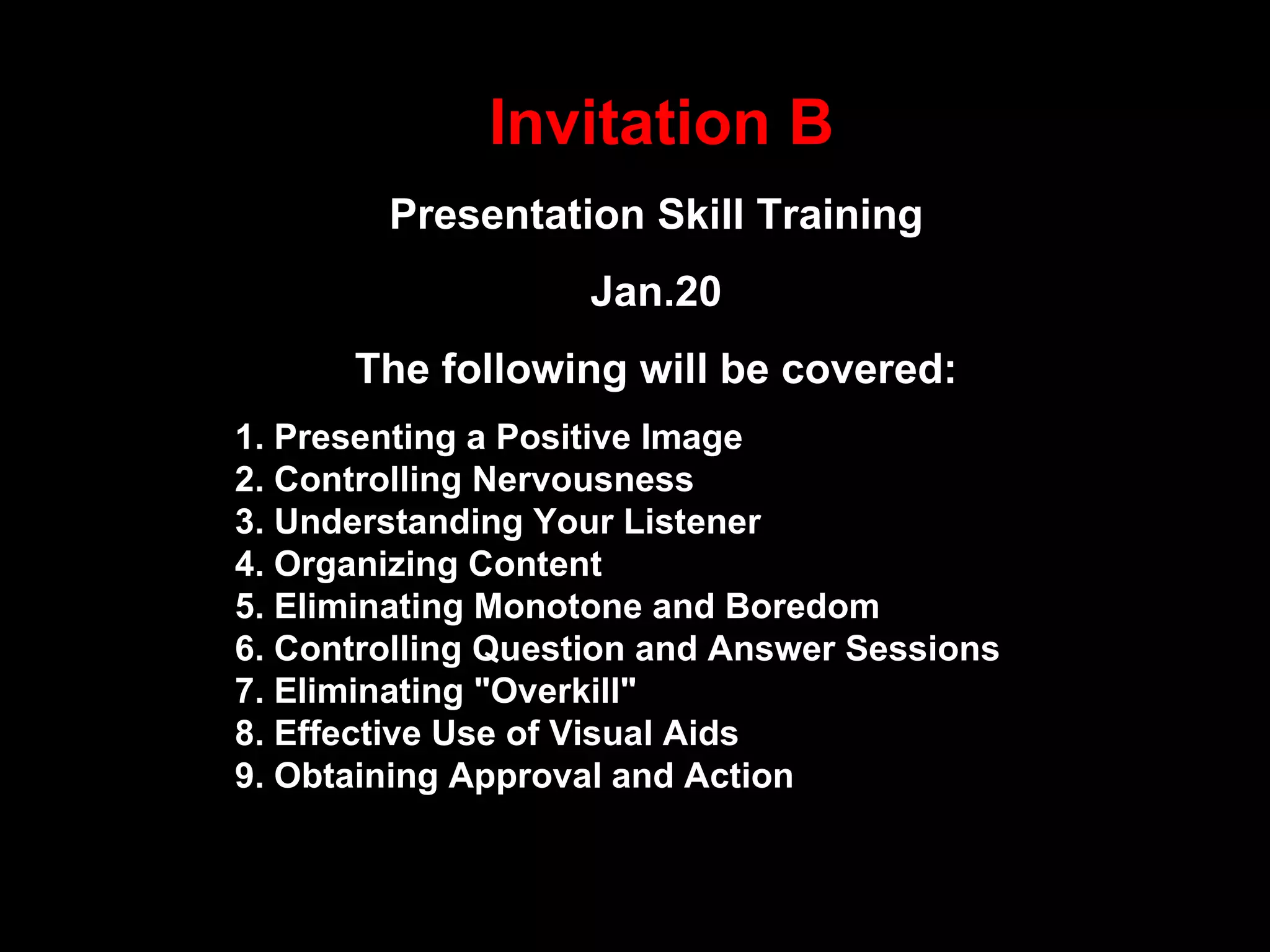
Invitation B Presentation Skill Training Jan.20 The following will be covered: 1. Presenting a Positive Image 2. Controlling Nervousness 3. Understanding Your Listener 4. Organizing Content 5. Eliminating Monotone and Boredom 6. Controlling Question and Answer Sessions 7. Eliminating "Overkill" 8. Effective Use of Visual Aids 9. Obtaining Approval and Action
Invitation C Presentation Skill Workshop Jan.20 This will be an interactive training with a lot of practice and discussion. Bring out your potential by more practice.
Invitation D Presentation Skill Workshop Jan.20 The one day training will not only improve your skills but … Bring more changes on you. Join us to and you will find the answer. ?
‘ Why’ People = 35% ‘ What’ People = 22% ‘ How’ People = 18% ‘ So What’ People = 25%
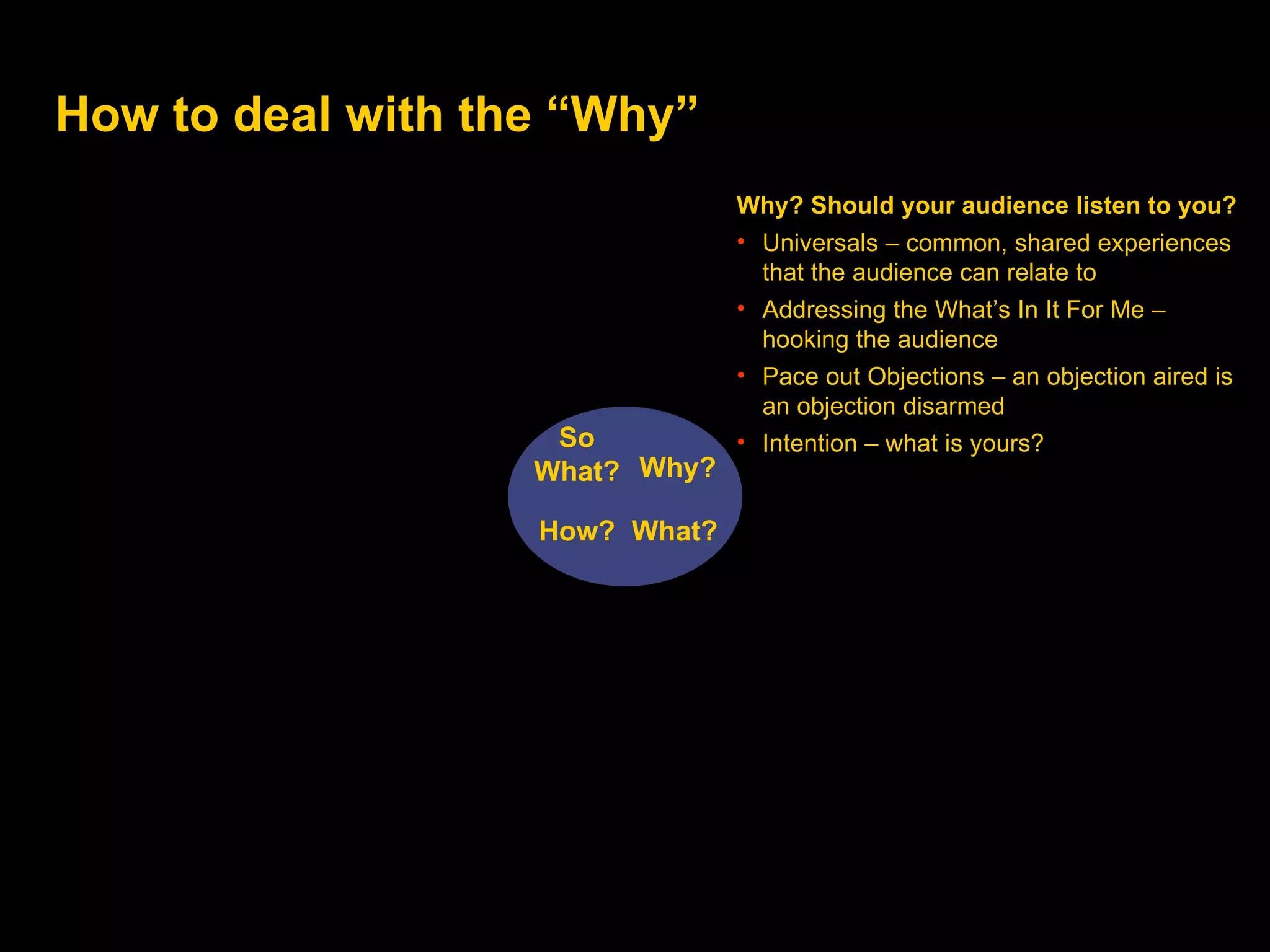
How to deal with the “Why” Why? What? How? So  W hat? Why? Should your audience listen to you? Universals – common, shared experiences that the audience can relate to Addressing the What’s In It For Me – hooking the audience Pace out Objections – an objection aired is an objection disarmed  Intention – what is yours?
Why? Why should I listen to you? Share experience & desire – Rapport Building “ Have you ever met a client who…..” “ We all have experienced conflict somewhere during our working or personal lives…..” “ Would you like to learn how to overcome your fear of public speaking?” Quotes & Statistics “ When we review projects for successful outcomes, 86% of the Critical Success Factors related to Stakeholder management” “ According to the  Book of List,  fear of public speaking is the No1 most common fea” “ If adults do not recall what they have learned within a 24hr time period, they will forget up to 70% of it!”
 
“ Be the Antagonist”  – The convenient storytelling tool
“ Be the Antagonist” “  Will it eat me?” – The antagonist starts with the ‘Problem’ to the audience. Get to the pain point! The antagonist give the audience the big picture, not the details. Start with the key idea! As early as possible.
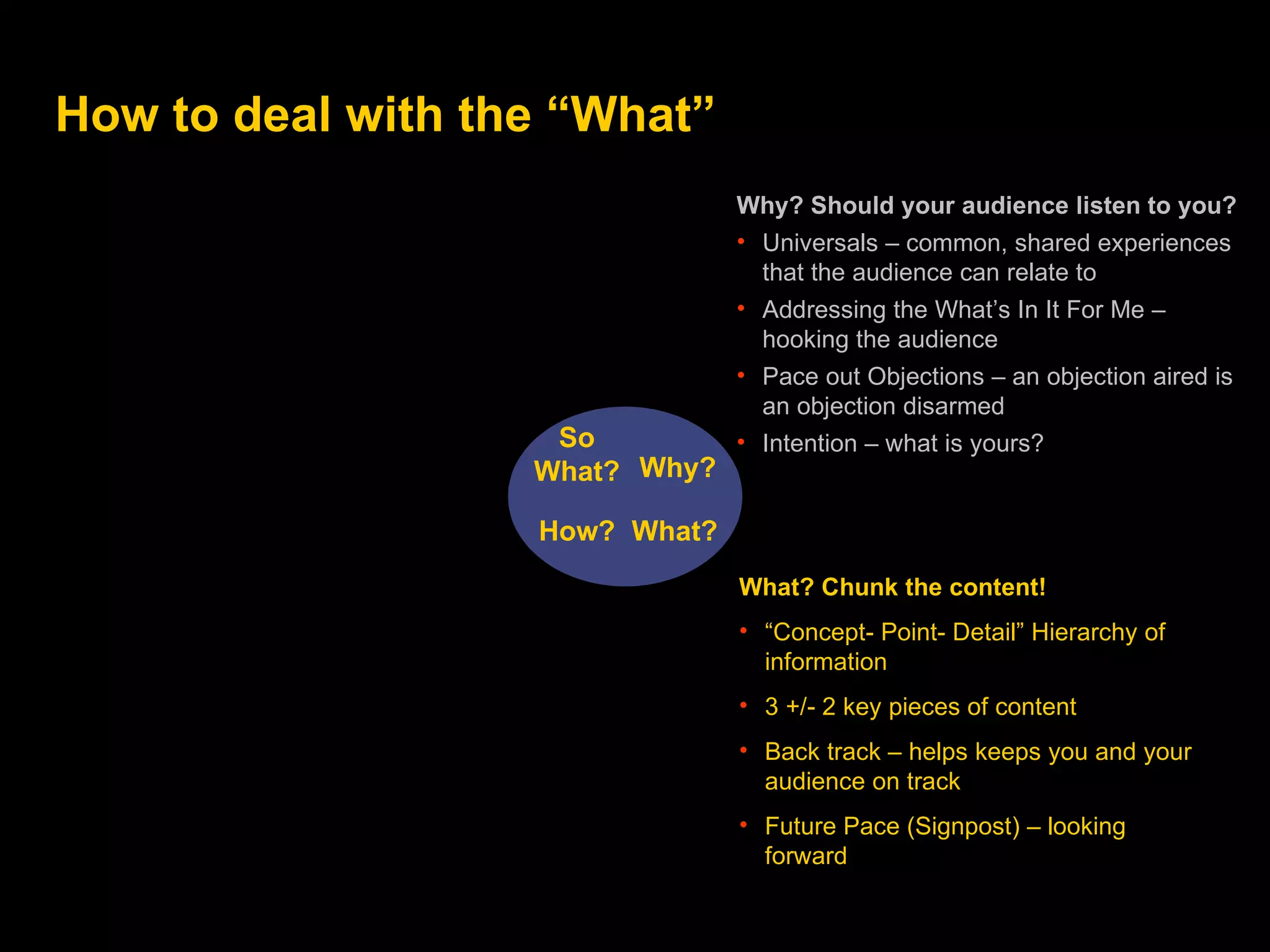
How to deal with the “What” Why? What? How? So  W hat? Why? Should your audience listen to you? Universals – common, shared experiences that the audience can relate to Addressing the What’s In It For Me – hooking the audience Pace out Objections – an objection aired is an objection disarmed  Intention – what is yours? What? Chunk the content! “ Concept- Point- Detail” Hierarchy of information 3 +/- 2 key pieces of content Back track – helps keeps you and your audience on track Future Pace (Signpost)  – looking forward
The magic   3
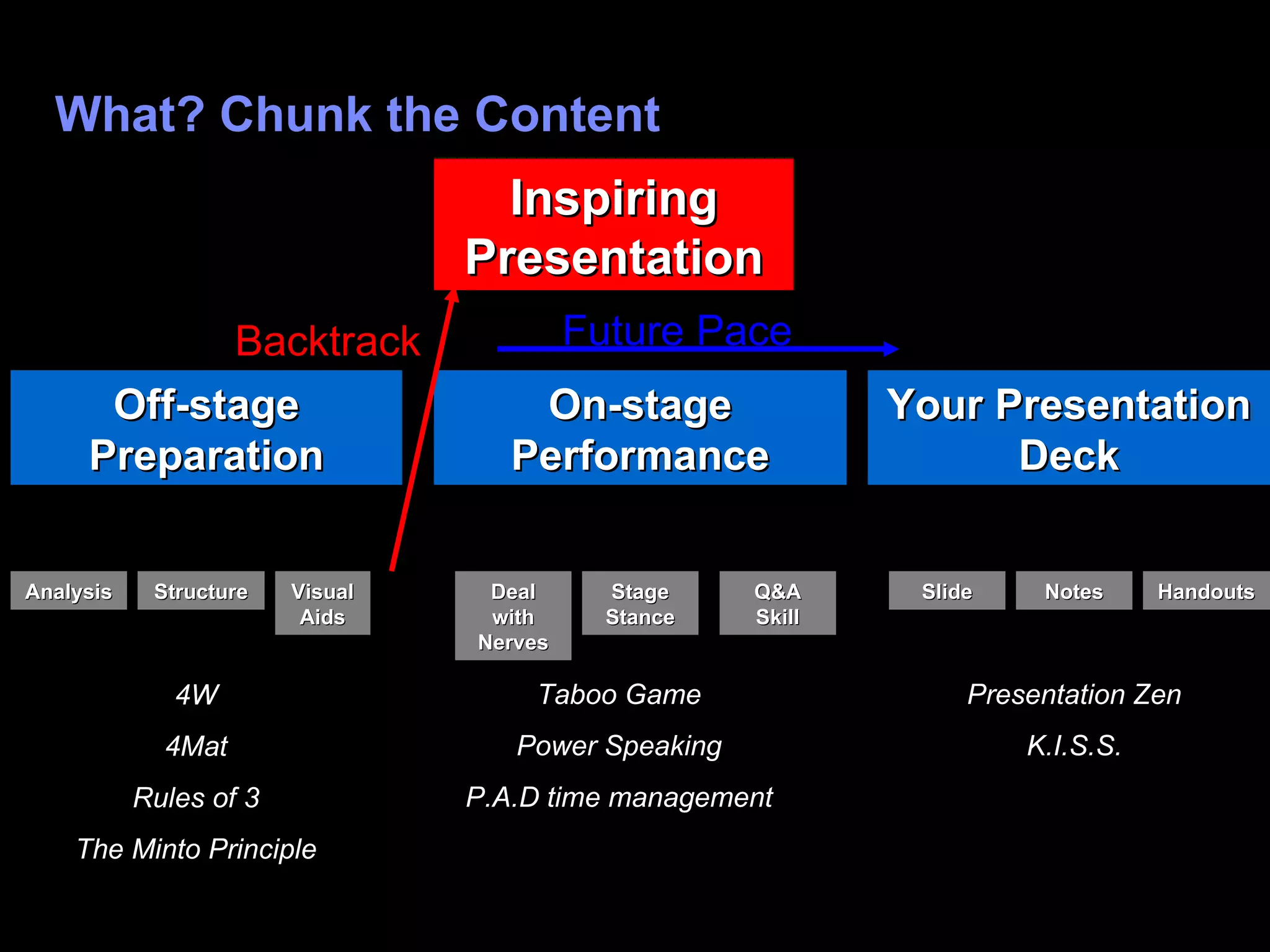
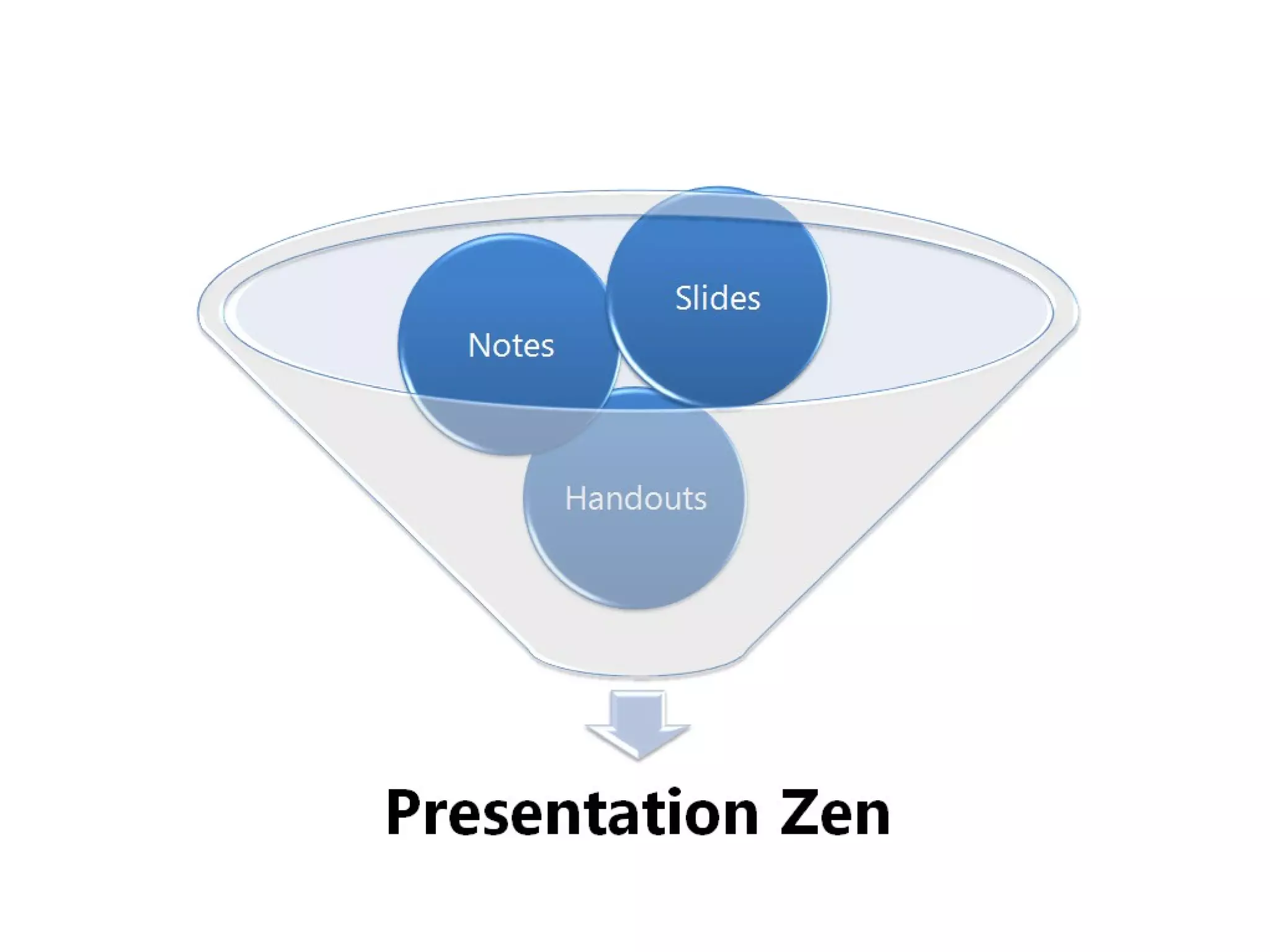
What? Chunk the Content Inspiring Presentation Off-stage Preparation Analysis Structure Visual Aids On-stage Performance Your Presentation Deck Deal with Nerves Stage Stance Q&A Skill Slide Notes Handouts 4W 4Mat Rules of 3 The Minto Principle Taboo Game Power Speaking P.A.D time management Presentation Zen K.I.S.S. Backtrack Future Pace
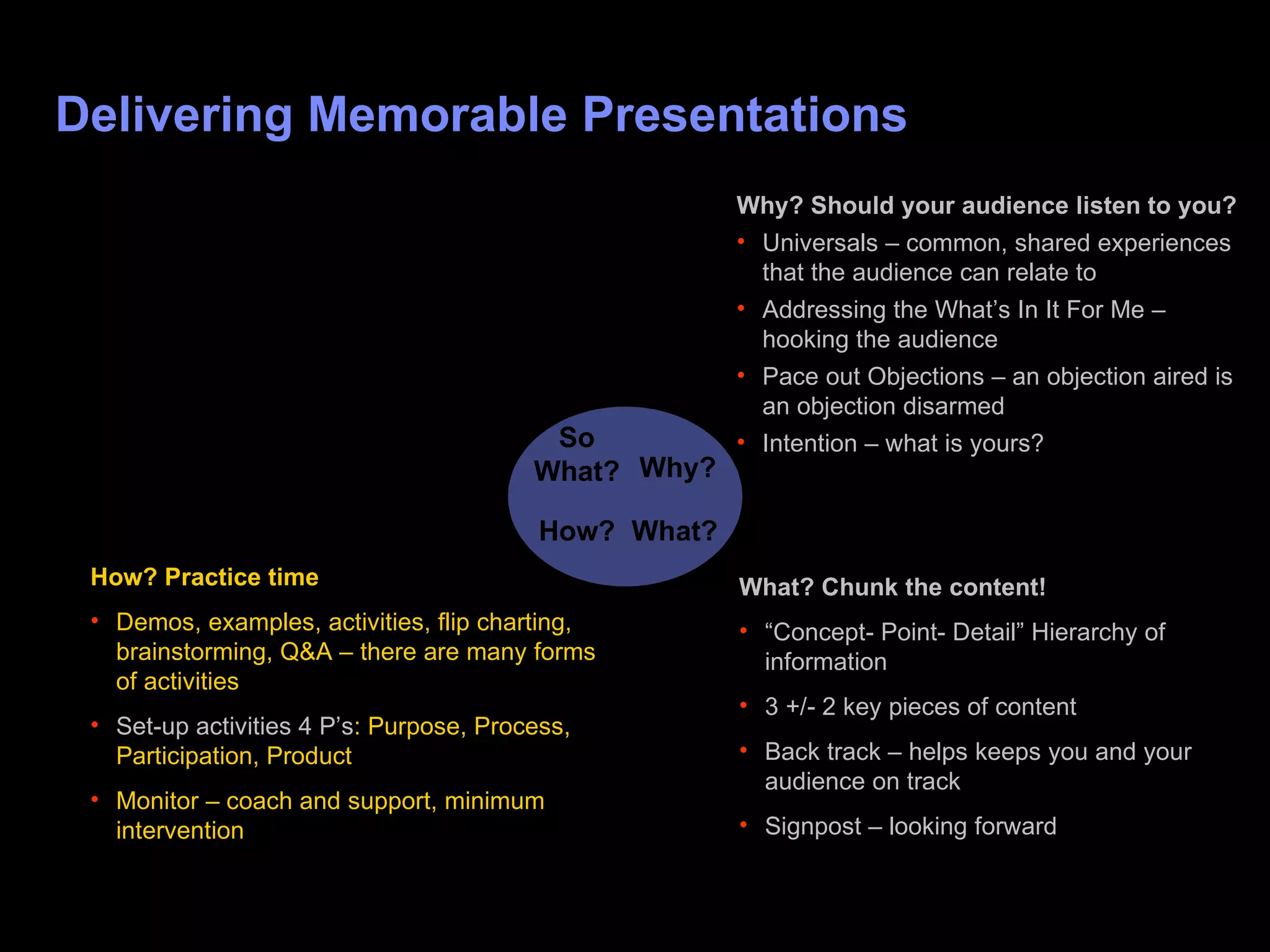
Delivering Memorable Presentations Why? What? How? So  W hat? Why? Should your audience listen to you? Universals – common, shared experiences that the audience can relate to Addressing the What’s In It For Me – hooking the audience Pace out Objections – an objection aired is an objection disarmed  Intention – what is yours? What? Chunk the content! “ Concept- Point- Detail” Hierarchy of information 3 +/- 2 key pieces of content Back track – helps keeps you and your audience on track Signpost – looking forward How? Practice time Demos, examples, activities, flip charting, brainstorming, Q&A – there are many forms of activities Set-up activities 4 P’s : Purpose, Process, Participation, Product Monitor – coach and support, minimum intervention
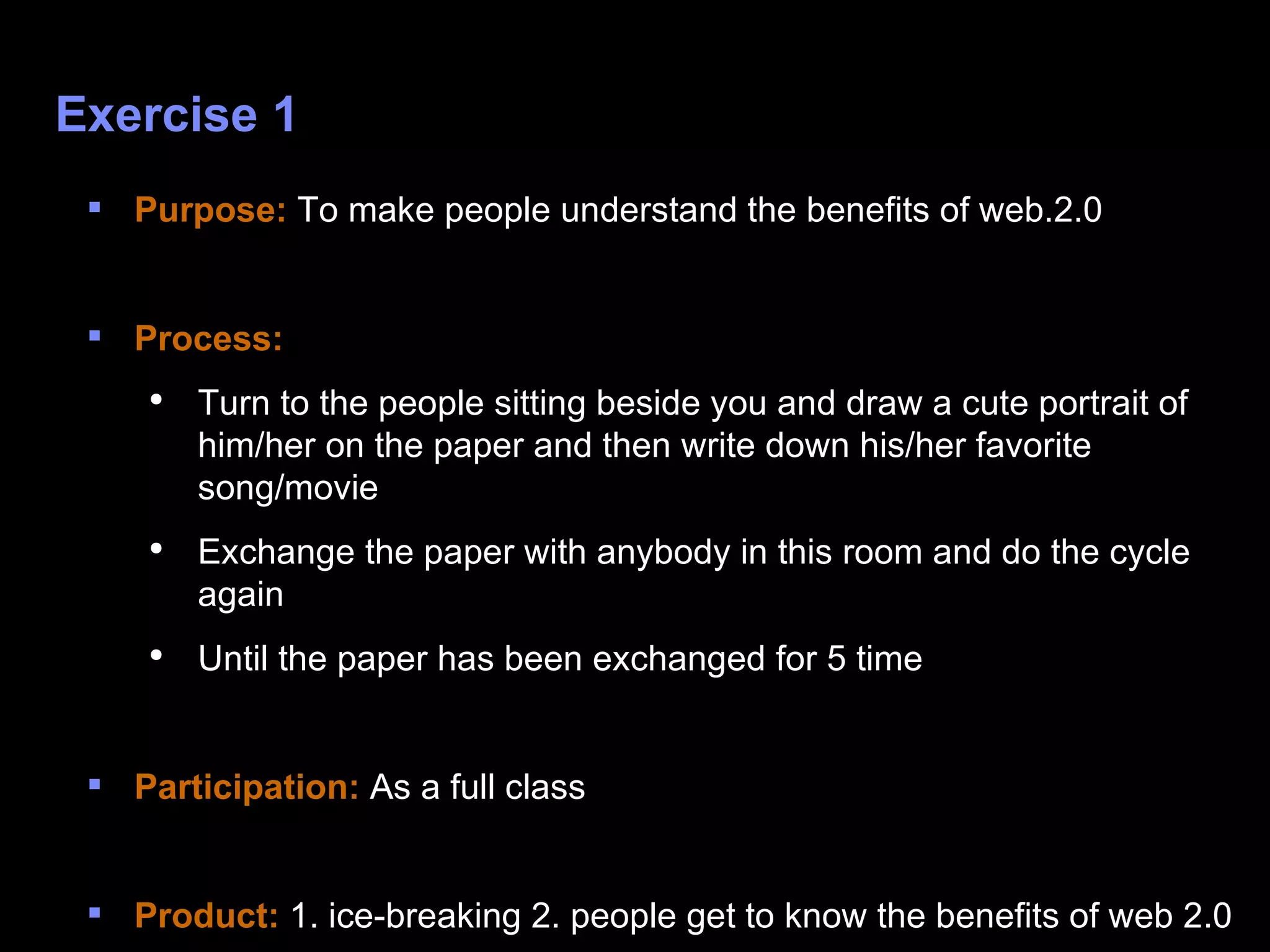
Exercise 1 Purpose:  To make people understand the benefits of web.2.0 Process:  Turn to the people sitting beside you and draw a cute portrait of him/her on the paper and then write down his/her favorite song/movie Exchange the paper with anybody in this room and do the cycle again Until the paper has been exchanged for 5 time  Participation:  As a full class Product:  1. ice-breaking 2. people get to know the benefits of web 2.0
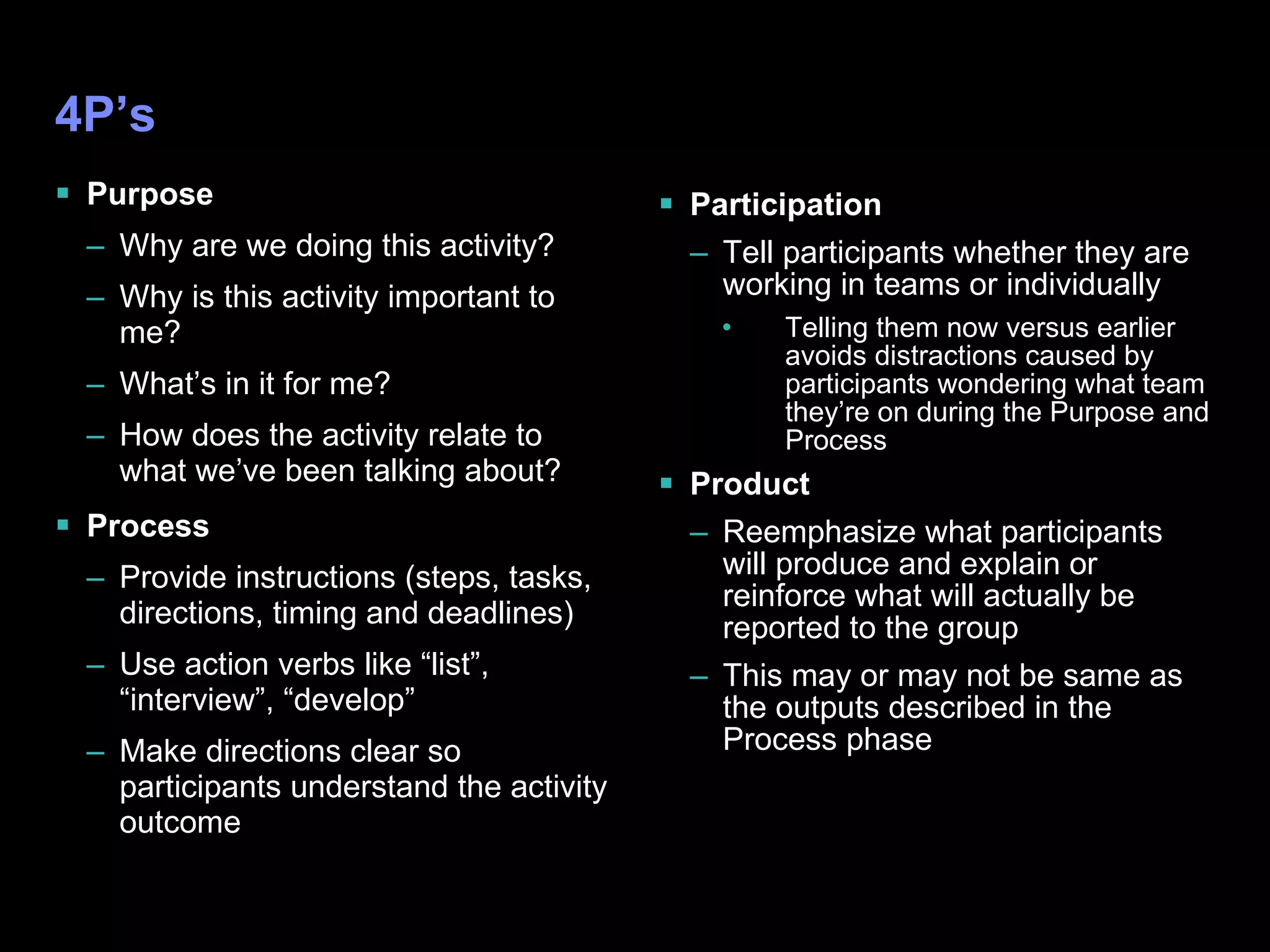
4P’s Purpose Why are we doing this activity? Why is this activity important to me? What’s in it for me? How does the activity relate to what we’ve been talking about? Process Provide instructions (steps, tasks, directions, timing and deadlines) Use action verbs like “list”, “interview”, “develop” Make directions clear so participants understand the activity outcome Participation Tell participants whether they are working in teams or individually Telling them now versus earlier avoids distractions caused by participants wondering what team they’re on during the Purpose and Process  Product Reemphasize what participants will produce and explain or reinforce what will actually be reported to the group This may or may not be same as the outputs described in the Process phase
Exercise 2
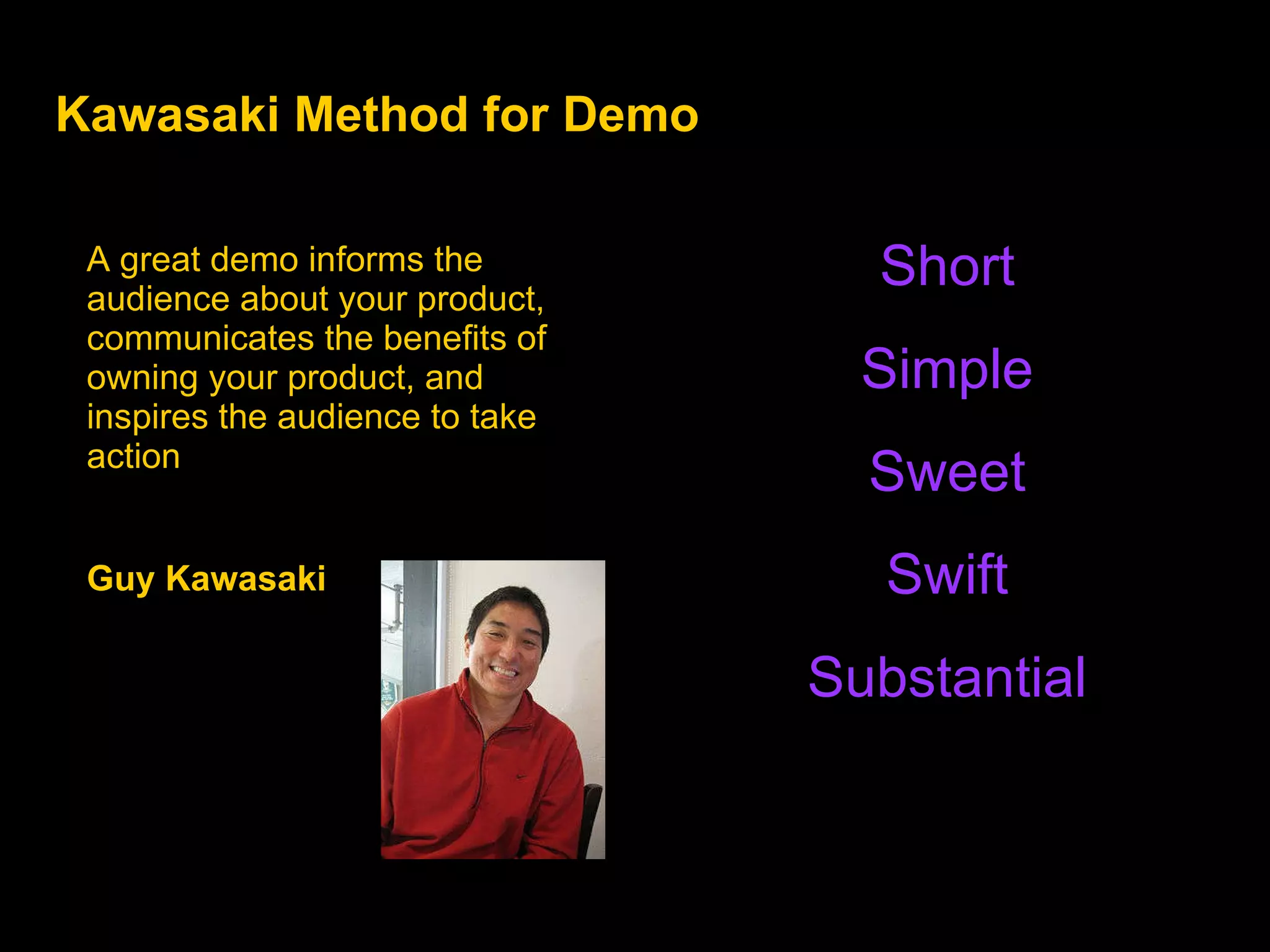
Kawasaki Method for Demo A great demo informs the audience about your product, communicates the benefits of  owning your product, and inspires the audience to take action Guy Kawasaki  Short Simple Sweet Swift Substantial
Delivering Memorable Presentations Why? What? How? So  W hat? Why? Should your audience listen to you? Universals – common, shared experiences that the audience can relate to Addressing the What’s In It For Me – hooking the audience Pace out Objections – an objection aired is an objection disarmed  Intention – what is yours? What? Chunk the content! “ Concept- Point- Detail” Hierarchy of information 3 +/- 2 key pieces of content Back track – helps keeps you and your audience on track Signpost – looking forward How? Practice time Demos, examples, activities, flip charting, brainstorming, Q&A – there are many forms of activities Set-up activities 4 P’s : Purpose, Process, Participation, Product Monitor – coach and support, minimum intervention So what? Back in the workplace Debrief – what happened? How did you feel? What did you learn? How will you apply? Recap – tell ‘em what you’ve told ‘em Future pace – paint a vision of the future with this new knowledge Close and link back to Why?
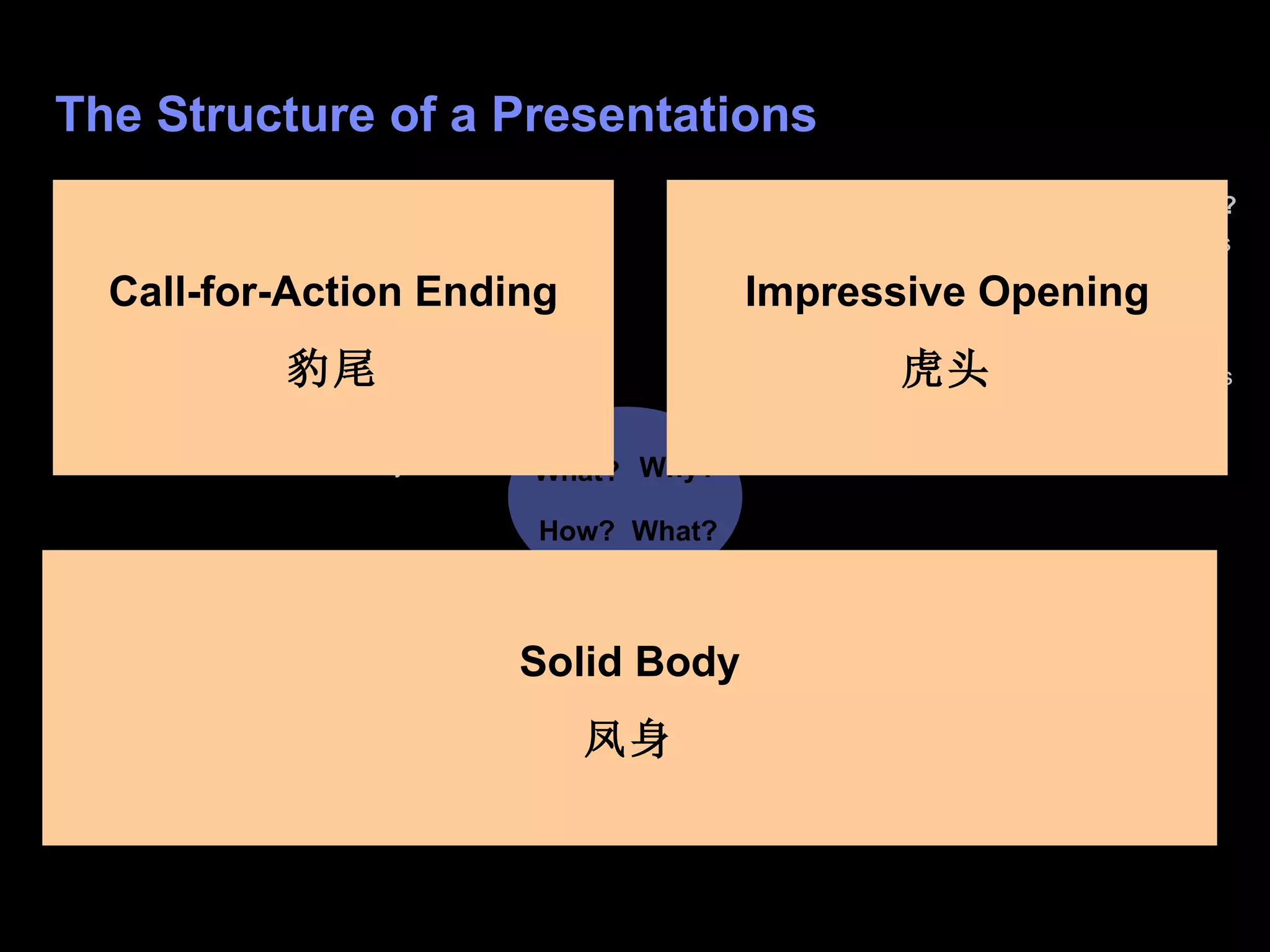
The Structure of a  Presentations Why? What? How? So  W hat? Why? Should your audience listen to you? Universals – common, shared experiences that the audience can relate to Addressing the What’s In It For Me – hooking the audience Pace out Objections – an objection aired is an objection disarmed  Intention – what is yours? What? Chunk the content! “ Concept- Point- Detail” Hierarchy of information 3 +/- 2 key pieces of content Back track – helps keeps you and your audience on track Signpost – looking forward How? Practice time Demos, examples, activities, flip charting, brainstorming, Q&A – there are many forms of activities Set-up activities 4 P’s : Purpose, Process, Participation, Product Monitor – coach and support, minimum intervention So what? Back in the workplace Debrief – what happened? How did you feel? What did you learn? How will you apply? Recap – tell ‘em what you’ve told ‘em Future pace – paint a vision of the future with this new knowledge Close and link back to Why? Impressive Opening 虎头 Solid Body 凤身 Call-for-Action Ending 豹尾
Wrap-Up Time
NO No… it is not the END. We still have something for the “So What”
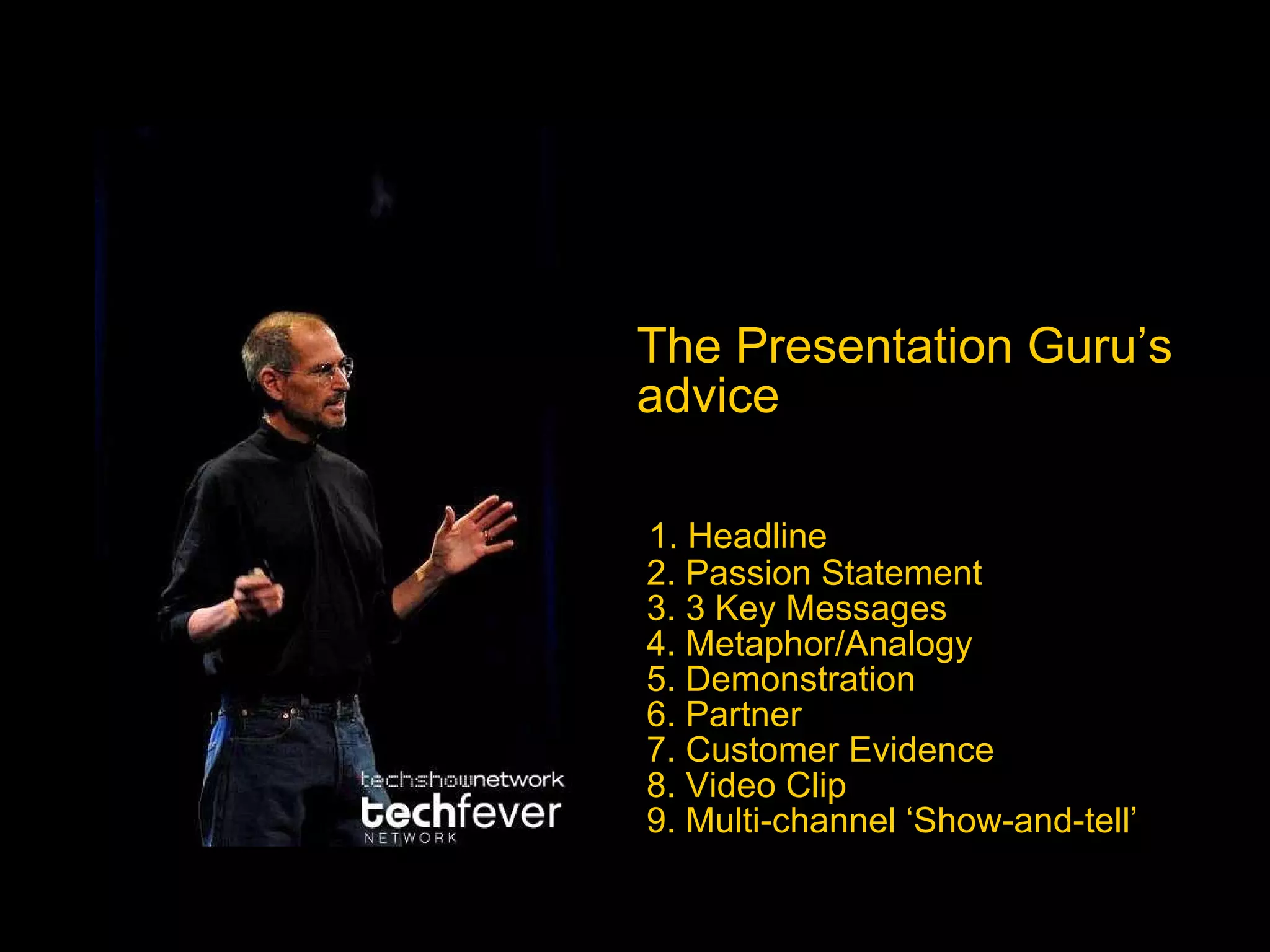
The Presentation Guru’s advice   1. Headline  2. Passion Statement  3. 3 Key Messages  4. Metaphor/Analogy  5. Demonstration  6. Partner  7. Customer Evidence  8. Video Clip  9. Multi-channel ‘Show-and-tell’
Practice isn’t the thing you do once you are good. It’s the thing you do that makes you good. -- Malcolm Gladwell
We Need CHANGE
It’s Your Stage Time


Inspiring Presentation 4mat Joan 120209

  • 1.
    4Mat Models MakeAn Inspiring Presentation Session A: 4 Mat Model Joan Shi
  • 2.
    What themost important thing to a presenter to make an effective presentation?
  • 3.
    The feeling ofyour audience
  • 4.
    People will forgetwhat you said, People will forget what you did, But people will never forget how you made them feel. -- Maya Angelou
  • 5.
    The 4Mat module is the tool to Identify the learning preferences of your audience Help you to prepare your presentation structure and tailor the content to make an effective presentation A magic tool to make quiet people bring out an inspiring presentation
  • 6.
    We will coverWhat’s 4Mat module What’s your preferred learning/delivery style What’s ‘tactics’ to handle different audience
  • 7.
    Children are thefounders of 4Mat Module Some children wanted Reasons “ Why are we doing this? Why does this happen . . ?” Some children wanted Facts “ Tell me about that. How many different sorts are there? What are they called? Where do they come from? What do they do?” Some children wanted Pragmatic “ How do I do this? How does this work?” Some children wanted to explore future consequences What would happen if I did this? What would happen if I didn’t do this? What wouldn’t happen if I did this?”
  • 8.
    Format Model (4Mat) Model Why? What? How? So What ? Sensing and feeling Doing Watching Thinking So What? How can I apply to my job / my life? The Future Why? Why should I listen to you? How does it connect to me How? Let me Try…. What? Show me the detail? Xxxxxxx Xxxxxxx xxxxxxx
  • 9.
    Format Model (4Mat) Model Why? What? How? So W hat? Need to understand why they are here before they are willing to listen, there needs to be something compelling for them to learn For those who just want content, data, facts etc For those kinesthetics that will get bored easily if there is no opportunity for them to get ‘hands on” For those people that need to have a specific and practical purpose for what you have told them, need to understand how to apply it in the workplace, where to go to or do next with this knowledge We naturally deliver in the style that we best learn in so be aware, when you are presenting/delivering There will always be some of each kind in your audience – ignore one section and they will lose interest in what you are saying and won’t learn – this is the same around the world
  • 10.
    What makes youto decide to attend this training Exercise: Identify your preferred style
  • 11.
    Invitation A Doyou have the same experiences like him? Join our class for the cure. Presentation Skill Training Jan.20
  • 12.
    Invitation B PresentationSkill Training Jan.20 The following will be covered: 1. Presenting a Positive Image 2. Controlling Nervousness 3. Understanding Your Listener 4. Organizing Content 5. Eliminating Monotone and Boredom 6. Controlling Question and Answer Sessions 7. Eliminating "Overkill" 8. Effective Use of Visual Aids 9. Obtaining Approval and Action
  • 13.
    Invitation C PresentationSkill Workshop Jan.20 This will be an interactive training with a lot of practice and discussion. Bring out your potential by more practice.
  • 14.
    Invitation D PresentationSkill Workshop Jan.20 The one day training will not only improve your skills but … Bring more changes on you. Join us to and you will find the answer. ?
  • 15.
    ‘ Why’ People= 35% ‘ What’ People = 22% ‘ How’ People = 18% ‘ So What’ People = 25%
  • 16.
    How to dealwith the “Why” Why? What? How? So W hat? Why? Should your audience listen to you? Universals – common, shared experiences that the audience can relate to Addressing the What’s In It For Me – hooking the audience Pace out Objections – an objection aired is an objection disarmed Intention – what is yours?
  • 17.
    Why? Why shouldI listen to you? Share experience & desire – Rapport Building “ Have you ever met a client who…..” “ We all have experienced conflict somewhere during our working or personal lives…..” “ Would you like to learn how to overcome your fear of public speaking?” Quotes & Statistics “ When we review projects for successful outcomes, 86% of the Critical Success Factors related to Stakeholder management” “ According to the Book of List, fear of public speaking is the No1 most common fea” “ If adults do not recall what they have learned within a 24hr time period, they will forget up to 70% of it!”
  • 18.
  • 19.
    “ Be theAntagonist” – The convenient storytelling tool
  • 20.
    “ Be theAntagonist” “ Will it eat me?” – The antagonist starts with the ‘Problem’ to the audience. Get to the pain point! The antagonist give the audience the big picture, not the details. Start with the key idea! As early as possible.
  • 21.
    How to dealwith the “What” Why? What? How? So W hat? Why? Should your audience listen to you? Universals – common, shared experiences that the audience can relate to Addressing the What’s In It For Me – hooking the audience Pace out Objections – an objection aired is an objection disarmed Intention – what is yours? What? Chunk the content! “ Concept- Point- Detail” Hierarchy of information 3 +/- 2 key pieces of content Back track – helps keeps you and your audience on track Future Pace (Signpost) – looking forward
  • 22.
  • 23.
    What? Chunk theContent Inspiring Presentation Off-stage Preparation Analysis Structure Visual Aids On-stage Performance Your Presentation Deck Deal with Nerves Stage Stance Q&A Skill Slide Notes Handouts 4W 4Mat Rules of 3 The Minto Principle Taboo Game Power Speaking P.A.D time management Presentation Zen K.I.S.S. Backtrack Future Pace
  • 24.
    Delivering Memorable PresentationsWhy? What? How? So W hat? Why? Should your audience listen to you? Universals – common, shared experiences that the audience can relate to Addressing the What’s In It For Me – hooking the audience Pace out Objections – an objection aired is an objection disarmed Intention – what is yours? What? Chunk the content! “ Concept- Point- Detail” Hierarchy of information 3 +/- 2 key pieces of content Back track – helps keeps you and your audience on track Signpost – looking forward How? Practice time Demos, examples, activities, flip charting, brainstorming, Q&A – there are many forms of activities Set-up activities 4 P’s : Purpose, Process, Participation, Product Monitor – coach and support, minimum intervention
  • 25.
    Exercise 1 Purpose: To make people understand the benefits of web.2.0 Process: Turn to the people sitting beside you and draw a cute portrait of him/her on the paper and then write down his/her favorite song/movie Exchange the paper with anybody in this room and do the cycle again Until the paper has been exchanged for 5 time Participation: As a full class Product: 1. ice-breaking 2. people get to know the benefits of web 2.0
  • 26.
    4P’s Purpose Whyare we doing this activity? Why is this activity important to me? What’s in it for me? How does the activity relate to what we’ve been talking about? Process Provide instructions (steps, tasks, directions, timing and deadlines) Use action verbs like “list”, “interview”, “develop” Make directions clear so participants understand the activity outcome Participation Tell participants whether they are working in teams or individually Telling them now versus earlier avoids distractions caused by participants wondering what team they’re on during the Purpose and Process Product Reemphasize what participants will produce and explain or reinforce what will actually be reported to the group This may or may not be same as the outputs described in the Process phase
  • 27.
  • 28.
    Kawasaki Method forDemo A great demo informs the audience about your product, communicates the benefits of owning your product, and inspires the audience to take action Guy Kawasaki Short Simple Sweet Swift Substantial
  • 29.
    Delivering Memorable PresentationsWhy? What? How? So W hat? Why? Should your audience listen to you? Universals – common, shared experiences that the audience can relate to Addressing the What’s In It For Me – hooking the audience Pace out Objections – an objection aired is an objection disarmed Intention – what is yours? What? Chunk the content! “ Concept- Point- Detail” Hierarchy of information 3 +/- 2 key pieces of content Back track – helps keeps you and your audience on track Signpost – looking forward How? Practice time Demos, examples, activities, flip charting, brainstorming, Q&A – there are many forms of activities Set-up activities 4 P’s : Purpose, Process, Participation, Product Monitor – coach and support, minimum intervention So what? Back in the workplace Debrief – what happened? How did you feel? What did you learn? How will you apply? Recap – tell ‘em what you’ve told ‘em Future pace – paint a vision of the future with this new knowledge Close and link back to Why?
  • 30.
    The Structure ofa Presentations Why? What? How? So W hat? Why? Should your audience listen to you? Universals – common, shared experiences that the audience can relate to Addressing the What’s In It For Me – hooking the audience Pace out Objections – an objection aired is an objection disarmed Intention – what is yours? What? Chunk the content! “ Concept- Point- Detail” Hierarchy of information 3 +/- 2 key pieces of content Back track – helps keeps you and your audience on track Signpost – looking forward How? Practice time Demos, examples, activities, flip charting, brainstorming, Q&A – there are many forms of activities Set-up activities 4 P’s : Purpose, Process, Participation, Product Monitor – coach and support, minimum intervention So what? Back in the workplace Debrief – what happened? How did you feel? What did you learn? How will you apply? Recap – tell ‘em what you’ve told ‘em Future pace – paint a vision of the future with this new knowledge Close and link back to Why? Impressive Opening 虎头 Solid Body 凤身 Call-for-Action Ending 豹尾
  • 31.
  • 32.
    NO No… itis not the END. We still have something for the “So What”
  • 33.
    The Presentation Guru’sadvice 1. Headline 2. Passion Statement 3. 3 Key Messages 4. Metaphor/Analogy 5. Demonstration 6. Partner 7. Customer Evidence 8. Video Clip 9. Multi-channel ‘Show-and-tell’
  • 34.
    Practice isn’t thething you do once you are good. It’s the thing you do that makes you good. -- Malcolm Gladwell
  • 35.
  • 36.
  • 37.
  • 38.
  • 39.

Editor's Notes

  • #23 The most powerful concept in communication