Bridging the Implementation Gap OSPI January 31, 2008 Alison Olzendam, Ph. D. Heather Knight, MA, Certified Coach
Agenda Research behind key strategies knowledge into action 5 principles of adult learning Adult development/improving teaching and learning Strategies for sustainable practices Collaborate in small groups to apply concepts
Think of a recent initiative New, proposed, or in process. What is the initiative? What is the plan for implementation? What has been done to ensure success of the initiative?
Let’s start at the beginning… What do we know about adult learning? Same?  Different?
Children………………Adults Children: Rely on others to decide what is important to be learned. Adults: Decide for themselves what is important to be learned.
Children……………Adults Children: Accept the information being presented  at face value. Adults: Need to validate the information based on their beliefs and values.
Children……………..Adults Children: Expect what they are learning to be useful in their long-term future. Adults: Expect what they are learning to be immediately useful.
Children……………..Adults Children: Have little or no experience upon which to draw, are relatively "blank slates.“ Adults: Have substantial experience upon which to draw. May have fixed viewpoints.
Children………………Adults Children: Little ability to serve as a knowledgeable resource to teacher or fellow classmates.  Adults: Significant ability to serve as a knowledgeable resource to the trainer and fellow learners.
Why should we concern ourselves with this? What are the reasons? Elbow partners, discuss all the reasons we should consider principles of adult learning
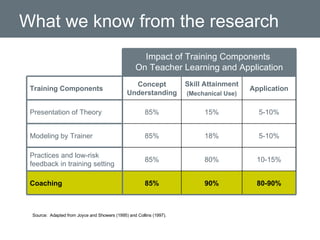
What we know from the research Source:  Adapted from Joyce and Showers (1995) and Collins (1997). 80-90% 90% 85% Coaching 10-15% 80% 85% Practices and low-risk feedback in training setting 5-10% 18% 85% Modeling by Trainer 5-10% 15% 85% Presentation of Theory Application Skill Attainment (Mechanical Use) Concept Understanding Training Components Impact of Training Components  On Teacher Learning and Application
Five Principles of Adult Learning Leadership Experience Appeal Respect Novel Styles
Groups of five Read the information on your principle Read the material individually, then discuss As a group decide the most important points Represent these on the poster Songs, skits, pictures, all are encouraged Decide which parts will be presented by whom.  This is a group effort.
Pike’s Laws of Adult Learning Read over Pike’s Laws.  What do you want to add to the principles? Discuss with a new partner what you would want to add and why.
Learning Targets  Know and understand the research behind implementation of training Be able to plan for turning training into practices
What do we know about implementation of training? Have we considered this aspect of training as carefully as the training itself?
The Implementation Problem How do we successfully transfer what is learned… Into what is done in the classroom?
Implementation of training What do we know about successful implementation?
Think of training in three phases Phase I Includes things you do in preparation  Pre-reading, gathering information
Phase II The learning event itself Could be workshop, e-learning course, etc.
Phase III All things that happen once the learning event is over Practicing a new skill, completing specific action commitments
Evidence suggests… One fourth of the final outcome-Phase I One fourth of the final outcome-Phase 2 Remaining half of any learning outcomes result from what is done during Phase 3 Phase 3-”learning transfer” or “implementation”
Why follow through important? What you can do to make implementation more successful
Training last week…great training! Monday morning…dozens of emails, papers to grade, voicemails… By the end of the week, caught up One month later… How are you doing on your goals? What has changed as a result of the training you received?
Phase 3 Huge investments in training  Phase 3 has been largely ignored
Where is the effort? On training, or transfer of learning after the event? We block out time to attend a learning Don’t always think about blocking out time to practice Focus on grasping new concepts…but fail to make concrete plans on application
Setting Goals…key part of process To complete daily work responsibilities Forget to set goals to implement commitments following development experience
Accountability? Accountable to contribute Accountable to apply or practice new skills? Not easy… “ I once took a physics course that was so hard I couldn’t find the classroom…Steve Connelly
Observations about accountability When principals don’t ask how new skills will be applied… Principals are busy…may be interested, but… We know what our job responsibilities are…is follow up and application new skills part of this?
Attention paid to implementation Attendance at training is observed and noticed How much attention paid to implementation?
Follow up systems? We have systems to manage daily business Follow up system to apply new learning? What could these systems look like? “ Right now I’m having amnesia and déjà vu at the same time.  I think I’ve forgotten this before”  -Steven Wright
To perform at your best… Schools need teachers to be at their best Are they the best they can be? Training takes them from good to great…if the training is applied. The nice thing about being mediocre is that you’re always at your best”  -Tommy Smothers
Continual improvement… How important? Why? “ It’s not that I’m so smart, it’s just that I stay with problems longer” -Albert Einstein
What’s in it for them?  You? Career opportunities? Personal growth? Think of something you have accomplished… “ It’s the performance that counts, not the size of the stage” –Neil A. Maxwell
Making a difference… Will PT & L make a difference?  How?
Goal statements We tend to set them…but… When and how are goals revisited? “ Sometimes I feel like a rhinoceros who doesn’t see so well and whose power of concentration is terrible.  He suddenly charges enthusiastically at something that is a long way off, then forgets where he is going and stops to eat grass”  CEO on the important of clear objectives
A strategy… Public commitments 97% of New Year’s resolutions are abandoned within 30 days Why?  They are private How can this process be public? Second step…ask for feedback
Help teachers understand… The implementation dip Temporary discomfort Remember the notion of practice When people ask me if I do my own stunts, I always answer, “not on purpose” –Billy Bob Thornton
Commitments and goals… How can you be sure those things will happen? Checkpoints along the way?  What would that look like? “ Success is not the result of spontaneous combustion.  You must set yourself on fire”  -Reggie Leach
Not rocket science… Awareness… Activities The word “genius” isn’t applicable in football.  A genius is a guy like Norman Einstein –Joe Theisman, Sports Analyst
High quality professional development takes place at school, not far away from school;  occurs daily, not occasionally; engages teams, not individuals; relies on discussion, not presentation; requires initiative, not passivity; stimulates thinking, not inattention; emphasizes creation, not replication; sparks investigation, not transmission;  generates understanding, not confusion;  produces ownership, not compliance; improves practice, not deception.
Let’s Look at Resistance… Beyond the Wall of Resistance Rick Maurer
Why do people resist? Protection from the unknown Patterns of behavior  Fear of change Ingrained loyalties that make it difficult to see other perspectives Inability to imagine or vision
Levels of Resistance Level One – Low Grade No hidden agenda, don’t like the idea/the proposed change etc. Level Two – Deeper Issues   People feel vulnerable, distrust, fearful Level Three – Deeply Embedded   conflicting values and vision, a history of distrust, “I’ve been burned before” or  “this too shall pass” –  Very difficult work
Recognizing resistance – Discussion How does resistance show up in your work?  Confusion Immediate criticism  “ Ya but” Easy agreement Sabotage Excuses, excuses and more excuses
Skills in resistance work- tips to keep in mind Take resistance seriously Design and structure questions that facilitate discovery Be patient, there are no quick fixes here Explore the unknown Give resistance a voice to dissipate the force
Skills in resistance work- tips to keep in mind Some resistance is normal Accept and work with resistance See their reluctance as avoidance not ill-will Help them search for incentives to move Tap others as resources  Explore your own reluctance and resistance
Maurer’s Five Touchstones  Maintain clear focus Embrace resistance  Respect those who resist Relax Join with the resistance
What’s Your Contribution to the Issue? “ Everyone thinks of changing the world, but no one thinks of changing himself” -Tolstoy Model not mandate.
The goals of the PTL experience for teachers are: Create a climate of professional learning community Promote opportunities for personal reflection and growth  Offer a constructivist learning experience for teachers  Provoke a sense of curiosity, exploration, and experimentation  Develop a shared understanding regarding effective teaching and learning practices  Transform teaching and learning to raise student performance
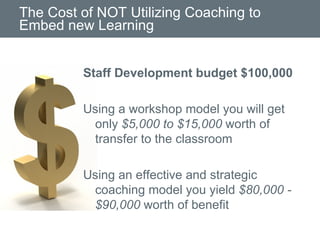
The Cost of NOT Utilizing Coaching to Embed new Learning Staff Development budget $100,000 Using a workshop model you will get only  $5,000 to $15,000  worth of transfer to the classroom Using an effective and strategic coaching model you yield  $80,000 - $90,000  worth of benefit
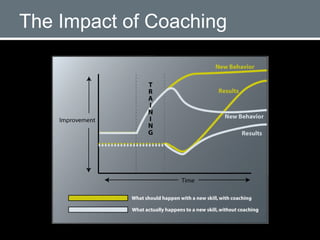
The Impact of Coaching
“ Who dares to teach must never cease to learn.” John Cotton Dana

Bridging the Implementation Gap

  • 1.
    Bridging the ImplementationGap OSPI January 31, 2008 Alison Olzendam, Ph. D. Heather Knight, MA, Certified Coach
  • 2.
    Agenda Research behindkey strategies knowledge into action 5 principles of adult learning Adult development/improving teaching and learning Strategies for sustainable practices Collaborate in small groups to apply concepts
  • 3.
    Think of arecent initiative New, proposed, or in process. What is the initiative? What is the plan for implementation? What has been done to ensure success of the initiative?
  • 4.
    Let’s start atthe beginning… What do we know about adult learning? Same? Different?
  • 5.
    Children………………Adults Children: Relyon others to decide what is important to be learned. Adults: Decide for themselves what is important to be learned.
  • 6.
    Children……………Adults Children: Acceptthe information being presented at face value. Adults: Need to validate the information based on their beliefs and values.
  • 7.
    Children……………..Adults Children: Expectwhat they are learning to be useful in their long-term future. Adults: Expect what they are learning to be immediately useful.
  • 8.
    Children……………..Adults Children: Havelittle or no experience upon which to draw, are relatively "blank slates.“ Adults: Have substantial experience upon which to draw. May have fixed viewpoints.
  • 9.
    Children………………Adults Children: Littleability to serve as a knowledgeable resource to teacher or fellow classmates. Adults: Significant ability to serve as a knowledgeable resource to the trainer and fellow learners.
  • 10.
    Why should weconcern ourselves with this? What are the reasons? Elbow partners, discuss all the reasons we should consider principles of adult learning
  • 11.
    What we knowfrom the research Source: Adapted from Joyce and Showers (1995) and Collins (1997). 80-90% 90% 85% Coaching 10-15% 80% 85% Practices and low-risk feedback in training setting 5-10% 18% 85% Modeling by Trainer 5-10% 15% 85% Presentation of Theory Application Skill Attainment (Mechanical Use) Concept Understanding Training Components Impact of Training Components On Teacher Learning and Application
  • 12.
    Five Principles ofAdult Learning Leadership Experience Appeal Respect Novel Styles
  • 13.
    Groups of fiveRead the information on your principle Read the material individually, then discuss As a group decide the most important points Represent these on the poster Songs, skits, pictures, all are encouraged Decide which parts will be presented by whom. This is a group effort.
  • 14.
    Pike’s Laws ofAdult Learning Read over Pike’s Laws. What do you want to add to the principles? Discuss with a new partner what you would want to add and why.
  • 15.
    Learning Targets Know and understand the research behind implementation of training Be able to plan for turning training into practices
  • 16.
    What do weknow about implementation of training? Have we considered this aspect of training as carefully as the training itself?
  • 17.
    The Implementation ProblemHow do we successfully transfer what is learned… Into what is done in the classroom?
  • 18.
    Implementation of trainingWhat do we know about successful implementation?
  • 19.
    Think of trainingin three phases Phase I Includes things you do in preparation Pre-reading, gathering information
  • 20.
    Phase II Thelearning event itself Could be workshop, e-learning course, etc.
  • 21.
    Phase III Allthings that happen once the learning event is over Practicing a new skill, completing specific action commitments
  • 22.
    Evidence suggests… Onefourth of the final outcome-Phase I One fourth of the final outcome-Phase 2 Remaining half of any learning outcomes result from what is done during Phase 3 Phase 3-”learning transfer” or “implementation”
  • 23.
    Why follow throughimportant? What you can do to make implementation more successful
  • 24.
    Training last week…greattraining! Monday morning…dozens of emails, papers to grade, voicemails… By the end of the week, caught up One month later… How are you doing on your goals? What has changed as a result of the training you received?
  • 25.
    Phase 3 Hugeinvestments in training Phase 3 has been largely ignored
  • 26.
    Where is theeffort? On training, or transfer of learning after the event? We block out time to attend a learning Don’t always think about blocking out time to practice Focus on grasping new concepts…but fail to make concrete plans on application
  • 27.
    Setting Goals…key partof process To complete daily work responsibilities Forget to set goals to implement commitments following development experience
  • 28.
    Accountability? Accountable tocontribute Accountable to apply or practice new skills? Not easy… “ I once took a physics course that was so hard I couldn’t find the classroom…Steve Connelly
  • 29.
    Observations about accountabilityWhen principals don’t ask how new skills will be applied… Principals are busy…may be interested, but… We know what our job responsibilities are…is follow up and application new skills part of this?
  • 30.
    Attention paid toimplementation Attendance at training is observed and noticed How much attention paid to implementation?
  • 31.
    Follow up systems?We have systems to manage daily business Follow up system to apply new learning? What could these systems look like? “ Right now I’m having amnesia and déjà vu at the same time. I think I’ve forgotten this before” -Steven Wright
  • 32.
    To perform atyour best… Schools need teachers to be at their best Are they the best they can be? Training takes them from good to great…if the training is applied. The nice thing about being mediocre is that you’re always at your best” -Tommy Smothers
  • 33.
    Continual improvement… Howimportant? Why? “ It’s not that I’m so smart, it’s just that I stay with problems longer” -Albert Einstein
  • 34.
    What’s in itfor them? You? Career opportunities? Personal growth? Think of something you have accomplished… “ It’s the performance that counts, not the size of the stage” –Neil A. Maxwell
  • 35.
    Making a difference…Will PT & L make a difference? How?
  • 36.
    Goal statements Wetend to set them…but… When and how are goals revisited? “ Sometimes I feel like a rhinoceros who doesn’t see so well and whose power of concentration is terrible. He suddenly charges enthusiastically at something that is a long way off, then forgets where he is going and stops to eat grass” CEO on the important of clear objectives
  • 37.
    A strategy… Publiccommitments 97% of New Year’s resolutions are abandoned within 30 days Why? They are private How can this process be public? Second step…ask for feedback
  • 38.
    Help teachers understand…The implementation dip Temporary discomfort Remember the notion of practice When people ask me if I do my own stunts, I always answer, “not on purpose” –Billy Bob Thornton
  • 39.
    Commitments and goals…How can you be sure those things will happen? Checkpoints along the way? What would that look like? “ Success is not the result of spontaneous combustion. You must set yourself on fire” -Reggie Leach
  • 40.
    Not rocket science…Awareness… Activities The word “genius” isn’t applicable in football. A genius is a guy like Norman Einstein –Joe Theisman, Sports Analyst
  • 41.
    High quality professionaldevelopment takes place at school, not far away from school; occurs daily, not occasionally; engages teams, not individuals; relies on discussion, not presentation; requires initiative, not passivity; stimulates thinking, not inattention; emphasizes creation, not replication; sparks investigation, not transmission; generates understanding, not confusion; produces ownership, not compliance; improves practice, not deception.
  • 42.
    Let’s Look atResistance… Beyond the Wall of Resistance Rick Maurer
  • 43.
    Why do peopleresist? Protection from the unknown Patterns of behavior Fear of change Ingrained loyalties that make it difficult to see other perspectives Inability to imagine or vision
  • 44.
    Levels of ResistanceLevel One – Low Grade No hidden agenda, don’t like the idea/the proposed change etc. Level Two – Deeper Issues People feel vulnerable, distrust, fearful Level Three – Deeply Embedded conflicting values and vision, a history of distrust, “I’ve been burned before” or “this too shall pass” – Very difficult work
  • 45.
    Recognizing resistance –Discussion How does resistance show up in your work? Confusion Immediate criticism “ Ya but” Easy agreement Sabotage Excuses, excuses and more excuses
  • 46.
    Skills in resistancework- tips to keep in mind Take resistance seriously Design and structure questions that facilitate discovery Be patient, there are no quick fixes here Explore the unknown Give resistance a voice to dissipate the force
  • 47.
    Skills in resistancework- tips to keep in mind Some resistance is normal Accept and work with resistance See their reluctance as avoidance not ill-will Help them search for incentives to move Tap others as resources Explore your own reluctance and resistance
  • 48.
    Maurer’s Five Touchstones Maintain clear focus Embrace resistance Respect those who resist Relax Join with the resistance
  • 49.
    What’s Your Contributionto the Issue? “ Everyone thinks of changing the world, but no one thinks of changing himself” -Tolstoy Model not mandate.
  • 50.
    The goals ofthe PTL experience for teachers are: Create a climate of professional learning community Promote opportunities for personal reflection and growth Offer a constructivist learning experience for teachers Provoke a sense of curiosity, exploration, and experimentation Develop a shared understanding regarding effective teaching and learning practices  Transform teaching and learning to raise student performance
  • 51.
    The Cost ofNOT Utilizing Coaching to Embed new Learning Staff Development budget $100,000 Using a workshop model you will get only $5,000 to $15,000 worth of transfer to the classroom Using an effective and strategic coaching model you yield $80,000 - $90,000 worth of benefit
  • 52.
    The Impact ofCoaching
  • 53.
    “ Who daresto teach must never cease to learn.” John Cotton Dana

Editor's Notes

  • #2 Welcome – Introductions introduce myself and Carla Jones Share my own experience with PTL and Coaching that brings me here, somehting personal and real why it gets me so fired up Have them share name, school role and why they are here (their PTL story that brings you here today or other motivating factor) How many of you as part of your role support others in finding ways to improve teaching and learning so that all students are achieving at high levels? We have a community fo people who serve in many capacities, but our common link is that work of supporting others to improve student achievement. This is a unique opportunity for those in instructional leadership. And I am very excited to have you here today. Logistics: Clock hours and credit are available Restroom locations Breaks Phones Lunch Depart at 4:00 Refreshments