

How to Detect and Prevent
Employee Theft
Timothy Dimoff, President, SACS Consulting
Timothy Dimoff
Timothy Dimoff, president of SACS Consulting &
Investigative Services, Inc., is a speaker, trainer and author
and a leading authority on high-risk workplace and human
resource security and crime. He is a Certified Protection
Professional, a certified legal expert in corporate security
procedures and training, a member of the Ohio and
International Narcotic Associations, the Ohio and National
Societies for Human Resource Managers, and the
American Society for Industrial Security. He holds a B.S. in
Sociology, with an emphasis in criminology, from Denison
University.
Surprise!
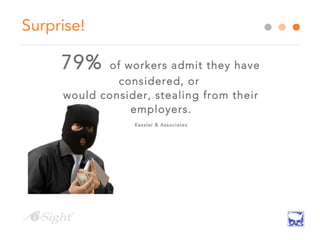
79% of workers admit they have
considered, or
would consider, stealing from their
employers.
Kessler & Associates
Cost of Theft
One of every three companies that
goes bankrupt each year does
so as a result of employee theft…
…costing businesses between $60 and $120
billion a year!
Checks and Balances
o Many employers overlook symptoms of theft,
failing to put adequate checks and balances in
place.
o The cheating culture has created an
atmosphere that dissuades “whistleblowers”
from coming forward to expose this extremely
pervasive practice.
Collateral Damage
Although workplace theft is probably somewhat
more
widespread among blue collar workers…
…the damage done by more senior employees is
usually far greater.
Why Employees Steal
o Greed 49%
o Vindictiveness, get even 43%
o Need 8%
The real reason people steal is opportunity. When
companies make it easy through lack of control,
an atmosphere of theft is created.
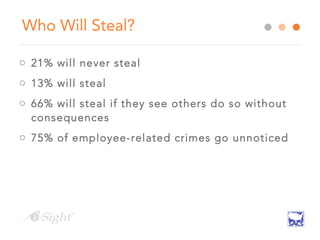
Who Will Steal?
o 21% will never steal
o 13% will steal
o 66% will steal if they see others do so without
consequences
o 75% of employee-related crimes go unnoticed
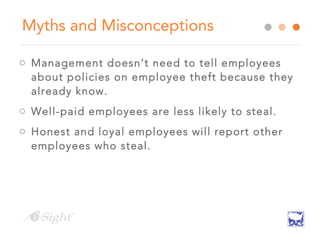
Myths and Misconceptions
o Management doesn’t need to tell employees
about policies on employee theft because they
already know.
o Well-paid employees are less likely to steal.
o Honest and loyal employees will report other
employees who steal.
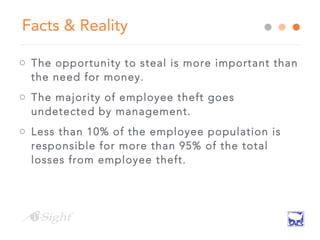
Facts & Reality
o The opportunity to steal is more important than
the need for money.
o The majority of employee theft goes
undetected by management.
o Less than 10% of the employee population is
responsible for more than 95% of the total
losses from employee theft.
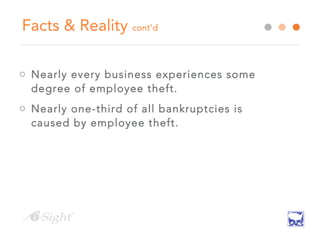
Facts & Reality cont’d
o Nearly every business experiences some
degree of employee theft.
o Nearly one-third of all bankruptcies is
caused by employee theft.
3 Major Categories of Workplace
Fraud
1. Asset Misappropriation: theft or misuse of an
organization’s assets. (Represents 87% of losses)
Examples:
oTheft of inventory
oSkimming revenues
oPayroll fraud
Cash is the targeted asset 90% of the time.
3 Major Categories of Workplace
Fraud
2. Corruption: Perpetrators wrongfully use their
influence in a business transaction to gain a
benefit for themselves or another.
Examples:
oConflicts of interest
oAccepting kickbacks
3. Fraudulent statements: Generally entail
falsification of financial statements.
Examples
oOverstating revenues
oUnderstating costs
3 Major Categories of Workplace
Fraud
How is Fraud Detected
o Tip from an employee is the most frequent
method of detection
o Discovery by accident
o Internal audit
o Internal controls
How to Stop Workplace Theft
o Start by creating a great work environment.
o Employees who like their job and feel they are
fairly treated and compensated are less likely
to steal.
o Employees are more likely to steal when
angered or treated unfairly.
o Encourage a sense of ownership.
o Reduce opportunities to steal.
How to Stop Workplace Theft
cont’d
o Pre-employment screenings are an effective
deterrent.
o A security audit of your business operations
helps employers identify and determine risks.
o Initiate strict universal security guidelines.
o Anonymous tip programs may compel honest
employees to volunteer information about
office theft without being labeled a snitch.
When Theft is Suspected
The three objectives of a fraud, theft, or
embezzlement investigation:
1. Discover who was involved so the employee
can be removed from the workplace.
2. Attempt to recover the money or lost property.
3. Prosecute the employee under applicable laws.
Investigation Procedures
o Quickly “shore up” confidentiality.
o Identify employees (at every level) who had
both access and opportunity to commit the act
resulting in the loss.
o Bring employees with access and opportunity
into private area (individually) and ask them to
write an account of their activities on the days
and times relevant to the loss.
Investigation Procedures cont’d
o Quickly “shore up” confidentiality.
o Identify employees (at every level) who had
both access and opportunity to commit the act
resulting in the loss.
o Bring employees with access and opportunity
into private area (individually) and ask them to
write an account of their activities on the days
and times relevant to the loss.
Prevention: The Best Medicine
“Employees steal to the extent management
permits it…
…there’s no shortcut to prevent it, you have
to remove the opportunity, create awareness
and achieve their support.”
Resources
www.sacsconsulting.co
m
Web Based Training
Tools for Success
IDENTITY
THEFT
Questions?
Please submit your questions now
Thank-you for participating
If you have any questions, please feel free
to email them to:
Timothy Dimoff, President, SACS Consulting
tadimoff@aol.com
Joe Gerard, Vice President Marketing and Sales
j.gerard@i-sight.com

Tips for Preventing and Detecting Employee Theft in the Workplace

  • 1.
    How to Detectand Prevent Employee Theft Timothy Dimoff, President, SACS Consulting
  • 2.
    Timothy Dimoff Timothy Dimoff,president of SACS Consulting & Investigative Services, Inc., is a speaker, trainer and author and a leading authority on high-risk workplace and human resource security and crime. He is a Certified Protection Professional, a certified legal expert in corporate security procedures and training, a member of the Ohio and International Narcotic Associations, the Ohio and National Societies for Human Resource Managers, and the American Society for Industrial Security. He holds a B.S. in Sociology, with an emphasis in criminology, from Denison University.
  • 3.
    Surprise! 79% of workersadmit they have considered, or would consider, stealing from their employers. Kessler & Associates
  • 4.
    Cost of Theft Oneof every three companies that goes bankrupt each year does so as a result of employee theft… …costing businesses between $60 and $120 billion a year!
  • 5.
    Checks and Balances oMany employers overlook symptoms of theft, failing to put adequate checks and balances in place. o The cheating culture has created an atmosphere that dissuades “whistleblowers” from coming forward to expose this extremely pervasive practice.
  • 6.
    Collateral Damage Although workplacetheft is probably somewhat more widespread among blue collar workers… …the damage done by more senior employees is usually far greater.
  • 7.
    Why Employees Steal oGreed 49% o Vindictiveness, get even 43% o Need 8% The real reason people steal is opportunity. When companies make it easy through lack of control, an atmosphere of theft is created.
  • 8.
    Who Will Steal? o21% will never steal o 13% will steal o 66% will steal if they see others do so without consequences o 75% of employee-related crimes go unnoticed
  • 9.
    Myths and Misconceptions oManagement doesn’t need to tell employees about policies on employee theft because they already know. o Well-paid employees are less likely to steal. o Honest and loyal employees will report other employees who steal.
  • 10.
    Facts & Reality oThe opportunity to steal is more important than the need for money. o The majority of employee theft goes undetected by management. o Less than 10% of the employee population is responsible for more than 95% of the total losses from employee theft.
  • 11.
    Facts & Realitycont’d o Nearly every business experiences some degree of employee theft. o Nearly one-third of all bankruptcies is caused by employee theft.
  • 12.
    3 Major Categoriesof Workplace Fraud 1. Asset Misappropriation: theft or misuse of an organization’s assets. (Represents 87% of losses) Examples: oTheft of inventory oSkimming revenues oPayroll fraud Cash is the targeted asset 90% of the time.
  • 13.
    3 Major Categoriesof Workplace Fraud 2. Corruption: Perpetrators wrongfully use their influence in a business transaction to gain a benefit for themselves or another. Examples: oConflicts of interest oAccepting kickbacks
  • 14.
    3. Fraudulent statements:Generally entail falsification of financial statements. Examples oOverstating revenues oUnderstating costs 3 Major Categories of Workplace Fraud
  • 15.
    How is FraudDetected o Tip from an employee is the most frequent method of detection o Discovery by accident o Internal audit o Internal controls
  • 16.
    How to StopWorkplace Theft o Start by creating a great work environment. o Employees who like their job and feel they are fairly treated and compensated are less likely to steal. o Employees are more likely to steal when angered or treated unfairly. o Encourage a sense of ownership. o Reduce opportunities to steal.
  • 17.
    How to StopWorkplace Theft cont’d o Pre-employment screenings are an effective deterrent. o A security audit of your business operations helps employers identify and determine risks. o Initiate strict universal security guidelines. o Anonymous tip programs may compel honest employees to volunteer information about office theft without being labeled a snitch.
  • 18.
    When Theft isSuspected The three objectives of a fraud, theft, or embezzlement investigation: 1. Discover who was involved so the employee can be removed from the workplace. 2. Attempt to recover the money or lost property. 3. Prosecute the employee under applicable laws.
  • 19.
    Investigation Procedures o Quickly“shore up” confidentiality. o Identify employees (at every level) who had both access and opportunity to commit the act resulting in the loss. o Bring employees with access and opportunity into private area (individually) and ask them to write an account of their activities on the days and times relevant to the loss.
  • 20.
    Investigation Procedures cont’d oQuickly “shore up” confidentiality. o Identify employees (at every level) who had both access and opportunity to commit the act resulting in the loss. o Bring employees with access and opportunity into private area (individually) and ask them to write an account of their activities on the days and times relevant to the loss.
  • 21.
    Prevention: The BestMedicine “Employees steal to the extent management permits it… …there’s no shortcut to prevent it, you have to remove the opportunity, create awareness and achieve their support.”
  • 22.
  • 23.
  • 24.
    Thank-you for participating Ifyou have any questions, please feel free to email them to: Timothy Dimoff, President, SACS Consulting tadimoff@aol.com Joe Gerard, Vice President Marketing and Sales j.gerard@i-sight.com