Time Theft
EBOOK
Table of
Contents
Introduction............................................................3
Chapter 1: Defining Time Theft..................................4
Chapter 2: Types of Time Theft..................................5
Chapter 3: Web Based Time Tracking Software............8
Chapter 4: Benefits of Workforce
Management Software..............................................9
Chapter 5: Why Zip Clock?....................................... 14
Author: Danielle Richards
2
Introduction
Accountability. It’s what all owners, operators, and managers want. When
it comes to employee’s schedules and attendance, accountability is critical.
Unfortunately, keeping track of employees’ schedules and attendance can feel
like a daunting process. With so many moving parts to consider, it’s easy to get
overwhelmed.
Take a moment and consider: how do your employees clock in and out for their
shifts? If it is with a physical punch card, it’s time to consider an alternative.
The traditional time punch system likely isn’t working for you, your managers,
or your employees. You want greater tracking and accountability for your
workforce, and you know it is a task that really consumes yours’ and your
managers’ time. Fortunately, tracking employee time and attendance doesn’t
have to be such a hassle. You’ve probably automated most other parts of your
business and operations; perhaps it’s time to consider automating workforce
management with time tracking software. In today’s business world, it is
necessary to invest in a web-based time clock.
The emergence of technology and automation in the workplace can have a
positive impact on the way you and your managers track employee schedules
and attendance, saving you time and money. With time clock software, you can
access employees schedules in real time, reduce labor costs, avoid labor law
breaches and penalties, reduce time theft, increase visibility and accountability,
and streamline human resources practices.
3
TIME IS MONEY
Time Theft
Is there truth behind your timesheet? Because it is one of a business’s major
expenses, everyone in leadership and management is constantly looking for
ways to cut labor costs. One of the ways you can reduce labor costs is by
reducing time theft.
Time theft is when employees gain extra hours and pad their paychecks through
several dishonest behaviors. Time theft comes in many forms including buddy
punching, milking the clock, and taking advantage of overtime.
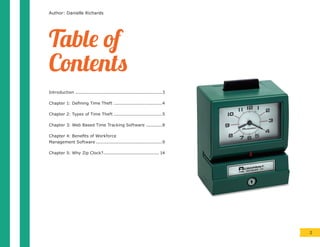
“Time clocks - with punch cards and a line of employees waiting to check in or
check out of work - are an almost universal signifier of the modern industrial
age. Punch cards, the physical paper type, are still in wide use, but as you might
expect, a digital time clock may offer more flexibility when it comes to keeping
track of employee time,” explains Jeffery Battersby, a regular contributor to
Macworld and an Apple Certified Trainer.
Time theft is an obvious concern for employers, and many owners and operators
are looking for ways to eliminate the behavior. Curbing time theft makes for a
healthier bottom line.
1CHAPTER
4
2CHAPTER
Types of Time Theft
Whether we like to admit it or not, we know that many of our employees have
attempted time theft. Perhaps, it is for the benefit of their own paychecks, or
to help a friend. Regardless of the motive, it is wrong and requires greater
accountability. Below we will examine some of the common types of time theft.
Extended Breaks
Believe it or not, long breaks are the most common type of time theft. While it
may seem innocent enough, even adding on a few minutes each day can have
a serious impact on productivity and efficiency.
Buddy Punching
Buddy punching is a common occurrence, especially on a staff with friends.
Sometimes, an employee may ask a friend to clock in for them, either by
manually entering an employee number or simply clicking their name on the
POS terminal. Without biometric scanners or face recognition systems, buddy
punching is fairly easy. Without these checks and balances, it is likely that
employees will punch a buddy in that is running late, or perhaps just need some
extra money in their paycheck. According to the APA, buddy punching accounts
for between 2% and 5% of payroll expenses.
Rounding Off Time Sheets
Employees who are regularly late may report that they arrived on time. Without
accountability, this can become a regular bad habit, and one other employees
are likely to take note of.
5
Milking the Clock
Milking the clock occurs when an employee has been “cut” by management and
yet, still remains on the clock. This can happen easily. Sometimes employees
will eat a meal, linger and talk, or take a call outside, all while still on the clock.
Timekeeping systems make it very obvious who is left on the clock, making it
nearly impossible for employees to get away with stealing a tad extra cash.
Intentionally Prolonging Meetings
Let’s face it, not all meetings are productive. Sometimes, to break up their day,
employees will prolong an unnecessary meeting, just to kill some time. Based
on a recent study by Clarizen/Harris Interactive, 40% of workers think daily
meetings are unnecessary, while 70% believe that meetings do not contribute
to their work.
Smartphones
While you can control what employees do on your company computers and
terminals, it can be more difficult to control their activity on their own mobile
devices. With today’s technology, it is easy for employees to zap a significant
amount of time tuned in to their mobile phone.
Taking Advantage of Overtime
Sometimes overtime is necessary, and sometimes it is taken advantage of.
Overtime typically means an employee is paid time and a half for their hourly
work. Because of this enticing compensation, some employees may look to
cash in without the effort, milking their hours in order to stay over time on
a regular basis. While HR is often on the lookout for such deception, it can
be difficult to spot with outdated methods of timekeeping. With traditional
6
methods, there is no warning for management when someone has breached
their weekly 40 hours or daily 8-hour overtime. Time tracking software shows
a visible warning and can send a push notification to management when an
employee has surpassed their overtime. If the employee has adequate reasons
for working past the given hours, management can approve the hours, or if
they realize an employee is taking advantage of the overtime rules, they can be
properly coached or dismissed.
Using the Internet for Personal Business
An employee behind a computer or terminal looks busy, and most managers
assume they are working. Without blocks set to control web browsing, employees
are often tempted to check their email or peruse social media.
Too Much Socializing
While camaraderie is great for morale, too much can seriously hurt your bottom
line. Especially because it involves more than one employee, socializing takes
up a lot of time.
By further engaging the workforce with self-service time tracking software, you
actively empower your employees, increasing employee engagement, improving
satisfaction, and significantly reducing the number of manual transactions. The
end result allows you to control labor costs, minimize compliance risk, and
improve workforce productivity
7
3CHAPTER
Web Based Time
Tracking Software
Time clock software is revolutionizing the way owners and managers utilize
workforce data. Managing your workforce and tracking time and attendance
can go far beyond the punch card. Time and attendance software enables
employers to keep track of attendance and schedules in real-time, regardless of
the size of their operation. This reinvention of timekeeping is crucial, especially
in light of the changing nature of employment, labor laws, and routines.
According to the U.S. Government Accountability Office, “In recent years
significant changes in work place habits and technological advances have effected
the manner in which time and attendance (T&A) reporting is accomplished. For
example, more flexible work schedules and places, and the trend in government
to streamline operations have provided a major impetus for changes in T&A
systems. However, perhaps the most significant influence on these changes is
advancing technology and the increased use of automation.”
Time tracking software is now commonplace in the business world because
of its intuitive contributions to tracking employee schedules and attendance.
In addition, with the emergence of mobile devices, employees are used to
using applications to streamline most areas of their lives. Many employees
today expect their schedules, time, and attendance to be automated as well.
Employees also want a fast, intuitive, and efficient way of managing their
time, instead of filling out time cards and cumbersome time off requests. In
response, many businesses are utilizing mobile-friendly time clock software to
ease the difficulties and headaches commonly associated with employee time
and attendance.
8
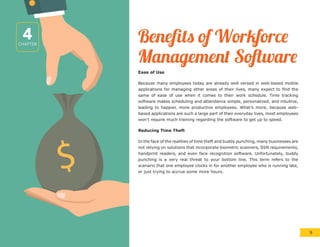
$
Benefits of Workforce
Management Software
Ease of Use
Because many employees today are already well versed in web-based mobile
applications for managing other areas of their lives, many expect to find the
same of ease of use when it comes to their work schedule. Time tracking
software makes scheduling and attendance simple, personalized, and intuitive,
leading to happier, more productive employees. What’s more, because web-
based applications are such a large part of their everyday lives, most employees
won’t require much training regarding the software to get up to speed.
Reducing Time Theft
In the face of the realities of time theft and buddy punching, many businesses are
not relying on solutions that incorporate biometric scanners, SSN requirements,
handprint readers, and even face recognition software. Unfortunately, buddy
punching is a very real threat to your bottom line. This term refers to the
scenario that one employee clocks in for another employee who is running late,
or just trying to accrue some more hours.
4CHAPTER
9
Greater Control
Simply stated, time tracking software gives you increased internal control
of your business. With real-time access, it’s all at your fingertips, no matter
where you are. You can see who is working and when, who has requested a
replacement, who didn’t show up, and who needs to take a mandatory break.
While software alone is helpful, it needs to be usable for employees. What
makes an application usable? It should be aesthetically appealing, easy to learn
and navigate, and intuitive design. If an application is confusing and difficult to
use, employees will dread logging on, and may wish for the old system of time
cards and punch clocks.
Time Savings
If your employees are clocking in and out at a POS terminal at shift changes,
you may notice groups of staff members waiting around the terminal for their
chance. With a web-based time clock, employees have the ability to clock in
and out from a variety of locations: a restaurant workstation, a freestanding
time clock, or from their smartphones. If they are using their smartphones, you
can be sure they are actually where they need to be with useful geolocation
positioning.
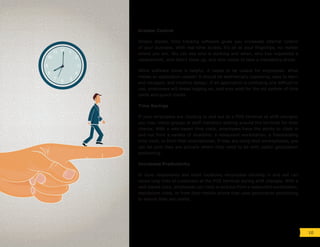
Increased Productivity
In busy restaurants and retail locations, employees clocking in and out can
cause long lines of customers at the POS terminal during shift changes. With a
web-based clock, employees can clock in and out from a restaurant workstation,
standalone clock, or from their mobile phone that uses geolocation positioning
to ensure they are onsite.
10
With a simple solution, you can experience greater usability and ease of use,
such as:
• Intuitive, aesthetically appealing dashboard
• Access anytime, anywhere
• Personalization
• Ability to integrate external content
• Information users want to see
Time tracking software empowers businesses to save time recording time and
attendance, as well as giving them the ability to manage their workforce in
real-time. From any location with Internet access, employers can access critical
information about their employees. Time clock software gives employers greater
control with access to reliable, accurate, and usable data.
According to the U.S. Government Accountability Office, “The primary objective
of a T&A system is to ensure that hours worked, hours in pay status, and
hours absent are properly reported. Reliable data are important to accurately
compute and account for computed pay, leave, and allowances. To achieve this
objective, management should have in place an internal control system. Fully
automated systems, for example, may require fewer approvals than manual
systems because of automated edits and controls, and the use of automated
signatures.
11
Appeal to Millennials
It’s pretty clear: everyone is addicted to their mobile devices. Today’s workforce
is used to smartphones and instant gratification, accessing information whenever
they need to. But, without mobile accessibility, applications are useless.
To today’s workforce, outdated software appears cumbersome and irrelevant.
Thus, it is critical that time tracking software is accessible on smartphones.
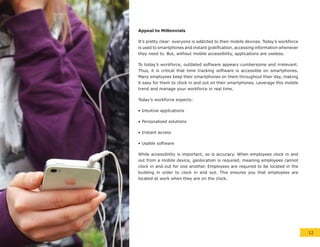
Many employees keep their smartphones on them throughout their day, making
it easy for them to clock in and out on their smartphones. Leverage this mobile
trend and manage your workforce in real time.
Today’s workforce expects:
• Intuitive applications
• Personalized solutions
• Instant access
• Usable software
While accessibility is important, so is accuracy. When employees clock in and
out from a mobile device, geolocation is required, meaning employees cannot
clock in and out for one another. Employees are required to be located in the
building in order to clock in and out. This ensures you that employees are
located at work when they are on the clock.
12
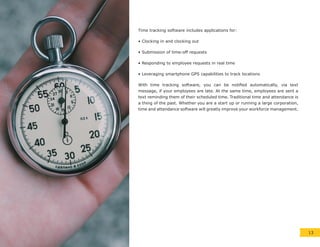
Time tracking software includes applications for:
• Clocking in and clocking out
• Submission of time-off requests
• Responding to employee requests in real time
• Leveraging smartphone GPS capabilities to track locations
With time tracking software, you can be notified automatically, via text
message, if your employees are late. At the same time, employees are sent a
text reminding them of their scheduled time. Traditional time and attendance is
a thing of the past. Whether you are a start up or running a large corporation,
time and attendance software will greatly improve your workforce management.
13
5CHAPTER
5CHAPTER Why Zip Clock?
Zip Clock can streamline operations and workforce management and help
leadership gain greater oversight of employee’s time tracking behaviors. This
application can help you curb your bottom line.
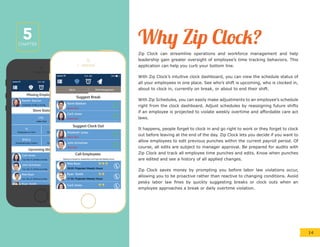
With Zip Clock’s intuitive clock dashboard, you can view the schedule status of
all your employees in one place. See who’s shift is upcoming, who is clocked in,
about to clock in, currently on break, or about to end their shift.
With Zip Schedules, you can easily make adjustments to an employee’s schedule
right from the clock dashboard. Adjust schedules by reassigning future shifts
if an employee is projected to violate weekly overtime and affordable care act
laws.
It happens, people forget to clock in and go right to work or they forget to clock
out before leaving at the end of the day. Zip Clock lets you decide if you want to
allow employees to edit previous punches within the current payroll period. Of
course, all edits are subject to manager approval. Be prepared for audits with
Zip Clock and track all employee time punches and edits. Know when punches
are edited and see a history of all applied changes.
Zip Clock saves money by prompting you before labor law violations occur,
allowing you to be proactive rather than reactive to changing conditions. Avoid
pesky labor law fines by quickly suggesting breaks or clock outs when an
employee approaches a break or daily overtime violation.
14
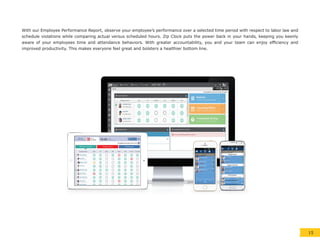
With our Employee Performance Report, observe your employee’s performance over a selected time period with respect to labor law and
schedule violations while comparing actual versus scheduled hours. Zip Clock puts the power back in your hands, keeping you keenly
aware of your employees time and attendance behaviors. With greater accountability, you and your team can enjoy efficiency and
improved productivity. This makes everyone feel great and bolsters a healthier bottom line.
15

8. eBook #8 time theft

  • 1.
  • 2.
    Table of Contents Introduction............................................................3 Chapter 1:Defining Time Theft..................................4 Chapter 2: Types of Time Theft..................................5 Chapter 3: Web Based Time Tracking Software............8 Chapter 4: Benefits of Workforce Management Software..............................................9 Chapter 5: Why Zip Clock?....................................... 14 Author: Danielle Richards 2
  • 3.
    Introduction Accountability. It’s whatall owners, operators, and managers want. When it comes to employee’s schedules and attendance, accountability is critical. Unfortunately, keeping track of employees’ schedules and attendance can feel like a daunting process. With so many moving parts to consider, it’s easy to get overwhelmed. Take a moment and consider: how do your employees clock in and out for their shifts? If it is with a physical punch card, it’s time to consider an alternative. The traditional time punch system likely isn’t working for you, your managers, or your employees. You want greater tracking and accountability for your workforce, and you know it is a task that really consumes yours’ and your managers’ time. Fortunately, tracking employee time and attendance doesn’t have to be such a hassle. You’ve probably automated most other parts of your business and operations; perhaps it’s time to consider automating workforce management with time tracking software. In today’s business world, it is necessary to invest in a web-based time clock. The emergence of technology and automation in the workplace can have a positive impact on the way you and your managers track employee schedules and attendance, saving you time and money. With time clock software, you can access employees schedules in real time, reduce labor costs, avoid labor law breaches and penalties, reduce time theft, increase visibility and accountability, and streamline human resources practices. 3
  • 4.
    TIME IS MONEY TimeTheft Is there truth behind your timesheet? Because it is one of a business’s major expenses, everyone in leadership and management is constantly looking for ways to cut labor costs. One of the ways you can reduce labor costs is by reducing time theft. Time theft is when employees gain extra hours and pad their paychecks through several dishonest behaviors. Time theft comes in many forms including buddy punching, milking the clock, and taking advantage of overtime. “Time clocks - with punch cards and a line of employees waiting to check in or check out of work - are an almost universal signifier of the modern industrial age. Punch cards, the physical paper type, are still in wide use, but as you might expect, a digital time clock may offer more flexibility when it comes to keeping track of employee time,” explains Jeffery Battersby, a regular contributor to Macworld and an Apple Certified Trainer. Time theft is an obvious concern for employers, and many owners and operators are looking for ways to eliminate the behavior. Curbing time theft makes for a healthier bottom line. 1CHAPTER 4
  • 5.
    2CHAPTER Types of TimeTheft Whether we like to admit it or not, we know that many of our employees have attempted time theft. Perhaps, it is for the benefit of their own paychecks, or to help a friend. Regardless of the motive, it is wrong and requires greater accountability. Below we will examine some of the common types of time theft. Extended Breaks Believe it or not, long breaks are the most common type of time theft. While it may seem innocent enough, even adding on a few minutes each day can have a serious impact on productivity and efficiency. Buddy Punching Buddy punching is a common occurrence, especially on a staff with friends. Sometimes, an employee may ask a friend to clock in for them, either by manually entering an employee number or simply clicking their name on the POS terminal. Without biometric scanners or face recognition systems, buddy punching is fairly easy. Without these checks and balances, it is likely that employees will punch a buddy in that is running late, or perhaps just need some extra money in their paycheck. According to the APA, buddy punching accounts for between 2% and 5% of payroll expenses. Rounding Off Time Sheets Employees who are regularly late may report that they arrived on time. Without accountability, this can become a regular bad habit, and one other employees are likely to take note of. 5
  • 6.
    Milking the Clock Milkingthe clock occurs when an employee has been “cut” by management and yet, still remains on the clock. This can happen easily. Sometimes employees will eat a meal, linger and talk, or take a call outside, all while still on the clock. Timekeeping systems make it very obvious who is left on the clock, making it nearly impossible for employees to get away with stealing a tad extra cash. Intentionally Prolonging Meetings Let’s face it, not all meetings are productive. Sometimes, to break up their day, employees will prolong an unnecessary meeting, just to kill some time. Based on a recent study by Clarizen/Harris Interactive, 40% of workers think daily meetings are unnecessary, while 70% believe that meetings do not contribute to their work. Smartphones While you can control what employees do on your company computers and terminals, it can be more difficult to control their activity on their own mobile devices. With today’s technology, it is easy for employees to zap a significant amount of time tuned in to their mobile phone. Taking Advantage of Overtime Sometimes overtime is necessary, and sometimes it is taken advantage of. Overtime typically means an employee is paid time and a half for their hourly work. Because of this enticing compensation, some employees may look to cash in without the effort, milking their hours in order to stay over time on a regular basis. While HR is often on the lookout for such deception, it can be difficult to spot with outdated methods of timekeeping. With traditional 6
  • 7.
    methods, there isno warning for management when someone has breached their weekly 40 hours or daily 8-hour overtime. Time tracking software shows a visible warning and can send a push notification to management when an employee has surpassed their overtime. If the employee has adequate reasons for working past the given hours, management can approve the hours, or if they realize an employee is taking advantage of the overtime rules, they can be properly coached or dismissed. Using the Internet for Personal Business An employee behind a computer or terminal looks busy, and most managers assume they are working. Without blocks set to control web browsing, employees are often tempted to check their email or peruse social media. Too Much Socializing While camaraderie is great for morale, too much can seriously hurt your bottom line. Especially because it involves more than one employee, socializing takes up a lot of time. By further engaging the workforce with self-service time tracking software, you actively empower your employees, increasing employee engagement, improving satisfaction, and significantly reducing the number of manual transactions. The end result allows you to control labor costs, minimize compliance risk, and improve workforce productivity 7
  • 8.
    3CHAPTER Web Based Time TrackingSoftware Time clock software is revolutionizing the way owners and managers utilize workforce data. Managing your workforce and tracking time and attendance can go far beyond the punch card. Time and attendance software enables employers to keep track of attendance and schedules in real-time, regardless of the size of their operation. This reinvention of timekeeping is crucial, especially in light of the changing nature of employment, labor laws, and routines. According to the U.S. Government Accountability Office, “In recent years significant changes in work place habits and technological advances have effected the manner in which time and attendance (T&A) reporting is accomplished. For example, more flexible work schedules and places, and the trend in government to streamline operations have provided a major impetus for changes in T&A systems. However, perhaps the most significant influence on these changes is advancing technology and the increased use of automation.” Time tracking software is now commonplace in the business world because of its intuitive contributions to tracking employee schedules and attendance. In addition, with the emergence of mobile devices, employees are used to using applications to streamline most areas of their lives. Many employees today expect their schedules, time, and attendance to be automated as well. Employees also want a fast, intuitive, and efficient way of managing their time, instead of filling out time cards and cumbersome time off requests. In response, many businesses are utilizing mobile-friendly time clock software to ease the difficulties and headaches commonly associated with employee time and attendance. 8
  • 9.
    $ Benefits of Workforce ManagementSoftware Ease of Use Because many employees today are already well versed in web-based mobile applications for managing other areas of their lives, many expect to find the same of ease of use when it comes to their work schedule. Time tracking software makes scheduling and attendance simple, personalized, and intuitive, leading to happier, more productive employees. What’s more, because web- based applications are such a large part of their everyday lives, most employees won’t require much training regarding the software to get up to speed. Reducing Time Theft In the face of the realities of time theft and buddy punching, many businesses are not relying on solutions that incorporate biometric scanners, SSN requirements, handprint readers, and even face recognition software. Unfortunately, buddy punching is a very real threat to your bottom line. This term refers to the scenario that one employee clocks in for another employee who is running late, or just trying to accrue some more hours. 4CHAPTER 9
  • 10.
    Greater Control Simply stated,time tracking software gives you increased internal control of your business. With real-time access, it’s all at your fingertips, no matter where you are. You can see who is working and when, who has requested a replacement, who didn’t show up, and who needs to take a mandatory break. While software alone is helpful, it needs to be usable for employees. What makes an application usable? It should be aesthetically appealing, easy to learn and navigate, and intuitive design. If an application is confusing and difficult to use, employees will dread logging on, and may wish for the old system of time cards and punch clocks. Time Savings If your employees are clocking in and out at a POS terminal at shift changes, you may notice groups of staff members waiting around the terminal for their chance. With a web-based time clock, employees have the ability to clock in and out from a variety of locations: a restaurant workstation, a freestanding time clock, or from their smartphones. If they are using their smartphones, you can be sure they are actually where they need to be with useful geolocation positioning. Increased Productivity In busy restaurants and retail locations, employees clocking in and out can cause long lines of customers at the POS terminal during shift changes. With a web-based clock, employees can clock in and out from a restaurant workstation, standalone clock, or from their mobile phone that uses geolocation positioning to ensure they are onsite. 10
  • 11.
    With a simplesolution, you can experience greater usability and ease of use, such as: • Intuitive, aesthetically appealing dashboard • Access anytime, anywhere • Personalization • Ability to integrate external content • Information users want to see Time tracking software empowers businesses to save time recording time and attendance, as well as giving them the ability to manage their workforce in real-time. From any location with Internet access, employers can access critical information about their employees. Time clock software gives employers greater control with access to reliable, accurate, and usable data. According to the U.S. Government Accountability Office, “The primary objective of a T&A system is to ensure that hours worked, hours in pay status, and hours absent are properly reported. Reliable data are important to accurately compute and account for computed pay, leave, and allowances. To achieve this objective, management should have in place an internal control system. Fully automated systems, for example, may require fewer approvals than manual systems because of automated edits and controls, and the use of automated signatures. 11
  • 12.
    Appeal to Millennials It’spretty clear: everyone is addicted to their mobile devices. Today’s workforce is used to smartphones and instant gratification, accessing information whenever they need to. But, without mobile accessibility, applications are useless. To today’s workforce, outdated software appears cumbersome and irrelevant. Thus, it is critical that time tracking software is accessible on smartphones. Many employees keep their smartphones on them throughout their day, making it easy for them to clock in and out on their smartphones. Leverage this mobile trend and manage your workforce in real time. Today’s workforce expects: • Intuitive applications • Personalized solutions • Instant access • Usable software While accessibility is important, so is accuracy. When employees clock in and out from a mobile device, geolocation is required, meaning employees cannot clock in and out for one another. Employees are required to be located in the building in order to clock in and out. This ensures you that employees are located at work when they are on the clock. 12
  • 13.
    Time tracking softwareincludes applications for: • Clocking in and clocking out • Submission of time-off requests • Responding to employee requests in real time • Leveraging smartphone GPS capabilities to track locations With time tracking software, you can be notified automatically, via text message, if your employees are late. At the same time, employees are sent a text reminding them of their scheduled time. Traditional time and attendance is a thing of the past. Whether you are a start up or running a large corporation, time and attendance software will greatly improve your workforce management. 13
  • 14.
    5CHAPTER 5CHAPTER Why ZipClock? Zip Clock can streamline operations and workforce management and help leadership gain greater oversight of employee’s time tracking behaviors. This application can help you curb your bottom line. With Zip Clock’s intuitive clock dashboard, you can view the schedule status of all your employees in one place. See who’s shift is upcoming, who is clocked in, about to clock in, currently on break, or about to end their shift. With Zip Schedules, you can easily make adjustments to an employee’s schedule right from the clock dashboard. Adjust schedules by reassigning future shifts if an employee is projected to violate weekly overtime and affordable care act laws. It happens, people forget to clock in and go right to work or they forget to clock out before leaving at the end of the day. Zip Clock lets you decide if you want to allow employees to edit previous punches within the current payroll period. Of course, all edits are subject to manager approval. Be prepared for audits with Zip Clock and track all employee time punches and edits. Know when punches are edited and see a history of all applied changes. Zip Clock saves money by prompting you before labor law violations occur, allowing you to be proactive rather than reactive to changing conditions. Avoid pesky labor law fines by quickly suggesting breaks or clock outs when an employee approaches a break or daily overtime violation. 14
  • 15.
    With our EmployeePerformance Report, observe your employee’s performance over a selected time period with respect to labor law and schedule violations while comparing actual versus scheduled hours. Zip Clock puts the power back in your hands, keeping you keenly aware of your employees time and attendance behaviors. With greater accountability, you and your team can enjoy efficiency and improved productivity. This makes everyone feel great and bolsters a healthier bottom line. 15