Presented by:Andrew Kramer, CPAFraud; A New Age of Risk for Contractors
Forensic Accounting and Investigative ServicesFraud preventionInternal control reviewFraud awareness trainingPre-employment background checksFraud detectionFraud scheme detectionInterviews and interrogationFraud investigationAsset theft investigationPartnership malfeasance investigationsDocumentation of fraud occurrenceLitigation support
Trends in FraudEconomy and fraud have an indirect relationship.Increase in fraud occurrences since economic crisis began in 2008.Scheme with the greatest increase in occurrence:Theft of company property.Embezzlement and expense account fraudMore fraud occurrences due to the economy will be found at a later date.Median duration of all fraud schemes is 18 months.Institute of Internal Auditors, “Knowledge Alert; Emerging Trends in Fraud Risks, 2010”
Trends in FraudMost frauds are uncovered by:Tips (40.2%)Management review (15.4%)Internal audit (13.9%)Small organizations (>100 employees):Suffer the greatest percentage of frauds.Median fraud scheme loss of $155,000.Most common schemes: BillingCheck tamperingCorruptionSkimmingAssociation of Certified Fraud Examiners, “Report to the Nation, 2010”
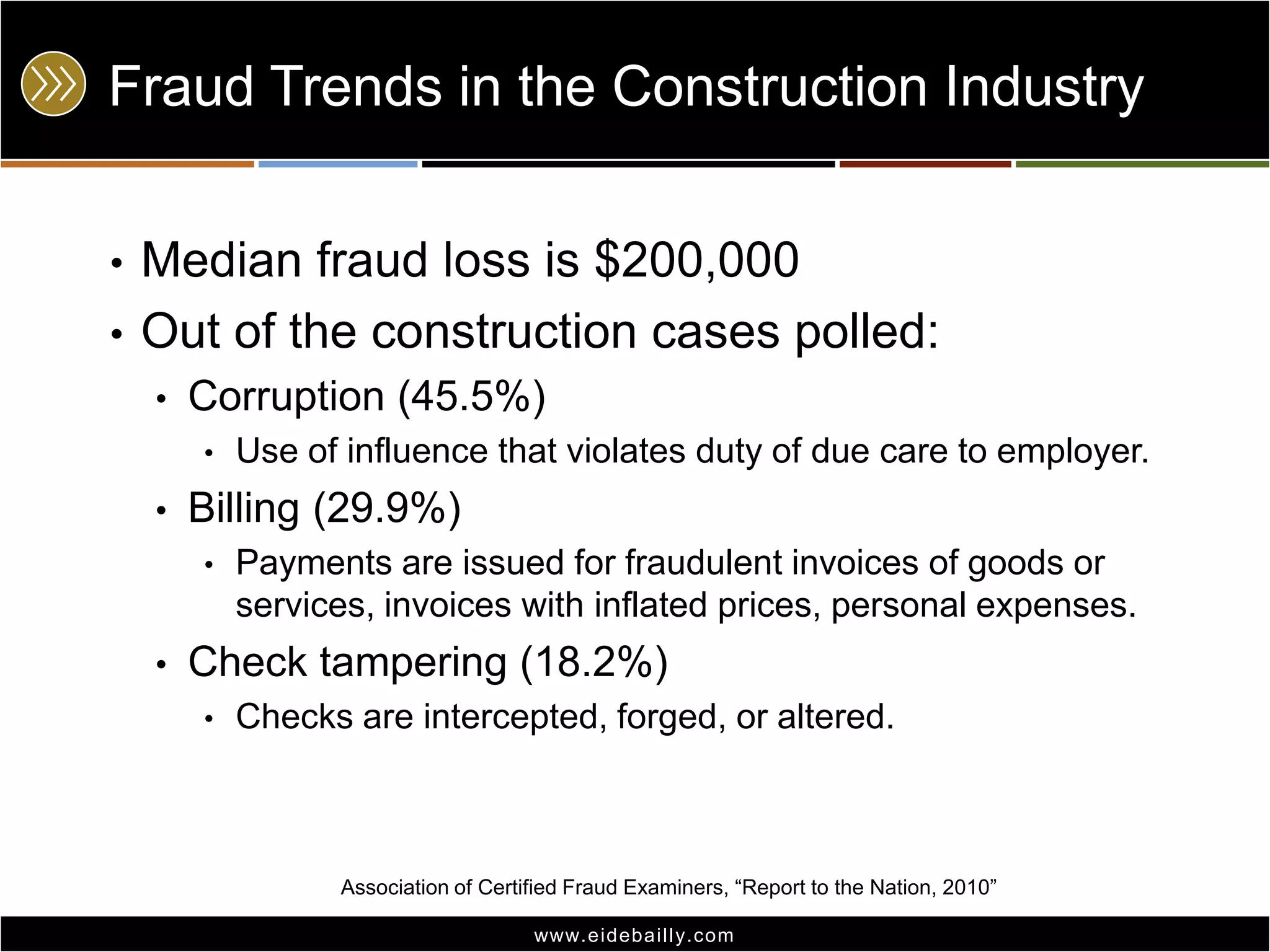
Fraud Trends in the Construction IndustryMedian fraud loss is $200,000Out of the construction cases polled:Corruption (45.5%)Use of influence that violates duty of due care to employer.Billing (29.9%)Payments are issued for fraudulent invoices of goods or services, invoices with inflated prices, personal expenses.Check tampering (18.2%)Checks are intercepted, forged, or altered.Association of Certified Fraud Examiners, “Report to the Nation, 2010”
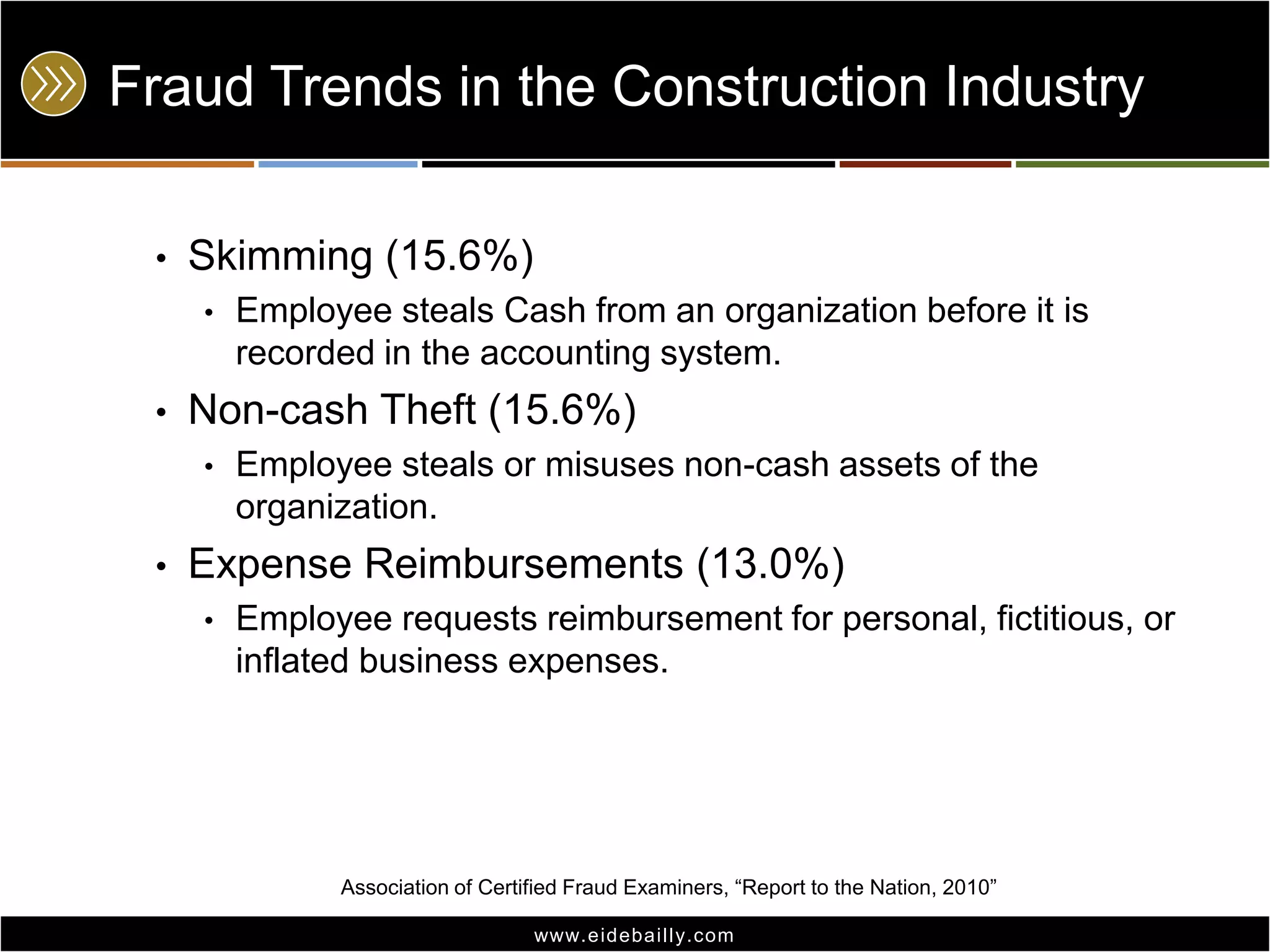
Fraud Trends in the Construction IndustrySkimming (15.6%)Employee steals Cash from an organization before it is recorded in the accounting system.Non-cash Theft (15.6%)Employee steals or misuses non-cash assets of the organization.Expense Reimbursements (13.0%)Employee requests reimbursement for personal, fictitious, or inflated business expenses. Association of Certified Fraud Examiners, “Report to the Nation, 2010”
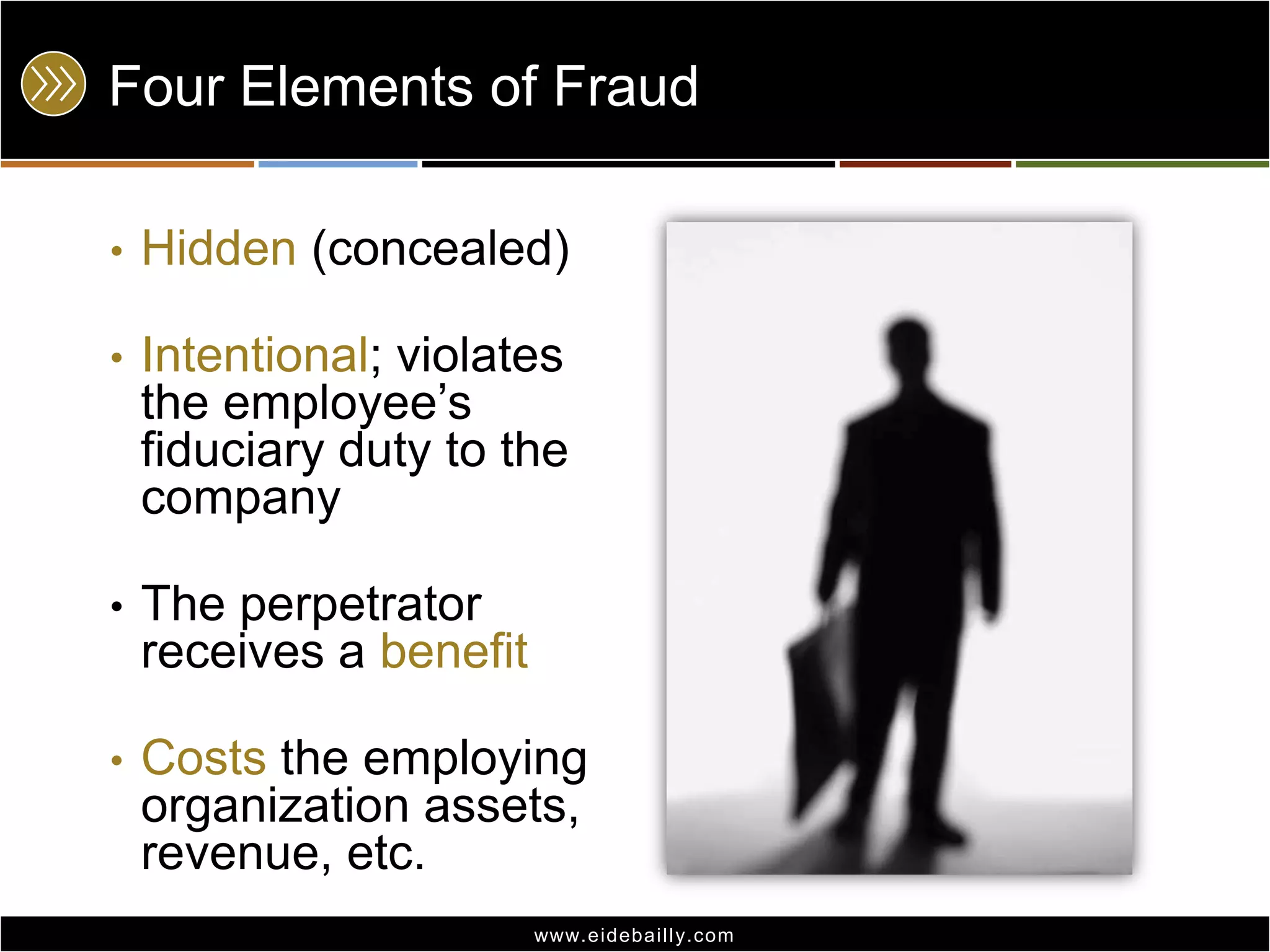
Four Elements of FraudHidden (concealed)Intentional; violates the employee’s fiduciary duty to the companyThe perpetrator receives a benefitCosts the employing organization assets, revenue, etc.
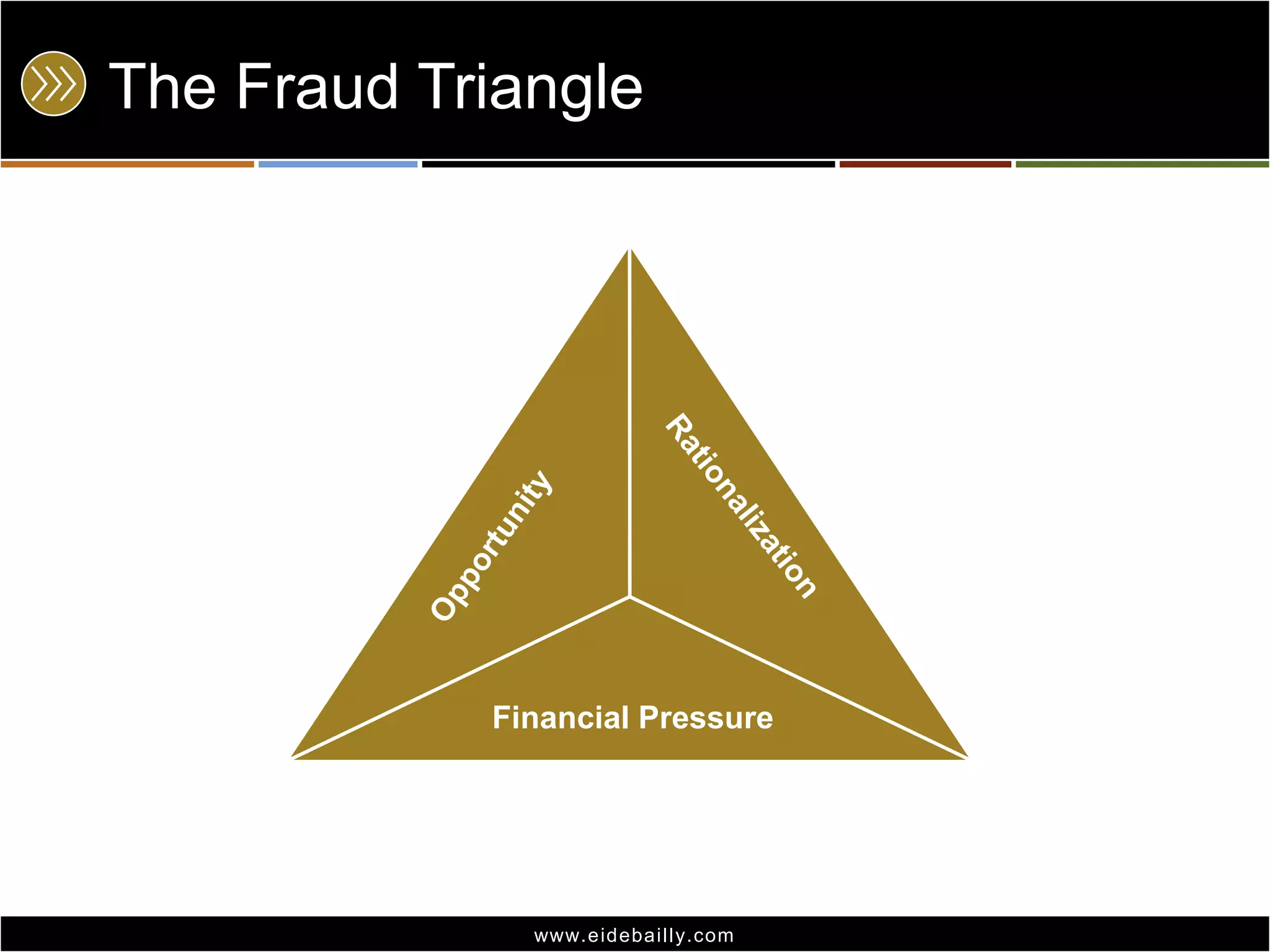
The Fraud TriangleOpportunityRationalizationFinancial Pressure
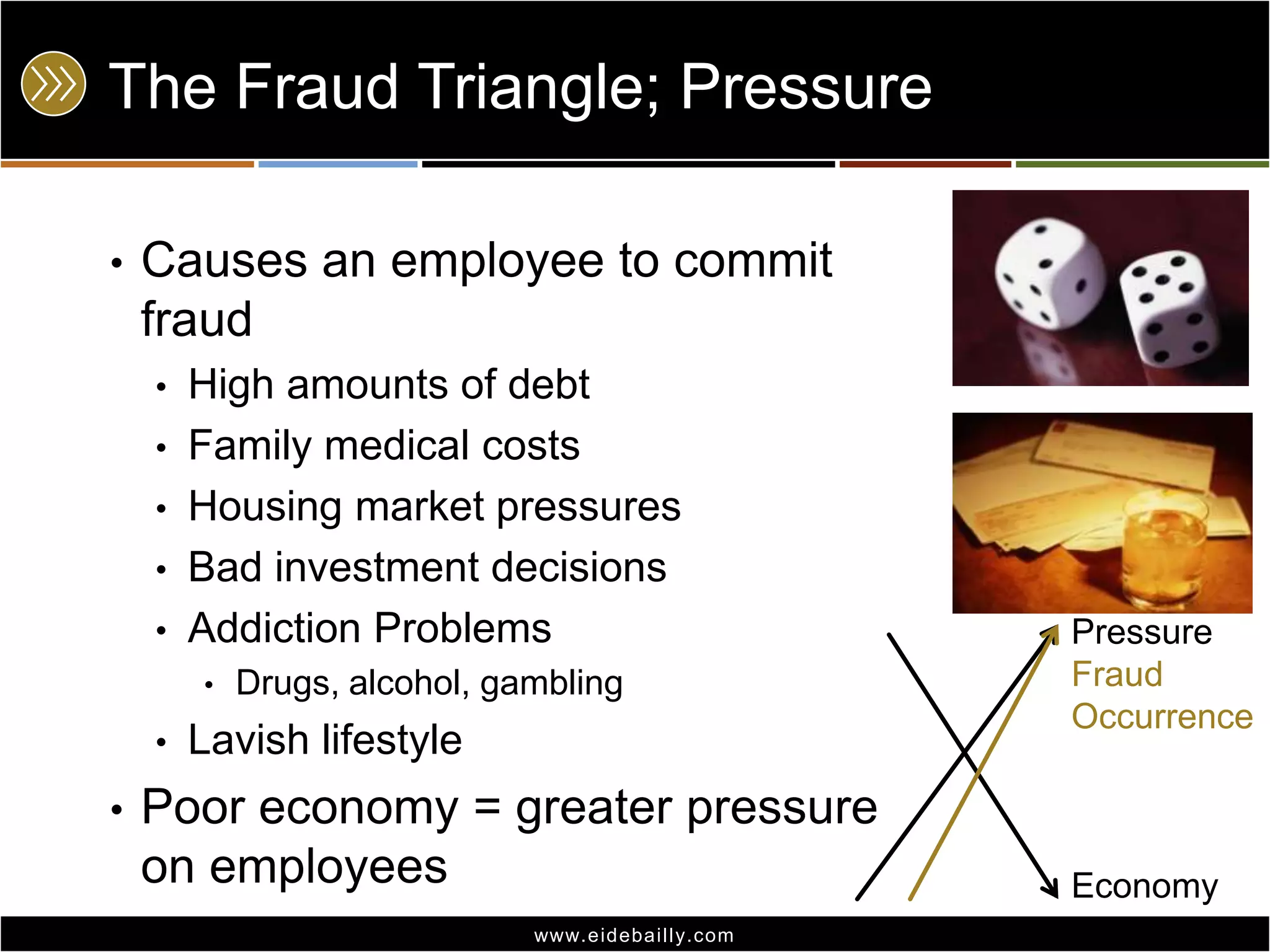
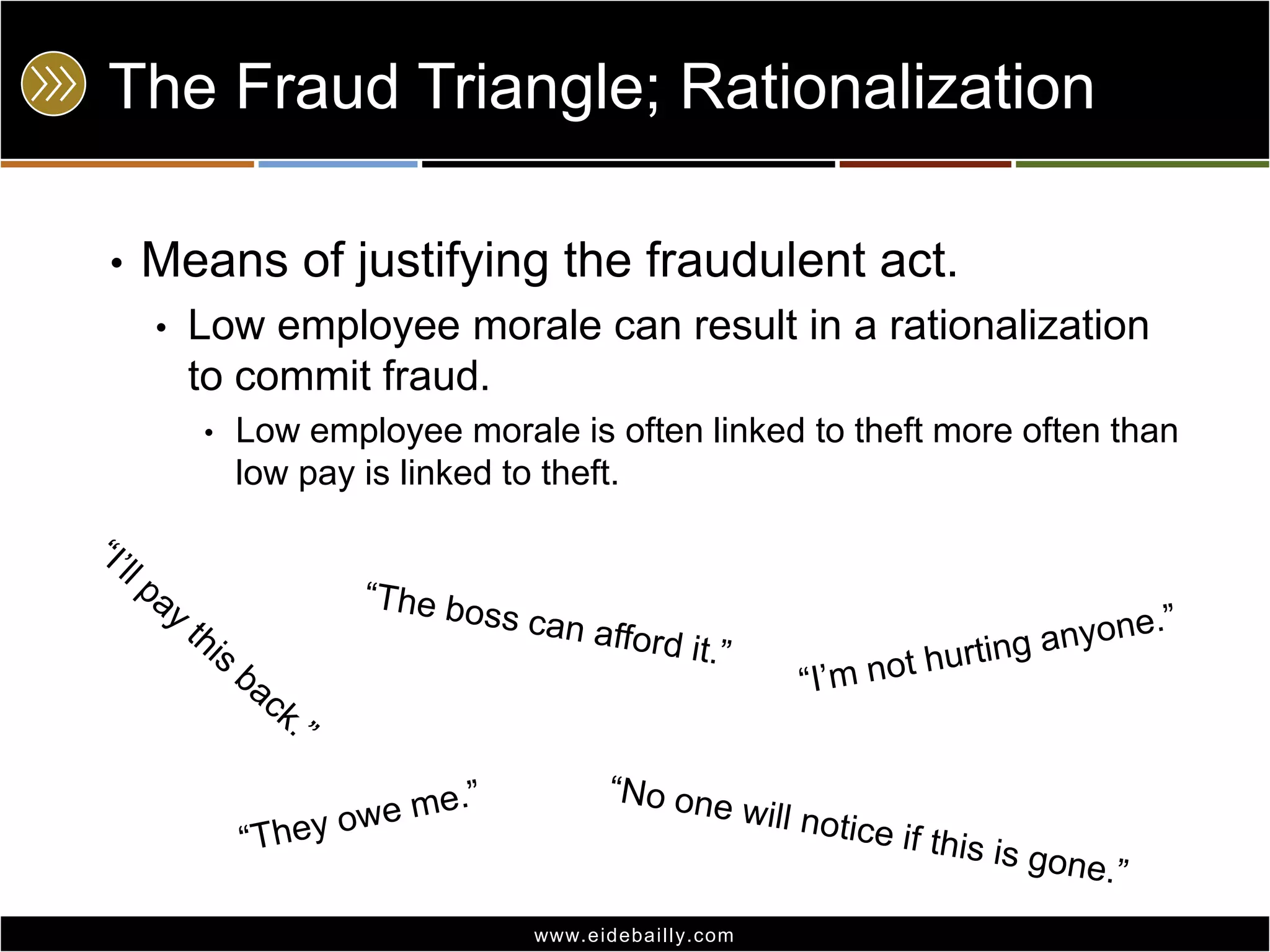
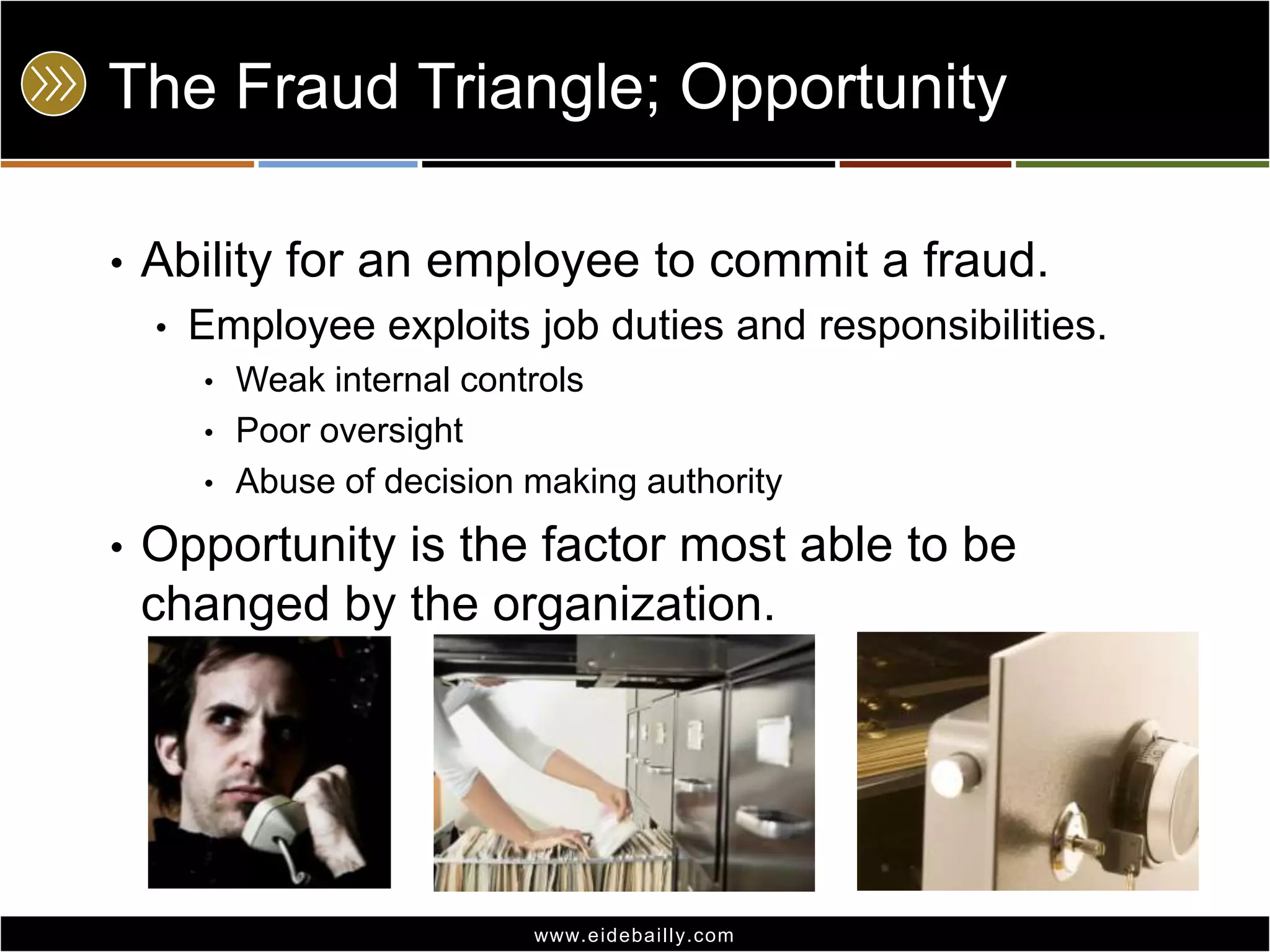
The Fraud Triangle; PressureCauses an employee to commit fraudHigh amounts of debtFamily medical costsHousing market pressuresBad investment decisionsAddiction ProblemsDrugs, alcohol, gamblingLavish lifestylePoor economy = greater pressure on employeesPressureFraud OccurrenceEconomy
The Fraud Triangle; RationalizationMeans of justifying the fraudulent act.Low employee morale can result in a rationalization to commit fraud.Low employee morale is often linked to theft more often than low pay is linked to theft.“The boss can afford it.”“I’m not hurting anyone.”“I’ll pay this back.”“They owe me.”“No one will notice if this is gone.”
The Fraud Triangle; OpportunityAbility for an employee to commit a fraud.Employee exploits job duties and responsibilities.Weak internal controlsPoor oversightAbuse of decision making authorityOpportunity is the factor most able to be changed by the organization.
Fraud PreventionEliminate OpportunityIncrease the perception of detectionPeople rarely commit fraud if they think they will be caught.Implement strong internal controls
Increasing Perception of Detection“Tone at the Top”Managers need to communicate that they are serious about fraud detection and preventionEmployee EducationInternal controls for monitoring employeesCompany fraud (ethics) policy
Increasing Perception of DetectionProactive policiesSurveillanceFraud assessment questioningMandatory vacationsSurprise auditsVigorously pursue dishonest actsImplement fraud hotlineWith hotline:Median Loss: $100,000Duration of fraud: 13 monthsWithout hotline:Median Loss: $245,000Duration of fraud: 20 months
Internal controlsSegregation of duties:AuthorizationRecording (Record keeping)Custody of assetsProper procedures for authorizationAdequate documents and recordsPhysical control over assets and recordsIndependent checks on performance
Internal controlsDevelop policies and proceduresDemand compliance by employeesEnforce punishment for violationsComplete pre-employment background investigations of employeesSafeguard company assetsUtilize employee dishonesty insurance
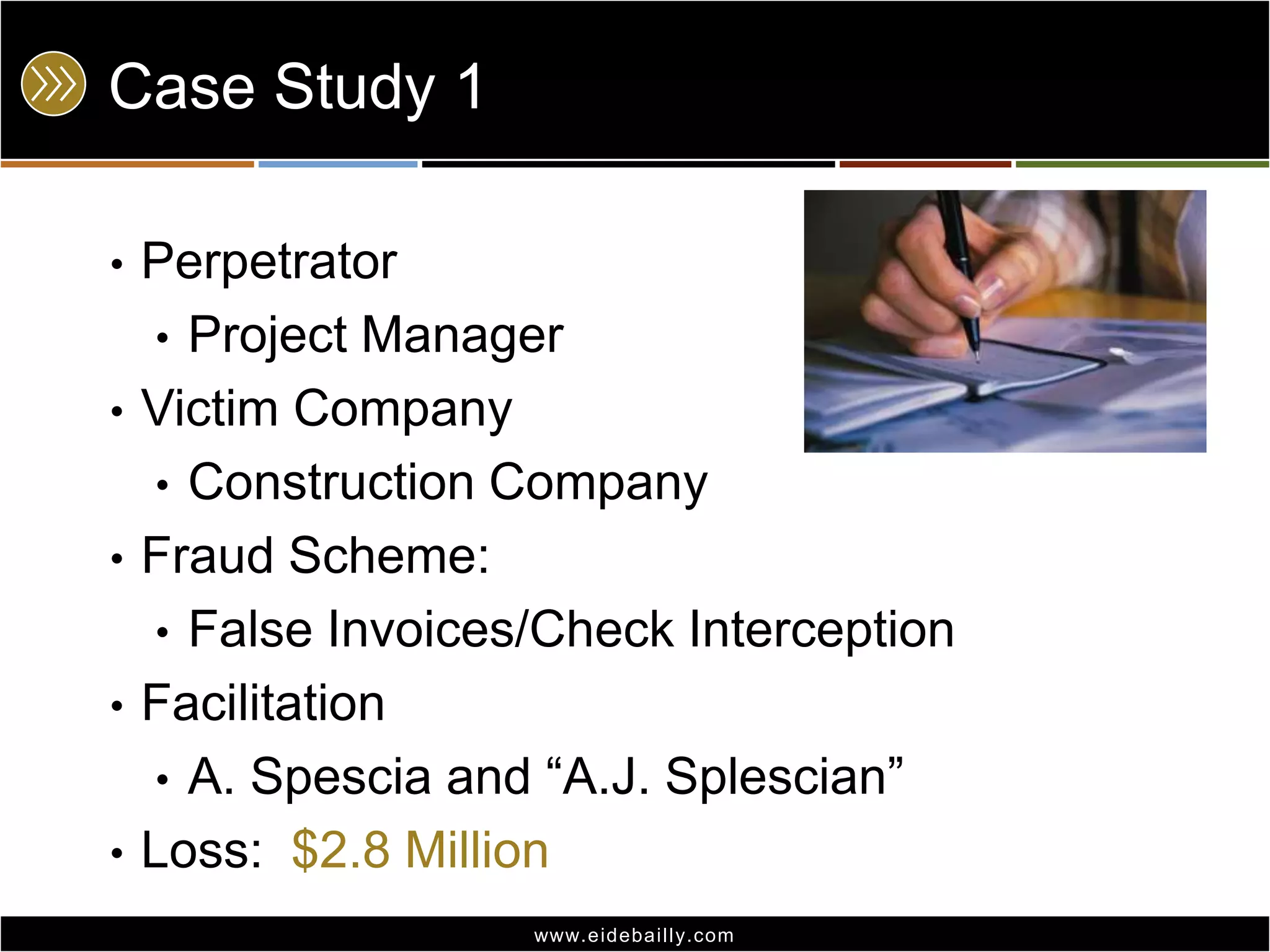
Case Study 1PerpetratorProject ManagerVictim CompanyConstruction CompanyFraud Scheme:False Invoices/Check InterceptionFacilitationA. Spescia and “A.J. Splescian”Loss:  $2.8 Million
Case Study 2PerpetratorBookkeeperVictim CompanyConstruction CompanyFraud Scheme:Fraudulent DisbursementsLoss:  $333,103.30
Case Example 3PerpetratorDivisional Merchandising ManagerVictim CompanyHome Improvement RetailerFraud SchemeAcceptance of BribesFacilitationNo quote/bid requirementsLoss:  $2.5 Million
What can you do NOW?Improve perception of detection:Implement a fraud policy.Decide what fraud is and the consequences of committing fraud.Communicate policy to employees.Employ a fraud hotline or anonymous reporting system. Check if insurance policy covers acts of employee dishonesty.If not, look into the cost/benefit of adding coverage.
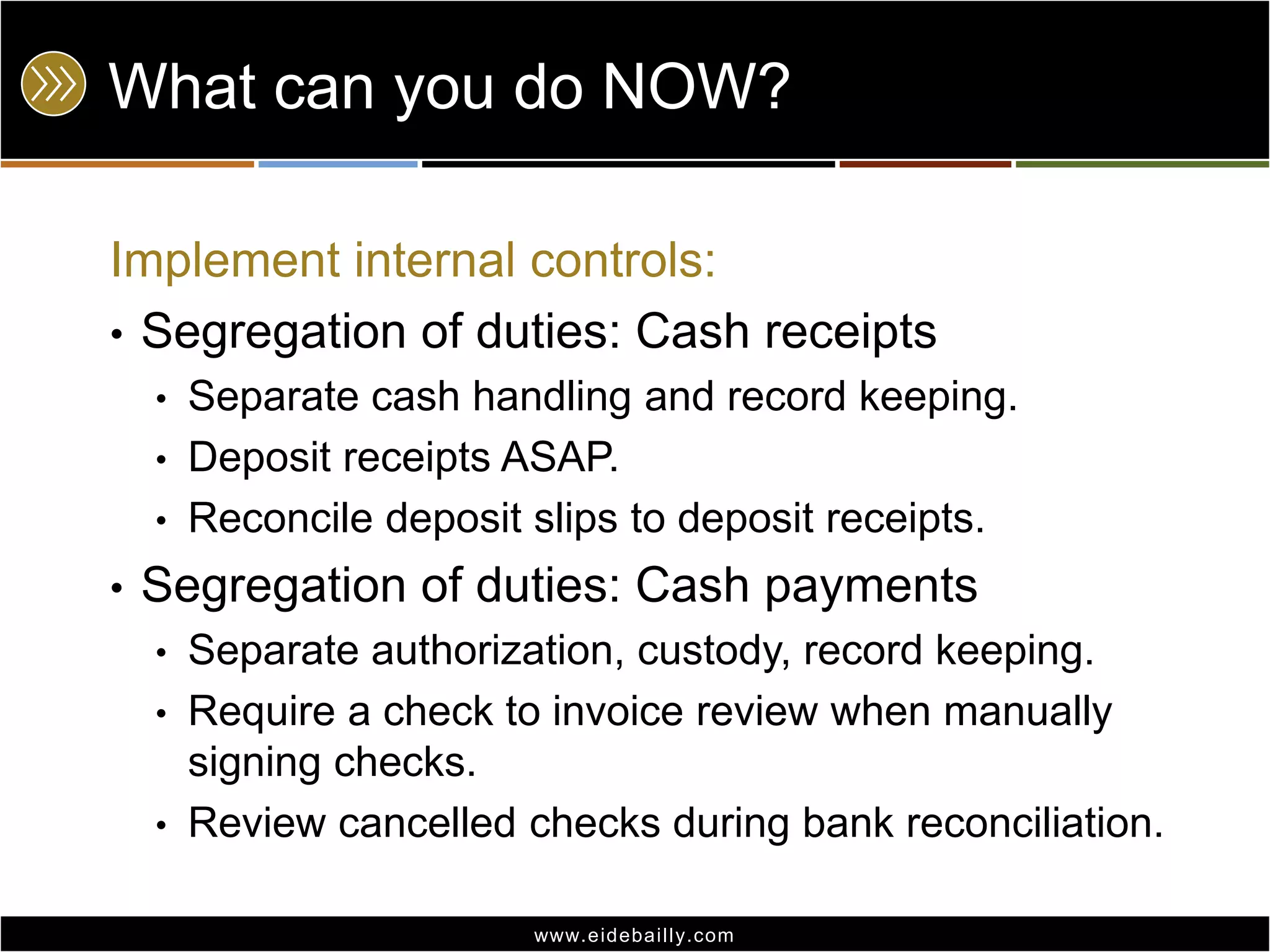
What can you do NOW?Implement internal controls:Segregation of duties: Cash receiptsSeparate cash handling and record keeping.Deposit receipts ASAP.Reconcile deposit slips to deposit receipts.Segregation of duties: Cash paymentsSeparate authorization, custody, record keeping.Require a check to invoice review when manually signing checks.Review cancelled checks during bank reconciliation.
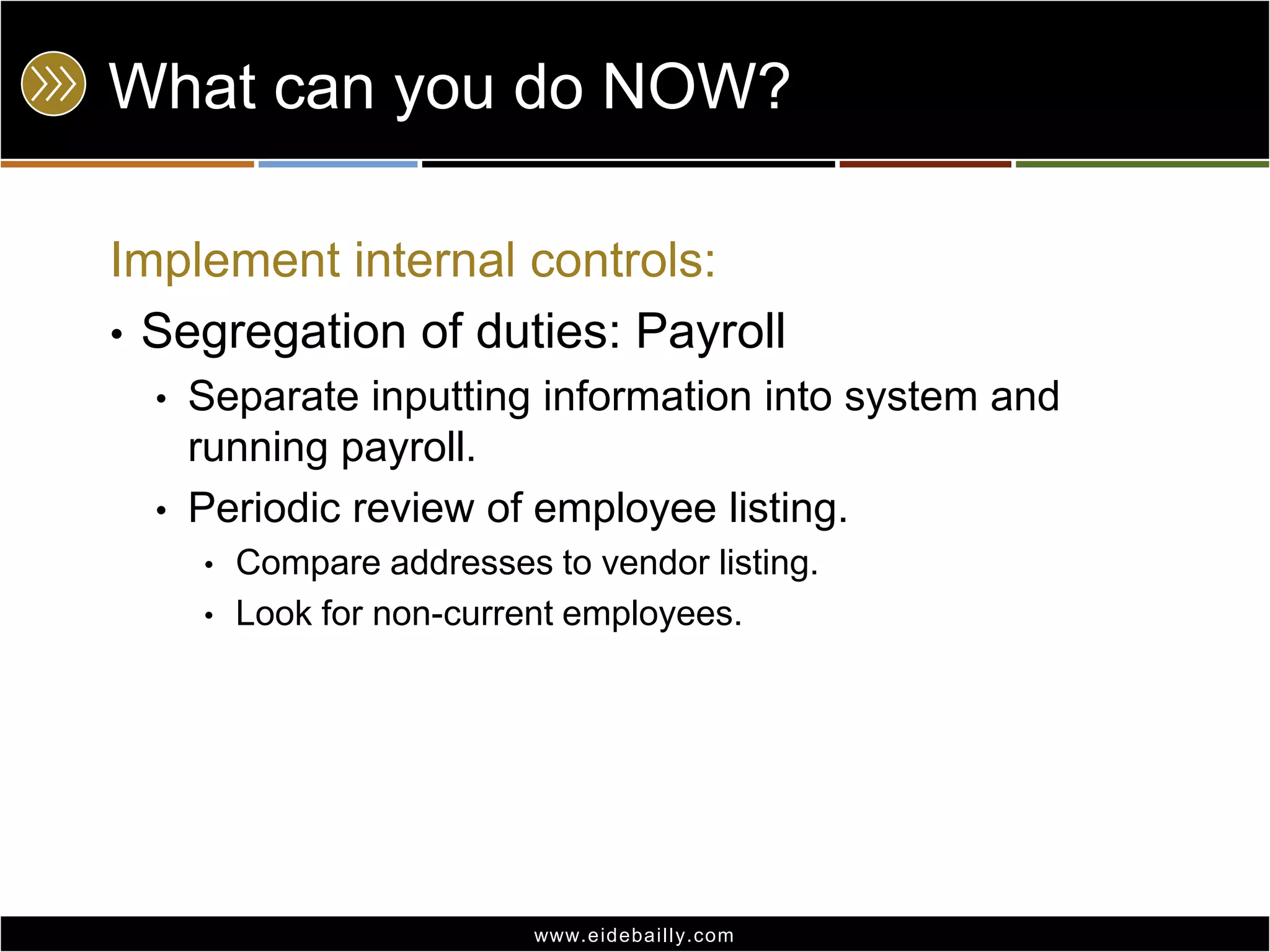
What can you do NOW?Implement internal controls:Segregation of duties: PayrollSeparate inputting information into system and running payroll.Periodic review of employee listing.Compare addresses to vendor listing.Look for non-current employees.
Contact InformationAndrew Kramer1850 North Central Ave, Suite 400.Phoenix, AZ 85004602-264-8604akramer@eidebailly.com

New age of risk for contractors slide presentation

  • 1.
    Presented by:Andrew Kramer,CPAFraud; A New Age of Risk for Contractors
  • 2.
    Forensic Accounting andInvestigative ServicesFraud preventionInternal control reviewFraud awareness trainingPre-employment background checksFraud detectionFraud scheme detectionInterviews and interrogationFraud investigationAsset theft investigationPartnership malfeasance investigationsDocumentation of fraud occurrenceLitigation support
  • 3.
    Trends in FraudEconomyand fraud have an indirect relationship.Increase in fraud occurrences since economic crisis began in 2008.Scheme with the greatest increase in occurrence:Theft of company property.Embezzlement and expense account fraudMore fraud occurrences due to the economy will be found at a later date.Median duration of all fraud schemes is 18 months.Institute of Internal Auditors, “Knowledge Alert; Emerging Trends in Fraud Risks, 2010”
  • 4.
    Trends in FraudMostfrauds are uncovered by:Tips (40.2%)Management review (15.4%)Internal audit (13.9%)Small organizations (>100 employees):Suffer the greatest percentage of frauds.Median fraud scheme loss of $155,000.Most common schemes: BillingCheck tamperingCorruptionSkimmingAssociation of Certified Fraud Examiners, “Report to the Nation, 2010”
  • 5.
    Fraud Trends inthe Construction IndustryMedian fraud loss is $200,000Out of the construction cases polled:Corruption (45.5%)Use of influence that violates duty of due care to employer.Billing (29.9%)Payments are issued for fraudulent invoices of goods or services, invoices with inflated prices, personal expenses.Check tampering (18.2%)Checks are intercepted, forged, or altered.Association of Certified Fraud Examiners, “Report to the Nation, 2010”
  • 6.
    Fraud Trends inthe Construction IndustrySkimming (15.6%)Employee steals Cash from an organization before it is recorded in the accounting system.Non-cash Theft (15.6%)Employee steals or misuses non-cash assets of the organization.Expense Reimbursements (13.0%)Employee requests reimbursement for personal, fictitious, or inflated business expenses. Association of Certified Fraud Examiners, “Report to the Nation, 2010”
  • 7.
    Four Elements ofFraudHidden (concealed)Intentional; violates the employee’s fiduciary duty to the companyThe perpetrator receives a benefitCosts the employing organization assets, revenue, etc.
  • 8.
  • 9.
    The Fraud Triangle;PressureCauses an employee to commit fraudHigh amounts of debtFamily medical costsHousing market pressuresBad investment decisionsAddiction ProblemsDrugs, alcohol, gamblingLavish lifestylePoor economy = greater pressure on employeesPressureFraud OccurrenceEconomy
  • 10.
    The Fraud Triangle;RationalizationMeans of justifying the fraudulent act.Low employee morale can result in a rationalization to commit fraud.Low employee morale is often linked to theft more often than low pay is linked to theft.“The boss can afford it.”“I’m not hurting anyone.”“I’ll pay this back.”“They owe me.”“No one will notice if this is gone.”
  • 11.
    The Fraud Triangle;OpportunityAbility for an employee to commit a fraud.Employee exploits job duties and responsibilities.Weak internal controlsPoor oversightAbuse of decision making authorityOpportunity is the factor most able to be changed by the organization.
  • 12.
    Fraud PreventionEliminate OpportunityIncreasethe perception of detectionPeople rarely commit fraud if they think they will be caught.Implement strong internal controls
  • 13.
    Increasing Perception ofDetection“Tone at the Top”Managers need to communicate that they are serious about fraud detection and preventionEmployee EducationInternal controls for monitoring employeesCompany fraud (ethics) policy
  • 14.
    Increasing Perception ofDetectionProactive policiesSurveillanceFraud assessment questioningMandatory vacationsSurprise auditsVigorously pursue dishonest actsImplement fraud hotlineWith hotline:Median Loss: $100,000Duration of fraud: 13 monthsWithout hotline:Median Loss: $245,000Duration of fraud: 20 months
  • 15.
    Internal controlsSegregation ofduties:AuthorizationRecording (Record keeping)Custody of assetsProper procedures for authorizationAdequate documents and recordsPhysical control over assets and recordsIndependent checks on performance
  • 16.
    Internal controlsDevelop policiesand proceduresDemand compliance by employeesEnforce punishment for violationsComplete pre-employment background investigations of employeesSafeguard company assetsUtilize employee dishonesty insurance
  • 17.
    Case Study 1PerpetratorProjectManagerVictim CompanyConstruction CompanyFraud Scheme:False Invoices/Check InterceptionFacilitationA. Spescia and “A.J. Splescian”Loss: $2.8 Million
  • 18.
    Case Study 2PerpetratorBookkeeperVictimCompanyConstruction CompanyFraud Scheme:Fraudulent DisbursementsLoss: $333,103.30
  • 19.
    Case Example 3PerpetratorDivisionalMerchandising ManagerVictim CompanyHome Improvement RetailerFraud SchemeAcceptance of BribesFacilitationNo quote/bid requirementsLoss: $2.5 Million
  • 20.
    What can youdo NOW?Improve perception of detection:Implement a fraud policy.Decide what fraud is and the consequences of committing fraud.Communicate policy to employees.Employ a fraud hotline or anonymous reporting system. Check if insurance policy covers acts of employee dishonesty.If not, look into the cost/benefit of adding coverage.
  • 21.
    What can youdo NOW?Implement internal controls:Segregation of duties: Cash receiptsSeparate cash handling and record keeping.Deposit receipts ASAP.Reconcile deposit slips to deposit receipts.Segregation of duties: Cash paymentsSeparate authorization, custody, record keeping.Require a check to invoice review when manually signing checks.Review cancelled checks during bank reconciliation.
  • 22.
    What can youdo NOW?Implement internal controls:Segregation of duties: PayrollSeparate inputting information into system and running payroll.Periodic review of employee listing.Compare addresses to vendor listing.Look for non-current employees.
  • 23.
    Contact InformationAndrew Kramer1850North Central Ave, Suite 400.Phoenix, AZ 85004602-264-8604akramer@eidebailly.com