INTERACTION FUNCTION I
The Nervous and Endocrine Systems
Transmitting, analyzing and working out responses.
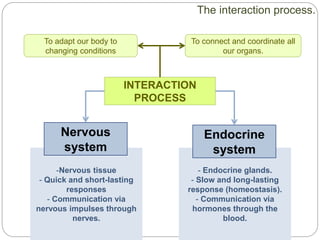
- Endocrine glands.
- Slow and long-lasting
response (homeostasis).
- Communication via
hormones through the
blood.
-Nervous tissue
- Quick and short-lasting
responses
- Communication via
nervous impulses through
nerves.
INTERACTION
PROCESS
To adapt our body to
changing conditions
To connect and coordinate all
our organs.
Nervous
system
Endocrine
system
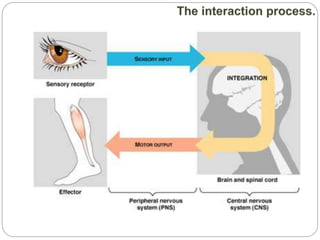
The interaction process.
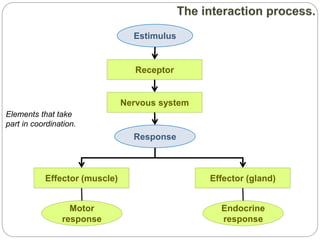
Receptor
Estimulus
Response
Nervous system
Effector (muscle) Effector (gland)
Motor
response
Endocrine
response
Elements that take
part in coordination.
THE NERVOUS SYSTEM
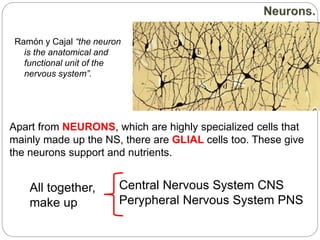
Ramón y Cajal “the neuron
is the anatomical and
functional unit of the
nervous system”.
Apart from NEURONS, which are highly specialized cells that
mainly made up the NS, there are GLIAL cells too. These give
the neurons support and nutrients.
All together,
make up
Central Nervous System CNS
Perypheral Nervous System PNS
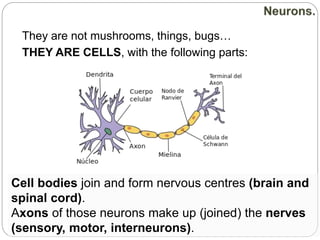
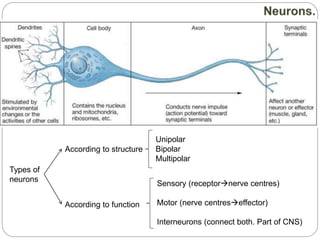
They are not mushrooms, things, bugs…
THEY ARE CELLS, with the following parts:
Cell bodies join and form nervous centres (brain and
spinal cord).
Axons of those neurons make up (joined) the nerves
(sensory, motor, interneurons).
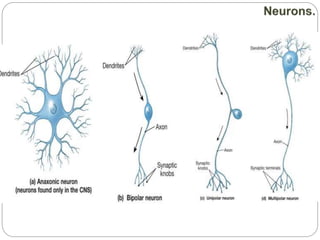
Types of
neurons
According to structure
According to function
Unipolar
Bipolar
Multipolar
Sensory (receptornerve centres)
Motor (nerve centreseffector)
Interneurons (connect both. Part of CNS)
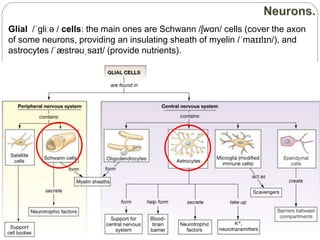
Glial /ˈɡliːə / cells: the main ones are Schwann /ʃwɑn/ cells (cover the axon
of some neurons, providing an insulating sheath of myelin /ˈmaɪɪlɪn/), and
astrocytes /ˈæstrəʊˌsaɪt/ (provide nutrients).
TRANSMITTING INFORMATION.
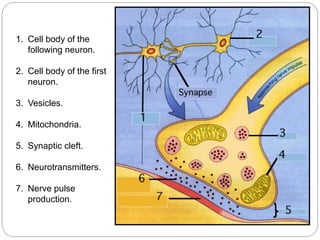
The “empty” space between neurons is called
SYNAPSE. /saɪnæps/
In that space, the transmitting neuron releases a
chemical compound, a NEUROTRANSMITTER.
/njʊərəʊtrænzˈmɪtə /
The receiving neuron, detects that substance,
becoming electrically excited.
The transmition of nervous impulse is
electrochemical, it means that:
1. Through the surface of the neuron, it is electric.
(in a neuron, “in the path”)
2. Trough the synapse, it is chemical.
(between two neurons, “in the space”)
Synapse and neurotransmitters.
1. Cell body of the
following neuron.
2. Cell body of the first
neuron.
3. Vesicles.
4. Mitochondria.
5. Synaptic cleft.
6. Neurotransmitters.
7. Nerve pulse
production.
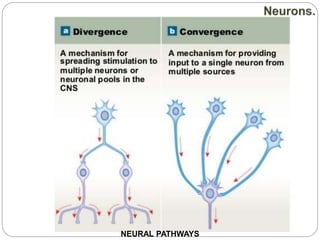
NEURAL PATHWAYS
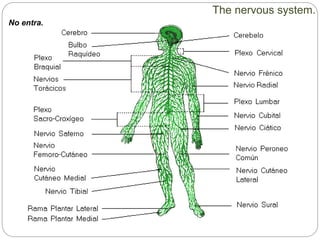
The nervous system.
No entra.
 Receives information from sensory organs.
 Intreprets information received.
 Transfers signals to effectors.
 Coordinates all organs.
 Carries out intellectual and mental functions.
 Responsible of emotions and feelings.
FUNCTIONS OF THE NERVOUS SYSTEM
The nervous system.
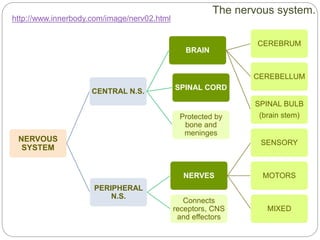
NERVOUS
SYSTEM
CENTRAL N.S.
Protected by
bone and
meninges
BRAIN
CEREBRUM
CEREBELLUM
SPINAL BULB
(brain stem)
SPINAL CORD
PERIPHERAL
N.S.
Connects
receptors, CNS
and effectors
NERVES
SENSORY
MOTORS
MIXED
The nervous system.
http://www.innerbody.com/image/nerv02.html
Folder_Body://NS/CNS/brain/…
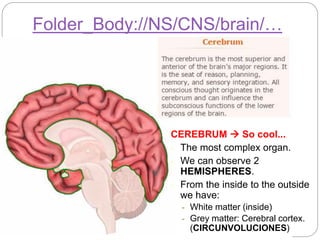
CEREBRUM  So cool...
- The most complex organ.
- We can observe 2
HEMISPHERES.
- From the inside to the outside
we have:
- White matter (inside)
- Grey matter: Cerebral cortex.
(CIRCUNVOLUCIONES)
Folder_Body://NS/CNS/brain/…
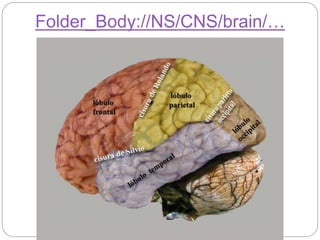
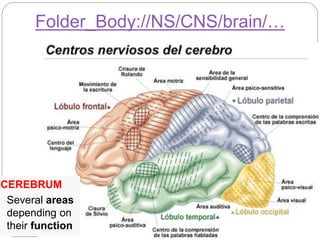
CEREBRUM
-Several areas
depending on
their function
Folder_Body://NS/CNS/brain/…
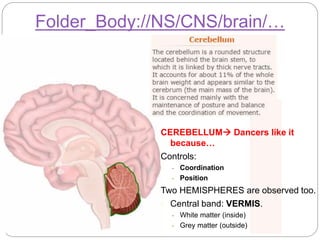
CEREBELLUM Dancers like it
because…
Controls:
- Coordination
- Position
Two HEMISPHERES are observed too.
- Central band: VERMIS.
- White matter (inside)
- Grey matter (outside)
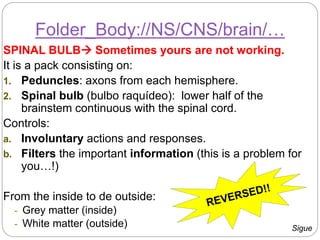
SPINAL BULB Sometimes yours are not working.
It is a pack consisting on:
1. Peduncles: axons from each hemisphere.
2. Spinal bulb (bulbo raquídeo): lower half of the
brainstem continuous with the spinal cord.
Controls:
a. Involuntary actions and responses.
b. Filters the important information (this is a problem for
you…!)
From the inside to de outside:
- Grey matter (inside)
- White matter (outside)
Folder_Body://NS/CNS/brain/…
Sigue
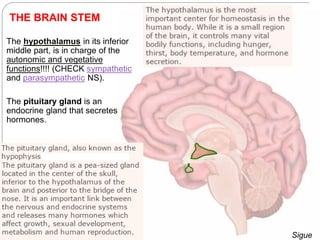
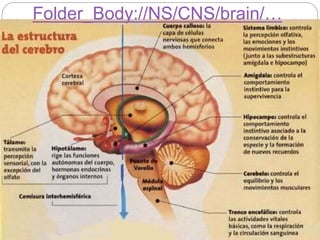
 The hypothalamus in its inferior
middle part, is in charge of the
autonomic and vegetative
functions!!!! (CHECK sympathetic
and parasympathetic NS).
 The pituitary gland is an
endocrine gland that secretes
hormones.
THE BRAIN STEM
Sigue
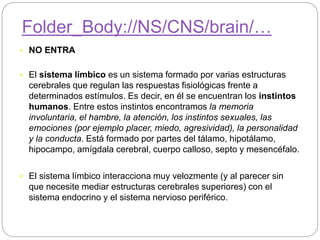
 NO ENTRA
 El sistema límbico es un sistema formado por varias estructuras
cerebrales que regulan las respuestas fisiológicas frente a
determinados estímulos. Es decir, en él se encuentran los instintos
humanos. Entre estos instintos encontramos la memoria
involuntaria, el hambre, la atención, los instintos sexuales, las
emociones (por ejemplo placer, miedo, agresividad), la personalidad
y la conducta. Está formado por partes del tálamo, hipotálamo,
hipocampo, amígdala cerebral, cuerpo calloso, septo y mesencéfalo.
 El sistema límbico interacciona muy velozmente (y al parecer sin
que necesite mediar estructuras cerebrales superiores) con el
sistema endocrino y el sistema nervioso periférico.
Folder_Body://NS/CNS/brain/…
- Extension of the brain stem.
- We have from the inside to the outside:
- Grey matter (inside)
- White matter (outside)
- Protected by the BACKBONE or VERTEBRAL
COLUMN.
- Funtions:
- Some involuntary actions.
- To connect body-brain-body.
Folder_Body://NS/CNS/spinal_cord/
Folder_Body://NS/PNS/nerves
It’s good to be nervous.
 They are in charge of connecting:
 External and internal receptors.
 CNS
 Effectors (next unit)
 They go through
all body from (the
CNS)
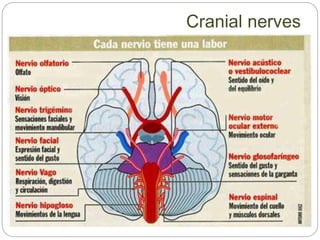
◦ Brain: CRANIAL
NERVES.
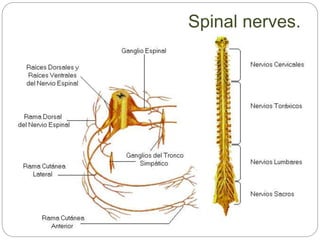
◦ Spinal cord:
SPINAL NERVES.
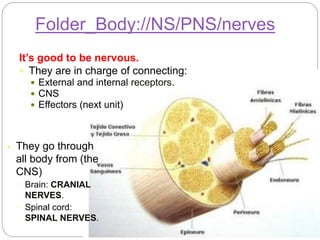
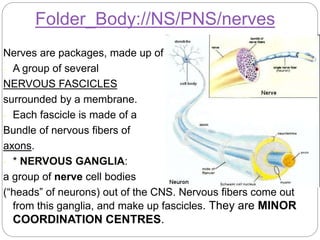
Nerves are packages, made up of
- A group of several
NERVOUS FASCICLES
surrounded by a membrane.
- Each fascicle is made of a
Bundle of nervous fibers of
axons.
- * NERVOUS GANGLIA:
a group of nerve cell bodies
(“heads” of neurons) out of the CNS. Nervous fibers come out
from this ganglia, and make up fascicles. They are MINOR
COORDINATION CENTRES.
Folder_Body://NS/PNS/nerves
Spinal nerves.
Cranial nerves
Nerves can be:
a. Sensory: sensory neurons from sensory organs
 CNS.
b. Motor: motor neurons from CNS  organs that
carry out the response. Depending on the
movement response can be:
- Somatic nervous system: voluntary and reflex
actions.
- Autonomic nervous system: involuntary
actions.
Folder_Body://NS/PNS/nerves
Be
careful with
mixing up
REFLEX actions
and
INVOLUNTARY
movements.
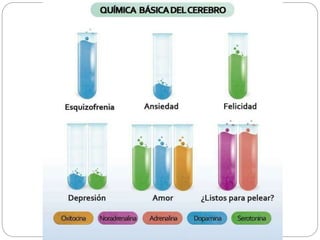
 They are varied: from “simple” spinal responses
to complex brain cortex responses.
 3 types
 REFLEXES: cerrar los ojos cuando me van a meter
el dedo en él.
 VOLUNTARY ACTIONS: guiñar un ojo a mi
cómplice.
 INVOLUNTARY or AUTONOMIC: parpadeo
constante. (Vamos a verlas a fondo).
RESPONSES
AUTONOMIC
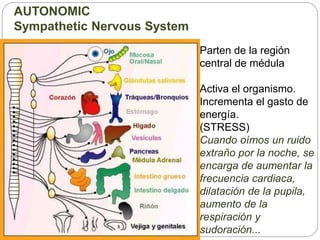
Sympathetic Nervous System
Parten de la región
central de médula
Activa el organismo.
Incrementa el gasto de
energía.
(STRESS)
Cuando oímos un ruido
extraño por la noche, se
encarga de aumentar la
frecuencia cardiaca,
dilatación de la pupila,
aumento de la
respiración y
sudoración...
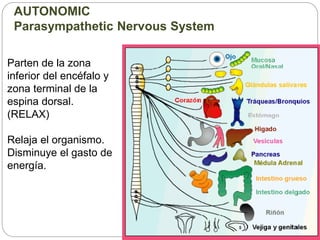
Parten de la zona
inferior del encéfalo y
zona terminal de la
espina dorsal.
(RELAX)
Relaja el organismo.
Disminuye el gasto de
energía.
AUTONOMIC
Parasympathetic Nervous System
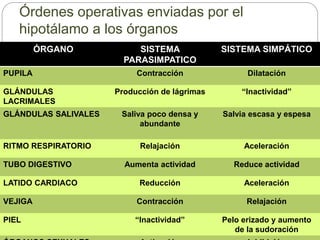
ÓRGANO SISTEMA
PARASIMPATICO
SISTEMA SIMPÁTICO
PUPILA Contracción Dilatación
GLÁNDULAS
LACRIMALES
Producción de lágrimas “Inactividad”
GLÁNDULAS SALIVALES Saliva poco densa y
abundante
Salvia escasa y espesa
RITMO RESPIRATORIO Relajación Aceleración
TUBO DIGESTIVO Aumenta actividad Reduce actividad
LATIDO CARDIACO Reducción Aceleración
VEJIGA Contracción Relajación
PIEL “Inactividad” Pelo erizado y aumento
de la sudoración
Órdenes operativas enviadas por el
hipotálamo a los órganos
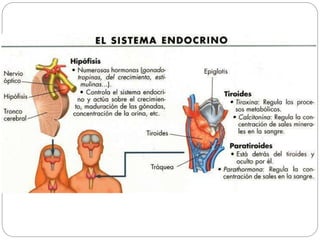
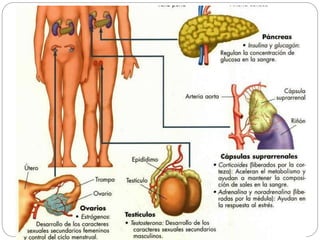
THE ENDOCRINE SYSTEM
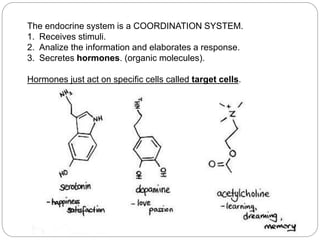
The endocrine system is a COORDINATION SYSTEM.
1. Receives stimuli.
2. Analize the information and elaborates a response.
3. Secretes hormones. (organic molecules).
Hormones just act on specific cells called target cells.
It helps to control and maintain:
1. Body energy levels.
2. Reproduction.
3. Growth and organisms development.
4. Internal systems balance (homeostasis).
5. Responses to external environment
(temperature, stress or injuries).
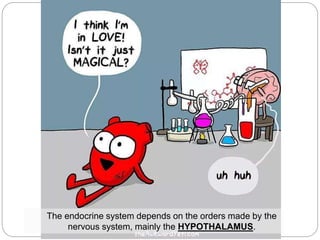
The endocrine system depends on the orders made by the
nervous system, mainly the HYPOTHALAMUS.
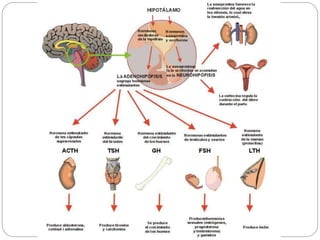
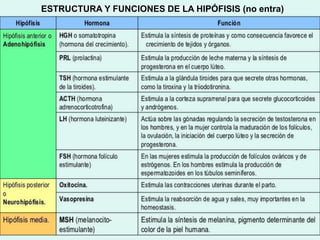
ESTRUCTURA Y FUNCIONES DE LA HIPÓFISIS (no entra)
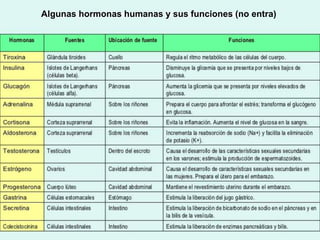
Algunas hormonas humanas y sus funciones (no entra)
Nervous and endocrine systems.

Nervous and endocrine systems.

  • 1.
    INTERACTION FUNCTION I TheNervous and Endocrine Systems Transmitting, analyzing and working out responses.
  • 2.
    - Endocrine glands. -Slow and long-lasting response (homeostasis). - Communication via hormones through the blood. -Nervous tissue - Quick and short-lasting responses - Communication via nervous impulses through nerves. INTERACTION PROCESS To adapt our body to changing conditions To connect and coordinate all our organs. Nervous system Endocrine system The interaction process.
  • 3.
    Receptor Estimulus Response Nervous system Effector (muscle)Effector (gland) Motor response Endocrine response Elements that take part in coordination.
  • 5.
  • 6.
    Ramón y Cajal“the neuron is the anatomical and functional unit of the nervous system”. Apart from NEURONS, which are highly specialized cells that mainly made up the NS, there are GLIAL cells too. These give the neurons support and nutrients. All together, make up Central Nervous System CNS Perypheral Nervous System PNS
  • 7.
    They are notmushrooms, things, bugs… THEY ARE CELLS, with the following parts: Cell bodies join and form nervous centres (brain and spinal cord). Axons of those neurons make up (joined) the nerves (sensory, motor, interneurons).
  • 8.
    Types of neurons According tostructure According to function Unipolar Bipolar Multipolar Sensory (receptornerve centres) Motor (nerve centreseffector) Interneurons (connect both. Part of CNS)
  • 10.
    Glial /ˈɡliːə /cells: the main ones are Schwann /ʃwɑn/ cells (cover the axon of some neurons, providing an insulating sheath of myelin /ˈmaɪɪlɪn/), and astrocytes /ˈæstrəʊˌsaɪt/ (provide nutrients).
  • 11.
    TRANSMITTING INFORMATION. The “empty”space between neurons is called SYNAPSE. /saɪnæps/ In that space, the transmitting neuron releases a chemical compound, a NEUROTRANSMITTER. /njʊərəʊtrænzˈmɪtə / The receiving neuron, detects that substance, becoming electrically excited.
  • 12.
    The transmition ofnervous impulse is electrochemical, it means that: 1. Through the surface of the neuron, it is electric. (in a neuron, “in the path”) 2. Trough the synapse, it is chemical. (between two neurons, “in the space”) Synapse and neurotransmitters.
  • 13.
    1. Cell bodyof the following neuron. 2. Cell body of the first neuron. 3. Vesicles. 4. Mitochondria. 5. Synaptic cleft. 6. Neurotransmitters. 7. Nerve pulse production.
  • 14.
  • 15.
  • 16.
     Receives informationfrom sensory organs.  Intreprets information received.  Transfers signals to effectors.  Coordinates all organs.  Carries out intellectual and mental functions.  Responsible of emotions and feelings. FUNCTIONS OF THE NERVOUS SYSTEM The nervous system.
  • 17.
    NERVOUS SYSTEM CENTRAL N.S. Protected by boneand meninges BRAIN CEREBRUM CEREBELLUM SPINAL BULB (brain stem) SPINAL CORD PERIPHERAL N.S. Connects receptors, CNS and effectors NERVES SENSORY MOTORS MIXED The nervous system. http://www.innerbody.com/image/nerv02.html
  • 18.
    Folder_Body://NS/CNS/brain/… CEREBRUM  Socool... - The most complex organ. - We can observe 2 HEMISPHERES. - From the inside to the outside we have: - White matter (inside) - Grey matter: Cerebral cortex. (CIRCUNVOLUCIONES)
  • 19.
  • 20.
  • 21.
    Folder_Body://NS/CNS/brain/… CEREBELLUM Dancers likeit because… Controls: - Coordination - Position Two HEMISPHERES are observed too. - Central band: VERMIS. - White matter (inside) - Grey matter (outside)
  • 22.
    SPINAL BULB Sometimesyours are not working. It is a pack consisting on: 1. Peduncles: axons from each hemisphere. 2. Spinal bulb (bulbo raquídeo): lower half of the brainstem continuous with the spinal cord. Controls: a. Involuntary actions and responses. b. Filters the important information (this is a problem for you…!) From the inside to de outside: - Grey matter (inside) - White matter (outside) Folder_Body://NS/CNS/brain/… Sigue
  • 23.
     The hypothalamusin its inferior middle part, is in charge of the autonomic and vegetative functions!!!! (CHECK sympathetic and parasympathetic NS).  The pituitary gland is an endocrine gland that secretes hormones. THE BRAIN STEM Sigue
  • 24.
     NO ENTRA El sistema límbico es un sistema formado por varias estructuras cerebrales que regulan las respuestas fisiológicas frente a determinados estímulos. Es decir, en él se encuentran los instintos humanos. Entre estos instintos encontramos la memoria involuntaria, el hambre, la atención, los instintos sexuales, las emociones (por ejemplo placer, miedo, agresividad), la personalidad y la conducta. Está formado por partes del tálamo, hipotálamo, hipocampo, amígdala cerebral, cuerpo calloso, septo y mesencéfalo.  El sistema límbico interacciona muy velozmente (y al parecer sin que necesite mediar estructuras cerebrales superiores) con el sistema endocrino y el sistema nervioso periférico. Folder_Body://NS/CNS/brain/…
  • 25.
  • 26.
    - Extension ofthe brain stem. - We have from the inside to the outside: - Grey matter (inside) - White matter (outside) - Protected by the BACKBONE or VERTEBRAL COLUMN. - Funtions: - Some involuntary actions. - To connect body-brain-body. Folder_Body://NS/CNS/spinal_cord/
  • 27.
    Folder_Body://NS/PNS/nerves It’s good tobe nervous.  They are in charge of connecting:  External and internal receptors.  CNS  Effectors (next unit)  They go through all body from (the CNS) ◦ Brain: CRANIAL NERVES. ◦ Spinal cord: SPINAL NERVES.
  • 28.
    Nerves are packages,made up of - A group of several NERVOUS FASCICLES surrounded by a membrane. - Each fascicle is made of a Bundle of nervous fibers of axons. - * NERVOUS GANGLIA: a group of nerve cell bodies (“heads” of neurons) out of the CNS. Nervous fibers come out from this ganglia, and make up fascicles. They are MINOR COORDINATION CENTRES. Folder_Body://NS/PNS/nerves
  • 29.
  • 30.
  • 31.
    Nerves can be: a.Sensory: sensory neurons from sensory organs  CNS. b. Motor: motor neurons from CNS  organs that carry out the response. Depending on the movement response can be: - Somatic nervous system: voluntary and reflex actions. - Autonomic nervous system: involuntary actions. Folder_Body://NS/PNS/nerves Be careful with mixing up REFLEX actions and INVOLUNTARY movements.
  • 32.
     They arevaried: from “simple” spinal responses to complex brain cortex responses.  3 types  REFLEXES: cerrar los ojos cuando me van a meter el dedo en él.  VOLUNTARY ACTIONS: guiñar un ojo a mi cómplice.  INVOLUNTARY or AUTONOMIC: parpadeo constante. (Vamos a verlas a fondo). RESPONSES
  • 33.
    AUTONOMIC Sympathetic Nervous System Partende la región central de médula Activa el organismo. Incrementa el gasto de energía. (STRESS) Cuando oímos un ruido extraño por la noche, se encarga de aumentar la frecuencia cardiaca, dilatación de la pupila, aumento de la respiración y sudoración...
  • 34.
    Parten de lazona inferior del encéfalo y zona terminal de la espina dorsal. (RELAX) Relaja el organismo. Disminuye el gasto de energía. AUTONOMIC Parasympathetic Nervous System
  • 35.
    ÓRGANO SISTEMA PARASIMPATICO SISTEMA SIMPÁTICO PUPILAContracción Dilatación GLÁNDULAS LACRIMALES Producción de lágrimas “Inactividad” GLÁNDULAS SALIVALES Saliva poco densa y abundante Salvia escasa y espesa RITMO RESPIRATORIO Relajación Aceleración TUBO DIGESTIVO Aumenta actividad Reduce actividad LATIDO CARDIACO Reducción Aceleración VEJIGA Contracción Relajación PIEL “Inactividad” Pelo erizado y aumento de la sudoración Órdenes operativas enviadas por el hipotálamo a los órganos
  • 36.
  • 37.
    The endocrine systemis a COORDINATION SYSTEM. 1. Receives stimuli. 2. Analize the information and elaborates a response. 3. Secretes hormones. (organic molecules). Hormones just act on specific cells called target cells.
  • 39.
    It helps tocontrol and maintain: 1. Body energy levels. 2. Reproduction. 3. Growth and organisms development. 4. Internal systems balance (homeostasis). 5. Responses to external environment (temperature, stress or injuries).
  • 40.
    The endocrine systemdepends on the orders made by the nervous system, mainly the HYPOTHALAMUS.
  • 44.
    ESTRUCTURA Y FUNCIONESDE LA HIPÓFISIS (no entra)
  • 45.
    Algunas hormonas humanasy sus funciones (no entra)