Unit 1
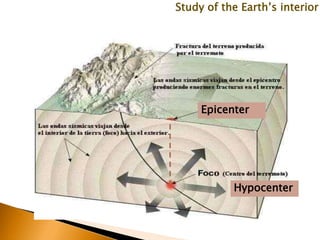
Hypocenter or focus: point at which the
slip of an earthquake begins.
Hypocenters are therefore always
located at some depth underground.
From there, body seismic waves
(ondas profundas) [primary waves (P)
and secondary waves (S)] spread in all
directions in spherical wavefronts.
Epicenter: An epicenter has no physical
meaning; it is simply the point on the
Earth's surface directly above the
hypocenter. From there, surface
seismic waves (ondas sísmicas
superficiales) are released [Rayleigh
waves (R) and Love waves (L)], the
ones causing damages.
Earthquakes elements
Study of the Earth’s interior
Hypocenter
Epicenter
Study of the Earth’s interior
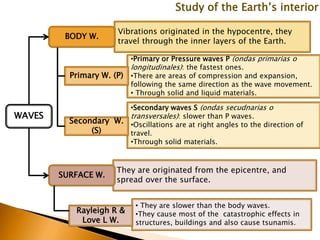
They are originated from the epicentre, and
spread over the surface.
Vibrations originated in the hypocentre, they
travel through the inner layers of the Earth.
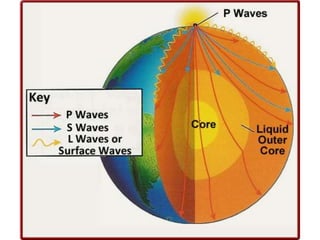
WAVES
BODY W.
SURFACE W.
•Primary or Pressure waves P (ondas primarias o
longitudinales): the fastest ones.
•There are areas of compression and expansion,
following the same direction as the wave movement.
• Through solid and liquid materials.
•Secondary waves S (ondas secudnarias o
transversales): slower than P waves.
•Oscillations are at right angles to the direction of
travel.
•Through solid materials.
• They are slower than the body waves.
•They cause most of the catastrophic effects in
structures, buildings and also cause tsunamis.
Primary W. (P)
Secondary W.
(S)
Rayleigh R &
Love L W.
Study of the Earth’s interior
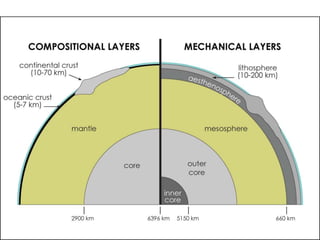
Estructura de la geosfera
Models
Geochemical
Geodynamic
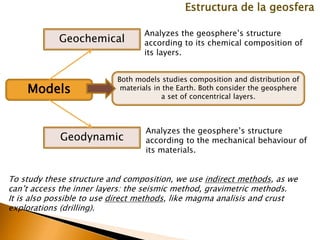
Analyzes the geosphere’s structure
according to its chemical composition of
its layers.
Analyzes the geosphere’s structure
according to the mechanical behaviour of
its materials.
Both models studies composition and distribution of
materials in the Earth. Both consider the geosphere
a set of concentrical layers.
To study these structure and composition, we use indirect methods, as we
can’t access the inner layers: the seismic method, gravimetric methods.
It is also possible to use direct methods, like magma analisis and crust
explorations (drilling).
Study of the Earth’s interior
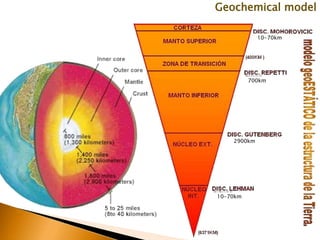
Geochemical model
10-70km
700km
2900km
10-70km
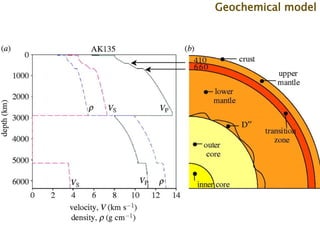
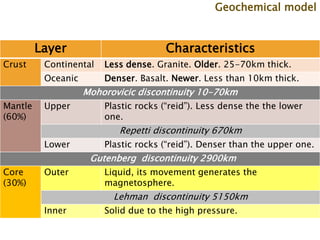
Geochemical model
Layer Characteristics
Crust Continental Less dense. Granite. Older. 25-70km thick.
Oceanic Denser. Basalt. Newer. Less than 10km thick.
Mohorovicic discontinuity 10-70km
Mantle
(60%)
Upper Plastic rocks (“reid”). Less dense the the lower
one.
Repetti discontinuity 670km
Lower Plastic rocks (“reid”). Denser than the upper one.
Gutenberg discontinuity 2900km
Core
(30%)
Outer Liquid, its movement generates the
magnetosphere.
Lehman discontinuity 5150km
Inner Solid due to the high pressure.
Geochemical model
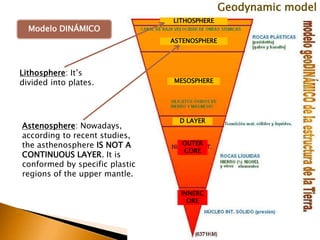
Geodynamic model
Modelo DINÁMICO
Astenosphere: Nowadays,
according to recent studies,
the asthenosphere IS NOT A
CONTINUOUS LAYER. It is
conformed by specific plastic
regions of the upper mantle.
Lithosphere: It’s
divided into plates.
LITHOSPHERE
ASTENOSPHERE
MESOSPHERE
D LAYER
OUTER
CORE
INNERC
ORE
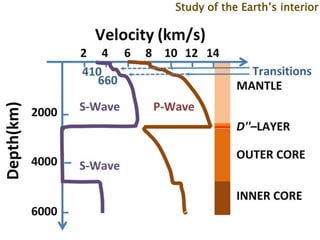
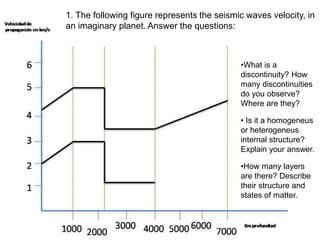
•What is a
discontinuity? How
many discontinuities
do you observe?
Where are they?
• Is it a homogeneus
or heterogeneus
internal structure?
Explain your answer.
•How many layers
are there? Describe
their structure and
states of matter.
1. The following figure represents the seismic waves velocity, in
an imaginary planet. Answer the questions:
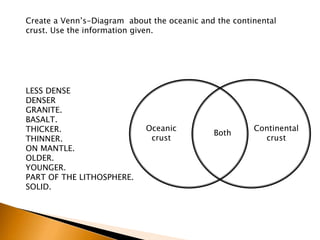
Create a Venn’s-Diagram about the oceanic and the continental
crust. Use the information given.
LESS DENSE
DENSER
GRANITE.
BASALT.
THICKER.
THINNER.
ON MANTLE.
OLDER.
YOUNGER.
PART OF THE LITHOSPHERE.
SOLID.
Oceanic
crust
Continental
crust
Both
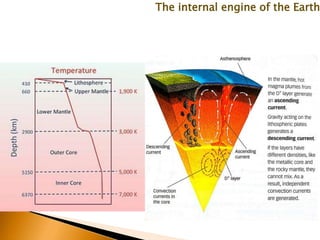
The internal engine of the Earth
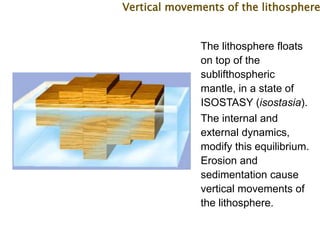
The lithosphere floats
on top of the
sublifthospheric
mantle, in a state of
ISOSTASY (isostasia).
The internal and
external dynamics,
modify this equilibrium.
Erosion and
sedimentation cause
vertical movements of
the lithosphere.
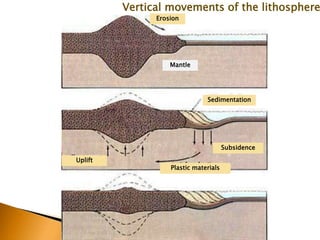
Vertical movements of the lithosphere
Mantle
Erosion
Sedimentation
Subsidence
Plastic materials
Uplift
Vertical movements of the lithosphere
Horizontal movements of the lithosphere
Plate tectonics nowadays
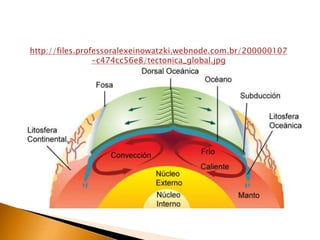
The engine of the plate tectonics is the subduction itself (not the
convection currents as we thought).
The subducting plate sinks into the mantle, and pulls the whole
plate behind. When it reaches around 670km, the plate stops,
because of being less dense than the surrounding materials (as it
was floating). This happens till it suddenly densifies, reaching
these materials lower levels (D’ layer).
This material gets hotter, until it floats and ascends forming
mantle plumes. This upwelling of hot rocks heat mantles regions
that start melting, these regions are called ASTHENOSPHERE.
In opposite regions, divergent plate separete from each other,
creating rifts or ridges.
https://www.youtube.com/watch?v=kwfNGatxUJI
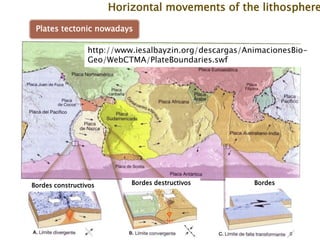
Plates tectonic nowadays
http://www.iesalbayzin.org/descargas/AnimacionesBio-
Geo/WebCTMA/PlateBoundaries.swf
Bordes destructivos Bordes
Horizontal movements of the lithosphere
Bordes constructivos
CONVERGENT BOUNDARY: Lithosphere is destroyed.
Oceanic plate vs. oceanic plate: Island arc.
http://www.iesalbayzin.org/descargas/AnimacionesBio-Geo/WebCTMA/SubdOcOc.swf
Oceanic plate vs. continental plate: Volcanic arc (Orógeno andino o térmico).
http://www.iesalbayzin.org/descargas/AnimacionesBio-
Geo/WebCTMA/SubdOcCont2.swf
Continental plate vs. continental plate: Collisional orogen (Orógeno de colisión,
obducción).
http://www.iesalbayzin.org/descargas/AnimacionesBio-
Geo/WebCTMA/SubdContCont.swf
DIVERGENT BOUNDARY: Plates separation creates new lithosphere, when magma
released in ridges, solidifies. Rift valley formation --> mid-ocean ridge (valle rift-->
dorsal oceánica).
http://www.iesalbayzin.org/descargas/AnimacionesBio-
Geo/WebCTMA/RiftValeyAfrica.swf
TRANSFORM BOUNDARY: A transform fault is produced.
HOT SPOT: VOLCANIC ARCHIPIELAGO and INTRAPLATE VULCANISM.
http://www.iesalbayzin.org/descargas/AnimacionesBio-Geo/WebCTMA/PuntosCali.swf
In all cases, plates tectonics is associated to seismic and volcanic phenomena (that can
be severe events or not).
Both are manifestations of this internal dynamic.
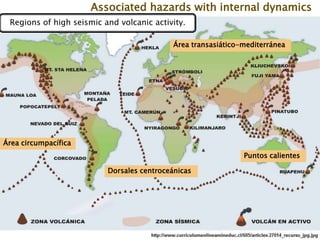
Associated hazards with internal dynamics
Área circumpacífica
Dorsales centroceánicas
Área transasiático-mediterránea
Puntos calientes
Regions of high seismic and volcanic activity.
Associated hazards with internal dynamics
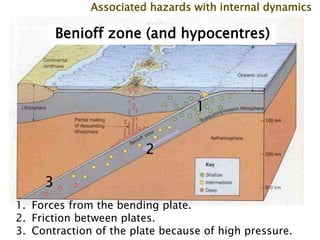
1. Forces from the bending plate.
2. Friction between plates.
3. Contraction of the plate because of high pressure.
1
2
3
Benioff zone (and hypocentres)
Associated hazards with internal dynamics
http://files.professoralexeinowatzki.webnode.com.br/200000107
-c474cc56e8/tectonica_global.jpg
4ESO. Unit 1 Plate tectonics.

4ESO. Unit 1 Plate tectonics.

  • 1.
  • 2.
    Hypocenter or focus:point at which the slip of an earthquake begins. Hypocenters are therefore always located at some depth underground. From there, body seismic waves (ondas profundas) [primary waves (P) and secondary waves (S)] spread in all directions in spherical wavefronts. Epicenter: An epicenter has no physical meaning; it is simply the point on the Earth's surface directly above the hypocenter. From there, surface seismic waves (ondas sísmicas superficiales) are released [Rayleigh waves (R) and Love waves (L)], the ones causing damages. Earthquakes elements Study of the Earth’s interior
  • 3.
  • 4.
    They are originatedfrom the epicentre, and spread over the surface. Vibrations originated in the hypocentre, they travel through the inner layers of the Earth. WAVES BODY W. SURFACE W. •Primary or Pressure waves P (ondas primarias o longitudinales): the fastest ones. •There are areas of compression and expansion, following the same direction as the wave movement. • Through solid and liquid materials. •Secondary waves S (ondas secudnarias o transversales): slower than P waves. •Oscillations are at right angles to the direction of travel. •Through solid materials. • They are slower than the body waves. •They cause most of the catastrophic effects in structures, buildings and also cause tsunamis. Primary W. (P) Secondary W. (S) Rayleigh R & Love L W. Study of the Earth’s interior
  • 5.
    Estructura de lageosfera Models Geochemical Geodynamic Analyzes the geosphere’s structure according to its chemical composition of its layers. Analyzes the geosphere’s structure according to the mechanical behaviour of its materials. Both models studies composition and distribution of materials in the Earth. Both consider the geosphere a set of concentrical layers. To study these structure and composition, we use indirect methods, as we can’t access the inner layers: the seismic method, gravimetric methods. It is also possible to use direct methods, like magma analisis and crust explorations (drilling).
  • 7.
    Study of theEarth’s interior
  • 9.
  • 10.
  • 11.
    Layer Characteristics Crust ContinentalLess dense. Granite. Older. 25-70km thick. Oceanic Denser. Basalt. Newer. Less than 10km thick. Mohorovicic discontinuity 10-70km Mantle (60%) Upper Plastic rocks (“reid”). Less dense the the lower one. Repetti discontinuity 670km Lower Plastic rocks (“reid”). Denser than the upper one. Gutenberg discontinuity 2900km Core (30%) Outer Liquid, its movement generates the magnetosphere. Lehman discontinuity 5150km Inner Solid due to the high pressure. Geochemical model
  • 12.
    Geodynamic model Modelo DINÁMICO Astenosphere:Nowadays, according to recent studies, the asthenosphere IS NOT A CONTINUOUS LAYER. It is conformed by specific plastic regions of the upper mantle. Lithosphere: It’s divided into plates. LITHOSPHERE ASTENOSPHERE MESOSPHERE D LAYER OUTER CORE INNERC ORE
  • 13.
    •What is a discontinuity?How many discontinuities do you observe? Where are they? • Is it a homogeneus or heterogeneus internal structure? Explain your answer. •How many layers are there? Describe their structure and states of matter. 1. The following figure represents the seismic waves velocity, in an imaginary planet. Answer the questions:
  • 14.
    Create a Venn’s-Diagramabout the oceanic and the continental crust. Use the information given. LESS DENSE DENSER GRANITE. BASALT. THICKER. THINNER. ON MANTLE. OLDER. YOUNGER. PART OF THE LITHOSPHERE. SOLID. Oceanic crust Continental crust Both
  • 15.
    The internal engineof the Earth
  • 16.
    The lithosphere floats ontop of the sublifthospheric mantle, in a state of ISOSTASY (isostasia). The internal and external dynamics, modify this equilibrium. Erosion and sedimentation cause vertical movements of the lithosphere. Vertical movements of the lithosphere
  • 17.
  • 18.
    Horizontal movements ofthe lithosphere Plate tectonics nowadays The engine of the plate tectonics is the subduction itself (not the convection currents as we thought). The subducting plate sinks into the mantle, and pulls the whole plate behind. When it reaches around 670km, the plate stops, because of being less dense than the surrounding materials (as it was floating). This happens till it suddenly densifies, reaching these materials lower levels (D’ layer). This material gets hotter, until it floats and ascends forming mantle plumes. This upwelling of hot rocks heat mantles regions that start melting, these regions are called ASTHENOSPHERE. In opposite regions, divergent plate separete from each other, creating rifts or ridges. https://www.youtube.com/watch?v=kwfNGatxUJI
  • 19.
    Plates tectonic nowadays http://www.iesalbayzin.org/descargas/AnimacionesBio- Geo/WebCTMA/PlateBoundaries.swf Bordesdestructivos Bordes Horizontal movements of the lithosphere Bordes constructivos
  • 20.
    CONVERGENT BOUNDARY: Lithosphereis destroyed. Oceanic plate vs. oceanic plate: Island arc. http://www.iesalbayzin.org/descargas/AnimacionesBio-Geo/WebCTMA/SubdOcOc.swf Oceanic plate vs. continental plate: Volcanic arc (Orógeno andino o térmico). http://www.iesalbayzin.org/descargas/AnimacionesBio- Geo/WebCTMA/SubdOcCont2.swf Continental plate vs. continental plate: Collisional orogen (Orógeno de colisión, obducción). http://www.iesalbayzin.org/descargas/AnimacionesBio- Geo/WebCTMA/SubdContCont.swf DIVERGENT BOUNDARY: Plates separation creates new lithosphere, when magma released in ridges, solidifies. Rift valley formation --> mid-ocean ridge (valle rift--> dorsal oceánica). http://www.iesalbayzin.org/descargas/AnimacionesBio- Geo/WebCTMA/RiftValeyAfrica.swf TRANSFORM BOUNDARY: A transform fault is produced. HOT SPOT: VOLCANIC ARCHIPIELAGO and INTRAPLATE VULCANISM. http://www.iesalbayzin.org/descargas/AnimacionesBio-Geo/WebCTMA/PuntosCali.swf In all cases, plates tectonics is associated to seismic and volcanic phenomena (that can be severe events or not). Both are manifestations of this internal dynamic. Associated hazards with internal dynamics
  • 21.
    Área circumpacífica Dorsales centroceánicas Áreatransasiático-mediterránea Puntos calientes Regions of high seismic and volcanic activity. Associated hazards with internal dynamics
  • 22.
    1. Forces fromthe bending plate. 2. Friction between plates. 3. Contraction of the plate because of high pressure. 1 2 3 Benioff zone (and hypocentres) Associated hazards with internal dynamics
  • 23.