www.masocialma.blogspot.in
In Search of the
Source of Wind
www.masocialma.blogspot.in
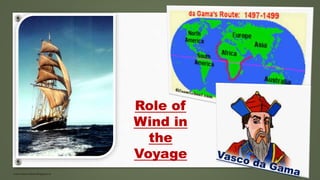
Role of
Wind in
the
Voyage
www.masocialma.blogspot.in
 The Weight of Atmospheric Air on
Earth
 Gravitational force helps Air to
remain on Earth
 Variations in the Atmospheric
Pressure are the Cause of Wind
Atmospheric Pressure
www.masocialma.blogspot.in
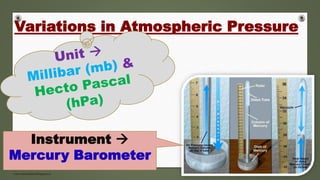
Variations in Atmospheric Pressure
Instrument 
Mercury Barometer
www.masocialma.blogspot.in
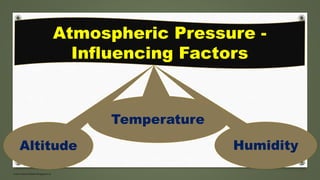
Atmospheric Pressure -
Influencing Factors
Altitude Humidity
Temperature
www.masocialma.blogspot.in
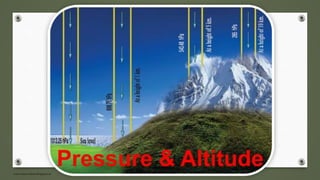
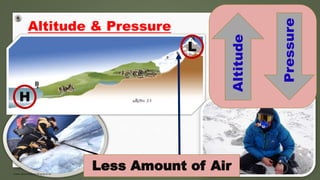
Altitude & Pressure
Altitude
Pressure
H
L
Less Amount of Air
www.masocialma.blogspot.in
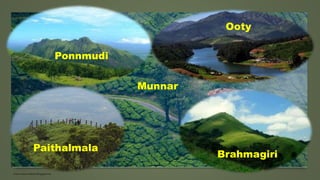
Ooty
Paithalmala
Brahmagiri
Munnar
Ponnmudi
www.masocialma.blogspot.in
Temperature & Pressure
Temperature
Pressure
L H
Air Expands
When Heated
The Tropical Region Experiences Low
Atmospheric Pressure than Colder
Region because of the Difference in
Temperature
www.masocialma.blogspot.in
Humidity
Pressure
Quantity of Water Present
in the Atmosphere is
Humidity
L
H
www.masocialma.blogspot.in
Activity 1 ( Answer the Following)
1. Which are the Influencing Factors of
Atmospheric Pressure?
2. Find out the Relation between
a) Pressure & Altitude
b) Pressure & Temperature
c) Pressure & Humidity
www.masocialma.blogspot.in
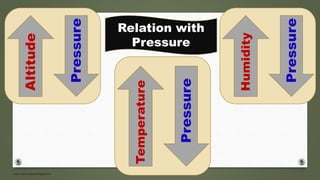
Altitude
Pressure
Temperature
Pressure
Humidity
Pressure
Relation with
Pressure
www.masocialma.blogspot.in
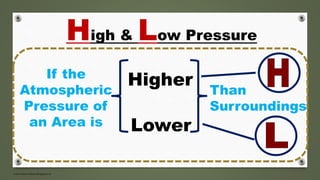
If the
Atmospheric
Pressure of
an Area is
Higher
Lower
Than
Surroundings
High & Low Pressure
www.masocialma.blogspot.in
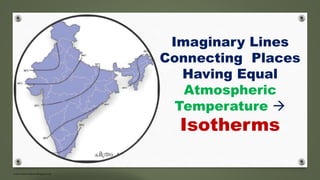
Imaginary Lines
Connecting Places
Having Equal
Atmospheric
Temperature 
Isotherms
www.masocialma.blogspot.in
H
L
Imaginary Lines
Connecting Places
Having Equal
Atmospheric
Pressure 
Isobars
www.masocialma.blogspot.in
Activity 2
1. Which are the Different Global Pressure
Belts?
2. Write Short note on Different Global
Pressure Belts
www.masocialma.blogspot.in
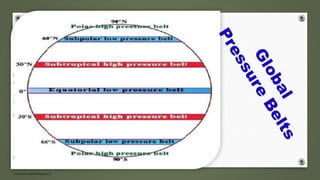
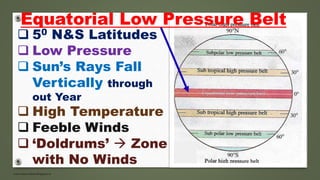
 50 N&S Latitudes
 Low Pressure
 Sun’s Rays Fall
Vertically through
out Year
 High Temperature
 Feeble Winds
 ‘Doldrums’  Zone
with No Winds
Equatorial Low Pressure Belt
www.masocialma.blogspot.in
Sub Tropical High
Pressure Belt
 300 N&S Latitudes
 High Pressure
 Hot air from
Equator Cools here
due to Rotation
www.masocialma.blogspot.in
Sub Polar Low
Pressure Belt
 600 N&S Latitudes
 Low Pressure
 Cold air is thrown
up due to Rotation
www.masocialma.blogspot.in
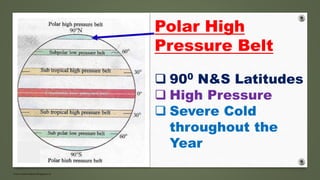
Polar High
Pressure Belt
 900 N&S Latitudes
 High Pressure
 Severe Cold
throughout the
Year
www.masocialma.blogspot.in
Pressure
Belt
Latitudinal
Extent
Pressure Features
Equatorial
Sub
Tropical
Sub Polar
Polar
Activity 3 ( Complete the Table)
www.masocialma.blogspot.in
Pre. Belt L. Extent Pressure Features
Equatorial 50 N&S Low High
Temperature
Sub
Tropical
300 N&S High Air Cools due
to Rotation
Sub Polar 600 N&S Low Cold air is
thrown up
Polar 900 N&S High Severe Cold
Global Pressure Belts
www.masocialma.blogspot.in
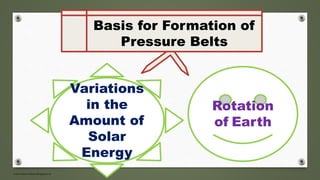
Variations
in the
Amount of
Solar
Energy
Rotation
of Earth
Basis for Formation of
Pressure Belts
www.masocialma.blogspot.in
The
Pressure
Belts Move
According
to the
Apparent
Movement
of the Sun
www.masocialma.blogspot.in
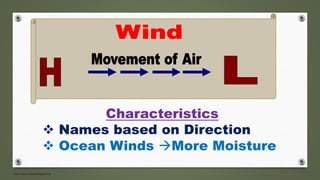
Characteristics
 Names based on Direction
 Ocean Winds More Moisture
www.masocialma.blogspot.in
Activity 4 ( Answer the Following)
1. List the Factors Influencing the Speed and
Direction of Wind?
2. Write Short Note on :
a) Pressure Gradient Force
b) Coriolis Force
c) Friction
www.masocialma.blogspot.in
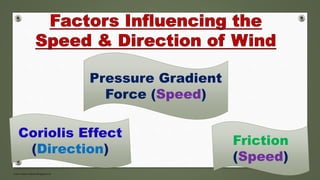
Pressure Gradient
Force (Speed)
Coriolis Effect
(Direction)
Friction
(Speed)
www.masocialma.blogspot.in
Activity 5 ( Answer the Following)
1. Mark the direction of Winds
2. In which of these situations will the speed
of the Wind be higher? Why?
www.masocialma.blogspot.in
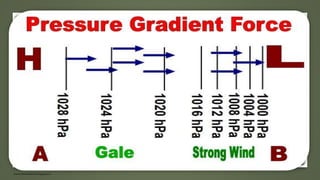
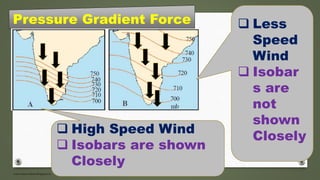
Pressure Gradient Force
 High Speed Wind
 Isobars are shown
Closely
 Less
Speed
Wind
 Isobar
s are
not
shown
Closely
www.masocialma.blogspot.in
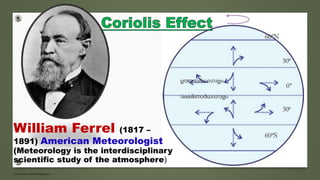
William Ferrel (1817 –
1891) American Meteorologist
(Meteorology is the interdisciplinary
scientific study of the atmosphere)
www.masocialma.blogspot.in
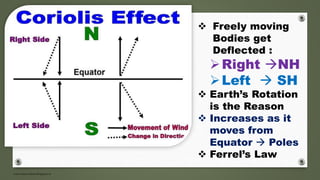
 Freely moving
Bodies get
Deflected :
Right NH
Left  SH
 Earth’s Rotation
is the Reason
 Increases as it
moves from
Equator  Poles
 Ferrel’s Law
www.masocialma.blogspot.in
Winds
www.masocialma.blogspot.in
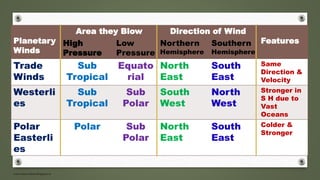
The Wind Formed
between the Global
Pressure Belts are
Planetary Winds
1. Trade Winds
2. Westerlies
3. Polar
Easterlies
www.masocialma.blogspot.in
 North East Winds N Hemisphere
 South East Winds  S Hemisphere
 Same Direction & Velocity
 Rainfall in Eastern Cost
 No Rain in Western-->Desert
 Helped Sea Travelers
 Subtropical  Equatorial
 High pressure  Low
www.masocialma.blogspot.in
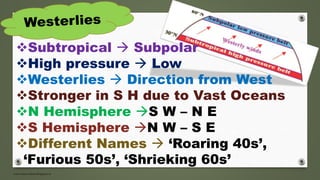
Subtropical  Subpolar
High pressure  Low
Westerlies  Direction from West
Stronger in S H due to Vast Oceans
N Hemisphere S W – N E
S Hemisphere N W – S E
Different Names  ‘Roaring 40s’,
‘Furious 50s’, ‘Shrieking 60s’
www.masocialma.blogspot.in
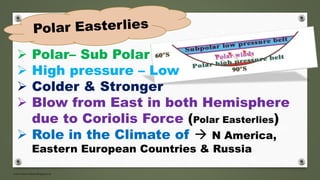
 Polar– Sub Polar
 High pressure – Low
 Colder & Stronger
 Blow from East in both Hemisphere
due to Coriolis Force (Polar Easterlies)
 Role in the Climate of  N America,
Eastern European Countries & Russia
www.masocialma.blogspot.in
Planetary
Winds
Area they Blow Direction of Wind
FeaturesHigh Pressure Low
Pressure
Northern
Hemisphere
Southern
Hemisphere
Trade
Winds
Westerlies
Polar
Easterlies
Activity 6 ( Complete the Table)
www.masocialma.blogspot.in
Planetary
Winds
Area they Blow Direction of Wind
FeaturesHigh
Pressure
Low
Pressure
Northern
Hemisphere
Southern
Hemisphere
Trade
Winds
Sub
Tropical
Equato
rial
North
East
South
East
Same
Direction &
Velocity
Westerli
es
Sub
Tropical
Sub
Polar
South
West
North
West
Stronger in
S H due to
Vast
Oceans
Polar
Easterli
es
Polar Sub
Polar
North
East
South
East
Colder &
Stronger
www.masocialma.blogspot.in
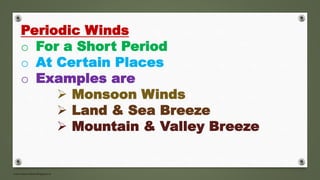
Periodic Winds
o For a Short Period
o At Certain Places
o Examples are
 Monsoon Winds
 Land & Sea Breeze
 Mountain & Valley Breeze
www.masocialma.blogspot.in
Monsoon Winds
 Due to Seasonal Changes
 Seasonal Reversal in a year
o S W Monsoon Winds
o N E Monsoon Winds
Formation of Monsoon Winds – Factors
 The Apparent Movement of Sun
 Coriolis Force
 Differences in Heating
Hippalus
www.masocialma.blogspot.in
Monsoon Winds
www.masocialma.blogspot.in
Southwest Monsoon
 Sun Northern H
 Pressure Belts Shift to North
 Summer NH - HTemperature
 As SE Trade Wind cross
Equator, Deflected (Coriolis
Force) and Transform into
Southwest Monsoon
Northeast Monsoon
 Winter HP on Asia & LP on
Indian Ocean
 Northeast Trade Wind Strengthened
& they are Northeast Monsoon
Arctic
Circle
Tropic of
Cancer
Equator
Tropic of
Capricorn
Antarctic
Circle
N
S
Polar HP
Polar HP
Sub Polar LP
Sub Tropical HP
Sub Tropical HP
Sub Polar LP
Equatorial LP
June 21
Sep 23
Dec 22
Mar 21
NE Trade Wind
SE Trade Wind
www.masocialma.blogspot.in
o The Planetary Winds In North European
Region blow on the Opposite Direction
o Winds are not From the Oceans
o Temperature difference between Land &
Sea is less
N
S
Polar HP
Polar HP
Sub Polar LP
Sub Tropical HP
Sub Tropical HP
Sub Polar LP
Equatorial LP
June 21
Sep 23
Dec 22
Mar 21
NE Trade Wind
SE Trade Wind
Monsoon Doesn’t Occur in N Europe
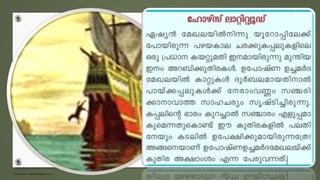
 Reached Kerala with the help of Monsoon Winds
 On Return he went against its Direction & it Troubled him
Vasco da Gama
www.masocialma.blogspot.in
Activity 7 (Comparison)
1. Make a Comparison Between Southwest &
Northeast Monsoon Winds
2. Make a Comparison Between Sea Breeze &
Land Breeze
3. Make a Comparison Between Valley Breeze &
Mountain Breeze
www.masocialma.blogspot.in
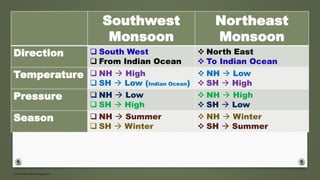
Southwest
Monsoon
Northeast
Monsoon
Direction  South West
 From Indian Ocean
 North East
 To Indian Ocean
Temperature  NH  High
 SH  Low (Indian Ocean)
 NH  Low
 SH  High
Pressure  NH  Low
 SH  High
 NH  High
 SH  Low
Season  NH  Summer
 SH  Winter
 NH  Winter
 SH  Summer
www.masocialma.blogspot.in
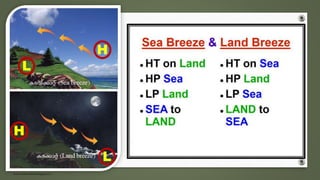
L
H
L
H
www.masocialma.blogspot.in
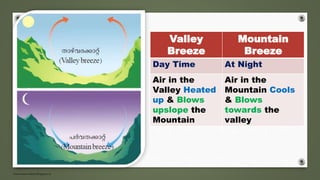
Valley
Breeze
Mountain
Breeze
Day Time At Night
Air in the
Valley Heated
up & Blows
upslope the
Mountain
Air in the
Mountain Cools
& Blows
towards the
valley
www.masocialma.blogspot.in
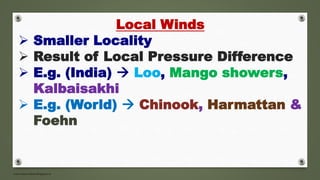
Local Winds
 Smaller Locality
 Result of Local Pressure Difference
 E.g. (India)  Loo, Mango showers,
Kalbaisakhi
 E.g. (World)  Chinook, Harmattan &
Foehn
www.masocialma.blogspot.in
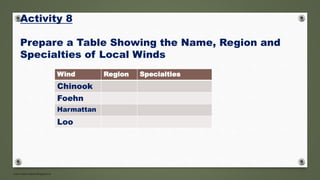
Activity 8
Prepare a Table Showing the Name, Region and
Specialties of Local Winds
Wind Region Specialties
Chinook
Foehn
Harmattan
Loo
www.masocialma.blogspot.in
Wind Region Specialties
Chinook Eastern
Slopes of
Rockies
Mountains
 Melting Snow
 Reduce Severity of Cold
 Wheat Cultivation in
Canadian lowlands
Foehn Southern
Valley of Alps
 Reduce Severity of Cold
Harmattan Sahara Desert
 W Africa
 Dry Wind
 Humidity & Sultry
Conditions Improved
Loo North Indian
Plains
 Hot Wind
 Rise in Temperature
www.masocialma.blogspot.in
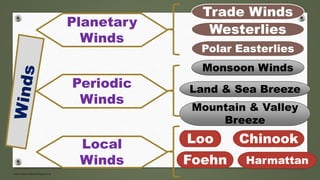
Activity 9 ( Complete the Flow Chart)
www.masocialma.blogspot.in
Planetary
Winds
Local
Winds
Periodic
Winds
Trade Winds
Westerlies
Polar Easterlies
Monsoon Winds
Land & Sea Breeze
Mountain & Valley
Breeze
Loo Chinook
Foehn Harmattan
www.masocialma.blogspot.in
Without the Sun’s Energy there would have been Nothing
www.masocialma.blogspot.in
Additional Activities
1. Difference between Isotherms & Isobars
2. Name the different Global Pressure Belts
3. What is Inter Tropical Convergence Zone (ITCZ)?
4. Which are the different names Westerly Winds?
5. Explain Doldrum
6.
7.
8.
9.
10.
www.masocialma.blogspot.in
Michael Angelo M.A. MA (Phi.,His.)
HSA(Social Science)
St. Mary’s H.S. Palliport
mamichaelma@gmail.com
9746953695

Geo02 wind