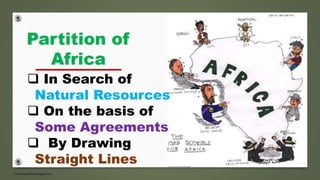
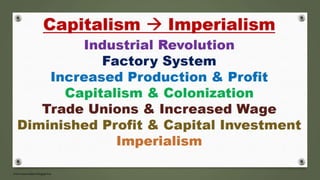
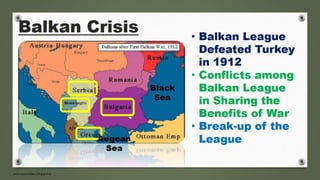
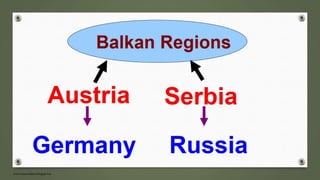
 In Search of
Natural Resources
 On the basis of
Some Agreements
 By Drawing
Straight Lines
Circumstances for the Growth
of Fascism & Nazism
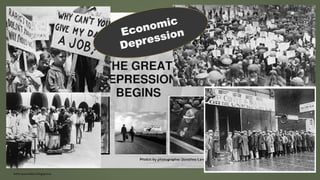
 Govts. Lost their Power
 Misery & Unemployment
 Poverty & Inflation
 Economic Destruction
 Rivalry against the Victors
 Aimlessness
Mussolini
&
Fascism
Circumstances for the Growth
of Fascism in Italy
 Italy got Nothing, though Won the War
 Industrialists Supported Fascism
 People Kept away from Govt
o Destruction of Industries
o Unemployment
o Increase in Tax
o Inflation
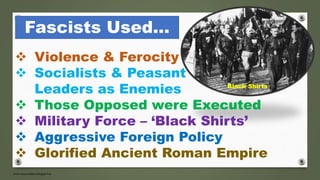
Fascists Used…
 Violence & Ferocity
 Socialists & Peasant
Leaders as Enemies
 Those Opposed were Executed
 Military Force – ‘Black Shirts’
 Aggressive Foreign Policy
 Glorified Ancient Roman Empire
Black Shirts
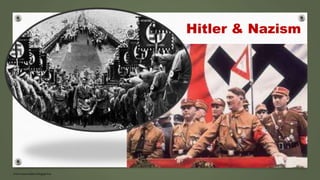
Hitler & Nazism
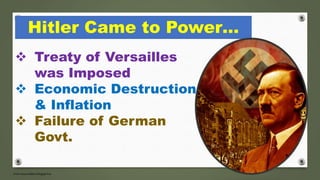
Hitler Came to Power…
 Treaty of Versailles
was Imposed
 Economic Destruction
& Inflation
 Failure of German
Govt.
Hitler
was a
Great
Orator
Concentration Camp
Brown Shirts
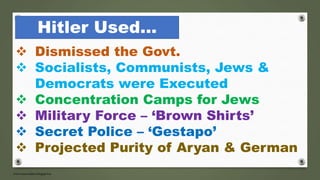
Hitler Used…
 Dismissed the Govt.
 Socialists, Communists, Jews &
Democrats were Executed
 Concentration Camps for Jews
 Military Force – ‘Brown Shirts’
 Secret Police – ‘Gestapo’
 Projected Purity of Aryan & German
Hitler Used…
 Banned Trade Unions, Political Parties
 Military Service was Compulsory
 Revenge against Versailles Treaty
 Used News Paper, Radio, Cinema,
Education to Propagate his Idea
 Aggressive Foreign Policy
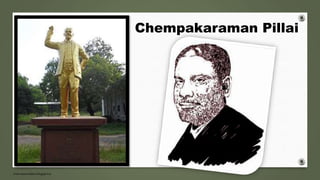
Chempakaraman Pillai
Anne Frank
Activity 4
Ideologies Put forth by both Fascists & Nazis
had several similarities.
Complete the Table
Ideology Fascism Nazism
Purity of Race Glorified Ancient
Roman Empire
Purity of Aryan &
German
Annihilation of
Enemies
Socialists, Leaders
of Peasants &
Workers, those who
Opposed
Socialists,
Communists, Jews &
Democrats
Military
Dictatorship
Military Force –
‘Black Shirts’
• Military Force –
‘Brown Shirts’
• Secret Police –
‘Gestapo’
Aggressive
Foreign Policy
Conquered
Ethiopia, Albania
Attacked Austria &
Czechoslovakia
Alliance with Italy &
Japan
World War II 1939-1945
Activity 5 (Group Activity)
GP 1  List out the Reasons for 2nd World War
GP 2  List out the Results of 2nd World War
Reasons of 2nd World war
Victorious Nations Shared the Colonies
Italy & Germany got Nothing
Military Alliances
Failure of League of Nations
Conquering of Countries
Growth of Fascism & Nazism
Enmity towards Soviet Union
www.masocialma.blogspot.in
Military Alliances During 2nd World War
Japan
ItalyGermany
Axis
Powers
ChinaFrance
England
Allied
Powers
Axis
Powers
Allied
Powers
British and French
Prime Ministers
Neville Chamberlain
and Edouard Daladier
sign the Munich Pact
with Nazi leader
Adolf Hitler. The
agreement averted
the outbreak of war
but gave
Czechoslovakia away
to German conquest.
Munich Pact
On August 23, 1939–shortly
before World War II (1939-45)
broke out in Europe - enemies
Nazi Germany and the Soviet
Union surprised the world by
signing the German-Soviet
Nonaggression Pact, in which
the two countries agreed to take
no military action against each
other for the next 10 years.
Non-Aggression
Pact
On 1 Sep 1939 Germany attacked Poland
Entry of
Soviet Union & America
Changed the War
The attack on Pearl Harbor,
also known as the Battle of
Pearl Harbor, the Hawaii
Operation or Operation AI by
the Japanese Imperial
General Headquarters, and
Operation Z during planning,
was a surprise military strike
by the Imperial Japanese
Navy against the United
States naval base at Pearl
Harbor, in the Territory of
Hawaii, on the morning of
December 7, 1941. The attack
led to the United States' entry
into World War II.
Mussolini Was Killed
by Local Partisans
Hitler Committed Suicide
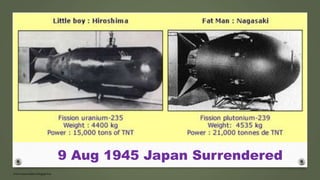
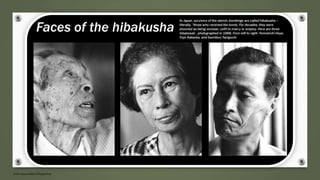
9 Aug 1945 Japan Surrendered
Guernica
Sadaco Sasuki –
Symbol of Anti-War Feeling
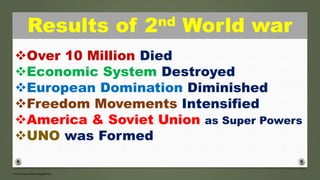
Results of 2nd World war
Over 10 Million Died
Economic System Destroyed
European Domination Diminished
Freedom Movements Intensified
America & Soviet Union as Super Powers
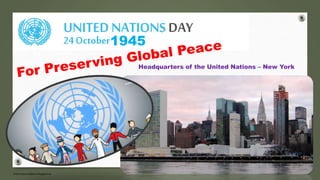
UNO was Formed
1945
Headquarters of the United Nations – New York
Activity 6
What are the Objectives of UNO
Foster Social & Economic
Development of Countries
Protect International Treaties & Laws
Save Future Generation from War
Objectives of UNO
Kofi A. Annan (Ghana)
Term of Office: 1997-2006
Ban Ki Moon (South Korea)
Term of Office: 2007-
UN Secretary Generals
Computer
Colonies Secured
Freedom from
Imperialist Countries
through Freedom
Movements
Decolonization
USA & USSR Came as Super Powers
after 2nd World War
Supported Freedom Movements in
the Colonies
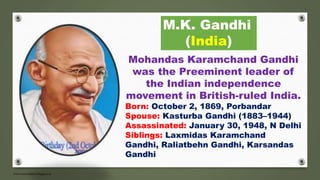
M.K. Gandhi
(India)
Mohandas Karamchand Gandhi
was the Preeminent leader of
the Indian independence
movement in British-ruled India.
Born: October 2, 1869, Porbandar
Spouse: Kasturba Gandhi (1883–1944)
Assassinated: January 30, 1948, N Delhi
Siblings: Laxmidas Karamchand
Gandhi, Raliatbehn Gandhi, Karsandas
Gandhi
Nelson Mandela
(South Africa)
Nelson Rolihlahla Mandela was a
South African Anti-Apartheid
Revolutionary, Politician, and
Philanthropist, who served as
President of South Africa from
1994 to 1999.
Born: July 18, 1918, Mvezo, South Africa
Died: December 5, 2013, Houghton Estate,
Johannesburg, South Africa
Influenced by: Mahatma Gandhi, Walter
Sisulu, Albert Lutuli
Awards: Nobel Peace Prize, Presidential
Medal of Freedom, more
Spouse: Graça Machel (m. 1998–2013),
Winnie Mandela (m. 1958–1996),
Evelyn Mase (m. 1944–1958)
Quami Nkrumah
(Ghana)
Kwame Nkrumah PC led Ghana
to independence from Britain in
1957 and served as its Prime
Minister and 1st President.
Nkrumah first gained power as
leader of the colonial Gold
Coast, and held it until he was
deposed in 1966.
Born: Sep 21, 1909, Nkroful, Ghana
Died: April 27, 1972, Bucharest,
Romania
Spouse: Fathia Nkrumah
Children: Samia Nkrumah, Gamal
Nkrumah
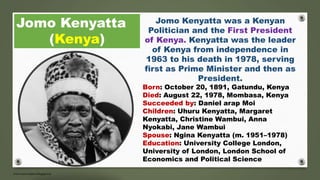
Jomo Kenyatta
(Kenya)
Jomo Kenyatta was a Kenyan
Politician and the First President
of Kenya. Kenyatta was the leader
of Kenya from independence in
1963 to his death in 1978, serving
first as Prime Minister and then as
President.
Born: October 20, 1891, Gatundu, Kenya
Died: August 22, 1978, Mombasa, Kenya
Succeeded by: Daniel arap Moi
Children: Uhuru Kenyatta, Margaret
Kenyatta, Christine Wambui, Anna
Nyokabi, Jane Wambui
Spouse: Ngina Kenyatta (m. 1951–1978)
Education: University College London,
University of London, London School of
Economics and Political Science
Ahmed Sukarno
(Indonasia)
Born: June 6, 1901, Surabaya, Indonesia
Died: June 21, 1970, Jakarta, Indonesia
Succeeded by: Suharto
Spouse: Heldy Djafar (m. 1966–1969),
more
Children: Megawati Sukarnoputri,
Rachmawati Sukarnoputri, more
The first President of
Indonesia, serving in office
from 1945 to 1967. He was
the leader of his country's
struggle for Independence
from the Netherlands.
Ho chi minh
(Vietnam)
Hồ Chí Minh, born Nguyễn Sinh
Cung, also known as Nguyễn Tất
Thành and Nguyễn Ái Quốc, was
a Vietnamese Communist
revolutionary leader who was
prime minister and president of
the Democratic Republic of
Vietnam.
Born: May 19, 1890, Kim Lien, Vietnam
Died: Sept 2, 1969, Hanoi, Vietnam
Organizations founded: Communist
Party of Vietnam, Viet Minh,
Robert Mugabe
(Zimbawe)
Robert Gabriel Mugabe is
the current President of
Zimbabwe, serving since 22
Dec 1987. As one of the
leaders of the rebel groups
against white minority rule,
he was elected as Prime
Minister, head .
Born: February 21, 1924 (age
92), Kutama, Zimbabwe
Spouse: Grace Mugabe (m.
1996), Sally Hayfron
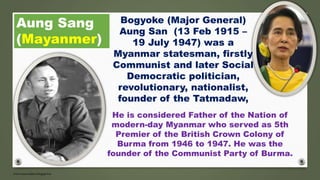
Aung Sang
(Mayanmer)
He is considered Father of the Nation of
modern-day Myanmar who served as 5th
Premier of the British Crown Colony of
Burma from 1946 to 1947. He was the
founder of the Communist Party of Burma.
Bogyoke (Major General)
Aung San (13 Feb 1915 –
19 July 1947) was a
Myanmar statesman, firstly
Communist and later Social
Democratic politician,
revolutionary, nationalist,
founder of the Tatmadaw,
USA v/s USSR
The Enmity based on Ideological
Conflict and Political & Diplomatic
Confrontations btween USA & USSR
2 Blocs Started New Military Alliances
America NATO, SEATO, CENTO
WARSAW PACT
Soviet
Union
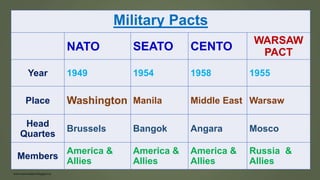
Military Pacts
NATO SEATO CENTO
WARSAW
PACT
Year 1949 1954 1958 1955
Place Washington Manila Middle East Warsaw
Head
Quartes
Brussels Bangok Angara Mosco
Members
America &
Allies
America &
Allies
America &
Allies
Russia &
Allies
Bipolar Politics
Historian Arnold Toynbee used this Term
Non-Aligned Movement
 Many Independent Countries after 2nd War
 Realized Cold War was another Imperialism
 It would Threaten World Peace
 Not joined any of the Blocs
 Formed Non-Aligned Movement
“Non- Alignment doesn’t mean to keep aloof from World
affairs. Rather, it is to face many issues we Confront.”
Non-Alignment
Leaders
Ahmed Sukarno
(Indonesia)
Jawaharlal Nehru
(India)
GamalAbdul
Nasser(Egypt)
MarshalTito
(Yugoslavia)
 Part of Turkish Empire
until 1st W War
 Britain took over it
 Britain helped to form
a Jewish State


History of Israel
Arthur Balfour,
British Foreign Secretary
declared the establishment
of a Jewish State in
West Asia
as a reward for the help
from Jews in the W War
Establishment of
a Homeland for
Jews
Idea by Theodor
Herzl in his book
The Jewish State
 In 1948 Israel was Formed
 War between Israel & Arab Nations
 Israel seized Palestinian
 Palestinians Migrated to Various
Arab Countries
 Formation of PLO
Palestine Liberation Organization
Yasser Arafat
 To establish a Nation
for Palestine
 Yasser Arafat as
President

The Oslo Accords were subsequently officially signed at
a public ceremony in Washington, D.C., on 13 September
1993 in the presence of PLO chairman Yasser Arafat, the
then Israeli Prime Minister Yitzhak Rabin and U.S.
President Bill Clinton
Oslo Pact
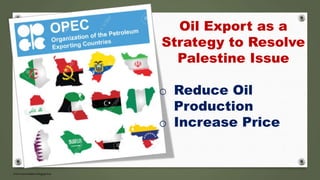
Oil Export as a
Strategy to Resolve
Palestine Issue
o Reduce Oil
Production
o Increase Price
Activity 7
What are the Reasons for the
Disintegration of Soviet Union
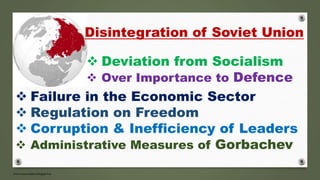
 Failure in the Economic Sector
 Regulation on Freedom
 Corruption & Inefficiency of Leaders
 Administrative Measures of Gorbachev
 Deviation from Socialism
 Over Importance to Defence
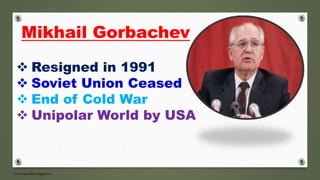
 Resigned in 1991
 Soviet Union Ceased
 End of Cold War
 Unipolar World by USA
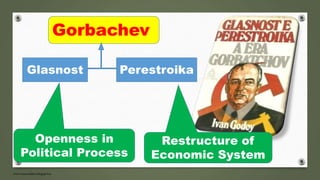
Mikhail Gorbachev
Gorbachev
PerestroikaGlasnost
Openness in
Political Process
Restructure of
Economic System
Unipolar World
USA Emerged as a Global
Power & Centre of World
Politics after the
Disintegration of Soviet Union
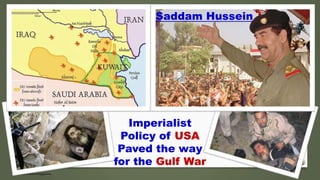
Saddam Hussein
Imperialist
Policy of USA
Paved the way
for the Gulf War
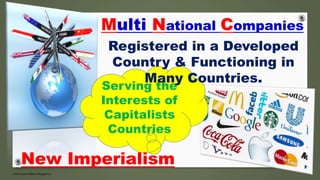
Multi National Companies
Serving the
Interests of
Capitalists
Countries
Registered in a Developed
Country & Functioning in
Many Countries.
New Imperialism
Multi National Companies - Features
The Economy of many Countries
Collapsed
Different Concepts of
New Imperialism
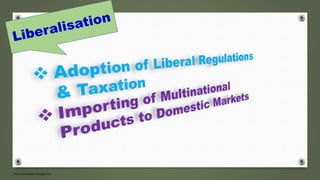
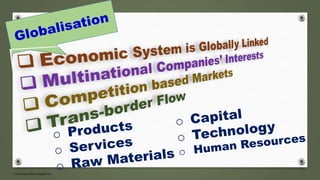
Liberalisation Globalisation
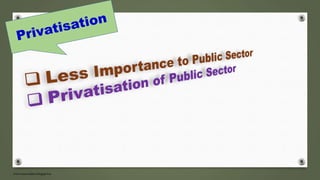
Privatisation
Activity 8
Write Short Note on the Following
 Liberalisation
 Privatisation
 Globalisation
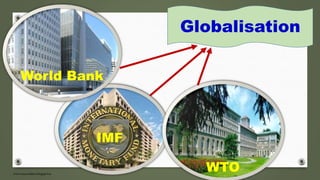
World Bank
IMF
WTO
Globalisation
Activity 9
Compare the Advantages &
Disadvantages of Globalisation
Globalisation - Advantages
 Transfer of
 Goods
 Products
 Services
 Information Technology
Beyond Boundaries
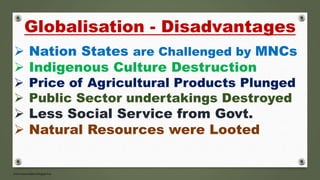
Globalisation - Disadvantages
 Nation States are Challenged by MNCs
 Indigenous Culture Destruction
 Price of Agricultural Products Plunged
 Public Sector undertakings Destroyed
 Less Social Service from Govt.
 Natural Resources were Looted
Additional Activities
1. Compare the Military Alliances during 1st &
2nd World War
2.
3.
4.
5.
His02 world20 cent

His02 world20 cent

  • 2.
     In Searchof Natural Resources  On the basis of Some Agreements  By Drawing Straight Lines
  • 41.
    Circumstances for theGrowth of Fascism & Nazism  Govts. Lost their Power  Misery & Unemployment  Poverty & Inflation  Economic Destruction  Rivalry against the Victors  Aimlessness
  • 43.
  • 44.
    Circumstances for theGrowth of Fascism in Italy  Italy got Nothing, though Won the War  Industrialists Supported Fascism  People Kept away from Govt o Destruction of Industries o Unemployment o Increase in Tax o Inflation
  • 45.
    Fascists Used…  Violence& Ferocity  Socialists & Peasant Leaders as Enemies  Those Opposed were Executed  Military Force – ‘Black Shirts’  Aggressive Foreign Policy  Glorified Ancient Roman Empire Black Shirts
  • 46.
  • 47.
    Hitler Came toPower…  Treaty of Versailles was Imposed  Economic Destruction & Inflation  Failure of German Govt.
  • 48.
  • 49.
  • 50.
  • 51.
    Hitler Used…  Dismissedthe Govt.  Socialists, Communists, Jews & Democrats were Executed  Concentration Camps for Jews  Military Force – ‘Brown Shirts’  Secret Police – ‘Gestapo’  Projected Purity of Aryan & German
  • 52.
    Hitler Used…  BannedTrade Unions, Political Parties  Military Service was Compulsory  Revenge against Versailles Treaty  Used News Paper, Radio, Cinema, Education to Propagate his Idea  Aggressive Foreign Policy
  • 53.
  • 54.
  • 55.
    Activity 4 Ideologies Putforth by both Fascists & Nazis had several similarities. Complete the Table
  • 56.
    Ideology Fascism Nazism Purityof Race Glorified Ancient Roman Empire Purity of Aryan & German Annihilation of Enemies Socialists, Leaders of Peasants & Workers, those who Opposed Socialists, Communists, Jews & Democrats Military Dictatorship Military Force – ‘Black Shirts’ • Military Force – ‘Brown Shirts’ • Secret Police – ‘Gestapo’ Aggressive Foreign Policy Conquered Ethiopia, Albania Attacked Austria & Czechoslovakia Alliance with Italy & Japan
  • 57.
    World War II1939-1945
  • 58.
    Activity 5 (GroupActivity) GP 1  List out the Reasons for 2nd World War GP 2  List out the Results of 2nd World War
  • 59.
    Reasons of 2ndWorld war Victorious Nations Shared the Colonies Italy & Germany got Nothing Military Alliances Failure of League of Nations Conquering of Countries Growth of Fascism & Nazism Enmity towards Soviet Union
  • 60.
    www.masocialma.blogspot.in Military Alliances During2nd World War Japan ItalyGermany Axis Powers ChinaFrance England Allied Powers
  • 61.
  • 62.
    British and French PrimeMinisters Neville Chamberlain and Edouard Daladier sign the Munich Pact with Nazi leader Adolf Hitler. The agreement averted the outbreak of war but gave Czechoslovakia away to German conquest. Munich Pact
  • 63.
    On August 23,1939–shortly before World War II (1939-45) broke out in Europe - enemies Nazi Germany and the Soviet Union surprised the world by signing the German-Soviet Nonaggression Pact, in which the two countries agreed to take no military action against each other for the next 10 years. Non-Aggression Pact
  • 64.
    On 1 Sep1939 Germany attacked Poland
  • 65.
    Entry of Soviet Union& America Changed the War
  • 66.
    The attack onPearl Harbor, also known as the Battle of Pearl Harbor, the Hawaii Operation or Operation AI by the Japanese Imperial General Headquarters, and Operation Z during planning, was a surprise military strike by the Imperial Japanese Navy against the United States naval base at Pearl Harbor, in the Territory of Hawaii, on the morning of December 7, 1941. The attack led to the United States' entry into World War II.
  • 67.
    Mussolini Was Killed byLocal Partisans Hitler Committed Suicide
  • 68.
    9 Aug 1945Japan Surrendered
  • 70.
  • 71.
    Sadaco Sasuki – Symbolof Anti-War Feeling
  • 72.
    Results of 2ndWorld war Over 10 Million Died Economic System Destroyed European Domination Diminished Freedom Movements Intensified America & Soviet Union as Super Powers UNO was Formed
  • 73.
    1945 Headquarters of theUnited Nations – New York
  • 74.
    Activity 6 What arethe Objectives of UNO
  • 75.
    Foster Social &Economic Development of Countries Protect International Treaties & Laws Save Future Generation from War Objectives of UNO
  • 76.
    Kofi A. Annan(Ghana) Term of Office: 1997-2006 Ban Ki Moon (South Korea) Term of Office: 2007- UN Secretary Generals Computer
  • 77.
    Colonies Secured Freedom from ImperialistCountries through Freedom Movements Decolonization
  • 78.
    USA & USSRCame as Super Powers after 2nd World War Supported Freedom Movements in the Colonies
  • 79.
    M.K. Gandhi (India) Mohandas KaramchandGandhi was the Preeminent leader of the Indian independence movement in British-ruled India. Born: October 2, 1869, Porbandar Spouse: Kasturba Gandhi (1883–1944) Assassinated: January 30, 1948, N Delhi Siblings: Laxmidas Karamchand Gandhi, Raliatbehn Gandhi, Karsandas Gandhi
  • 80.
    Nelson Mandela (South Africa) NelsonRolihlahla Mandela was a South African Anti-Apartheid Revolutionary, Politician, and Philanthropist, who served as President of South Africa from 1994 to 1999. Born: July 18, 1918, Mvezo, South Africa Died: December 5, 2013, Houghton Estate, Johannesburg, South Africa Influenced by: Mahatma Gandhi, Walter Sisulu, Albert Lutuli Awards: Nobel Peace Prize, Presidential Medal of Freedom, more Spouse: Graça Machel (m. 1998–2013), Winnie Mandela (m. 1958–1996), Evelyn Mase (m. 1944–1958)
  • 81.
    Quami Nkrumah (Ghana) Kwame NkrumahPC led Ghana to independence from Britain in 1957 and served as its Prime Minister and 1st President. Nkrumah first gained power as leader of the colonial Gold Coast, and held it until he was deposed in 1966. Born: Sep 21, 1909, Nkroful, Ghana Died: April 27, 1972, Bucharest, Romania Spouse: Fathia Nkrumah Children: Samia Nkrumah, Gamal Nkrumah
  • 82.
    Jomo Kenyatta (Kenya) Jomo Kenyattawas a Kenyan Politician and the First President of Kenya. Kenyatta was the leader of Kenya from independence in 1963 to his death in 1978, serving first as Prime Minister and then as President. Born: October 20, 1891, Gatundu, Kenya Died: August 22, 1978, Mombasa, Kenya Succeeded by: Daniel arap Moi Children: Uhuru Kenyatta, Margaret Kenyatta, Christine Wambui, Anna Nyokabi, Jane Wambui Spouse: Ngina Kenyatta (m. 1951–1978) Education: University College London, University of London, London School of Economics and Political Science
  • 83.
    Ahmed Sukarno (Indonasia) Born: June6, 1901, Surabaya, Indonesia Died: June 21, 1970, Jakarta, Indonesia Succeeded by: Suharto Spouse: Heldy Djafar (m. 1966–1969), more Children: Megawati Sukarnoputri, Rachmawati Sukarnoputri, more The first President of Indonesia, serving in office from 1945 to 1967. He was the leader of his country's struggle for Independence from the Netherlands.
  • 84.
    Ho chi minh (Vietnam) HồChí Minh, born Nguyễn Sinh Cung, also known as Nguyễn Tất Thành and Nguyễn Ái Quốc, was a Vietnamese Communist revolutionary leader who was prime minister and president of the Democratic Republic of Vietnam. Born: May 19, 1890, Kim Lien, Vietnam Died: Sept 2, 1969, Hanoi, Vietnam Organizations founded: Communist Party of Vietnam, Viet Minh,
  • 85.
    Robert Mugabe (Zimbawe) Robert GabrielMugabe is the current President of Zimbabwe, serving since 22 Dec 1987. As one of the leaders of the rebel groups against white minority rule, he was elected as Prime Minister, head . Born: February 21, 1924 (age 92), Kutama, Zimbabwe Spouse: Grace Mugabe (m. 1996), Sally Hayfron
  • 86.
    Aung Sang (Mayanmer) He isconsidered Father of the Nation of modern-day Myanmar who served as 5th Premier of the British Crown Colony of Burma from 1946 to 1947. He was the founder of the Communist Party of Burma. Bogyoke (Major General) Aung San (13 Feb 1915 – 19 July 1947) was a Myanmar statesman, firstly Communist and later Social Democratic politician, revolutionary, nationalist, founder of the Tatmadaw,
  • 87.
  • 88.
    The Enmity basedon Ideological Conflict and Political & Diplomatic Confrontations btween USA & USSR
  • 89.
    2 Blocs StartedNew Military Alliances America NATO, SEATO, CENTO WARSAW PACT Soviet Union
  • 90.
    Military Pacts NATO SEATOCENTO WARSAW PACT Year 1949 1954 1958 1955 Place Washington Manila Middle East Warsaw Head Quartes Brussels Bangok Angara Mosco Members America & Allies America & Allies America & Allies Russia & Allies
  • 91.
    Bipolar Politics Historian ArnoldToynbee used this Term
  • 92.
    Non-Aligned Movement  ManyIndependent Countries after 2nd War  Realized Cold War was another Imperialism  It would Threaten World Peace  Not joined any of the Blocs  Formed Non-Aligned Movement “Non- Alignment doesn’t mean to keep aloof from World affairs. Rather, it is to face many issues we Confront.”
  • 93.
  • 94.
     Part ofTurkish Empire until 1st W War  Britain took over it  Britain helped to form a Jewish State   History of Israel
  • 95.
    Arthur Balfour, British ForeignSecretary declared the establishment of a Jewish State in West Asia as a reward for the help from Jews in the W War
  • 96.
    Establishment of a Homelandfor Jews Idea by Theodor Herzl in his book The Jewish State
  • 97.
     In 1948Israel was Formed  War between Israel & Arab Nations  Israel seized Palestinian  Palestinians Migrated to Various Arab Countries  Formation of PLO
  • 99.
    Palestine Liberation Organization YasserArafat  To establish a Nation for Palestine  Yasser Arafat as President 
  • 100.
    The Oslo Accordswere subsequently officially signed at a public ceremony in Washington, D.C., on 13 September 1993 in the presence of PLO chairman Yasser Arafat, the then Israeli Prime Minister Yitzhak Rabin and U.S. President Bill Clinton Oslo Pact
  • 101.
    Oil Export asa Strategy to Resolve Palestine Issue o Reduce Oil Production o Increase Price
  • 102.
    Activity 7 What arethe Reasons for the Disintegration of Soviet Union
  • 103.
    Disintegration of SovietUnion  Failure in the Economic Sector  Regulation on Freedom  Corruption & Inefficiency of Leaders  Administrative Measures of Gorbachev  Deviation from Socialism  Over Importance to Defence
  • 104.
     Resigned in1991  Soviet Union Ceased  End of Cold War  Unipolar World by USA Mikhail Gorbachev
  • 105.
  • 106.
    Unipolar World USA Emergedas a Global Power & Centre of World Politics after the Disintegration of Soviet Union
  • 107.
    Saddam Hussein Imperialist Policy ofUSA Paved the way for the Gulf War
  • 108.
    Multi National Companies Servingthe Interests of Capitalists Countries Registered in a Developed Country & Functioning in Many Countries. New Imperialism
  • 109.
    Multi National Companies- Features The Economy of many Countries Collapsed
  • 110.
    Different Concepts of NewImperialism Liberalisation Globalisation Privatisation
  • 111.
    Activity 8 Write ShortNote on the Following  Liberalisation  Privatisation  Globalisation
  • 115.
  • 116.
    Activity 9 Compare theAdvantages & Disadvantages of Globalisation
  • 117.
    Globalisation - Advantages Transfer of  Goods  Products  Services  Information Technology Beyond Boundaries
  • 118.
    Globalisation - Disadvantages Nation States are Challenged by MNCs  Indigenous Culture Destruction  Price of Agricultural Products Plunged  Public Sector undertakings Destroyed  Less Social Service from Govt.  Natural Resources were Looted
  • 119.
    Additional Activities 1. Comparethe Military Alliances during 1st & 2nd World War 2. 3. 4. 5.