Experiences in providing secure multi-tenant
Lustre access to OpenStack
Peter Clapham <pc7@sanger.ac.uk>
Wellcome Trust Sanger Institute
Sanger Science
Scientific Research Programmes
Core Facilities
HPC and Cloud computing are
complementary
Traditional HPC
● Highest possible performance
● A mature and centrally managed
compute platform
● High performance Lustre
filesystems for data intensive
analysis
Flexible Compute
● Full segregation of projects ensures
data security
● Developers no longer tied to a single
stack
● Reproducibility through containers /
images and infrastructure-as-code
But there’s a catch or two...
• Large number of traditional/legacy pipelines
• They require a performant shared POSIX filesystem, while cloud workloads
support object stores
• We do not always have the source code or expertise to migrate
• We need multi-gigabyte per second performance
• The tenant will have root
• and could impersonate any user, but Lustre trusts the client’s identity assertions,
just like NFSv3
• The solution must be simple for the tenant and administrator
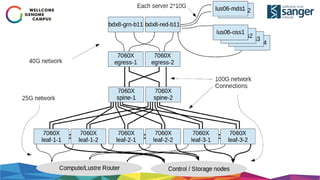
Lustre hardware
6+ year old hardware
• 4x Lustre object storage servers
• Dual Intel E5620 @ 2.40GHz
• 256GB RAM
• Dual 10G network
• lustre: 2.9.0.ddnsec2
• https://jira.hpdd.intel.com/browse/LU-9289 (landed in 2.10)
• OSTs from DDN SFA-10k
• 300x SATA, 7200rpm , 1TB spindles
We have seen this system reach 6 GByte/second in production
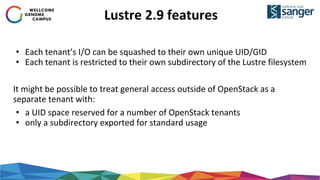
Lustre 2.9 features
• Each tenant’s I/O can be squashed to their own unique UID/GID
• Each tenant is restricted to their own subdirectory of the Lustre filesystem
It might be possible to treat general access outside of OpenStack as a
separate tenant with:
• a UID space reserved for a number of OpenStack tenants
• only a subdirectory exported for standard usage
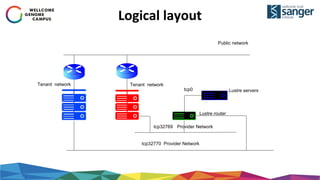
Public network
tcp32769 Provider Network
Lustre router
Lustre serverstcp0
Tenant network
tcp32770 Provider Network
Logical layout
Tenant network
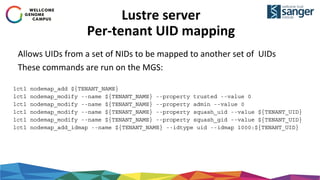
Lustre server
Per-tenant UID mapping
Allows UIDs from a set of NIDs to be mapped to another set of UIDs
These commands are run on the MGS:
lctl nodemap_add ${TENANT_NAME}
lctl nodemap_modify --name ${TENANT_NAME} --property trusted --value 0
lctl nodemap_modify --name ${TENANT_NAME} --property admin --value 0
lctl nodemap_modify --name ${TENANT_NAME} --property squash_uid --value ${TENANT_UID}
lctl nodemap_modify --name ${TENANT_NAME} --property squash_gid --value ${TENANT_UID}
lctl nodemap_add_idmap --name ${TENANT_NAME} --idtype uid --idmap 1000:${TENANT_UID}
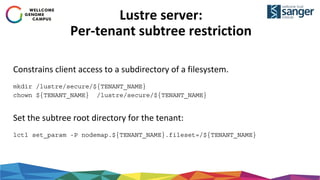
Lustre server:
Per-tenant subtree restriction
Constrains client access to a subdirectory of a filesystem.
mkdir /lustre/secure/${TENANT_NAME}
chown ${TENANT_NAME} /lustre/secure/${TENANT_NAME}
Set the subtree root directory for the tenant:
lctl set_param -P nodemap.${TENANT_NAME}.fileset=/${TENANT_NAME}
Lustre server:
Map nodemap to network
Add the tenant network range to the Lustre nodemap
lctl nodemap_add_range --name ${TENANT_NAME} --range 
[0-255].[0-255].[0-255].[0-255]@tcp${TENANT_UID}
And this command adds a route via a Lustre network router. This is run on all
MDS and OSS (or the route added to
/etc/modprobe.d/lustre.conf)
lnetctl route add --net tcp${TENANT_UID} --gateway ${LUSTRE_ROUTER_IP}@tcp
In the same way a similar command is needed on each client using TCP
Openstack:
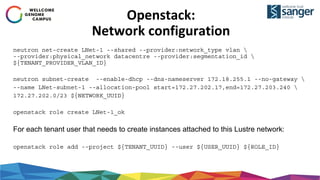
Network configuration
neutron net-create LNet-1 --shared --provider:network_type vlan 
--provider:physical_network datacentre --provider:segmentation_id 
${TENANT_PROVIDER_VLAN_ID}
neutron subnet-create --enable-dhcp --dns-nameserver 172.18.255.1 --no-gateway 
--name LNet-subnet-1 --allocation-pool start=172.27.202.17,end=172.27.203.240 
172.27.202.0/23 ${NETWORK_UUID}
openstack role create LNet-1_ok
For each tenant user that needs to create instances attached to this Lustre network:
openstack role add --project ${TENANT_UUID} --user ${USER_UUID} ${ROLE_ID}
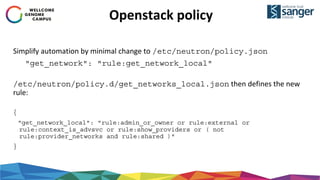
Openstack policy
Simplify automation by minimal change to /etc/neutron/policy.json
"get_network": "rule:get_network_local"
/etc/neutron/policy.d/get_networks_local.json then defines the new
rule:
{
"get_network_local": "rule:admin_or_owner or rule:external or
rule:context_is_advsvc or rule:show_providers or ( not
rule:provider_networks and rule:shared )"
}
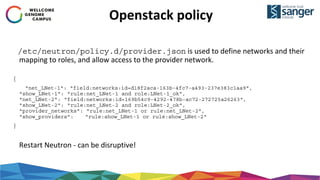
Openstack policy
/etc/neutron/policy.d/provider.json is used to define networks and their
mapping to roles, and allow access to the provider network.
{
"net_LNet-1": "field:networks:id=d18f2aca-163b-4fc7-a493-237e383c1aa9",
"show_LNet-1": "rule:net_LNet-1 and role:LNet-1_ok",
"net_LNet-2": "field:networks:id=169b54c9-4292-478b-ac72-272725a26263",
"show_LNet-2": "rule:net_LNet-2 and role:LNet-2_ok",
"provider_networks": "rule:net_LNet-1 or rule:net_LNet-2",
"show_providers": "rule:show_LNet-1 or rule:show_LNet-2"
}
Restart Neutron - can be disruptive!
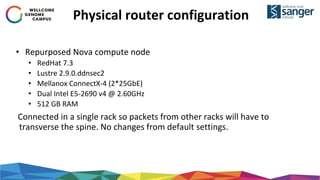
Physical router configuration
• Repurposed Nova compute node
• RedHat 7.3
• Lustre 2.9.0.ddnsec2
• Mellanox ConnectX-4 (2*25GbE)
• Dual Intel E5-2690 v4 @ 2.60GHz
• 512 GB RAM
Connected in a single rack so packets from other racks will have to
transverse the spine. No changes from default settings.
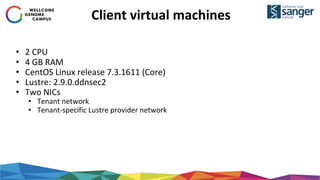
Client virtual machines
• 2 CPU
• 4 GB RAM
• CentOS Linux release 7.3.1611 (Core)
• Lustre: 2.9.0.ddnsec2
• Two NICs
• Tenant network
• Tenant-specific Lustre provider network
Filesets and uid mapping have no effect
Instance size has little effect
Single client read performance
Single client write performance
Multiple VMs, aggregate write
performance, metal LNet routers
Multiple VMs, aggregate read
performance, metal LNet routers
Virtualised Lustre routers
• We could see that bare metal Lustre routers gave acceptable
performance
• We wanted to know if we could virtualise these routers
• Each tenant could have their own set of virtual routers
• Fault isolation
• Ease of provisioning routers
• No additional cost
• Increases east-west traffic, but that’s OK.
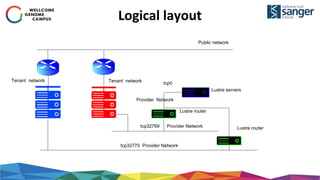
Public network
Tenant network
tcp32769 Provider Network
Lustre router
Lustre servers
tcp0
Provider Network
Tenant network
Lustre router
tcp32770 Provider Network
Logical layout
Improved security
As each tenant has its own set of Lustre routers:
• The traffic to a different tenant does not go to a shared router
• A Lustre router could be compromised without directly compromising
another tenant’s data - the filesystem servers will not route data for
@tcp1 to the router @tcp2
• Either a second Lustre router or the Lustre servers would need to be
compromised to intercept or reroute the data
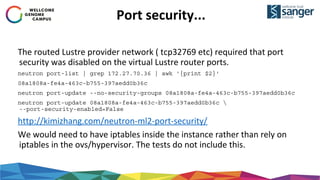
Port security...
The routed Lustre provider network ( tcp32769 etc) required that port
security was disabled on the virtual Lustre router ports.
neutron port-list | grep 172.27.70.36 | awk '{print $2}'
08a1808a-fe4a-463c-b755-397aedd0b36c
neutron port-update --no-security-groups 08a1808a-fe4a-463c-b755-397aedd0b36c
neutron port-update 08a1808a-fe4a-463c-b755-397aedd0b36c 
--port-security-enabled=False
http://kimizhang.com/neutron-ml2-port-security/
We would need to have iptables inside the instance rather than rely on
iptables in the ovs/hypervisor. The tests do not include this.
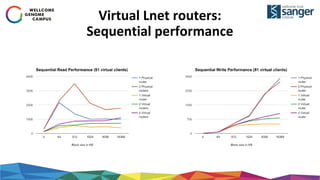
Virtual Lnet routers:
Sequential performance
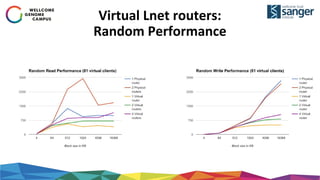
Virtual Lnet routers:
Random Performance
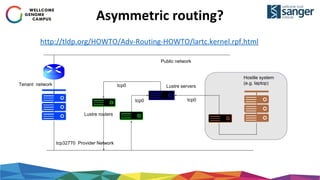
Asymmetric routing?
http://tldp.org/HOWTO/Adv-Routing-HOWTO/lartc.kernel.rpf.html
Public network
Lustre routers
Lustre servers
tcp0
Tenant network
tcp32770 Provider Network
Hostile system
(e.g. laptop)
tcp0
tcp0
Conclusions
• Follow our activities on http://hpc-news.sanger.ac.uk
• Isolated POSIX islands can be deployed to OpenStack with Lustre 2.9+
• Performance is acceptable
• Lustre routers require little CPU and memory
• Physical routers work and can give good locality for network usage
• Virtual routers work, can scale and give additional security benefits
• Next steps:
• Improve configuration automation
• Understand the neutron port security issue
• Improve network performance (MTU, OpenVSwitch etc).
Acknowledgements
DDN: Sébastien Buisson, Thomas Favre-Bulle, Richard Mansfield, James Coomer
Sanger Informatics Systems Group: Pete Clapham, James Beal, John Constable,
Helen Cousins, Brett Hartley, Dave Holland, Jon Nicholson, Matthew Vernon

Experiences in Providing Secure Mult-Tenant Lustre Access to OpenStack

  • 1.
    Experiences in providingsecure multi-tenant Lustre access to OpenStack Peter Clapham <pc7@sanger.ac.uk> Wellcome Trust Sanger Institute
  • 2.
    Sanger Science Scientific ResearchProgrammes Core Facilities
  • 3.
    HPC and Cloudcomputing are complementary Traditional HPC ● Highest possible performance ● A mature and centrally managed compute platform ● High performance Lustre filesystems for data intensive analysis Flexible Compute ● Full segregation of projects ensures data security ● Developers no longer tied to a single stack ● Reproducibility through containers / images and infrastructure-as-code
  • 4.
    But there’s acatch or two... • Large number of traditional/legacy pipelines • They require a performant shared POSIX filesystem, while cloud workloads support object stores • We do not always have the source code or expertise to migrate • We need multi-gigabyte per second performance • The tenant will have root • and could impersonate any user, but Lustre trusts the client’s identity assertions, just like NFSv3 • The solution must be simple for the tenant and administrator
  • 5.
    Lustre hardware 6+ yearold hardware • 4x Lustre object storage servers • Dual Intel E5620 @ 2.40GHz • 256GB RAM • Dual 10G network • lustre: 2.9.0.ddnsec2 • https://jira.hpdd.intel.com/browse/LU-9289 (landed in 2.10) • OSTs from DDN SFA-10k • 300x SATA, 7200rpm , 1TB spindles We have seen this system reach 6 GByte/second in production
  • 7.
    Lustre 2.9 features •Each tenant’s I/O can be squashed to their own unique UID/GID • Each tenant is restricted to their own subdirectory of the Lustre filesystem It might be possible to treat general access outside of OpenStack as a separate tenant with: • a UID space reserved for a number of OpenStack tenants • only a subdirectory exported for standard usage
  • 8.
    Public network tcp32769 ProviderNetwork Lustre router Lustre serverstcp0 Tenant network tcp32770 Provider Network Logical layout Tenant network
  • 9.
    Lustre server Per-tenant UIDmapping Allows UIDs from a set of NIDs to be mapped to another set of UIDs These commands are run on the MGS: lctl nodemap_add ${TENANT_NAME} lctl nodemap_modify --name ${TENANT_NAME} --property trusted --value 0 lctl nodemap_modify --name ${TENANT_NAME} --property admin --value 0 lctl nodemap_modify --name ${TENANT_NAME} --property squash_uid --value ${TENANT_UID} lctl nodemap_modify --name ${TENANT_NAME} --property squash_gid --value ${TENANT_UID} lctl nodemap_add_idmap --name ${TENANT_NAME} --idtype uid --idmap 1000:${TENANT_UID}
  • 10.
    Lustre server: Per-tenant subtreerestriction Constrains client access to a subdirectory of a filesystem. mkdir /lustre/secure/${TENANT_NAME} chown ${TENANT_NAME} /lustre/secure/${TENANT_NAME} Set the subtree root directory for the tenant: lctl set_param -P nodemap.${TENANT_NAME}.fileset=/${TENANT_NAME}
  • 11.
    Lustre server: Map nodemapto network Add the tenant network range to the Lustre nodemap lctl nodemap_add_range --name ${TENANT_NAME} --range [0-255].[0-255].[0-255].[0-255]@tcp${TENANT_UID} And this command adds a route via a Lustre network router. This is run on all MDS and OSS (or the route added to /etc/modprobe.d/lustre.conf) lnetctl route add --net tcp${TENANT_UID} --gateway ${LUSTRE_ROUTER_IP}@tcp In the same way a similar command is needed on each client using TCP
  • 12.
    Openstack: Network configuration neutron net-createLNet-1 --shared --provider:network_type vlan --provider:physical_network datacentre --provider:segmentation_id ${TENANT_PROVIDER_VLAN_ID} neutron subnet-create --enable-dhcp --dns-nameserver 172.18.255.1 --no-gateway --name LNet-subnet-1 --allocation-pool start=172.27.202.17,end=172.27.203.240 172.27.202.0/23 ${NETWORK_UUID} openstack role create LNet-1_ok For each tenant user that needs to create instances attached to this Lustre network: openstack role add --project ${TENANT_UUID} --user ${USER_UUID} ${ROLE_ID}
  • 13.
    Openstack policy Simplify automationby minimal change to /etc/neutron/policy.json "get_network": "rule:get_network_local" /etc/neutron/policy.d/get_networks_local.json then defines the new rule: { "get_network_local": "rule:admin_or_owner or rule:external or rule:context_is_advsvc or rule:show_providers or ( not rule:provider_networks and rule:shared )" }
  • 14.
    Openstack policy /etc/neutron/policy.d/provider.json isused to define networks and their mapping to roles, and allow access to the provider network. { "net_LNet-1": "field:networks:id=d18f2aca-163b-4fc7-a493-237e383c1aa9", "show_LNet-1": "rule:net_LNet-1 and role:LNet-1_ok", "net_LNet-2": "field:networks:id=169b54c9-4292-478b-ac72-272725a26263", "show_LNet-2": "rule:net_LNet-2 and role:LNet-2_ok", "provider_networks": "rule:net_LNet-1 or rule:net_LNet-2", "show_providers": "rule:show_LNet-1 or rule:show_LNet-2" } Restart Neutron - can be disruptive!
  • 15.
    Physical router configuration •Repurposed Nova compute node • RedHat 7.3 • Lustre 2.9.0.ddnsec2 • Mellanox ConnectX-4 (2*25GbE) • Dual Intel E5-2690 v4 @ 2.60GHz • 512 GB RAM Connected in a single rack so packets from other racks will have to transverse the spine. No changes from default settings.
  • 16.
    Client virtual machines •2 CPU • 4 GB RAM • CentOS Linux release 7.3.1611 (Core) • Lustre: 2.9.0.ddnsec2 • Two NICs • Tenant network • Tenant-specific Lustre provider network
  • 17.
    Filesets and uidmapping have no effect Instance size has little effect Single client read performance
  • 18.
  • 19.
    Multiple VMs, aggregatewrite performance, metal LNet routers
  • 20.
    Multiple VMs, aggregateread performance, metal LNet routers
  • 21.
    Virtualised Lustre routers •We could see that bare metal Lustre routers gave acceptable performance • We wanted to know if we could virtualise these routers • Each tenant could have their own set of virtual routers • Fault isolation • Ease of provisioning routers • No additional cost • Increases east-west traffic, but that’s OK.
  • 22.
    Public network Tenant network tcp32769Provider Network Lustre router Lustre servers tcp0 Provider Network Tenant network Lustre router tcp32770 Provider Network Logical layout
  • 23.
    Improved security As eachtenant has its own set of Lustre routers: • The traffic to a different tenant does not go to a shared router • A Lustre router could be compromised without directly compromising another tenant’s data - the filesystem servers will not route data for @tcp1 to the router @tcp2 • Either a second Lustre router or the Lustre servers would need to be compromised to intercept or reroute the data
  • 24.
    Port security... The routedLustre provider network ( tcp32769 etc) required that port security was disabled on the virtual Lustre router ports. neutron port-list | grep 172.27.70.36 | awk '{print $2}' 08a1808a-fe4a-463c-b755-397aedd0b36c neutron port-update --no-security-groups 08a1808a-fe4a-463c-b755-397aedd0b36c neutron port-update 08a1808a-fe4a-463c-b755-397aedd0b36c --port-security-enabled=False http://kimizhang.com/neutron-ml2-port-security/ We would need to have iptables inside the instance rather than rely on iptables in the ovs/hypervisor. The tests do not include this.
  • 25.
  • 26.
  • 27.
    Asymmetric routing? http://tldp.org/HOWTO/Adv-Routing-HOWTO/lartc.kernel.rpf.html Public network Lustrerouters Lustre servers tcp0 Tenant network tcp32770 Provider Network Hostile system (e.g. laptop) tcp0 tcp0
  • 28.
    Conclusions • Follow ouractivities on http://hpc-news.sanger.ac.uk • Isolated POSIX islands can be deployed to OpenStack with Lustre 2.9+ • Performance is acceptable • Lustre routers require little CPU and memory • Physical routers work and can give good locality for network usage • Virtual routers work, can scale and give additional security benefits • Next steps: • Improve configuration automation • Understand the neutron port security issue • Improve network performance (MTU, OpenVSwitch etc).
  • 29.
    Acknowledgements DDN: Sébastien Buisson,Thomas Favre-Bulle, Richard Mansfield, James Coomer Sanger Informatics Systems Group: Pete Clapham, James Beal, John Constable, Helen Cousins, Brett Hartley, Dave Holland, Jon Nicholson, Matthew Vernon