Work, Energy, and Power
 Work is done on a system when a force is applied
through a displacement.
 Work is measured in joules.
 One joule of work is done when a force of 1N acts on
a system over a displacement of 1m .
Work
Work
 Consider a force is exerted on an object while
the object moves a certain distance.
 There is a net force, so the object is
accelerated, a =
𝑓
𝑚
, and its velocity changes.
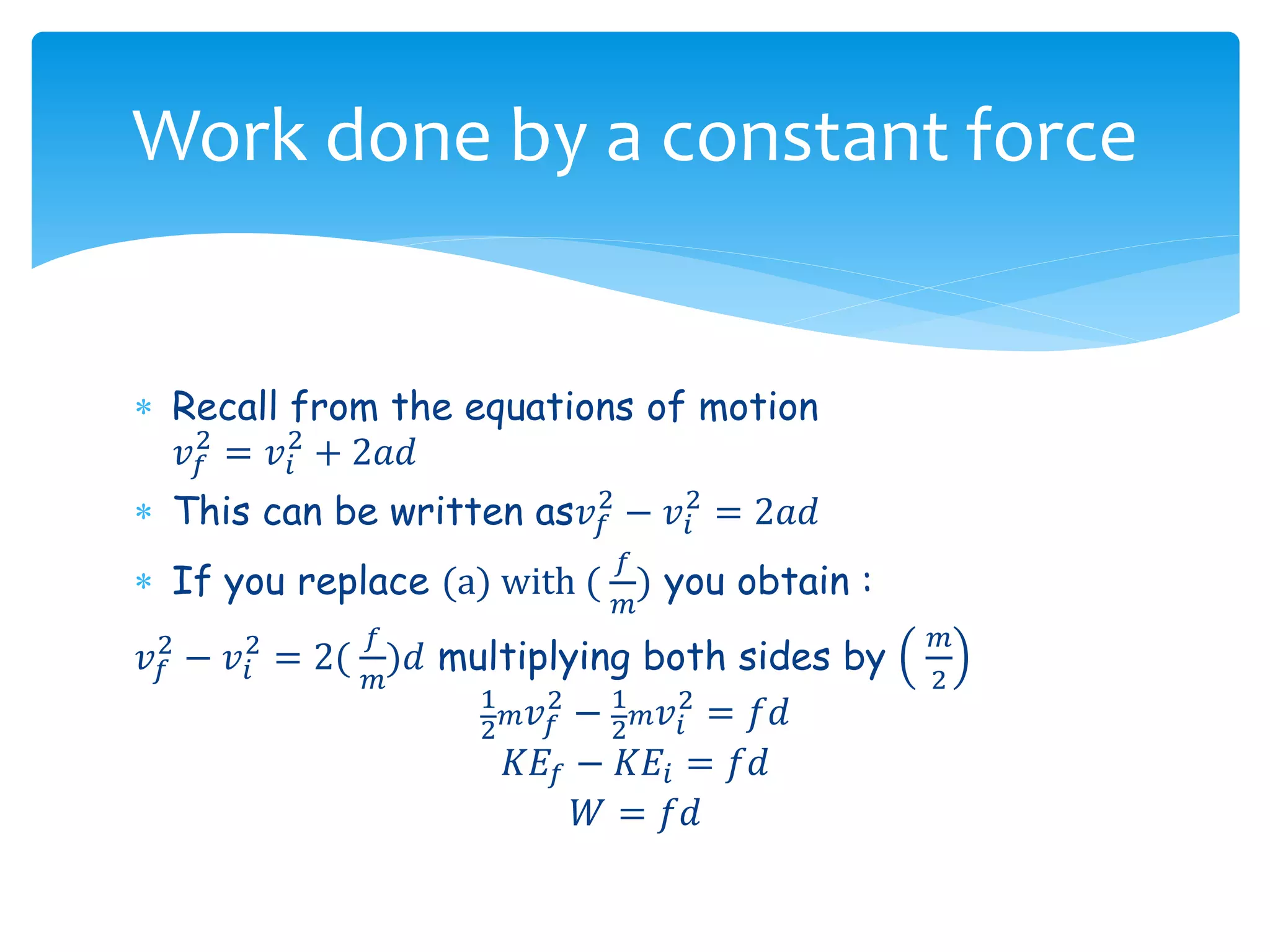
Work done by a constant force
 Recall from the equations of motion
𝑣 𝑓
2
= 𝑣𝑖
2
+ 2𝑎𝑑
 This can be written as𝑣 𝑓
2
− 𝑣𝑖
2
= 2𝑎𝑑
 If you replace (a) with (
𝑓
𝑚
) you obtain :
𝑣 𝑓
2
− 𝑣𝑖
2
= 2(
𝑓
𝑚
)𝑑 multiplying both sides by
𝑚
2
1
2 𝑚 𝑣 𝑓
2
− 1
2 𝑚 𝑣𝑖
2
= 𝑓𝑑
𝐾𝐸𝑓 − 𝐾𝐸𝑖 = 𝑓𝑑
𝑊 = 𝑓𝑑
Work done by a constant force
exerted at an angle
𝐹𝑥 = 𝐹 cos 𝜃 = 125𝑁 cos 25° = 113 𝑁.
𝐹𝑥 = 𝐹 sin 𝜃 = 125𝑁 sin 25° = −52.8 𝑁.
 The negative sign shows that the force is
downward.
 Because the displacement is in the x
direction, only the x-component does work.
The y-component does no work.
 The work you do when you exert a force
on a system at an angle to the direction of
motion is equal to the component of the
direction of the displacement multiplied
by the displacement.
 Work is equal to the product of the magnitude of the
force and magnitude of displacement times the
cosine of the angle between them.
𝑊 = 𝐹𝑑 cos 𝜃
W : work
F : force
d : displacement
𝜃 : the angle between the two directions of both force
and displacement
Work
 When several forces are exerted on a system,
calculate the work done by each force, and then add
the results.
 Suppose you are pushing a box on a friction less
surface while your friend is trying to prevent you from
moving it, as shown in the following figure.
Work done by many forces
 What are the forces are acting on the box?
You are exerting a force to the right and your friend is
exerting a force to the left.
Earth’s gravity exerts a downward force, and the
ground exerts an upward normal force.
Work done by many forces
 How much work is done on the box?
The upward and downward forces are perpendicular 𝜃 = 90° to the
direction of motion and do no work. For these forces, 𝜃 = 90°, which
makes cos 𝜃 = 0, and thus 𝑊 = 0.
The force you exert is in the direction of the displacement, so the
work you do is W = 𝐹𝑜𝑛 𝑏𝑜𝑥 𝑏𝑦 𝑦𝑜𝑢 × 𝑑
Your friend exerts a force in the direction opposite the displacement
𝜃 = 180° . Because cos 180° = −1, your friend does negative work.
W = −𝐹𝑜𝑛 𝑏𝑜𝑥 𝑏𝑦 𝑓𝑟𝑖𝑒𝑛𝑑 × 𝑑
The total work done on the box would be
W = (𝐹𝑜𝑛 𝑏𝑜𝑥 𝑏𝑦 𝑦𝑜𝑢× 𝑑) −(𝐹𝑜𝑛 𝑏𝑜𝑥 𝑏𝑦 𝑓𝑟𝑖𝑒𝑛𝑑 × 𝑑)
Work done by many forces
 In the last example, the force changed, but we could
determine the done in each segment. But what if the
force changes in a more complicated way?
 A graph of force versus displacement lets you
determine the work done by a force.
 This graphical method can be used to solve problems
in which the force is changing.
Finding work done when forces
change
Finding work done when forces
change
 The left panel of this figure shows the work done by a constant force of 20.0
N that is exerted to lift an object 1.50 m.
 The work is done by this force is represented by 𝑊 = 𝐹𝑑 =
20𝑁 1.5𝑚 = 30𝐽
 Notice that the shaded area under the left graph is also equal to
20𝑁 1.5𝑚 , 𝑜𝑟 30𝐽
 The area under a force-displacement graph is equal to the force done by
that force.
Finding work done when forces
change
 The right panel of this figure shows the force exerted by a
spring, which varies linearly from 0 to 20 N as it
compressed 1.5 m. the work done by the force that
compressed the spring is the area under the graph, which
is the area of a triangle, 𝐴𝑟𝑒𝑎∆ = 1
2
𝑏𝑎𝑠𝑒 𝑎𝑙𝑡𝑖𝑡𝑢𝑑𝑒 , or
𝑊 = 1
2
20𝑁 1.5𝑚 = 15 𝐽
Finding work done when forces
change
Use the problem-solving strategies
below when you solve
 Energy is the ability of a system to produce a change
in it self or the world around it.
Energy
 Work-Energy theorem states that work done on a
system is equal to the change in the system’s energy.
𝑤 = ∆𝐸
 Energy is measured in joules.
Work-Energy Theorem
 Through the process of doing work, energy can move
between the external world and the system.
 The direction of energy transfer can be either way.
 if the external world does work on a system, then W
is positive and the energy of the system increases.
 If a system does work on the external world, then W
is negative and the energy of the system decreases.
 Work is the transfer of energy that occurs when a
force is applied through a displacement.
Work-Energy Theorem
 Kinetic energy (KE) is the energy associated with
motion.
 Translational kinetic energy (𝐾𝐸𝑡𝑟𝑎𝑛𝑠) is the energy
due to changing position.
𝐾𝐸𝑡𝑟𝑎𝑛𝑠 = 1
2 𝑚𝑣2
 A system’s translational kinetic energy is equal to
1
2
times the system’s mass multiplied by the system’s
speed squared.
Changing kinetic energy
 Suppose you had a stack of books to move from the
floor to a shelf.
 You could lift the entire stack at once, or you could
move the books one at a time.
 How would the amount of work compare between
the two cases? Since the total force applied and the
displacement are the same in both cases, the work is
the same.
Power
 The time needed is different. Recall that work causes
a change in energy. The rate at which energy is
transformed is power.
 Power is equal to the change in energy divided by the
time required for the change.
𝑃 =
∆𝐸
𝑡
Power
 When work causes the change in energy, power is
equal to the work done divided by the time taken to
do the work.
𝑃 =
𝑊
𝑡
 Power is measured in watts (W).
 One watt is 1 J of energy transformed in 1 s.
 1,000 W = 1 KW 1,000,000 W = 1 MW
Power
You might have noticed in Example problem 3 that
when the force has a component 𝐹𝑥 in the same
direction as the displacement, 𝑃 =
𝐹𝑥 𝑑
𝑡
.
However, because 𝑣 =
𝑑
𝑡
, power also can be calculated
using 𝑃 = 𝐹𝑣
Power and speed
Power and speed

Physics Chapter 10 section 1 Work, Energy, and Power

  • 1.
  • 2.
     Work isdone on a system when a force is applied through a displacement.  Work is measured in joules.  One joule of work is done when a force of 1N acts on a system over a displacement of 1m . Work
  • 3.
  • 4.
     Consider aforce is exerted on an object while the object moves a certain distance.  There is a net force, so the object is accelerated, a = 𝑓 𝑚 , and its velocity changes. Work done by a constant force
  • 5.
     Recall fromthe equations of motion 𝑣 𝑓 2 = 𝑣𝑖 2 + 2𝑎𝑑  This can be written as𝑣 𝑓 2 − 𝑣𝑖 2 = 2𝑎𝑑  If you replace (a) with ( 𝑓 𝑚 ) you obtain : 𝑣 𝑓 2 − 𝑣𝑖 2 = 2( 𝑓 𝑚 )𝑑 multiplying both sides by 𝑚 2 1 2 𝑚 𝑣 𝑓 2 − 1 2 𝑚 𝑣𝑖 2 = 𝑓𝑑 𝐾𝐸𝑓 − 𝐾𝐸𝑖 = 𝑓𝑑 𝑊 = 𝑓𝑑 Work done by a constant force
  • 6.
    Work done bya constant force exerted at an angle 𝐹𝑥 = 𝐹 cos 𝜃 = 125𝑁 cos 25° = 113 𝑁. 𝐹𝑥 = 𝐹 sin 𝜃 = 125𝑁 sin 25° = −52.8 𝑁.  The negative sign shows that the force is downward.  Because the displacement is in the x direction, only the x-component does work. The y-component does no work.  The work you do when you exert a force on a system at an angle to the direction of motion is equal to the component of the direction of the displacement multiplied by the displacement.
  • 7.
     Work isequal to the product of the magnitude of the force and magnitude of displacement times the cosine of the angle between them. 𝑊 = 𝐹𝑑 cos 𝜃 W : work F : force d : displacement 𝜃 : the angle between the two directions of both force and displacement Work
  • 8.
     When severalforces are exerted on a system, calculate the work done by each force, and then add the results.  Suppose you are pushing a box on a friction less surface while your friend is trying to prevent you from moving it, as shown in the following figure. Work done by many forces
  • 9.
    Work done bymany forces
  • 10.
     What arethe forces are acting on the box? You are exerting a force to the right and your friend is exerting a force to the left. Earth’s gravity exerts a downward force, and the ground exerts an upward normal force. Work done by many forces
  • 11.
     How muchwork is done on the box? The upward and downward forces are perpendicular 𝜃 = 90° to the direction of motion and do no work. For these forces, 𝜃 = 90°, which makes cos 𝜃 = 0, and thus 𝑊 = 0. The force you exert is in the direction of the displacement, so the work you do is W = 𝐹𝑜𝑛 𝑏𝑜𝑥 𝑏𝑦 𝑦𝑜𝑢 × 𝑑 Your friend exerts a force in the direction opposite the displacement 𝜃 = 180° . Because cos 180° = −1, your friend does negative work. W = −𝐹𝑜𝑛 𝑏𝑜𝑥 𝑏𝑦 𝑓𝑟𝑖𝑒𝑛𝑑 × 𝑑 The total work done on the box would be W = (𝐹𝑜𝑛 𝑏𝑜𝑥 𝑏𝑦 𝑦𝑜𝑢× 𝑑) −(𝐹𝑜𝑛 𝑏𝑜𝑥 𝑏𝑦 𝑓𝑟𝑖𝑒𝑛𝑑 × 𝑑) Work done by many forces
  • 12.
     In thelast example, the force changed, but we could determine the done in each segment. But what if the force changes in a more complicated way?  A graph of force versus displacement lets you determine the work done by a force.  This graphical method can be used to solve problems in which the force is changing. Finding work done when forces change
  • 13.
    Finding work donewhen forces change
  • 14.
     The leftpanel of this figure shows the work done by a constant force of 20.0 N that is exerted to lift an object 1.50 m.  The work is done by this force is represented by 𝑊 = 𝐹𝑑 = 20𝑁 1.5𝑚 = 30𝐽  Notice that the shaded area under the left graph is also equal to 20𝑁 1.5𝑚 , 𝑜𝑟 30𝐽  The area under a force-displacement graph is equal to the force done by that force. Finding work done when forces change
  • 15.
     The rightpanel of this figure shows the force exerted by a spring, which varies linearly from 0 to 20 N as it compressed 1.5 m. the work done by the force that compressed the spring is the area under the graph, which is the area of a triangle, 𝐴𝑟𝑒𝑎∆ = 1 2 𝑏𝑎𝑠𝑒 𝑎𝑙𝑡𝑖𝑡𝑢𝑑𝑒 , or 𝑊 = 1 2 20𝑁 1.5𝑚 = 15 𝐽 Finding work done when forces change
  • 16.
    Use the problem-solvingstrategies below when you solve
  • 21.
     Energy isthe ability of a system to produce a change in it self or the world around it. Energy
  • 22.
     Work-Energy theoremstates that work done on a system is equal to the change in the system’s energy. 𝑤 = ∆𝐸  Energy is measured in joules. Work-Energy Theorem
  • 23.
     Through theprocess of doing work, energy can move between the external world and the system.  The direction of energy transfer can be either way.  if the external world does work on a system, then W is positive and the energy of the system increases.  If a system does work on the external world, then W is negative and the energy of the system decreases.  Work is the transfer of energy that occurs when a force is applied through a displacement. Work-Energy Theorem
  • 24.
     Kinetic energy(KE) is the energy associated with motion.  Translational kinetic energy (𝐾𝐸𝑡𝑟𝑎𝑛𝑠) is the energy due to changing position. 𝐾𝐸𝑡𝑟𝑎𝑛𝑠 = 1 2 𝑚𝑣2  A system’s translational kinetic energy is equal to 1 2 times the system’s mass multiplied by the system’s speed squared. Changing kinetic energy
  • 25.
     Suppose youhad a stack of books to move from the floor to a shelf.  You could lift the entire stack at once, or you could move the books one at a time.  How would the amount of work compare between the two cases? Since the total force applied and the displacement are the same in both cases, the work is the same. Power
  • 26.
     The timeneeded is different. Recall that work causes a change in energy. The rate at which energy is transformed is power.  Power is equal to the change in energy divided by the time required for the change. 𝑃 = ∆𝐸 𝑡 Power
  • 27.
     When workcauses the change in energy, power is equal to the work done divided by the time taken to do the work. 𝑃 = 𝑊 𝑡  Power is measured in watts (W).  One watt is 1 J of energy transformed in 1 s.  1,000 W = 1 KW 1,000,000 W = 1 MW Power
  • 30.
    You might havenoticed in Example problem 3 that when the force has a component 𝐹𝑥 in the same direction as the displacement, 𝑃 = 𝐹𝑥 𝑑 𝑡 . However, because 𝑣 = 𝑑 𝑡 , power also can be calculated using 𝑃 = 𝐹𝑣 Power and speed
  • 31.