

Graphic notes on
“Linear Algebra for Everyone”
authored by Prof. Gilbert Strang
Visualization to practically understand Linear Algebra
Kenji Hiranabe
Version 1.0
=
1
What is
this?
• Prof. Gilbert Strangʻs
“Linear Algebra for Everyone”
is a great book for an introduction
to Linear Algebra!
• Not theorem-proof chains but “matrix languages” and examples to get
intuitive understanding for practical applications.
• Linked to the best Linear Algebra course video MIT 18.06 and 18.065
youtube MIT OpenCourseWare playlist with over 2 milion subscribers(I am
one of them!)
• Hightlights…
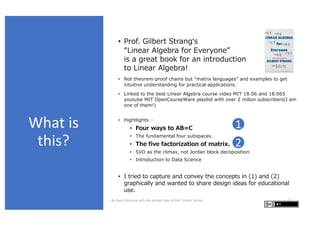
• Four ways to AB=C
• The fundamental four subspaces.
• The five factorization of matrix.
• SVD as the climax, not Jordan block decoposition.
• Introduction to Data Science
• I tried to capture and convey the concepts in (1) and (2)
graphically and wanted to share design ideas for educational
use.
By Kenji Hiranabe with the kindest help of Prof. Gilbert Strang 2
1
2
Why you
read this
note?
• There are several ways to view,
express and calculate matrix/vector
multiplications.
• This notes are my try to graphically
illustrate those matrix operations in
visual designs as an educational
material.
• So to ...
• Understand matrix/vector operations
intuitively, and
• Connect the intuitions to concepts
including the “five factorizations of
matrix”.
By Kenji Hiranabe with the kindest help of Prof. Gilbert Strang 3
Table of Contents
• Viewing a Matrix – 4 Ways
• Vector times Vector
• Matrix times Vector – 2 Ways
• Matrix times Matrix – 4 Ways
• Practical Patterns
• The Five Matrix Factorizations
• 𝐶𝑅, 𝐿𝑈, 𝑄𝑅, 𝑄Λ𝑄!, 𝑈Σ𝑉!
By Kenji Hiranabe with the kindest help of Prof. Gilbert Strang 4
= = =
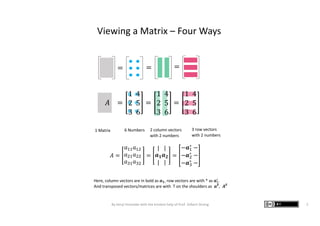
2 column vectors
with 2 numbers
3 row vectors
with 2 numbers
6 Numbers1 Matrix
Viewing a Matrix – Four Ways
𝐴 =
𝑎!! 𝑎!"
𝑎"! 𝑎""
𝑎#! 𝑎#"
=
|
𝒂 𝟏
|
|
𝒂 𝟐
|
=
−𝒂!
∗ −
−𝒂"
∗ −
−𝒂#
∗ −
Here, column vectors are in bold as 𝒂 𝟏, row vectors are with * as 𝒂"
∗
.
And transposed vectors/matrices are with T on the shoulders as 𝒂 𝑻, 𝑨 𝑻
𝐴 =
1 4
2 5
3 6
=
1 4
2 5
3 6
=
1 4
2 5
3 6
By Kenji Hiranabe with the kindest help of Prof. Gilbert Strang 5
= = =Dot product(number) Rank1 Matrix
v1 =
1
2
3
𝑥 𝑦 =
𝑥 𝑦
2𝑥 2𝑦
3𝑥 3𝑦
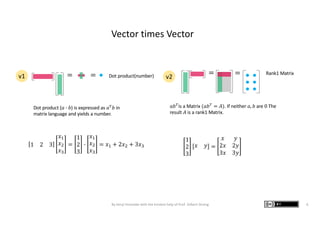
Vector times Vector
1 2 3
𝑥!
𝑥"
𝑥#
=
1
2
3
,
𝑥!
𝑥"
𝑥#
= 𝑥! + 2𝑥" + 3𝑥#
𝑎𝑏!
is a Matrix (𝑎𝑏!
= 𝐴). If neither 𝑎, 𝑏 are 0 The
result 𝐴 is a rank1 Matrix.
Dot product (𝑎 ) 𝑏) is expressed as 𝑎!
𝑏 in
matrix language and yields a number.
v2
By Kenji Hiranabe with the kindest help of Prof. Gilbert Strang 6
= = +
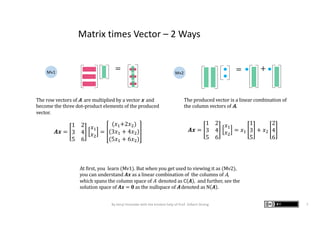
Matrix times Vector – 2 Ways
The	row	vectors	of	A	 are	multiplied	by	a	vector	x and	
become	the	three	dot-product	elements	of	the	produced	
vector.
The	produced	vector	is	a	linear	combination	of	
the	column	vectors	of	A.
𝑨𝒙 =
1 2
3 4
5 6
𝑥!
𝑥"
=
(𝑥!+2𝑥")
(3𝑥! + 4𝑥")
(5𝑥! + 6𝑥")
𝑨𝒙 =
1 2
3 4
5 6
𝑥!
𝑥"
= 𝑥!
1
3
5
+ 𝑥"
2
4
6
At	first,	you		learn (Mv1).	But	when	you	get	used	to	viewing	it	as	(Mv2),	
you	can	understand	𝑨𝒙 as	a	linear	combination	of	 the	columns	of	A,
which	spans	the	column	space	of	A denoted	as C 𝑨 ,		and	further,	see	the	
solution	space	of	𝑨𝒙 = 𝟎 as the	nullspace	of	A	denoted	as N 𝑨 .
Mv1 Mv2
By Kenji Hiranabe with the kindest help of Prof. Gilbert Strang 7
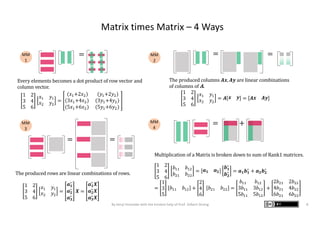
Matrix times Matrix – 4 Ways
=
= +
1 2
3 4
5 6
𝑥" 𝑦"
𝑥# 𝑦#
=
(𝑥"+2𝑥#) (𝑦"+2𝑦#)
(3𝑥"+4𝑥#) (3𝑦"+4𝑦#)
(5𝑥"+6𝑥#) (5𝑦"+6𝑦#)
1 2
3 4
5 6
𝑥" 𝑦"
𝑥# 𝑦#
= 𝑨 𝒙 𝒚 = 𝑨 𝒙 𝑨𝒚
= =
= =
1 2
3 4
5 6
𝑏"" 𝑏"#
𝑏#" 𝑏##
= 𝒂 𝟏 𝒂 𝟐
𝒃 𝟏
∗
𝒃 𝟐
∗ = 𝒂 𝟏 𝒃 𝟏
∗
+ 𝒂 𝟐 𝒃 𝟐
∗
=
1
3
5
𝑏"" 𝑏"# +
2
4
6
𝑏#" 𝑏## =
𝑏"" 𝑏"#
3𝑏"" 3𝑏"#
5𝑏"" 5𝑏"#
+
2𝑏#" 2𝑏##
4𝑏#" 4𝑏##
6𝑏#" 6𝑏##
The	produced columns	𝑨𝒙, 𝑨𝒚 are	linear	combinations	
of	columns	of	A.
1 2
3 4
5 6
𝑥" 𝑦"
𝑥# 𝑦#
=
𝒂 𝟏
∗
𝒂 𝟐
∗
𝒂 𝟑
∗
𝑿 =
𝒂 𝟏
∗
𝑿
𝒂 𝟐
∗
𝑿
𝒂 𝟑
∗
𝑿
Multiplication	of	a	Matrix	is	broken	down	to	sum	of	Rank1	matrices.
The	produced	rows	are	linear	combinations	of	rows.
Every	elements	becomes	a	dot	product	of	row	vector	and	
column	vector.
MM
1
MM
2
MM
3
MM
4
By Kenji Hiranabe with the kindest help of Prof. Gilbert Strang 8
Practical Patterns (1/3)
2 3
=
1 2 31 1
=
21
+
3
+
2
=
21
+
3
+
3
=
21
+
3
+
1
2
3
= 1
2
3
1 = +1 2 3+
2 = +1 2 3+
3 = +1 2 3+
MM
2
Mv2
MM
3
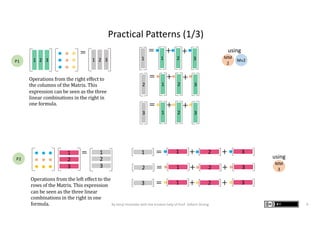
Operations	from	the	right	effect	to	
the	columns	of	the	Matrix.	This	
expression	can	be	seen	as	the	three	
linear	combinations	in	the	right	in	
one	formula.
P1
P2
using
using
By Kenji Hiranabe with the kindest help of Prof. Gilbert Strang 9
Operations	from	the	left	effect	to	the	
rows	of	the	Matrix.	This	expression	
can	be	seen	as	the	three	linear	
combinations	in	the	right	in	one	
formula.
= =
𝐴𝐷 = 𝒂 𝟏 𝒂 𝟐 𝒂 𝟑
𝑑!
𝑑"
𝑑#
= 𝑑! 𝒂 𝟏 𝑑" 𝒂 𝟐 𝑑" 𝒂 𝟐
𝐷𝐵 =
𝑑!
𝑑"
𝑑#
𝒃!
∗
𝒃!
∗
𝒃!
∗
=
𝑑! 𝒃!
∗
𝑑! 𝒃!
∗
𝑑! 𝒃!
∗
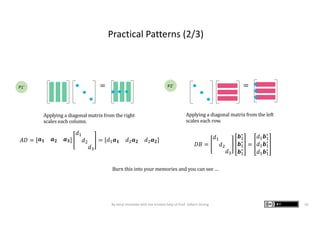
Applying	a	diagonal	matrix	from	the	right
scales	each	column.
Applying	a	diagonal	matrix	from	the	left
scales	each	row.
Burn	this	into	your	memories	and	you	can	see	…
P1’ P2’
By Kenji Hiranabe with the kindest help of Prof. Gilbert Strang 10
Practical Patterns (2/3)
Practical Patterns (3/3)
= + +
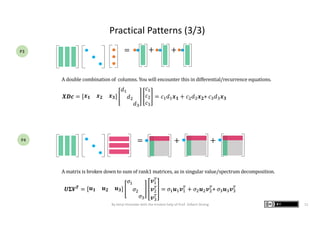
A	double	combination	of		columns.	You	will	encounter	this	in	differential/recurrence	equations.
=
𝑿𝑫𝒄 = 𝒙 𝟏 𝒙 𝟐 𝒙 𝟑
𝑑!
𝑑"
𝑑#
𝑐!
𝑐"
𝑐#
= 𝑐! 𝑑! 𝒙 𝟏 + 𝑐" 𝑑" 𝒙 𝟐+ 𝑐# 𝑑# 𝒙 𝟑
𝑼𝚺𝑽 𝑻 = 𝒖 𝟏 𝒖 𝟐 𝒖 𝟑
𝜎!
𝜎"
𝜎#
𝒗!
-
𝒗"
-
𝒗#
-
= 𝜎! 𝒖! 𝒗!
-
+ 𝜎" 𝒖" 𝒗"
-
+ 𝜎# 𝒖# 𝒗#
-
+ +
A	matrix is	broken	down	to	sum	of	rank1	matrices,	as	in	singular	value/spectrum	decomposition.
P3
P4
By Kenji Hiranabe with the kindest help of Prof. Gilbert Strang 11
The Five Matrix Factorization
𝐴 = 𝐶𝑅
𝐴 = 𝐿𝑈
𝐴 = 𝑄𝑅
𝑆 = 𝑄Λ𝑄!
𝐴 = 𝑈Σ𝑉!
By Kenji Hiranabe with the kindest help of Prof. Gilbert Strang 12
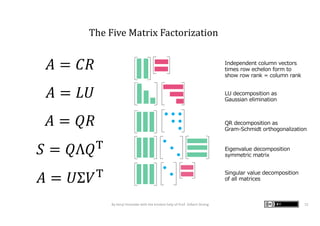
Independent column vectors
times row echelon form to
show row rank = column rank
LU decomposition as
Gaussian elimination
QR decomposition as
Gram-Schmidt orthogonalization
Eigenvalue decomposition
symmetric matrix
Singular value decomposition
of all matrices
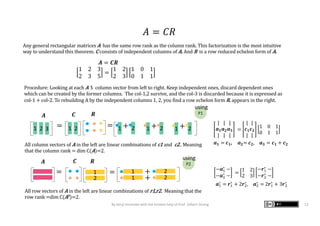
𝐴 = 𝐶𝑅
Procedure:	Looking	at	each	A	‘s		column	vector	from	left	to	right.	Keep	independent	ones,	discard	dependent	ones	
which	can	be	created	by	the	former	columns. The	col-1,2	survive,	and	the	col-3	is	discarded	because	it	is	expressed	as	
col-1	+	col-2. To	rebuilding	A	by	the	independent	columns	1,	2,	you	find	a	row	echelon	form	R.	appears	in	the	right.
Any	general	rectangular	matrices	A has	the	same	row	rank	as	the	column	rank.	This	factorization	is	the	most	intuitive	
way	to	understand	this	theorem.	C consists	of	independent	columns	of	A.	And	R is	a	row	reduced	echelon	form	of	A.
2 =
1 2 3
2 3 5
=
1 2
2 3
1 0 1
0 1 1
1
|
𝒂 𝟏
|
|
𝒂 𝟐
|
|
𝒂 𝟑
|
=
|
𝒄 𝟏
|
|
𝒄 𝟐
|
1 0 1
0 1 1
𝒂 𝟏 = 𝒄 𝟏,	 𝒂 𝟐= 𝒄 𝟐, 𝒂 𝟑 = 𝒄 𝟏 + 𝒄 𝟐
−𝒂"
∗
−
−𝒂#
∗
−
=
1 2
2 3
−𝒓"
∗
−
−𝒓#
∗
−
𝒂"
∗
= 𝒓"
∗
+ 2𝒓#
∗
, 𝒂#
∗
= 2𝒓"
∗
+ 3𝒓#
∗
213 = 1 + 2 1 + 2 1 + 2
All	column	vectors	of	A	in	the	left	are	linear	combinations	of	c1 and		c2..	Meaning	
that	the	column	rank	=	dim	C(A)=2.
= +1
2
1 2
1 2+
=
All	row	vectors	of	A	in	the	left	are	linear	combinations	of	r1,r2.		Meaning	that	the	
row	rank	=dim	C(AT)=2.
𝑨 = 𝑪𝑹
P1
P2
using
using
By Kenji Hiranabe with the kindest help of Prof. Gilbert Strang 13
𝑨 𝑪 𝑹
𝑨 𝑪 𝑹
== + +
𝑨 =
|
𝒍 𝟏
|
−𝒖!
∗
− +
𝟎 𝟎 𝟎
𝟎
𝟎
𝑨 𝟐
=
|
𝒍 𝟏
|
−𝒖!
∗
− +
|
𝒍 𝟐
|
−𝒖"
∗
− +
𝟎 𝟎 𝟎
𝟎 𝟎 𝟎
𝟎 𝟎 𝑨 𝟑
= 𝑳𝑼
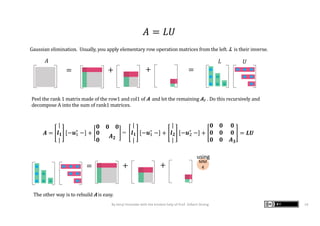
𝐴 = 𝐿𝑈
Peel	the	rank	1	matrix	made	of	the	row1	and	col1	of	A		and	let	the	remaining	A1	 .	Do	this	recursively	and	
decompose	A	into	the	sum	of	rank1	matrices.
= + +
The	other	way	is	to	rebuild	A is	easy.
MM
4
Gaussian	elimination.		Usually,	you	apply	elementary	row	operation	matrices	from	the	left.	L		is	their	inverse.
𝐿 𝑈
using
By Kenji Hiranabe with the kindest help of Prof. Gilbert Strang 14
𝐴
==
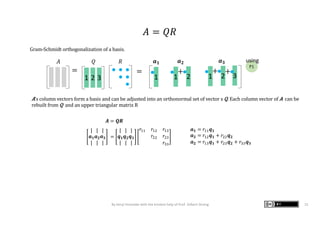
𝐴 = 𝑄𝑅
A’s	column	vectors	form	a	basis	and	can	be	adjusted	into	an	orthonormal	set	of	vector	s	Q.	Each	column	vector	of	A can	be
rebuilt	from	Q		and	an	upper	triangular	matrix	R
Gram-Schmidt	orthogonalization	of	a	basis.
2 31
|
𝒂 𝟏
|
|
𝒂 𝟐
|
|
𝒂 𝟑
|
=
|
𝒒 𝟏
|
|
𝒒 𝟐
|
|
𝒒 𝟑
|
𝑟"" 𝑟"# 𝑟"(
𝑟## 𝑟#(
𝑟((
31
+
1 2
+
1 2
+
𝒂 𝟏 = 𝑟"" 𝒒 𝟏
𝒂 𝟐 = 𝑟"# 𝒒 𝟏 + 𝑟## 𝒒 𝟐
𝒂 𝟐 = 𝑟"( 𝒒 𝟏 + 𝑟#( 𝒒 𝟐 + 𝑟(( 𝒒 𝟑
𝑨 = 𝑸𝑹
P1
using
By Kenji Hiranabe with the kindest help of Prof. Gilbert Strang 15
𝑄 𝑅𝐴 𝒂 𝟏 𝒂 𝟐 𝒂 𝟑
𝑺 = 𝑸𝜦𝑸-=
|
𝒒 𝟏
|
|
𝒒 𝟐
|
|
𝒒 𝟑
|
𝜆!
𝜆"
𝜆#
−𝒒!
-
−
−𝒒"
- −
−𝒒#
- −
=𝜆!
|
𝒒 𝟏
|
−𝒒!
-
− + 𝜆"
|
𝒒 𝟐
|
−𝒒"
-
− + 𝜆#
|
𝒒 𝟑
|
−𝒒#
- −
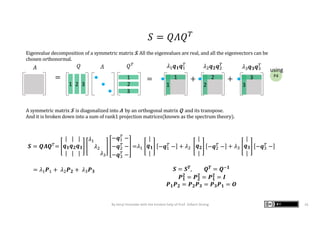
𝑆 = 𝑄𝛬𝑄3
A	symmetric	matrix	S		is	diagonalized	into	Λ by	an	orthogonal	matrix	Q	 and	its	transpose.
And	it	is	broken	down	into	a	sum	of	rank1	projection	matrices(known	as	the	spectrum theory).
= 𝜆! 𝑷! + 𝜆" 𝑷 𝟐 + 𝜆# 𝑷 𝟑
Eigenvalue	decomposition	of	a	symmetric	matrix	S.	All	the	eigenvalues	are	real,	and	all	the	eigenvectors	can	be	
chosen	orthonormal.
2 31
= + += 1
2
3
1
1
2
2
3
3
𝑺 = 𝑺 𝑻, 𝑸 𝑻 = 𝑸.𝟏
𝑷 𝟏
𝟐
= 𝑷 𝟐
𝟐
= 𝑷 𝟏
𝟐
= 𝑰
𝑷 𝟏 𝑷 𝟐 = 𝑷 𝟐 𝑷 𝟑 = 𝑷 𝟑 𝑷 𝟏 = 𝑶
P4
using
By Kenji Hiranabe with the kindest help of Prof. Gilbert Strang 16
𝑄 𝛬𝐴 𝑄- 𝜆! 𝒒 𝟏 𝒒!
-
𝜆" 𝒒 𝟐 𝒒"
-
𝜆# 𝒒 𝟑 𝒒#
-
𝐴 = 𝑈Σ𝑉-=
|
𝒖 𝟏
|
|
𝒖 𝟐
|
|
𝒖 𝟑
|
𝜎!
𝜎"
−𝒗!
- −
−𝒗"
-
−
=𝜎!
|
𝒖 𝟏
|
−𝒗!
- − + 𝜎"
|
𝒖 𝟐
|
−𝒗"
-
−
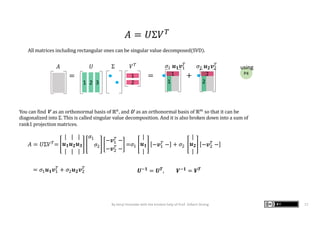
𝐴 = 𝑈Σ𝑉3
You can	find V		as an	orthonormal	basis	of	ℝ)
,	and	U		as an	orthonormal	basis	of	ℝ*
so	that	it	can	be	
diagonalized into Σ.	This	is	called	singular	value	decomposition. And	it	is	also	broken	down	into	a	sum	of	
rank1	projection	matrices.
= 𝜎! 𝒖 𝟏 𝒗!
-
+ 𝜎" 𝒖 𝟐 𝒗"
-
All	matrices	including	rectangular	ones	can	be	singular	value	decomposed(SVD).
= +=
1
1
2
2
2 31
1
2
𝑼.𝟏 = 𝑼 𝑻, 𝑽.𝟏 = 𝑽 𝑻
P4
using
By Kenji Hiranabe with the kindest help of Prof. Gilbert Strang 17
𝑈 Σ𝐴 𝑉- 𝜎! 𝒖 𝟏 𝒗!
-
𝜎" 𝒖 𝟐 𝒗"
-
References
and
Credits
• Linear Algebra for Everyone
http://math.mit.edu/everyone/
• MIT OpenCourseWare 18.06
http://web.mit.edu/18.06/www/vi
deos.shtml
• A 2020 Vision of Linear Algebra
https://ocw.mit.edu/resources/res
-18-010-a-2020-vision-of-linear-
algebra-spring-2020/
• My blog entry Matrix World
https://anagileway.com/2020/09/
29/matrix-world-in-linear-algebra-
for-everyone/
• The four subspaces T-shirt
https://anagileway.com/2020/06/
04/prof-gilbert-strang-linear-
algebra/
This work is inspired by Prof. Strangʼs
books and lecture videos. I deeply
appreciate his work, passion and
personality.
By Kenji Hiranabe with the kindest help of Prof. Gilbert Strang
18
Thank you for
reading!
Any comments or feedbacks are welcome to:
Kenji Hiranabe (hiranabe@gmail.com)
=
19

Graphic Notes on Introduction to Linear Algebra

  • 1.
    Graphic notes on “LinearAlgebra for Everyone” authored by Prof. Gilbert Strang Visualization to practically understand Linear Algebra Kenji Hiranabe Version 1.0 = 1
  • 2.
    What is this? • Prof.Gilbert Strangʻs “Linear Algebra for Everyone” is a great book for an introduction to Linear Algebra! • Not theorem-proof chains but “matrix languages” and examples to get intuitive understanding for practical applications. • Linked to the best Linear Algebra course video MIT 18.06 and 18.065 youtube MIT OpenCourseWare playlist with over 2 milion subscribers(I am one of them!) • Hightlights… • Four ways to AB=C • The fundamental four subspaces. • The five factorization of matrix. • SVD as the climax, not Jordan block decoposition. • Introduction to Data Science • I tried to capture and convey the concepts in (1) and (2) graphically and wanted to share design ideas for educational use. By Kenji Hiranabe with the kindest help of Prof. Gilbert Strang 2 1 2
  • 3.
    Why you read this note? •There are several ways to view, express and calculate matrix/vector multiplications. • This notes are my try to graphically illustrate those matrix operations in visual designs as an educational material. • So to ... • Understand matrix/vector operations intuitively, and • Connect the intuitions to concepts including the “five factorizations of matrix”. By Kenji Hiranabe with the kindest help of Prof. Gilbert Strang 3
  • 4.
    Table of Contents •Viewing a Matrix – 4 Ways • Vector times Vector • Matrix times Vector – 2 Ways • Matrix times Matrix – 4 Ways • Practical Patterns • The Five Matrix Factorizations • 𝐶𝑅, 𝐿𝑈, 𝑄𝑅, 𝑄Λ𝑄!, 𝑈Σ𝑉! By Kenji Hiranabe with the kindest help of Prof. Gilbert Strang 4
  • 5.
    = = = 2column vectors with 2 numbers 3 row vectors with 2 numbers 6 Numbers1 Matrix Viewing a Matrix – Four Ways 𝐴 = 𝑎!! 𝑎!" 𝑎"! 𝑎"" 𝑎#! 𝑎#" = | 𝒂 𝟏 | | 𝒂 𝟐 | = −𝒂! ∗ − −𝒂" ∗ − −𝒂# ∗ − Here, column vectors are in bold as 𝒂 𝟏, row vectors are with * as 𝒂" ∗ . And transposed vectors/matrices are with T on the shoulders as 𝒂 𝑻, 𝑨 𝑻 𝐴 = 1 4 2 5 3 6 = 1 4 2 5 3 6 = 1 4 2 5 3 6 By Kenji Hiranabe with the kindest help of Prof. Gilbert Strang 5
  • 6.
    = = =Dotproduct(number) Rank1 Matrix v1 = 1 2 3 𝑥 𝑦 = 𝑥 𝑦 2𝑥 2𝑦 3𝑥 3𝑦 Vector times Vector 1 2 3 𝑥! 𝑥" 𝑥# = 1 2 3 , 𝑥! 𝑥" 𝑥# = 𝑥! + 2𝑥" + 3𝑥# 𝑎𝑏! is a Matrix (𝑎𝑏! = 𝐴). If neither 𝑎, 𝑏 are 0 The result 𝐴 is a rank1 Matrix. Dot product (𝑎 ) 𝑏) is expressed as 𝑎! 𝑏 in matrix language and yields a number. v2 By Kenji Hiranabe with the kindest help of Prof. Gilbert Strang 6
  • 7.
    = = + Matrixtimes Vector – 2 Ways The row vectors of A are multiplied by a vector x and become the three dot-product elements of the produced vector. The produced vector is a linear combination of the column vectors of A. 𝑨𝒙 = 1 2 3 4 5 6 𝑥! 𝑥" = (𝑥!+2𝑥") (3𝑥! + 4𝑥") (5𝑥! + 6𝑥") 𝑨𝒙 = 1 2 3 4 5 6 𝑥! 𝑥" = 𝑥! 1 3 5 + 𝑥" 2 4 6 At first, you learn (Mv1). But when you get used to viewing it as (Mv2), you can understand 𝑨𝒙 as a linear combination of the columns of A, which spans the column space of A denoted as C 𝑨 , and further, see the solution space of 𝑨𝒙 = 𝟎 as the nullspace of A denoted as N 𝑨 . Mv1 Mv2 By Kenji Hiranabe with the kindest help of Prof. Gilbert Strang 7
  • 8.
    Matrix times Matrix– 4 Ways = = + 1 2 3 4 5 6 𝑥" 𝑦" 𝑥# 𝑦# = (𝑥"+2𝑥#) (𝑦"+2𝑦#) (3𝑥"+4𝑥#) (3𝑦"+4𝑦#) (5𝑥"+6𝑥#) (5𝑦"+6𝑦#) 1 2 3 4 5 6 𝑥" 𝑦" 𝑥# 𝑦# = 𝑨 𝒙 𝒚 = 𝑨 𝒙 𝑨𝒚 = = = = 1 2 3 4 5 6 𝑏"" 𝑏"# 𝑏#" 𝑏## = 𝒂 𝟏 𝒂 𝟐 𝒃 𝟏 ∗ 𝒃 𝟐 ∗ = 𝒂 𝟏 𝒃 𝟏 ∗ + 𝒂 𝟐 𝒃 𝟐 ∗ = 1 3 5 𝑏"" 𝑏"# + 2 4 6 𝑏#" 𝑏## = 𝑏"" 𝑏"# 3𝑏"" 3𝑏"# 5𝑏"" 5𝑏"# + 2𝑏#" 2𝑏## 4𝑏#" 4𝑏## 6𝑏#" 6𝑏## The produced columns 𝑨𝒙, 𝑨𝒚 are linear combinations of columns of A. 1 2 3 4 5 6 𝑥" 𝑦" 𝑥# 𝑦# = 𝒂 𝟏 ∗ 𝒂 𝟐 ∗ 𝒂 𝟑 ∗ 𝑿 = 𝒂 𝟏 ∗ 𝑿 𝒂 𝟐 ∗ 𝑿 𝒂 𝟑 ∗ 𝑿 Multiplication of a Matrix is broken down to sum of Rank1 matrices. The produced rows are linear combinations of rows. Every elements becomes a dot product of row vector and column vector. MM 1 MM 2 MM 3 MM 4 By Kenji Hiranabe with the kindest help of Prof. Gilbert Strang 8
  • 9.
    Practical Patterns (1/3) 23 = 1 2 31 1 = 21 + 3 + 2 = 21 + 3 + 3 = 21 + 3 + 1 2 3 = 1 2 3 1 = +1 2 3+ 2 = +1 2 3+ 3 = +1 2 3+ MM 2 Mv2 MM 3 Operations from the right effect to the columns of the Matrix. This expression can be seen as the three linear combinations in the right in one formula. P1 P2 using using By Kenji Hiranabe with the kindest help of Prof. Gilbert Strang 9 Operations from the left effect to the rows of the Matrix. This expression can be seen as the three linear combinations in the right in one formula.
  • 10.
    = = 𝐴𝐷 =𝒂 𝟏 𝒂 𝟐 𝒂 𝟑 𝑑! 𝑑" 𝑑# = 𝑑! 𝒂 𝟏 𝑑" 𝒂 𝟐 𝑑" 𝒂 𝟐 𝐷𝐵 = 𝑑! 𝑑" 𝑑# 𝒃! ∗ 𝒃! ∗ 𝒃! ∗ = 𝑑! 𝒃! ∗ 𝑑! 𝒃! ∗ 𝑑! 𝒃! ∗ Applying a diagonal matrix from the right scales each column. Applying a diagonal matrix from the left scales each row. Burn this into your memories and you can see … P1’ P2’ By Kenji Hiranabe with the kindest help of Prof. Gilbert Strang 10 Practical Patterns (2/3)
  • 11.
    Practical Patterns (3/3) =+ + A double combination of columns. You will encounter this in differential/recurrence equations. = 𝑿𝑫𝒄 = 𝒙 𝟏 𝒙 𝟐 𝒙 𝟑 𝑑! 𝑑" 𝑑# 𝑐! 𝑐" 𝑐# = 𝑐! 𝑑! 𝒙 𝟏 + 𝑐" 𝑑" 𝒙 𝟐+ 𝑐# 𝑑# 𝒙 𝟑 𝑼𝚺𝑽 𝑻 = 𝒖 𝟏 𝒖 𝟐 𝒖 𝟑 𝜎! 𝜎" 𝜎# 𝒗! - 𝒗" - 𝒗# - = 𝜎! 𝒖! 𝒗! - + 𝜎" 𝒖" 𝒗" - + 𝜎# 𝒖# 𝒗# - + + A matrix is broken down to sum of rank1 matrices, as in singular value/spectrum decomposition. P3 P4 By Kenji Hiranabe with the kindest help of Prof. Gilbert Strang 11
  • 12.
    The Five MatrixFactorization 𝐴 = 𝐶𝑅 𝐴 = 𝐿𝑈 𝐴 = 𝑄𝑅 𝑆 = 𝑄Λ𝑄! 𝐴 = 𝑈Σ𝑉! By Kenji Hiranabe with the kindest help of Prof. Gilbert Strang 12 Independent column vectors times row echelon form to show row rank = column rank LU decomposition as Gaussian elimination QR decomposition as Gram-Schmidt orthogonalization Eigenvalue decomposition symmetric matrix Singular value decomposition of all matrices
  • 13.
    𝐴 = 𝐶𝑅 Procedure: Looking at each A ‘s column vector from left to right. Keep independent ones, discard dependent ones which can be created by the former columns.The col-1,2 survive, and the col-3 is discarded because it is expressed as col-1 + col-2. To rebuilding A by the independent columns 1, 2, you find a row echelon form R. appears in the right. Any general rectangular matrices A has the same row rank as the column rank. This factorization is the most intuitive way to understand this theorem. C consists of independent columns of A. And R is a row reduced echelon form of A. 2 = 1 2 3 2 3 5 = 1 2 2 3 1 0 1 0 1 1 1 | 𝒂 𝟏 | | 𝒂 𝟐 | | 𝒂 𝟑 | = | 𝒄 𝟏 | | 𝒄 𝟐 | 1 0 1 0 1 1 𝒂 𝟏 = 𝒄 𝟏, 𝒂 𝟐= 𝒄 𝟐, 𝒂 𝟑 = 𝒄 𝟏 + 𝒄 𝟐 −𝒂" ∗ − −𝒂# ∗ − = 1 2 2 3 −𝒓" ∗ − −𝒓# ∗ − 𝒂" ∗ = 𝒓" ∗ + 2𝒓# ∗ , 𝒂# ∗ = 2𝒓" ∗ + 3𝒓# ∗ 213 = 1 + 2 1 + 2 1 + 2 All column vectors of A in the left are linear combinations of c1 and c2.. Meaning that the column rank = dim C(A)=2. = +1 2 1 2 1 2+ = All row vectors of A in the left are linear combinations of r1,r2. Meaning that the row rank =dim C(AT)=2. 𝑨 = 𝑪𝑹 P1 P2 using using By Kenji Hiranabe with the kindest help of Prof. Gilbert Strang 13 𝑨 𝑪 𝑹 𝑨 𝑪 𝑹
  • 14.
    == + + 𝑨= | 𝒍 𝟏 | −𝒖! ∗ − + 𝟎 𝟎 𝟎 𝟎 𝟎 𝑨 𝟐 = | 𝒍 𝟏 | −𝒖! ∗ − + | 𝒍 𝟐 | −𝒖" ∗ − + 𝟎 𝟎 𝟎 𝟎 𝟎 𝟎 𝟎 𝟎 𝑨 𝟑 = 𝑳𝑼 𝐴 = 𝐿𝑈 Peel the rank 1 matrix made of the row1 and col1 of A and let the remaining A1 . Do this recursively and decompose A into the sum of rank1 matrices. = + + The other way is to rebuild A is easy. MM 4 Gaussian elimination. Usually, you apply elementary row operation matrices from the left. L is their inverse. 𝐿 𝑈 using By Kenji Hiranabe with the kindest help of Prof. Gilbert Strang 14 𝐴
  • 15.
    == 𝐴 = 𝑄𝑅 A’s column vectors form a basis and can be adjusted into an orthonormal set of vector s Q. Each column vector of Acan be rebuilt from Q and an upper triangular matrix R Gram-Schmidt orthogonalization of a basis. 2 31 | 𝒂 𝟏 | | 𝒂 𝟐 | | 𝒂 𝟑 | = | 𝒒 𝟏 | | 𝒒 𝟐 | | 𝒒 𝟑 | 𝑟"" 𝑟"# 𝑟"( 𝑟## 𝑟#( 𝑟(( 31 + 1 2 + 1 2 + 𝒂 𝟏 = 𝑟"" 𝒒 𝟏 𝒂 𝟐 = 𝑟"# 𝒒 𝟏 + 𝑟## 𝒒 𝟐 𝒂 𝟐 = 𝑟"( 𝒒 𝟏 + 𝑟#( 𝒒 𝟐 + 𝑟(( 𝒒 𝟑 𝑨 = 𝑸𝑹 P1 using By Kenji Hiranabe with the kindest help of Prof. Gilbert Strang 15 𝑄 𝑅𝐴 𝒂 𝟏 𝒂 𝟐 𝒂 𝟑
  • 16.
    𝑺 = 𝑸𝜦𝑸-= | 𝒒𝟏 | | 𝒒 𝟐 | | 𝒒 𝟑 | 𝜆! 𝜆" 𝜆# −𝒒! - − −𝒒" - − −𝒒# - − =𝜆! | 𝒒 𝟏 | −𝒒! - − + 𝜆" | 𝒒 𝟐 | −𝒒" - − + 𝜆# | 𝒒 𝟑 | −𝒒# - − 𝑆 = 𝑄𝛬𝑄3 A symmetric matrix S is diagonalized into Λ by an orthogonal matrix Q and its transpose. And it is broken down into a sum of rank1 projection matrices(known as the spectrum theory). = 𝜆! 𝑷! + 𝜆" 𝑷 𝟐 + 𝜆# 𝑷 𝟑 Eigenvalue decomposition of a symmetric matrix S. All the eigenvalues are real, and all the eigenvectors can be chosen orthonormal. 2 31 = + += 1 2 3 1 1 2 2 3 3 𝑺 = 𝑺 𝑻, 𝑸 𝑻 = 𝑸.𝟏 𝑷 𝟏 𝟐 = 𝑷 𝟐 𝟐 = 𝑷 𝟏 𝟐 = 𝑰 𝑷 𝟏 𝑷 𝟐 = 𝑷 𝟐 𝑷 𝟑 = 𝑷 𝟑 𝑷 𝟏 = 𝑶 P4 using By Kenji Hiranabe with the kindest help of Prof. Gilbert Strang 16 𝑄 𝛬𝐴 𝑄- 𝜆! 𝒒 𝟏 𝒒! - 𝜆" 𝒒 𝟐 𝒒" - 𝜆# 𝒒 𝟑 𝒒# -
  • 17.
    𝐴 = 𝑈Σ𝑉-= | 𝒖𝟏 | | 𝒖 𝟐 | | 𝒖 𝟑 | 𝜎! 𝜎" −𝒗! - − −𝒗" - − =𝜎! | 𝒖 𝟏 | −𝒗! - − + 𝜎" | 𝒖 𝟐 | −𝒗" - − 𝐴 = 𝑈Σ𝑉3 You can find V as an orthonormal basis of ℝ) , and U as an orthonormal basis of ℝ* so that it can be diagonalized into Σ. This is called singular value decomposition. And it is also broken down into a sum of rank1 projection matrices. = 𝜎! 𝒖 𝟏 𝒗! - + 𝜎" 𝒖 𝟐 𝒗" - All matrices including rectangular ones can be singular value decomposed(SVD). = += 1 1 2 2 2 31 1 2 𝑼.𝟏 = 𝑼 𝑻, 𝑽.𝟏 = 𝑽 𝑻 P4 using By Kenji Hiranabe with the kindest help of Prof. Gilbert Strang 17 𝑈 Σ𝐴 𝑉- 𝜎! 𝒖 𝟏 𝒗! - 𝜎" 𝒖 𝟐 𝒗" -
  • 18.
    References and Credits • Linear Algebrafor Everyone http://math.mit.edu/everyone/ • MIT OpenCourseWare 18.06 http://web.mit.edu/18.06/www/vi deos.shtml • A 2020 Vision of Linear Algebra https://ocw.mit.edu/resources/res -18-010-a-2020-vision-of-linear- algebra-spring-2020/ • My blog entry Matrix World https://anagileway.com/2020/09/ 29/matrix-world-in-linear-algebra- for-everyone/ • The four subspaces T-shirt https://anagileway.com/2020/06/ 04/prof-gilbert-strang-linear- algebra/ This work is inspired by Prof. Strangʼs books and lecture videos. I deeply appreciate his work, passion and personality. By Kenji Hiranabe with the kindest help of Prof. Gilbert Strang 18
  • 19.
    Thank you for reading! Anycomments or feedbacks are welcome to: Kenji Hiranabe (hiranabe@gmail.com) = 19