CERVICAL CANCER
DR HEM NATH SUBEDI
II YEAR
OBGYN
COMSTH
• 55 YEARS P5L5, SECOND MARRIAGE TO EX
ARMY HAD POSTMENOPAUSAL BLEEDING
WITH FOUL SMELLING VAGINAL DISCHARGE
FOR 6 MONTHS,ON PV EXAMINATION THERE
IS A GROWTH.
• WHAT COULD BE DIAGNOSIS?
CONTENTS
• INTRODUCTION
• INCIDENCE
• ETIOLOGY
• PATHOLOGY
• CLINICAL FEATURES
• PATTERN OF SPREAD
• STAGING
• DIAGNOSIS
• MANAGEMENT
INTRODUCTION
• Worldwide, cervical carcinoma continues to
be a significant health care problem.
• In developing countries, where health care
resources are limited, cervical carcinoma is
the second most frequent cause of cancer
death in women.
INCIDENCE
GENITAL CANCER IN DC DUTTA TEXT BOOK OF GYNECOLOGY , 6TH EDITION, NEW DELHI PP334
• SECOND MOST COMMON IN DEVELOPING COUNTRY
• THIRD MOST COMMON IN DEVELOPED ONES.
• SCREENING PROGRAM
• HPV VACCINATION : Gardasil( quadravalant), Cervarix (bivalent)
• ALMOST 30% OF CERVICAL CANCER OCCURS IN WOMEN WHO HAD NEVER GONE
THROUGH THE SCREENING PROGRAM.
• THIS PERCENTAGE APPROACH TO 60% IN DEVELOPING COUNTRY.
• THE PEAK INCIDENCE IS BIMODAL .
AETIOLOGY
• AGE
-35-39 AND 60-64 YEARS .
• RACE
• SOCIOECONOMIC STATUS
– LOW SOCIOECONOMIC STATUS
• COITUS
– Multiple sex partners
– EARLY AGE OF COITUS AND FREQUENT COITUS
• CHILD BEARING
• ESTROGEN
• CERVICAL IRRITATION AND INFECTION
– HPV high risk types16,18,31,33,45
– HPV low risk types
• PREDISPOSING HISTOLOGICAL STATUS
– CIN II, CIN III AND CARCINOMA IN SITU
PATHOLOGY
Histopathologic Types
• Cervical intraephithelial neoplasia,
Grade III
• Squamous cell carcinoma in situ
• Squamous cell carcinoma
– Keratinising
– Non-Keratinising
– Verrucous
• Adenocarcinoma in situ
• Adenocarcinoma in situ, endocervical
type
• Endometrioid adenocarcinoma
• Clear cell adenocarcinoma
• Adenosquamous carcinoma
• Adenoid cystic carcinoma
• Small cell carcinoma
• Undifferentiated carcinoma
CLINICAL FEATURES
• VAGINAL BLEEDING SPECIALLY POSTCOITAL
BLEEDING
• POSTMENOPAUSAL BLEEDING
• WITH ADVANCE DISEASE
– MALODOROUS VAGINAL DISCHARGE
– WT LOSS
– OBSTRUCTIVE UROPATHIES
– GROWTH OF THE MASS
PATTERN OF SPREAD
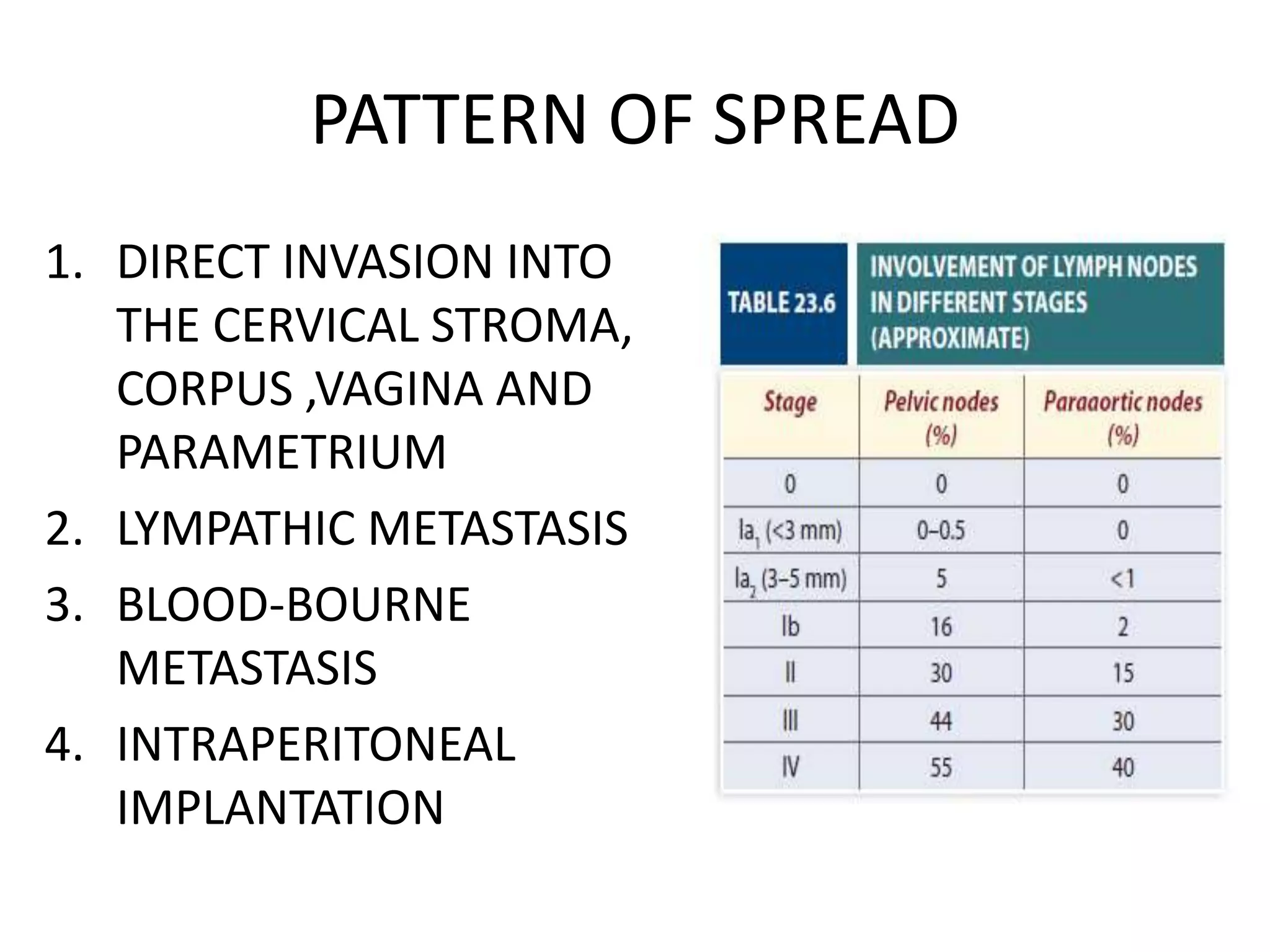
1. DIRECT INVASION INTO
THE CERVICAL STROMA,
CORPUS ,VAGINA AND
PARAMETRIUM
2. LYMPATHIC METASTASIS
3. BLOOD-BOURNE
METASTASIS
4. INTRAPERITONEAL
IMPLANTATION
STAGING
GENITAL CANCER IN DC DUTTA TEXT BOOK OF GYNECOLOGY , 6TH EDITION, NEW DELHI PP334
STAGING
STAGING
STAGING
DIFFERENTIAL DIAGNOSIS
The growth needs to be differentiated from:
• Cervical tuberculosis .
• Syphilitic ulcer .
• Cervical ectopy.
• Products of conception in incomplete
abortion.
• Fibroid polyp .
DIAGNOSIS
• History
• Clinical Features
• Investigation
– Lab investigation
– Colposcopic finding
– Tissue biopsy
– Chest –x ray
– CT scan
– MRI Scan
– Lymphography
COMPLICATIONS
• The following complications may occur sooner
or later, as the lesion progresses.
– ™Hemorrhage.
– ™Frequent attacks of ureteric pain, due to pyelitis
and pyelonephritis and hydronephrosis.
– ™Pyometra — specially with endocervical variety.
– ™Vesicovaginal fistula.
– ™Rectovaginal fistula
Causes of death
• Uremia
• Hemorrhage
• Sepsis
• Cachexia
• Metastasis
MANAGEMENT
• Preventive
– Primary prevention
– Secondary prevention
• Curative
– Primary surgery
– Primary radiotherapy
– Chemotherapy
– Combination therapy
Prevention
• Primary prevention
– Identifying high risk male and female
– HPV vaccine
– Use of condom
– Removal of cervix during surgery
• Secondary prevention
– By doing screening program
– Down staging program of WHO
CURATIVE
– Primary surgery
– Primary radiotherapy
– Chemotherapy
– Combination therapy
SURGERY
• HYSTERECTOMY
• RADICAL HYSTERECTOMY
– EXTRAFACIAL
– MODIFIED RADICAL
– RADICAL
– EXTENSIVE
– PELVIC EXCENTRATION
• LAPROSCOPIC RADICAL HYSTERECTOMY
• ROBOTIC LAPAROSCOPIC HYSTERECTOMY
Radical Hysterectomy
Rutledge has defined five classes of hysterectomy in cases of malignancy,
depending on the extent of resection.
Class I – Extrafascial hysterectomy with bilateral salpingo-oophorectomy
Class II – Modified radical hysterectomy which is the original Wertheim
hysterectomy. In this the medial half of the cardinal and uterosacral
ligaments are also removed as well as those pelvic lymph nodes which are
enlarged.
Class III – Radical hysterectomy. This is the modified Wertheim’s operation as
described by Meigs. It includes complete pelvic lymph node dissection,
removal of almost the whole of the cardinal and uterosacral ligaments and
the upper one-third of the vagina.
Class IV – Extended radical hysterectomy. This includes removal of the
periureteral tissue, superior vesical artery and up to three-fourths of the
vagina.
Class V – Partial exenteration. This is rarely performed. Here portions of the
distal ureter and bladder are also dissected.
PRIMARY RADIOTHERAPY
• TELETHERAPY
– FOR LARGE TUMOR
– To SHRINKK THE TUMOR
• BRACHYTHERAPY
– FOR SMALLER ONES
CHEMORADIATION
• Cisplatin
• Carboplatin
• Vincristine
• Hydroxyuria
• Tepotetan
• Note : best result with cisplatin with
radiotherapy
Palliative care
• At last symptomatic treatment
• Analgesic
• Chemotherapy
• Diet
• Rest
IMPORTANT QUESTIONS
1. WHAT ARE THE RISK FACTORS FOR THE
DEVELOPMENT OF CERVICAL CARCINOMA IN FEMALE
2. DEFINE HPV AND ITS SIGNIFICANCE FOR CERVICAL
CANCER
3. FOR STAGE IA 1 BEST MODALITIES OF TREATMENT IS
1. HYSTERECTOMY
2. CONE BIOPSY
3. RADIOTHERAPY
4. CHEMOTHERAPY
4. VIRUS CAUSING CERVICAL CANCER
A. HPV
B. CMV
C. VERICELLA
D. RUBELLA
THANK YOU
TAKE HOME MESSAGE

Cervical cancer

  • 1.
    CERVICAL CANCER DR HEMNATH SUBEDI II YEAR OBGYN COMSTH
  • 2.
    • 55 YEARSP5L5, SECOND MARRIAGE TO EX ARMY HAD POSTMENOPAUSAL BLEEDING WITH FOUL SMELLING VAGINAL DISCHARGE FOR 6 MONTHS,ON PV EXAMINATION THERE IS A GROWTH. • WHAT COULD BE DIAGNOSIS?
  • 3.
    CONTENTS • INTRODUCTION • INCIDENCE •ETIOLOGY • PATHOLOGY • CLINICAL FEATURES • PATTERN OF SPREAD • STAGING • DIAGNOSIS • MANAGEMENT
  • 4.
    INTRODUCTION • Worldwide, cervicalcarcinoma continues to be a significant health care problem. • In developing countries, where health care resources are limited, cervical carcinoma is the second most frequent cause of cancer death in women.
  • 5.
    INCIDENCE GENITAL CANCER INDC DUTTA TEXT BOOK OF GYNECOLOGY , 6TH EDITION, NEW DELHI PP334
  • 6.
    • SECOND MOSTCOMMON IN DEVELOPING COUNTRY • THIRD MOST COMMON IN DEVELOPED ONES. • SCREENING PROGRAM • HPV VACCINATION : Gardasil( quadravalant), Cervarix (bivalent) • ALMOST 30% OF CERVICAL CANCER OCCURS IN WOMEN WHO HAD NEVER GONE THROUGH THE SCREENING PROGRAM. • THIS PERCENTAGE APPROACH TO 60% IN DEVELOPING COUNTRY. • THE PEAK INCIDENCE IS BIMODAL .
  • 7.
    AETIOLOGY • AGE -35-39 AND60-64 YEARS . • RACE • SOCIOECONOMIC STATUS – LOW SOCIOECONOMIC STATUS • COITUS – Multiple sex partners – EARLY AGE OF COITUS AND FREQUENT COITUS • CHILD BEARING • ESTROGEN • CERVICAL IRRITATION AND INFECTION – HPV high risk types16,18,31,33,45 – HPV low risk types • PREDISPOSING HISTOLOGICAL STATUS – CIN II, CIN III AND CARCINOMA IN SITU
  • 8.
    PATHOLOGY Histopathologic Types • Cervicalintraephithelial neoplasia, Grade III • Squamous cell carcinoma in situ • Squamous cell carcinoma – Keratinising – Non-Keratinising – Verrucous • Adenocarcinoma in situ • Adenocarcinoma in situ, endocervical type • Endometrioid adenocarcinoma • Clear cell adenocarcinoma • Adenosquamous carcinoma • Adenoid cystic carcinoma • Small cell carcinoma • Undifferentiated carcinoma
  • 9.
    CLINICAL FEATURES • VAGINALBLEEDING SPECIALLY POSTCOITAL BLEEDING • POSTMENOPAUSAL BLEEDING • WITH ADVANCE DISEASE – MALODOROUS VAGINAL DISCHARGE – WT LOSS – OBSTRUCTIVE UROPATHIES – GROWTH OF THE MASS
  • 10.
    PATTERN OF SPREAD 1.DIRECT INVASION INTO THE CERVICAL STROMA, CORPUS ,VAGINA AND PARAMETRIUM 2. LYMPATHIC METASTASIS 3. BLOOD-BOURNE METASTASIS 4. INTRAPERITONEAL IMPLANTATION
  • 11.
    STAGING GENITAL CANCER INDC DUTTA TEXT BOOK OF GYNECOLOGY , 6TH EDITION, NEW DELHI PP334
  • 12.
  • 13.
  • 14.
  • 15.
    DIFFERENTIAL DIAGNOSIS The growthneeds to be differentiated from: • Cervical tuberculosis . • Syphilitic ulcer . • Cervical ectopy. • Products of conception in incomplete abortion. • Fibroid polyp .
  • 16.
    DIAGNOSIS • History • ClinicalFeatures • Investigation – Lab investigation – Colposcopic finding – Tissue biopsy – Chest –x ray – CT scan – MRI Scan – Lymphography
  • 17.
    COMPLICATIONS • The followingcomplications may occur sooner or later, as the lesion progresses. – ™Hemorrhage. – ™Frequent attacks of ureteric pain, due to pyelitis and pyelonephritis and hydronephrosis. – ™Pyometra — specially with endocervical variety. – ™Vesicovaginal fistula. – ™Rectovaginal fistula
  • 18.
    Causes of death •Uremia • Hemorrhage • Sepsis • Cachexia • Metastasis
  • 19.
    MANAGEMENT • Preventive – Primaryprevention – Secondary prevention • Curative – Primary surgery – Primary radiotherapy – Chemotherapy – Combination therapy
  • 20.
    Prevention • Primary prevention –Identifying high risk male and female – HPV vaccine – Use of condom – Removal of cervix during surgery • Secondary prevention – By doing screening program – Down staging program of WHO
  • 21.
    CURATIVE – Primary surgery –Primary radiotherapy – Chemotherapy – Combination therapy
  • 23.
    SURGERY • HYSTERECTOMY • RADICALHYSTERECTOMY – EXTRAFACIAL – MODIFIED RADICAL – RADICAL – EXTENSIVE – PELVIC EXCENTRATION • LAPROSCOPIC RADICAL HYSTERECTOMY • ROBOTIC LAPAROSCOPIC HYSTERECTOMY
  • 24.
    Radical Hysterectomy Rutledge hasdefined five classes of hysterectomy in cases of malignancy, depending on the extent of resection. Class I – Extrafascial hysterectomy with bilateral salpingo-oophorectomy Class II – Modified radical hysterectomy which is the original Wertheim hysterectomy. In this the medial half of the cardinal and uterosacral ligaments are also removed as well as those pelvic lymph nodes which are enlarged. Class III – Radical hysterectomy. This is the modified Wertheim’s operation as described by Meigs. It includes complete pelvic lymph node dissection, removal of almost the whole of the cardinal and uterosacral ligaments and the upper one-third of the vagina. Class IV – Extended radical hysterectomy. This includes removal of the periureteral tissue, superior vesical artery and up to three-fourths of the vagina. Class V – Partial exenteration. This is rarely performed. Here portions of the distal ureter and bladder are also dissected.
  • 26.
    PRIMARY RADIOTHERAPY • TELETHERAPY –FOR LARGE TUMOR – To SHRINKK THE TUMOR • BRACHYTHERAPY – FOR SMALLER ONES
  • 28.
    CHEMORADIATION • Cisplatin • Carboplatin •Vincristine • Hydroxyuria • Tepotetan • Note : best result with cisplatin with radiotherapy
  • 29.
    Palliative care • Atlast symptomatic treatment • Analgesic • Chemotherapy • Diet • Rest
  • 30.
    IMPORTANT QUESTIONS 1. WHATARE THE RISK FACTORS FOR THE DEVELOPMENT OF CERVICAL CARCINOMA IN FEMALE 2. DEFINE HPV AND ITS SIGNIFICANCE FOR CERVICAL CANCER 3. FOR STAGE IA 1 BEST MODALITIES OF TREATMENT IS 1. HYSTERECTOMY 2. CONE BIOPSY 3. RADIOTHERAPY 4. CHEMOTHERAPY 4. VIRUS CAUSING CERVICAL CANCER A. HPV B. CMV C. VERICELLA D. RUBELLA
  • 31.