HEALTH​SECTION - 12
DR. MONIQUE BETHELL
Group 5 - ​Now or Laters
CERVICAL CANCER
GLOBAL KILLER
_________
| Braxton Smith | Destinee Wormack | Dynah Sutton | Keseana Brandon |
WHAT IS CERVICAL CANCER?
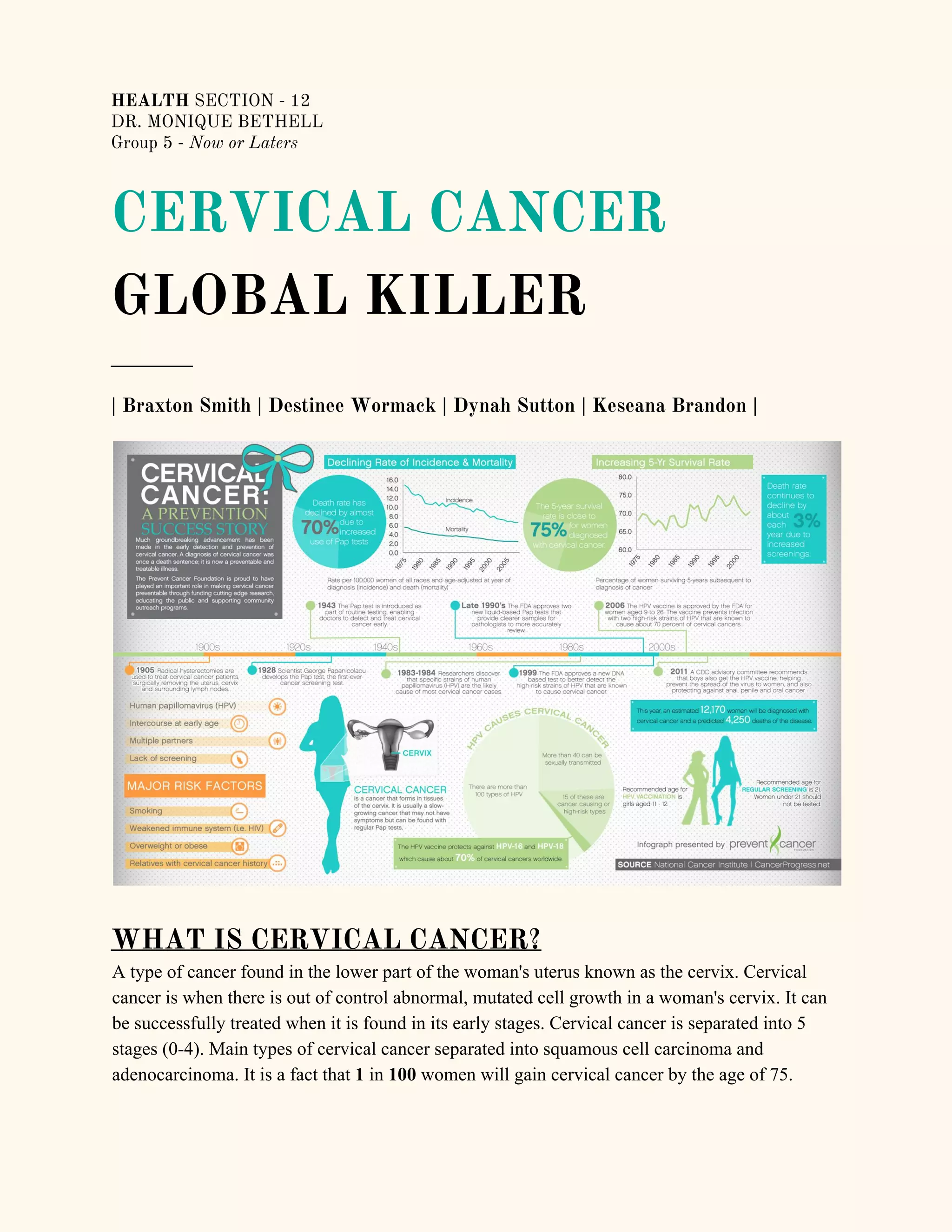
A type of cancer found in the lower part of the woman's uterus known as the cervix. Cervical 
cancer is when there is out of control abnormal, mutated cell growth in a woman's cervix. It can 
be successfully treated when it is found in its early stages. Cervical cancer is separated into 5 
stages (0­4). Main types of cervical cancer separated into squamous cell carcinoma and 
adenocarcinoma. It is a fact that ​1 ​in ​100 ​women will gain cervical cancer by the age of 75. 
2
TYPES OF CERVICAL CANCER
__________________________________________________
SQUAMOUS CELL CARCINOMA
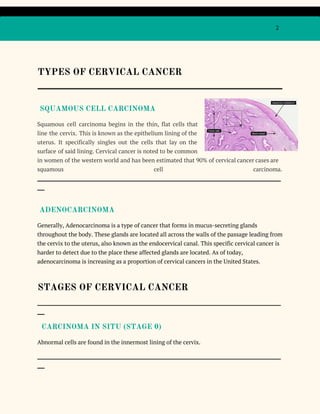
Squamous cell carcinoma begins in the thin, flat cells that
line the cervix. This is known as the epithelium lining of the
uterus. It specifically singles out the cells that lay on the
surface of said lining. Cervical cancer is noted to be common
in women of the western world and has been estimated that 90% of cervical cancer cases are
squamous cell carcinoma.
_____________________________________________________________________________________________________
___
ADENOCARCINOMA
Generally, Adenocarcinoma is a type of cancer that forms in mucus-secreting glands
throughout the body. These glands are located all across the walls of the passage leading from
the cervix to the uterus, also known as the endocervical canal. This specific cervical cancer is
harder to detect due to the place these affected glands are located. As of today,
adenocarcinoma is increasing as a proportion of cervical cancers in the United States.
STAGES OF CERVICAL CANCER
_____________________________________________________________________________________________________
___
​CARCINOMA IN SITU (STAGE 0)
Abnormal cells are found in the innermost lining of the cervix.
_____________________________________________________________________________________________________
___
3
STAGE I
Found only in the cervix, A very small amount of cancer that can only be seen with a
microscope​is found in the ​tissues​of the ​cervix​.
_____________________________________________________________________________________________________
___
​STAGE I
“In ​stage II​, ​cancer has spread beyond the ​uterus but not onto the ​pelvic wall (the ​tissues that
line the part of the body between the hips) or to the lower third of the ​vagina​.”
_____________________________________________________________________________________________________
___
​STAGE III
“In ​stage III​, ​cancer has spread to the lower third of the ​vagina​, and/or onto the ​pelvic wall​,
and/or has caused ​kidney​problems.”
_____________________________________________________________________________________________________
___
​STAGE IV
“In ​stage IV​, ​cancer has spread beyond the ​pelvis​, or can be seen in the lining of the ​bladder
and/or ​rectum​, or has spread to other parts of the body.”
CAUSES/RISK FACTORS
_____________________________________________________________________________________________________
___
CAUSES
4
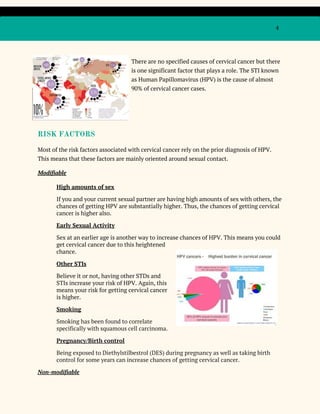
There are no specified causes of cervical cancer but there
is one significant factor that plays a role. The STI known
as Human Papillomavirus (HPV) is the cause of almost
90% of cervical cancer cases.
RISK FACTORS
Most of the risk factors associated with cervical cancer rely on the prior diagnosis of HPV.
This means that these factors are mainly oriented around sexual contact.
Modifiable
High amounts of sex
If you and your current sexual partner are having high amounts of sex with others, the
chances of getting HPV are substantially higher. Thus, the chances of getting cervical
cancer is higher also.
Early Sexual Activity
Sex at an earlier age is another way to increase chances of HPV. This means you could
get cervical cancer due to this heightened
chance.
Other STIs
Believe it or not, having other STDs and
STIs increase your risk of HPV. Again, this
means your risk for getting cervical cancer
is higher.
Smoking
Smoking has been found to correlate
specifically with squamous cell carcinoma.
Pregnancy/Birth control
Being exposed to Diethylstilbestrol (DES) during pregnancy as well as taking birth
control for some years can increase chances of getting cervical cancer.
Non-modifiable
5
Weak Immune System
You may be more likely to develop cervical cancer if your immune system is weakened
by another health condition and you have HPV.
SYMPTOMS
_____________________________________________________________________________________________________
___
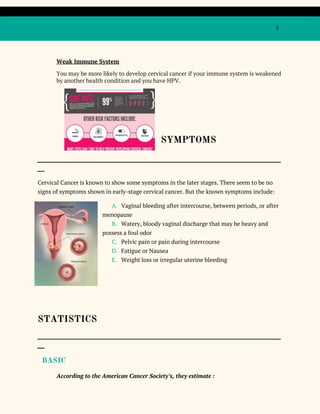
Cervical Cancer is known to show some symptoms in the later stages. There seem to be no
signs of symptoms shown in early-stage cervical cancer. But the known symptoms include:
A. Vaginal bleeding after intercourse, between periods, or after
menopause
B. Watery, bloody vaginal discharge that may be heavy and
possess a foul odor
C. Pelvic pain or pain during intercourse
D. Fatigue or Nausea
E. Weight loss or irregular uterine bleeding
STATISTICS
_____________________________________________________________________________________________________
___
​BASIC
According to the American Cancer Society’s, they estimate :
6
A. About ​12, 900 ​cases of invasive cervical cancer will be ​diagnosed​in the United States
(2015)
B. About ​4, 100​women will ​die​from cervical cancer this year
a. **Over the last 30 years, the cervical cancer death rate has gone down by more
than 50%**
C. About ​75%​of men and ​women​who have had sex will be exposed to ​HPV​at some
point
_____________________________________________________________________________________________________
___
SURVIVAL RATE
Cancer.Net states that:
A. For ​all stages ​of cervical cancer, the ​five-year​survival rate is ​68%​.
B. When detected at an ​early stage​, the ​five-year ​survival rate for women with invasive
cervical cancer is ​91%​.
C. If cervical cancer has ​spread to surrounding tissues or organs and/or the regional
lymph nodes​, the ​five-year​survival rate is ​57%​.
D. If the cancer has ​spread to a distant part of the body​, the ​five-yea​r survival rate is
16%​.
_____________________________________________________________________________________________________
___
CASE DISTRIBUTION
According to the American Cancer Society, they state :
A. Most cases are found in ​midlife​women,​younger than​​50
a. It ​rarely​develops ​below​ages of ​20
B. About ​15%​of cases of cervical cancer are found in women ​over​​65
a. It is rare if the patient is getting regular check-ups
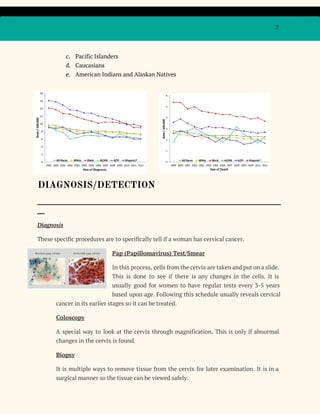
C. Race Distribution for United States (Highest to lowest)
a. Hispanic
b. African American
7
c. Pacific Islanders
d. Caucasians
e. American Indians and Alaskan Natives
DIAGNOSIS/DETECTION
_____________________________________________________________________________________________________
___
Diagnosis
These specific procedures are to specifically tell if a woman has cervical cancer.
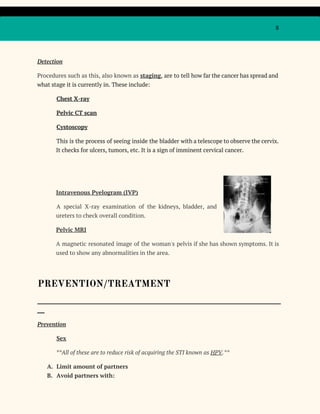
Pap (Papillomavirus) Test/Smear
In this process, cells from the cervix are taken and put on a slide.
This is done to see if there is any changes in the cells. It is
usually good for women to have regular tests every 3-5 years
based upon age. Following this schedule usually reveals cervical
cancer in its earlier stages so it can be treated.
Coloscopy
A special way to look at the cervix through magnification. This is only if abnormal
changes in the cervix is found.
Biopsy
It is multiple ways to remove tissue from the cervix for later examination. It is in a
surgical manner so the tissue can be viewed safely.
8
Detection
Procedures such as this, also known as ​staging​, are to tell how far the cancer has spread and
what stage it is currently in. These include:
Chest X-ray
Pelvic CT scan
Cystoscopy
This is the process of seeing inside the bladder with a telescope to observe the cervix.
It checks for ulcers, tumors, etc. It is a sign of imminent cervical cancer.
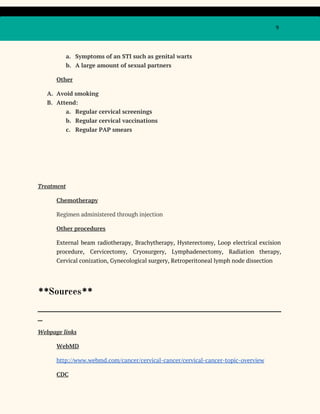
Intravenous Pyelogram (IVP)
A special X-ray examination of the kidneys, bladder, and
ureters to check overall condition.
Pelvic MRI
A magnetic resonated image of the woman's pelvis if she has shown symptoms. It is
used to show any abnormalities in the area.
PREVENTION/TREATMENT
_____________________________________________________________________________________________________
___
Prevention
Sex
**All of these are to reduce risk of acquiring the STI known as ​HPV​.**
A. Limit amount of partners
B. Avoid partners with:
9
a. Symptoms of an STI such as genital warts
b. A large amount of sexual partners
Other
A. Avoid smoking
B. Attend:
a. Regular cervical screenings
b. Regular cervical vaccinations
c. Regular PAP smears
Treatment
Chemotherapy
Regimen administered through injection
Other procedures
External beam radiotherapy, Brachytherapy, Hysterectomy, Loop electrical excision
procedure, Cervicectomy, Cryosurgery, Lymphadenectomy, Radiation therapy,
Cervical conization, Gynecological surgery, Retroperitoneal lymph node dissection
**​Sources​**
_____________________________________________________________________________________________________
__
Webpage links
WebMD
http://www.webmd.com/cancer/cervical-cancer/cervical-cancer-topic-overview
CDC
10
http://www.cdc.gov/cancer/cervical/
Mayo Clinic
http://www.mayoclinic.org/diseases-conditions/cervical-cancer/basics/definition/con
-20030522
Video link
“​Cervical Cancer” (5:45)
https://www.youtube.com/watch?v=ZRV7ij--ldg
“Cervical Cancer” (8:32)
https://www.youtube.com/watch?v=A8cabcHn3J4

Cancer

  • 1.
    HEALTH​SECTION - 12 DR.MONIQUE BETHELL Group 5 - ​Now or Laters CERVICAL CANCER GLOBAL KILLER _________ | Braxton Smith | Destinee Wormack | Dynah Sutton | Keseana Brandon | WHAT IS CERVICAL CANCER? A type of cancer found in the lower part of the woman's uterus known as the cervix. Cervical  cancer is when there is out of control abnormal, mutated cell growth in a woman's cervix. It can  be successfully treated when it is found in its early stages. Cervical cancer is separated into 5  stages (0­4). Main types of cervical cancer separated into squamous cell carcinoma and  adenocarcinoma. It is a fact that ​1 ​in ​100 ​women will gain cervical cancer by the age of 75. 
  • 2.
    2 TYPES OF CERVICALCANCER __________________________________________________ SQUAMOUS CELL CARCINOMA Squamous cell carcinoma begins in the thin, flat cells that line the cervix. This is known as the epithelium lining of the uterus. It specifically singles out the cells that lay on the surface of said lining. Cervical cancer is noted to be common in women of the western world and has been estimated that 90% of cervical cancer cases are squamous cell carcinoma. _____________________________________________________________________________________________________ ___ ADENOCARCINOMA Generally, Adenocarcinoma is a type of cancer that forms in mucus-secreting glands throughout the body. These glands are located all across the walls of the passage leading from the cervix to the uterus, also known as the endocervical canal. This specific cervical cancer is harder to detect due to the place these affected glands are located. As of today, adenocarcinoma is increasing as a proportion of cervical cancers in the United States. STAGES OF CERVICAL CANCER _____________________________________________________________________________________________________ ___ ​CARCINOMA IN SITU (STAGE 0) Abnormal cells are found in the innermost lining of the cervix. _____________________________________________________________________________________________________ ___
  • 3.
    3 STAGE I Found onlyin the cervix, A very small amount of cancer that can only be seen with a microscope​is found in the ​tissues​of the ​cervix​. _____________________________________________________________________________________________________ ___ ​STAGE I “In ​stage II​, ​cancer has spread beyond the ​uterus but not onto the ​pelvic wall (the ​tissues that line the part of the body between the hips) or to the lower third of the ​vagina​.” _____________________________________________________________________________________________________ ___ ​STAGE III “In ​stage III​, ​cancer has spread to the lower third of the ​vagina​, and/or onto the ​pelvic wall​, and/or has caused ​kidney​problems.” _____________________________________________________________________________________________________ ___ ​STAGE IV “In ​stage IV​, ​cancer has spread beyond the ​pelvis​, or can be seen in the lining of the ​bladder and/or ​rectum​, or has spread to other parts of the body.” CAUSES/RISK FACTORS _____________________________________________________________________________________________________ ___ CAUSES
  • 4.
    4 There are nospecified causes of cervical cancer but there is one significant factor that plays a role. The STI known as Human Papillomavirus (HPV) is the cause of almost 90% of cervical cancer cases. RISK FACTORS Most of the risk factors associated with cervical cancer rely on the prior diagnosis of HPV. This means that these factors are mainly oriented around sexual contact. Modifiable High amounts of sex If you and your current sexual partner are having high amounts of sex with others, the chances of getting HPV are substantially higher. Thus, the chances of getting cervical cancer is higher also. Early Sexual Activity Sex at an earlier age is another way to increase chances of HPV. This means you could get cervical cancer due to this heightened chance. Other STIs Believe it or not, having other STDs and STIs increase your risk of HPV. Again, this means your risk for getting cervical cancer is higher. Smoking Smoking has been found to correlate specifically with squamous cell carcinoma. Pregnancy/Birth control Being exposed to Diethylstilbestrol (DES) during pregnancy as well as taking birth control for some years can increase chances of getting cervical cancer. Non-modifiable
  • 5.
    5 Weak Immune System Youmay be more likely to develop cervical cancer if your immune system is weakened by another health condition and you have HPV. SYMPTOMS _____________________________________________________________________________________________________ ___ Cervical Cancer is known to show some symptoms in the later stages. There seem to be no signs of symptoms shown in early-stage cervical cancer. But the known symptoms include: A. Vaginal bleeding after intercourse, between periods, or after menopause B. Watery, bloody vaginal discharge that may be heavy and possess a foul odor C. Pelvic pain or pain during intercourse D. Fatigue or Nausea E. Weight loss or irregular uterine bleeding STATISTICS _____________________________________________________________________________________________________ ___ ​BASIC According to the American Cancer Society’s, they estimate :
  • 6.
    6 A. About ​12,900 ​cases of invasive cervical cancer will be ​diagnosed​in the United States (2015) B. About ​4, 100​women will ​die​from cervical cancer this year a. **Over the last 30 years, the cervical cancer death rate has gone down by more than 50%** C. About ​75%​of men and ​women​who have had sex will be exposed to ​HPV​at some point _____________________________________________________________________________________________________ ___ SURVIVAL RATE Cancer.Net states that: A. For ​all stages ​of cervical cancer, the ​five-year​survival rate is ​68%​. B. When detected at an ​early stage​, the ​five-year ​survival rate for women with invasive cervical cancer is ​91%​. C. If cervical cancer has ​spread to surrounding tissues or organs and/or the regional lymph nodes​, the ​five-year​survival rate is ​57%​. D. If the cancer has ​spread to a distant part of the body​, the ​five-yea​r survival rate is 16%​. _____________________________________________________________________________________________________ ___ CASE DISTRIBUTION According to the American Cancer Society, they state : A. Most cases are found in ​midlife​women,​younger than​​50 a. It ​rarely​develops ​below​ages of ​20 B. About ​15%​of cases of cervical cancer are found in women ​over​​65 a. It is rare if the patient is getting regular check-ups C. Race Distribution for United States (Highest to lowest) a. Hispanic b. African American
  • 7.
    7 c. Pacific Islanders d.Caucasians e. American Indians and Alaskan Natives DIAGNOSIS/DETECTION _____________________________________________________________________________________________________ ___ Diagnosis These specific procedures are to specifically tell if a woman has cervical cancer. Pap (Papillomavirus) Test/Smear In this process, cells from the cervix are taken and put on a slide. This is done to see if there is any changes in the cells. It is usually good for women to have regular tests every 3-5 years based upon age. Following this schedule usually reveals cervical cancer in its earlier stages so it can be treated. Coloscopy A special way to look at the cervix through magnification. This is only if abnormal changes in the cervix is found. Biopsy It is multiple ways to remove tissue from the cervix for later examination. It is in a surgical manner so the tissue can be viewed safely.
  • 8.
    8 Detection Procedures such asthis, also known as ​staging​, are to tell how far the cancer has spread and what stage it is currently in. These include: Chest X-ray Pelvic CT scan Cystoscopy This is the process of seeing inside the bladder with a telescope to observe the cervix. It checks for ulcers, tumors, etc. It is a sign of imminent cervical cancer. Intravenous Pyelogram (IVP) A special X-ray examination of the kidneys, bladder, and ureters to check overall condition. Pelvic MRI A magnetic resonated image of the woman's pelvis if she has shown symptoms. It is used to show any abnormalities in the area. PREVENTION/TREATMENT _____________________________________________________________________________________________________ ___ Prevention Sex **All of these are to reduce risk of acquiring the STI known as ​HPV​.** A. Limit amount of partners B. Avoid partners with:
  • 9.
    9 a. Symptoms ofan STI such as genital warts b. A large amount of sexual partners Other A. Avoid smoking B. Attend: a. Regular cervical screenings b. Regular cervical vaccinations c. Regular PAP smears Treatment Chemotherapy Regimen administered through injection Other procedures External beam radiotherapy, Brachytherapy, Hysterectomy, Loop electrical excision procedure, Cervicectomy, Cryosurgery, Lymphadenectomy, Radiation therapy, Cervical conization, Gynecological surgery, Retroperitoneal lymph node dissection **​Sources​** _____________________________________________________________________________________________________ __ Webpage links WebMD http://www.webmd.com/cancer/cervical-cancer/cervical-cancer-topic-overview CDC
  • 10.
    10 http://www.cdc.gov/cancer/cervical/ Mayo Clinic http://www.mayoclinic.org/diseases-conditions/cervical-cancer/basics/definition/con -20030522 Video link “​CervicalCancer” (5:45) https://www.youtube.com/watch?v=ZRV7ij--ldg “Cervical Cancer” (8:32) https://www.youtube.com/watch?v=A8cabcHn3J4