Dr.S.V.Hari krishnan
PGT , M.S .(Ortho)
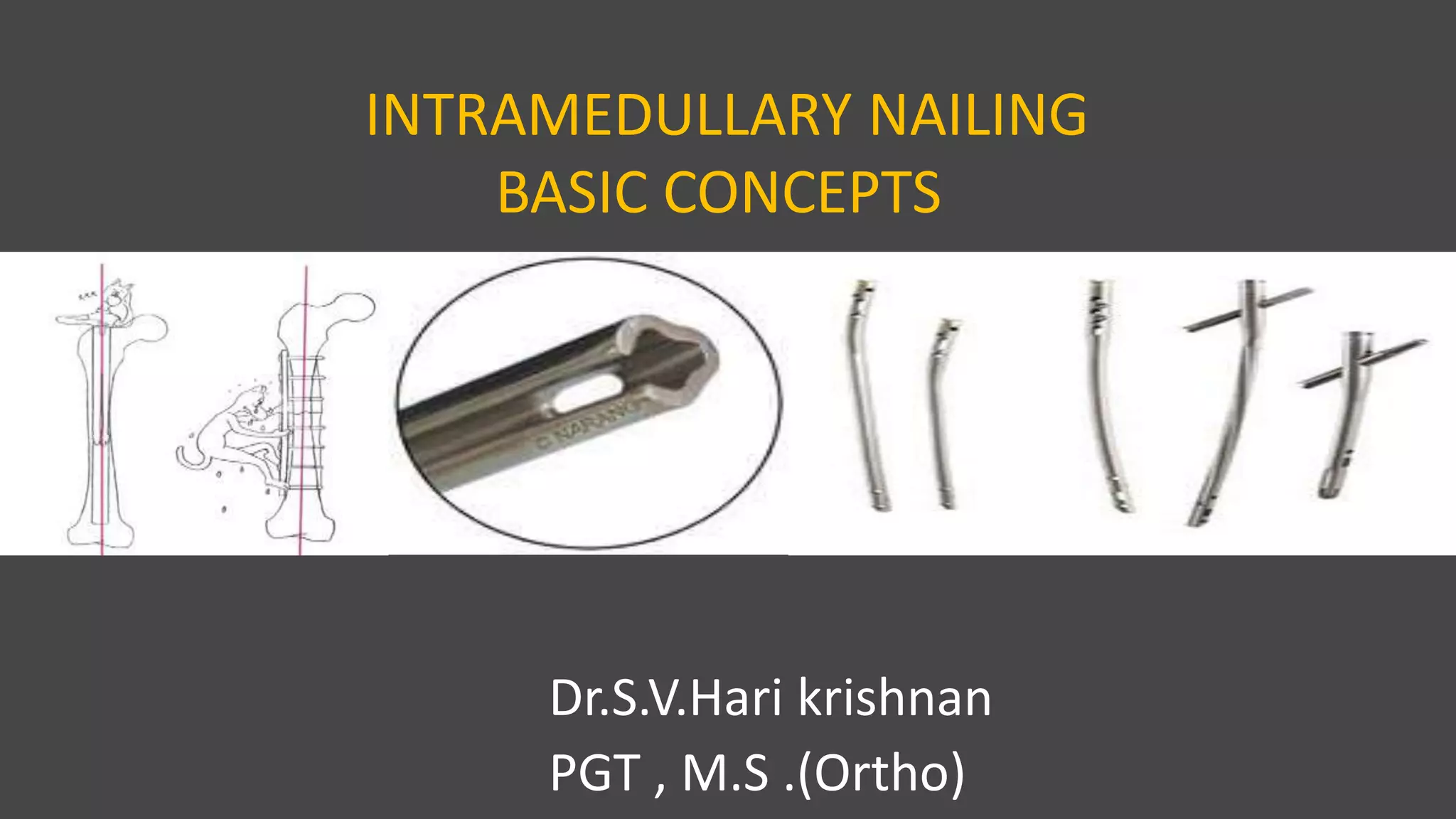
INTRAMEDULLARY NAILING
BASIC CONCEPTS
Learning Objectives
 Introduction
 Evolution
 Classification
 Biomechanics
 Applications
 Special Circumstances
 Recent Advances
Introduction
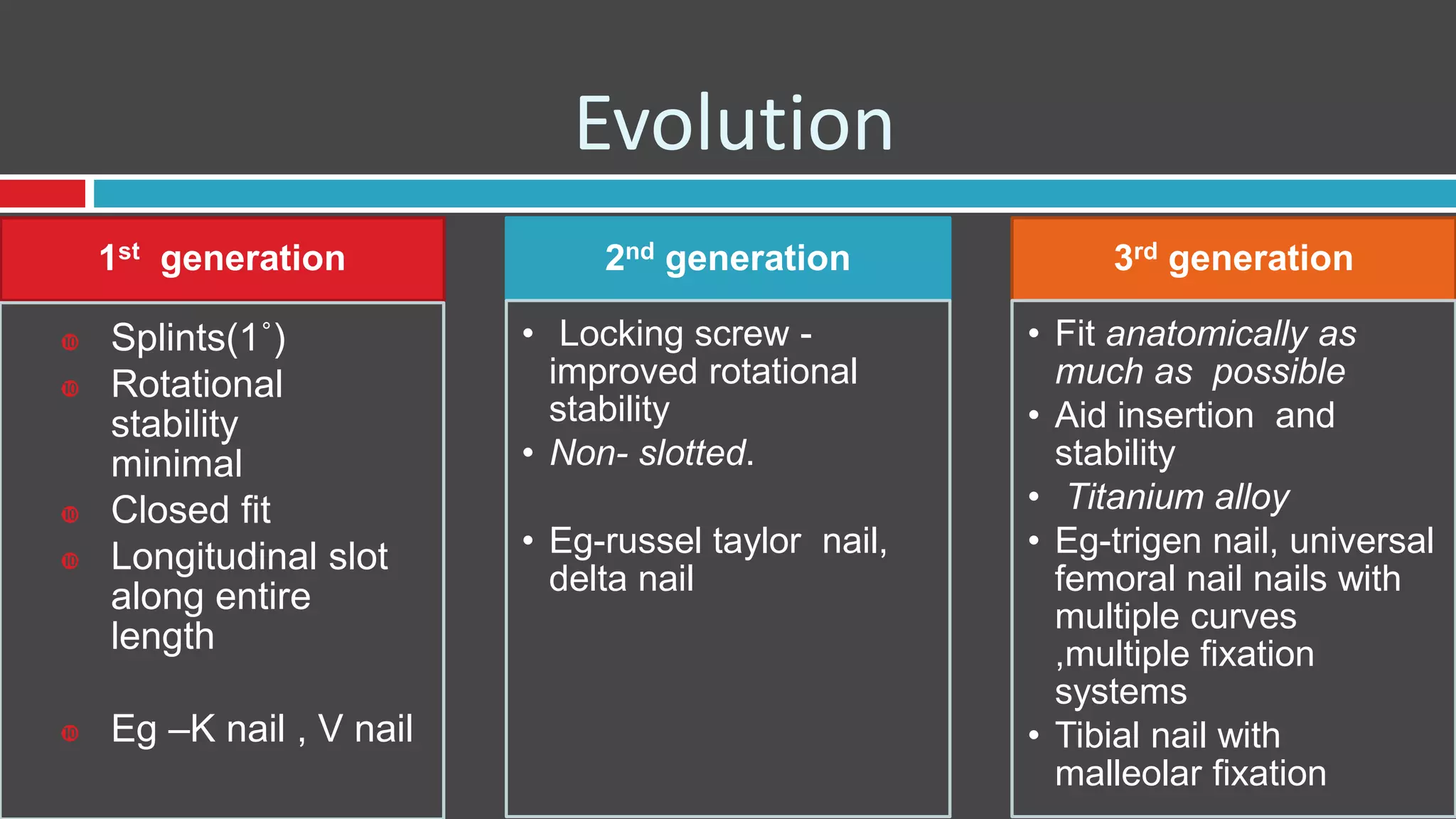
 Fracture stabilized by one of two systems
 Compression
 Splinting
 Intramedullary fixation - internal splinting
 Splintage -micro motion between bone & implant
 Relative stability without interfragmentary compression.
 Entry point - distant from fracture site – hematoma retained.
 Closed reduction and fixation (biological)
Evolution
1st generation
 Splints(1˚)
 Rotational
stability
minimal
 Closed fit
 Longitudinal slot
along entire
length
 Eg –K nail , V nail
2nd generation
• Locking screw -
improved rotational
stability
• Non- slotted.
• Eg-russel taylor nail,
delta nail
3rd generation
• Fit anatomically as
much as possible
• Aid insertion and
stability
• Titanium alloy
• Eg-trigen nail, universal
femoral nail nails with
multiple curves
,multiple fixation
systems
• Tibial nail with
malleolar fixation
Classification
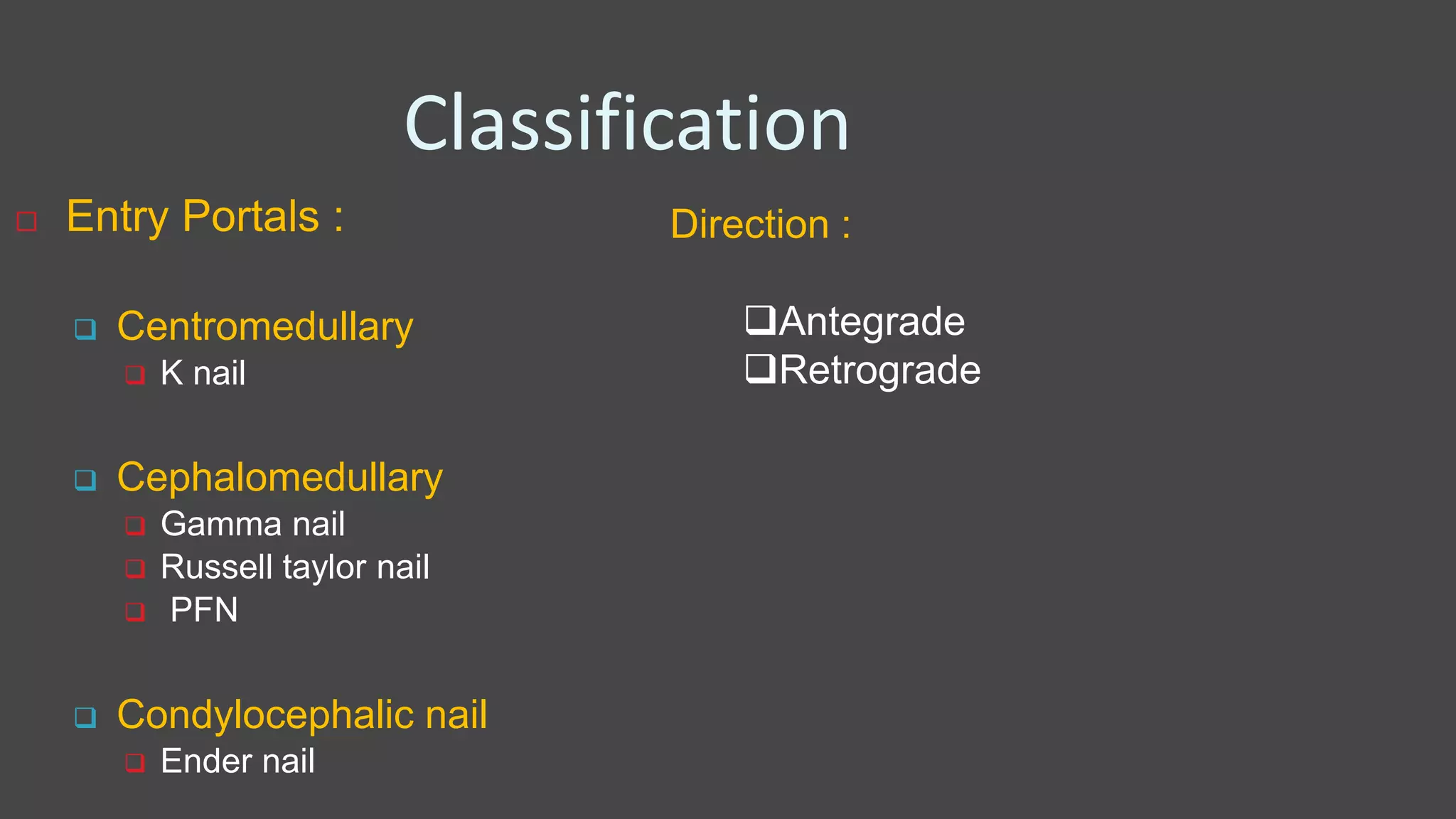
 Entry Portals :
 Centromedullary
 K nail
 Cephalomedullary
 Gamma nail
 Russell taylor nail
 PFN
 Condylocephalic nail
 Ender nail
Direction :
Antegrade
Retrograde
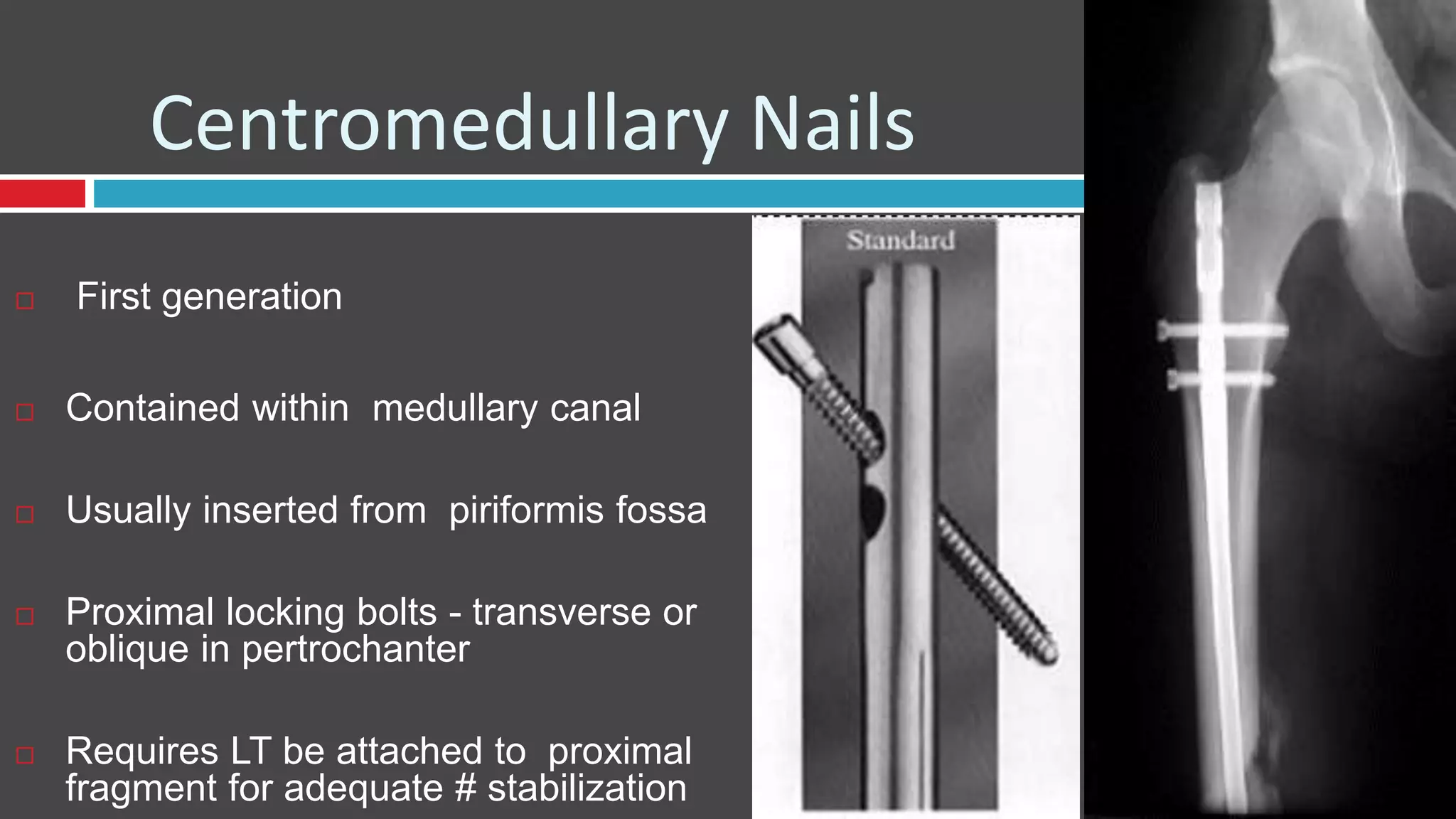
Centromedullary Nails
 First generation
 Contained within medullary canal
 Usually inserted from piriformis fossa
 Proximal locking bolts - transverse or
oblique in pertrochanter
 Requires LT be attached to proximal
fragment for adequate # stabilization
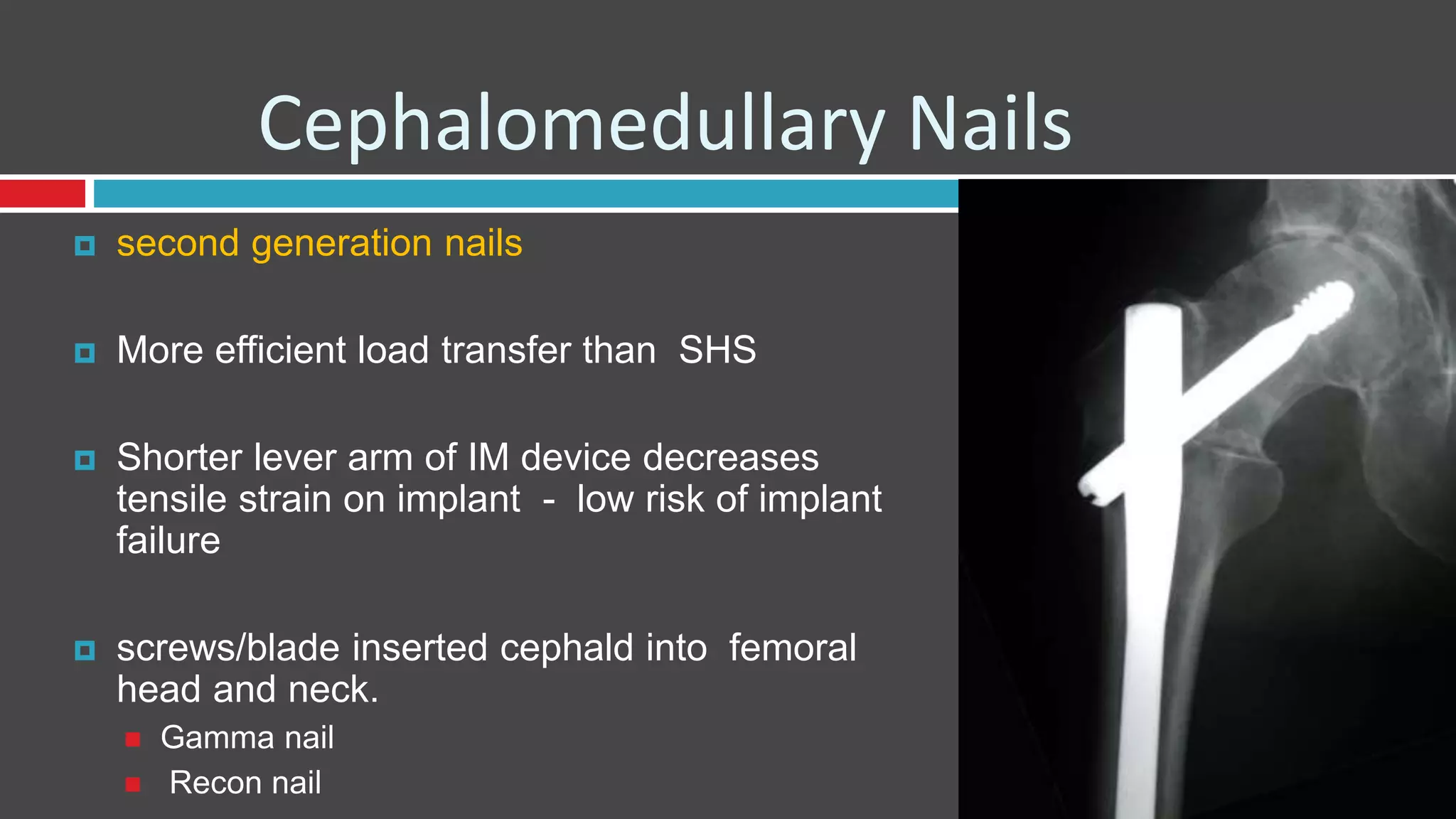
Cephalomedullary Nails
 second generation nails
 More efficient load transfer than SHS
 Shorter lever arm of IM device decreases
tensile strain on implant - low risk of implant
failure
 screws/blade inserted cephald into femoral
head and neck.
 Gamma nail
 Recon nail
C o n d y l o c e p h a l i c F i x a t i o n
 Elastic stable intramedullary nailing (ESIN) - primary definitive
paediatric fracture care .
 3 – point fixation or bundle nailing.
 Elastic and small - micro-motion for rapid fracture healing.
 Flexible -insertion through a cortical window.
 Examples :
 Lottes nails
 Rush pins
 Ender nails
 Morote nails
 Nancy nails
 Prevot nails
 Bundle nails
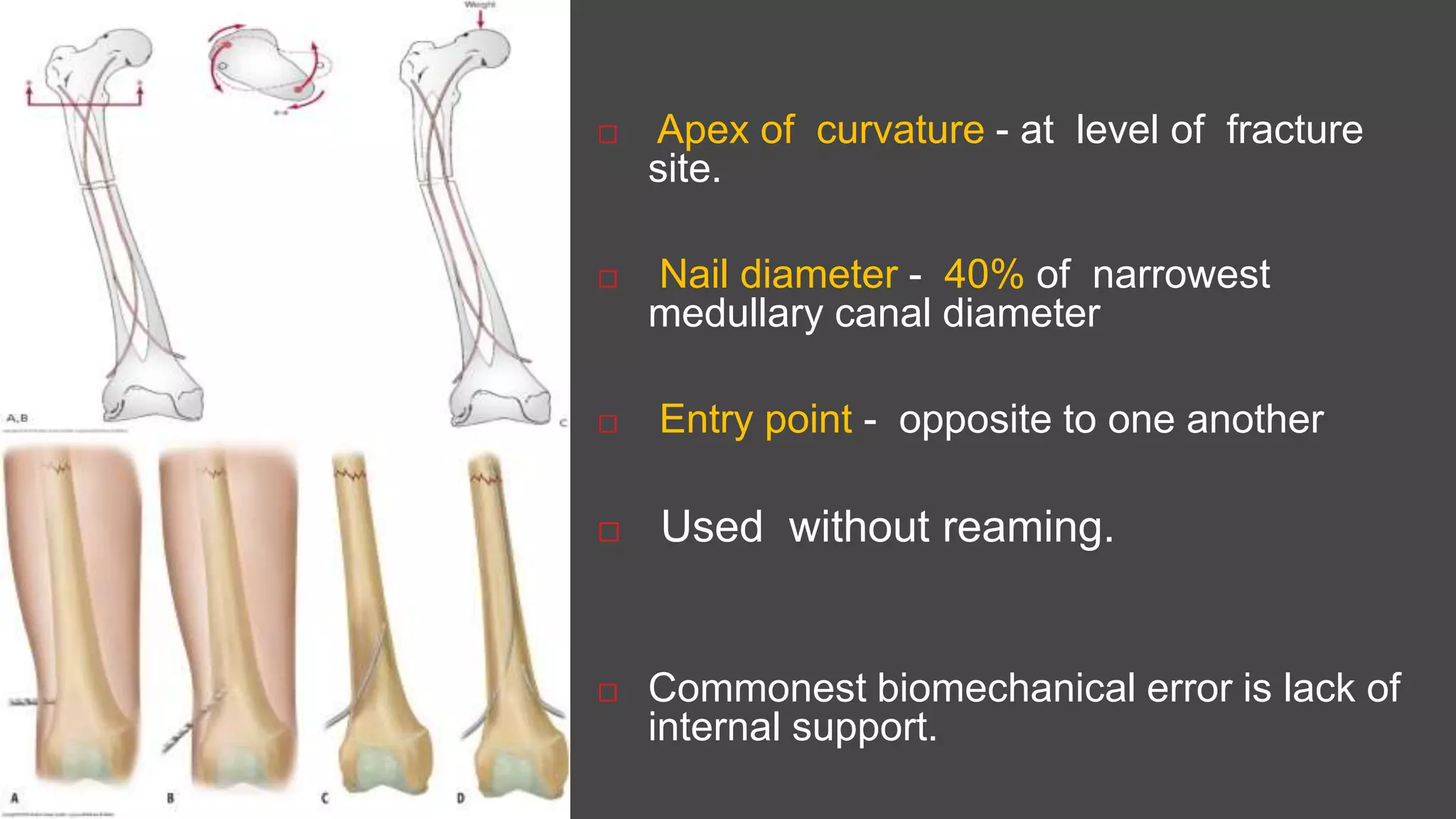
Opposite  Apex of curvature - at level of fracture
site.
 Nail diameter - 40% of narrowest
medullary canal diameter
 Entry point - opposite to one another
 Used without reaming.
 Commonest biomechanical error is lack of
internal support.
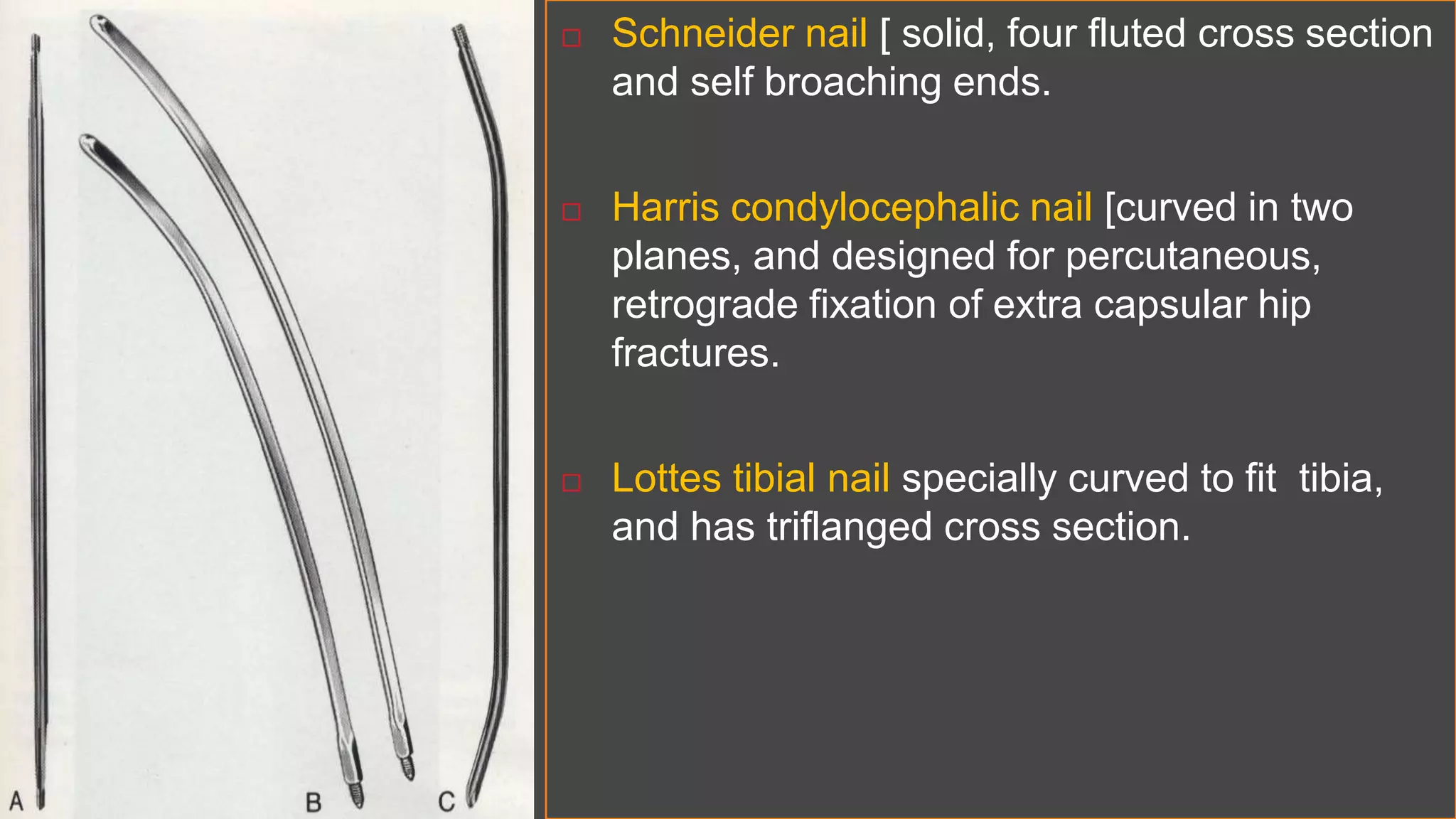
 Schneider nail [ solid, four fluted cross section
and self broaching ends.
 Harris condylocephalic nail [curved in two
planes, and designed for percutaneous,
retrograde fixation of extra capsular hip
fractures.
 Lottes tibial nail specially curved to fit tibia,
and has triflanged cross section.
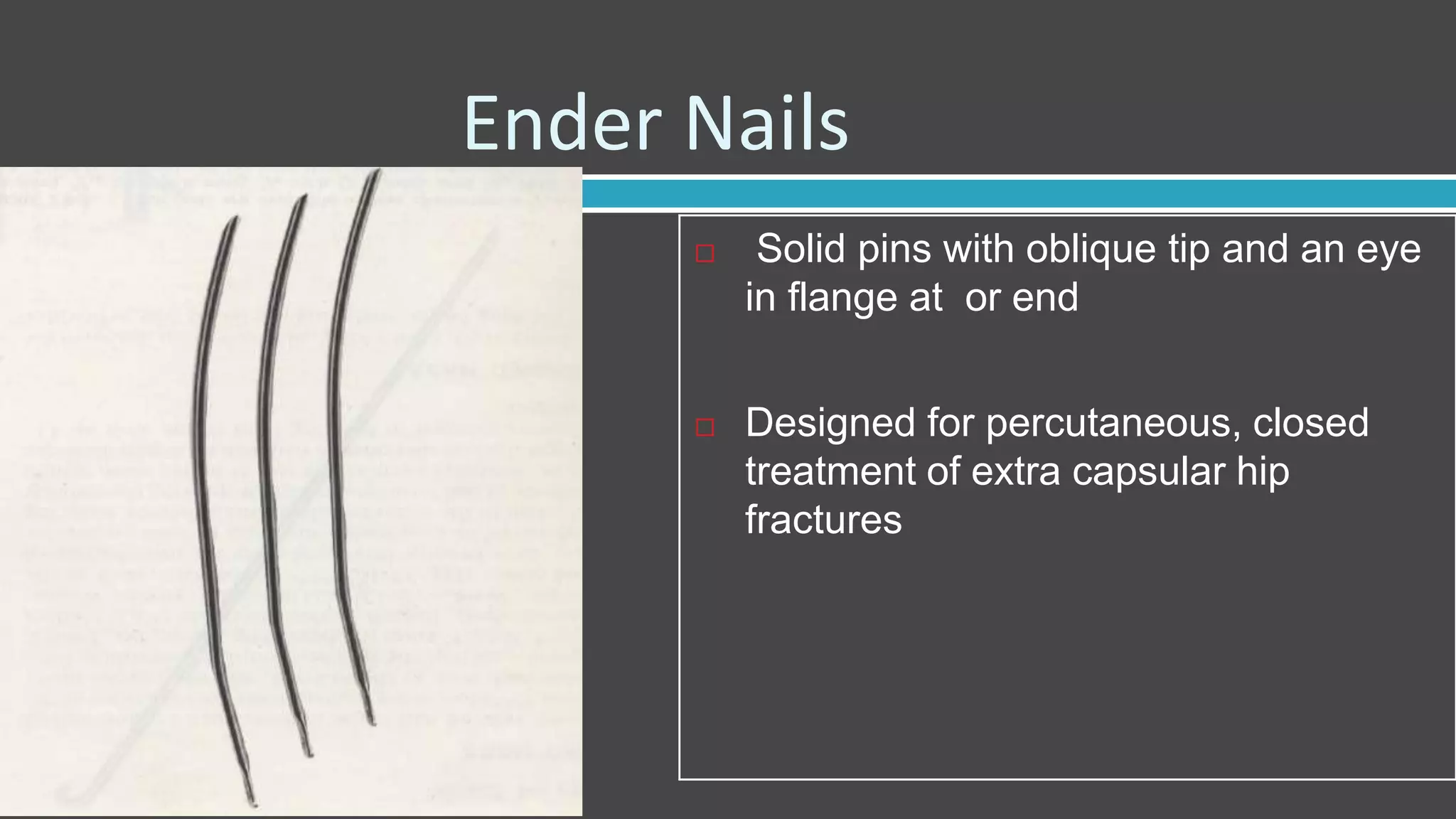
Ender Nails
 Solid pins with oblique tip and an eye
in flange at or end
 Designed for percutaneous, closed
treatment of extra capsular hip
fractures
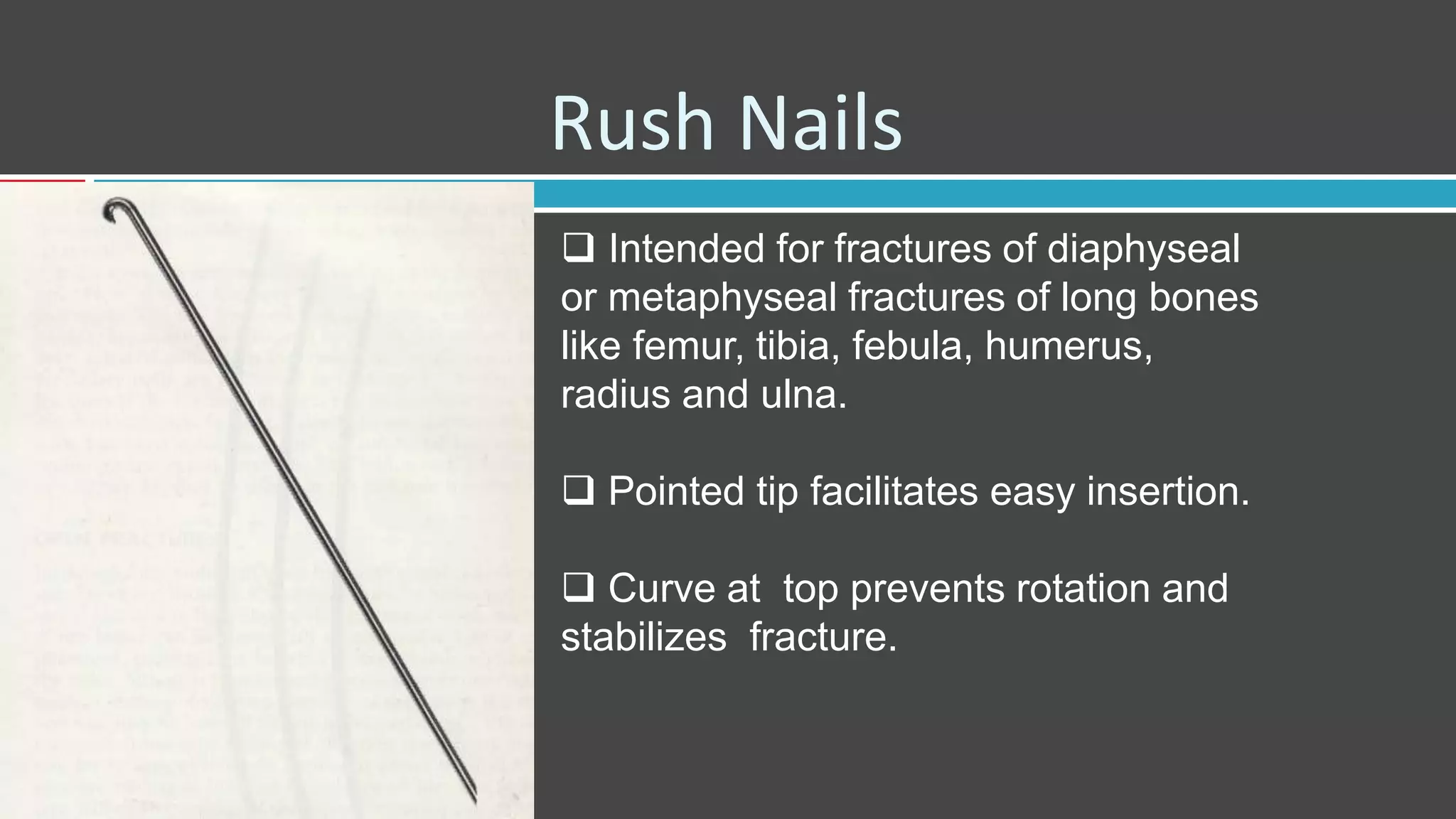
Rush Nails
 Intended for fractures of diaphyseal
or metaphyseal fractures of long bones
like femur, tibia, febula, humerus,
radius and ulna.
 Pointed tip facilitates easy insertion.
 Curve at top prevents rotation and
stabilizes fracture.
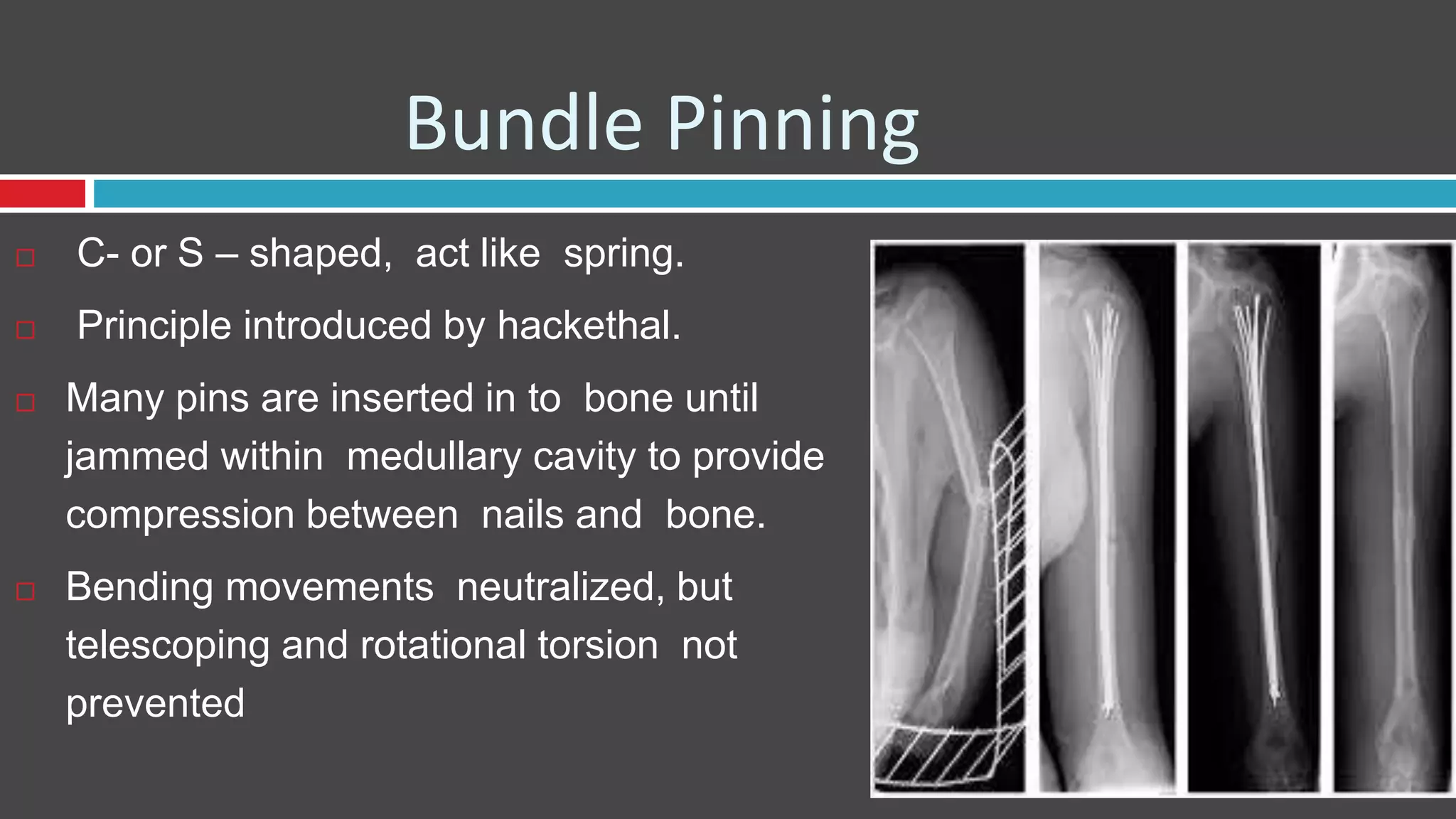
Bundle Pinning
 C- or S – shaped, act like spring.
 Principle introduced by hackethal.
 Many pins are inserted in to bone until
jammed within medullary cavity to provide
compression between nails and bone.
 Bending movements neutralized, but
telescoping and rotational torsion not
prevented
Applications
 Diaphyseal fractures of long bones
 High proximal and low distal fractures of
long bones
 Floating hip, floating knee, floating elbow.
 Aseptic and septic non-union
 Osteoporotic long bone fractures
 Pathological fractures
 Open fractures up to grade IIIA
Contraindications
 Narrow and anomalous medullary canal
 Open growth plates
 Prior malunion - prevents nail placement
 History of intramedullary infection
 Associated ipsilateral femoral neck or acetabular fracture (relative)
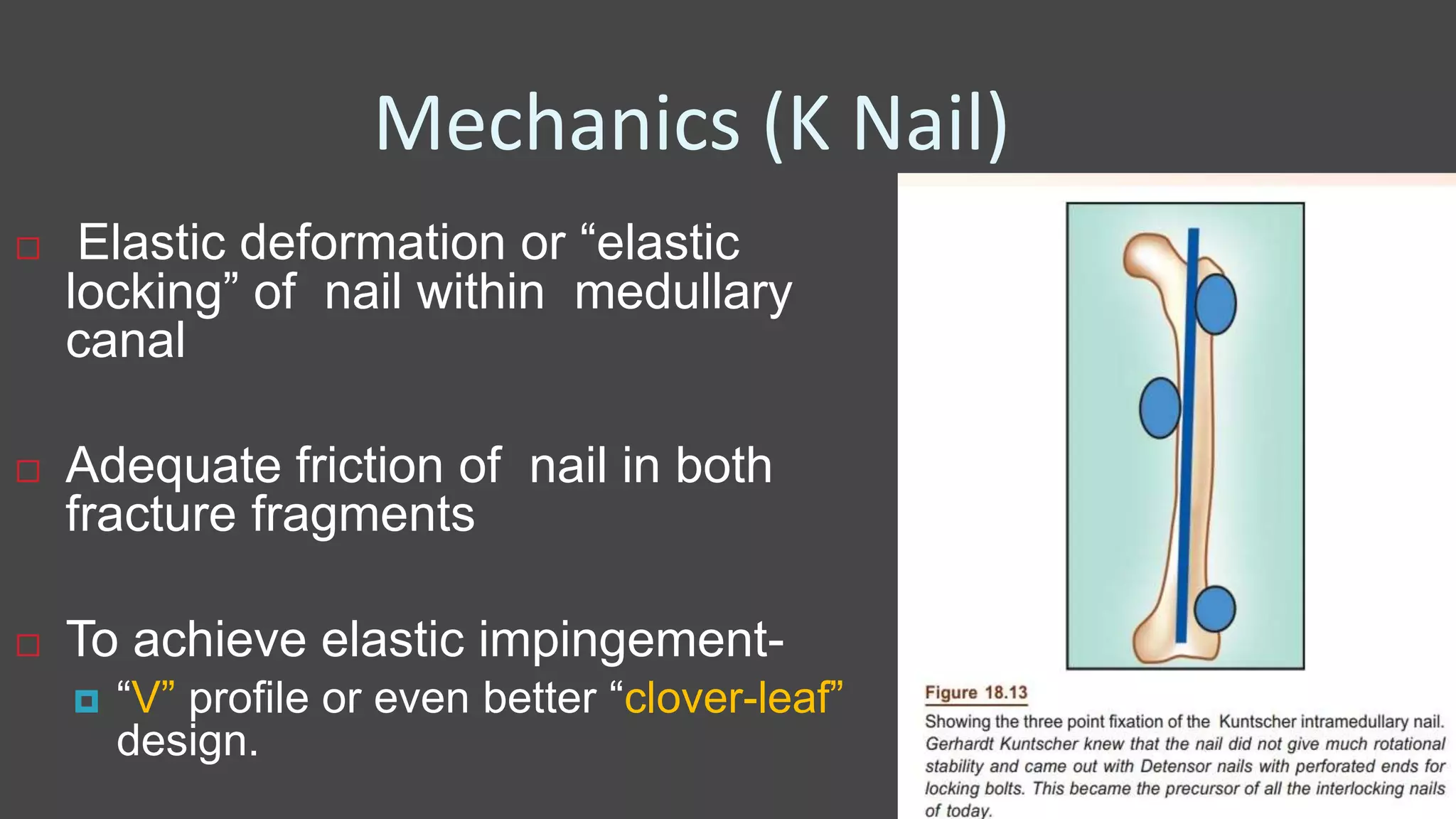
Mechanics (K Nail)
 Elastic deformation or “elastic
locking” of nail within medullary
canal
 Adequate friction of nail in both
fracture fragments
 To achieve elastic impingement-
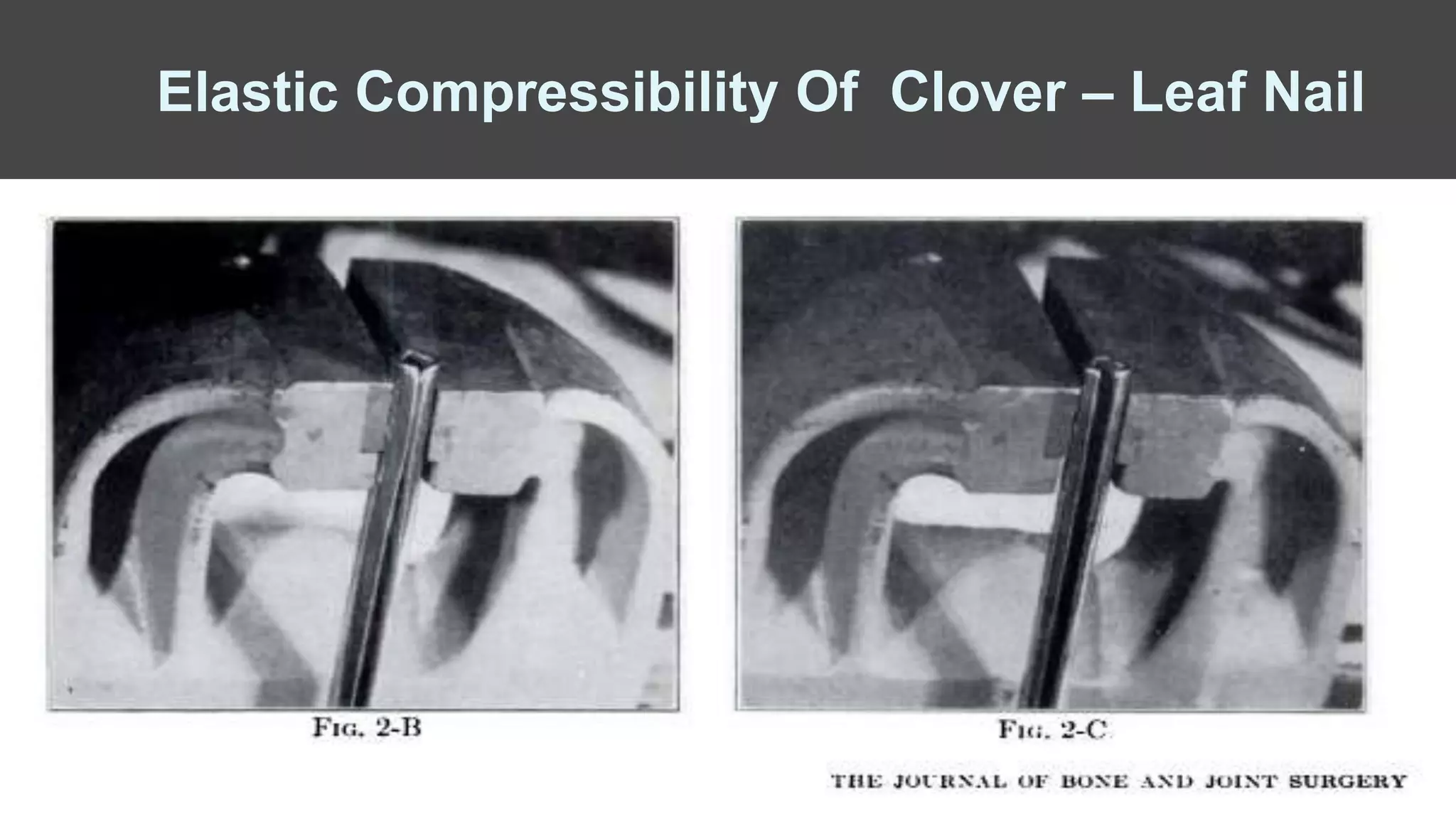
 “V” profile or even better “clover-leaf”
design.
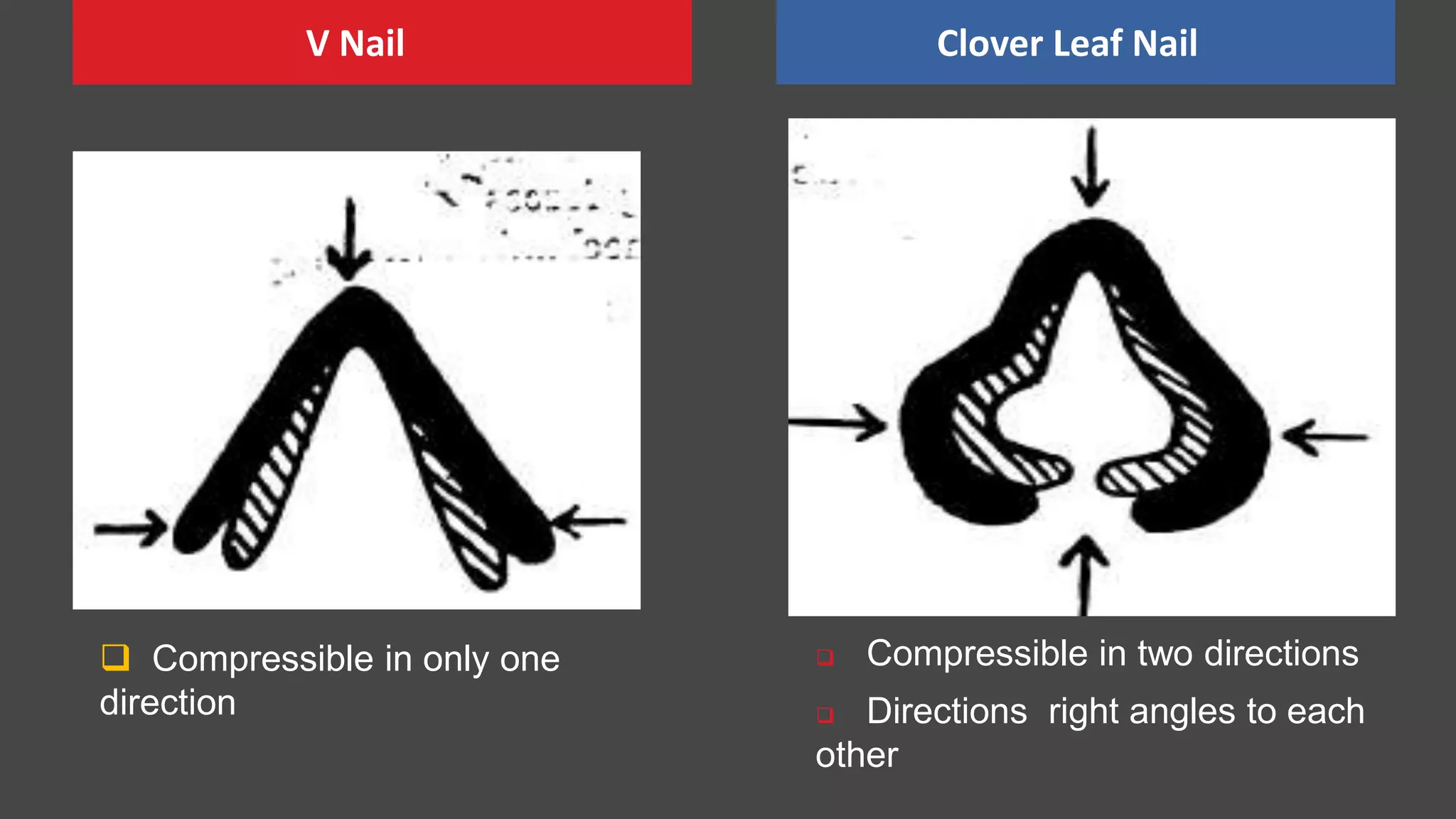
 Compressible in two directions
 Directions right angles to each
other
V Nail Clover Leaf Nail
 Compressible in only one
direction
Elastic Compressibility Of Clover – Leaf Nail
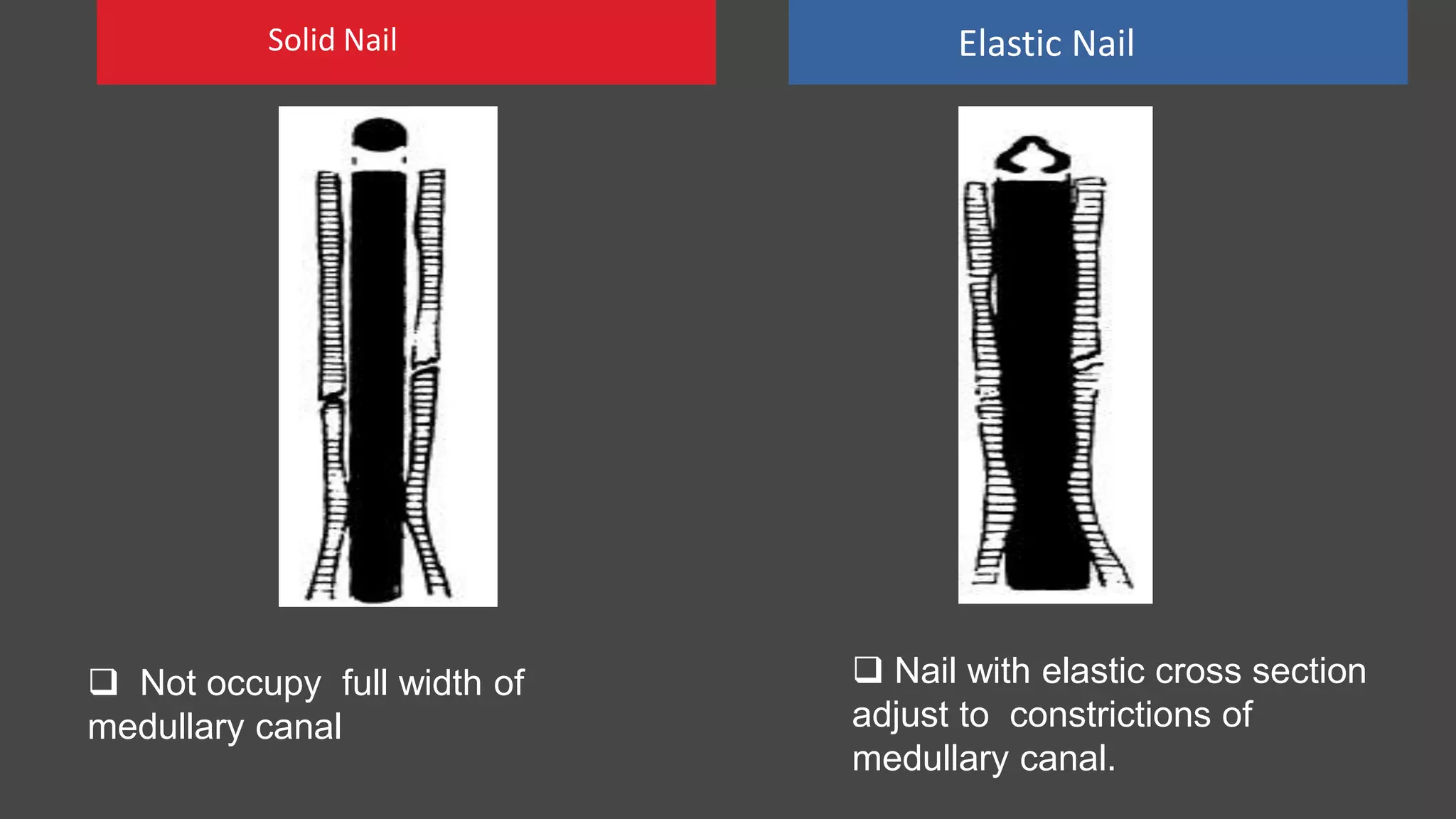
Solid Nail Elastic Nail
 Not occupy full width of
medullary canal
 Nail with elastic cross section
adjust to constrictions of
medullary canal.
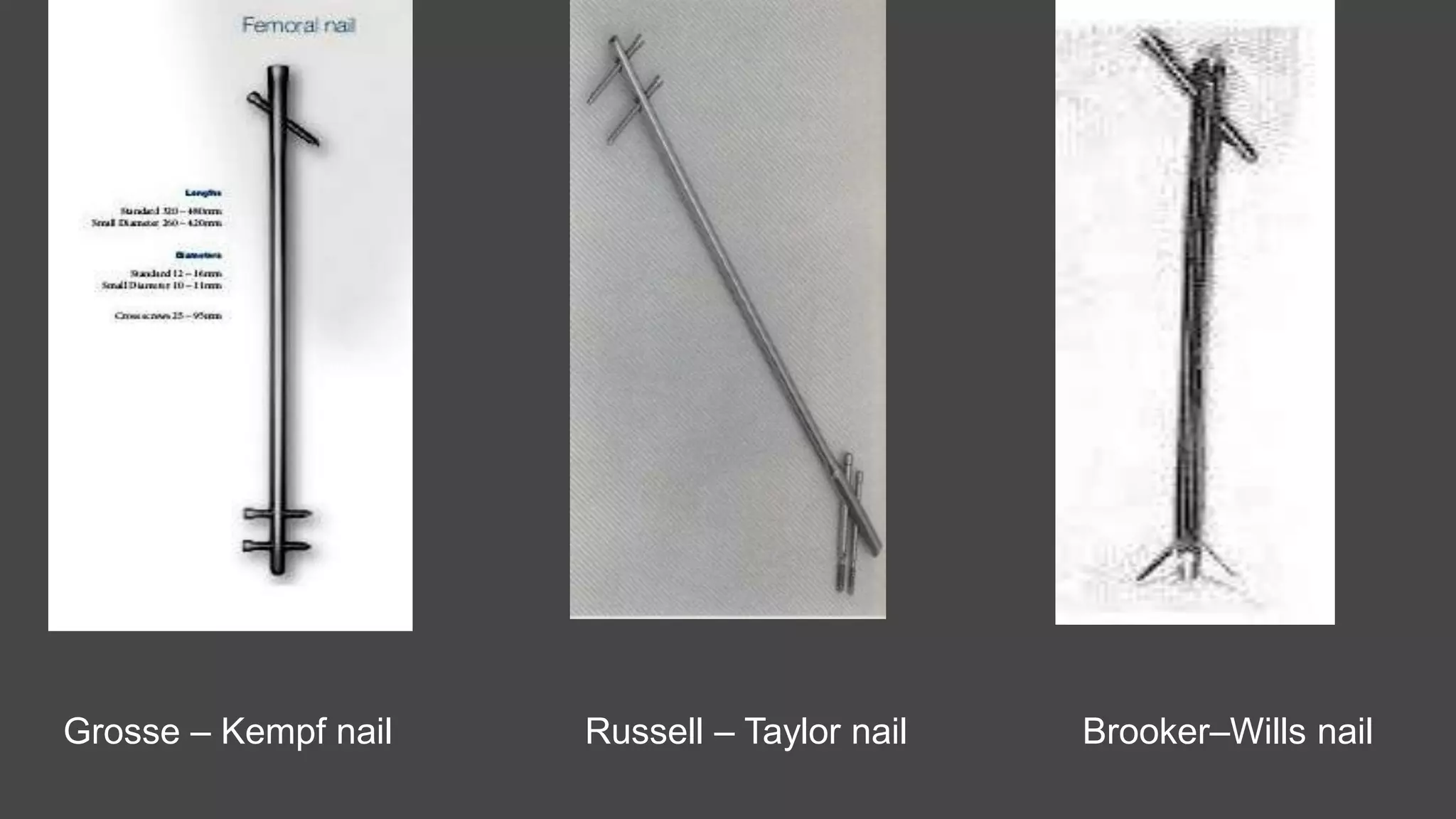
Grosse – Kempf nail Russell – Taylor nail Brooker–Wills nail
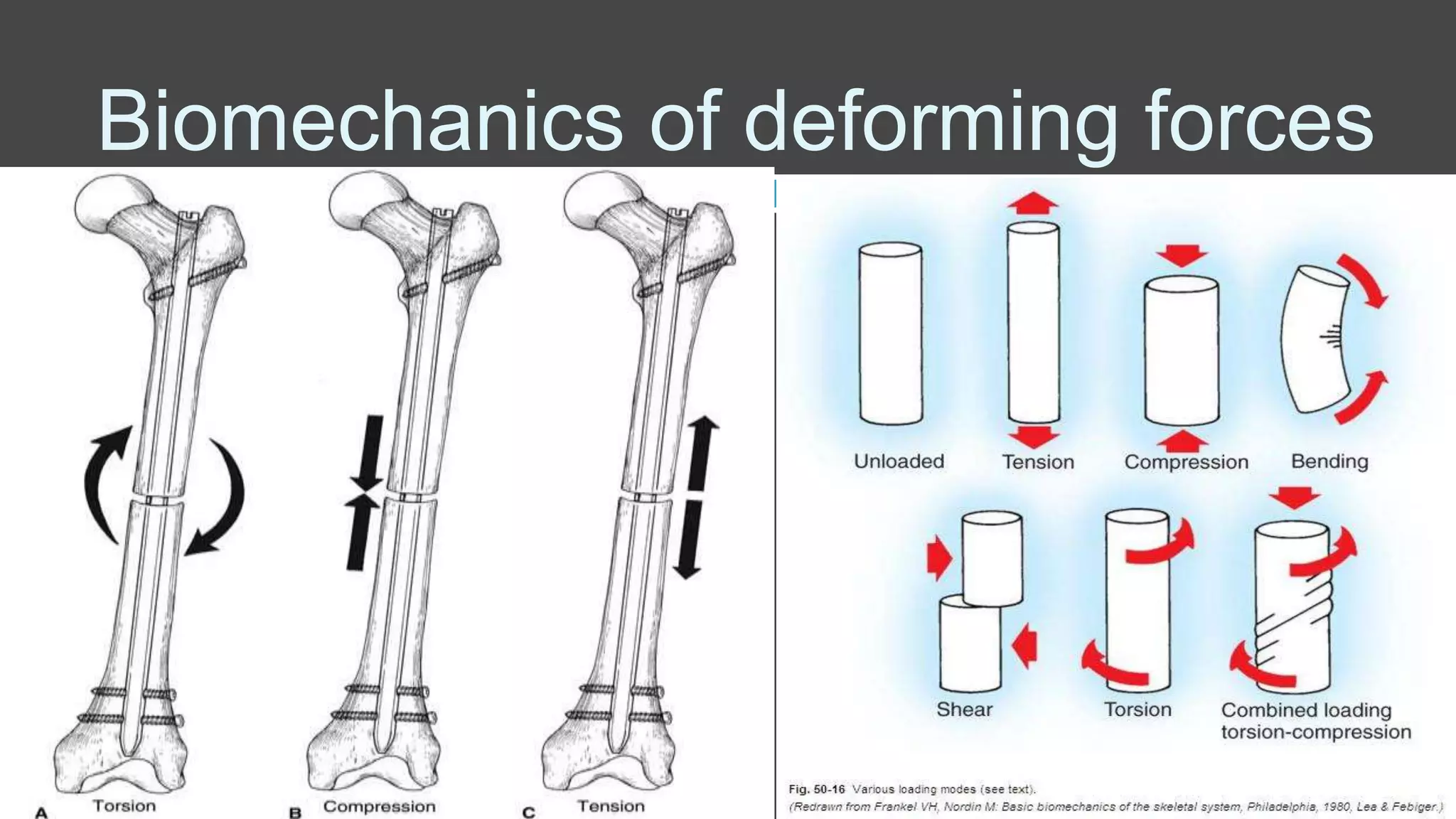
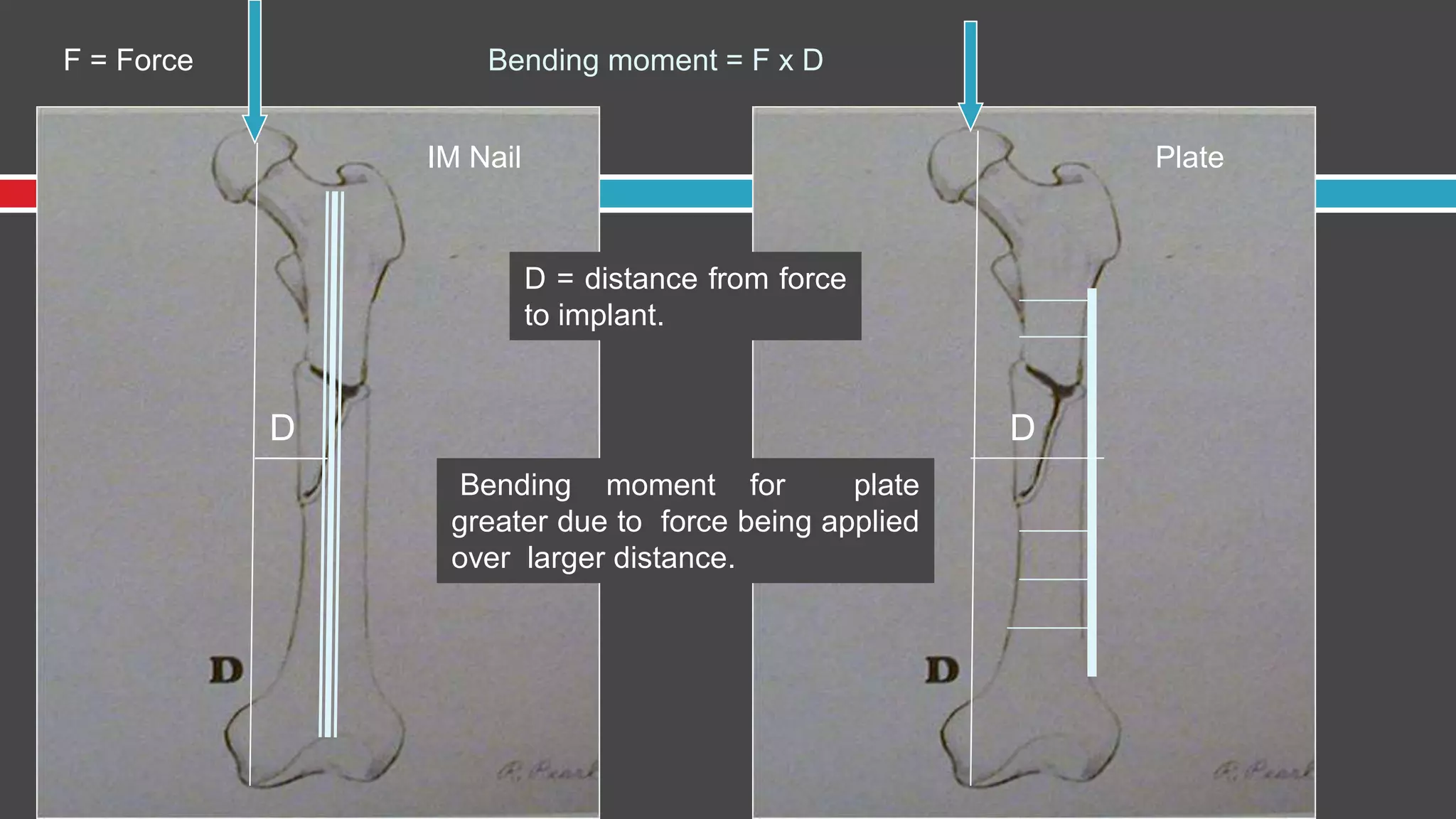
Biomechanics of deforming forces
D
F = Force Bending moment = F x D
D
PlateIM Nail
Bending moment for plate
greater due to force being applied
over larger distance.
D = distance from force
to implant.
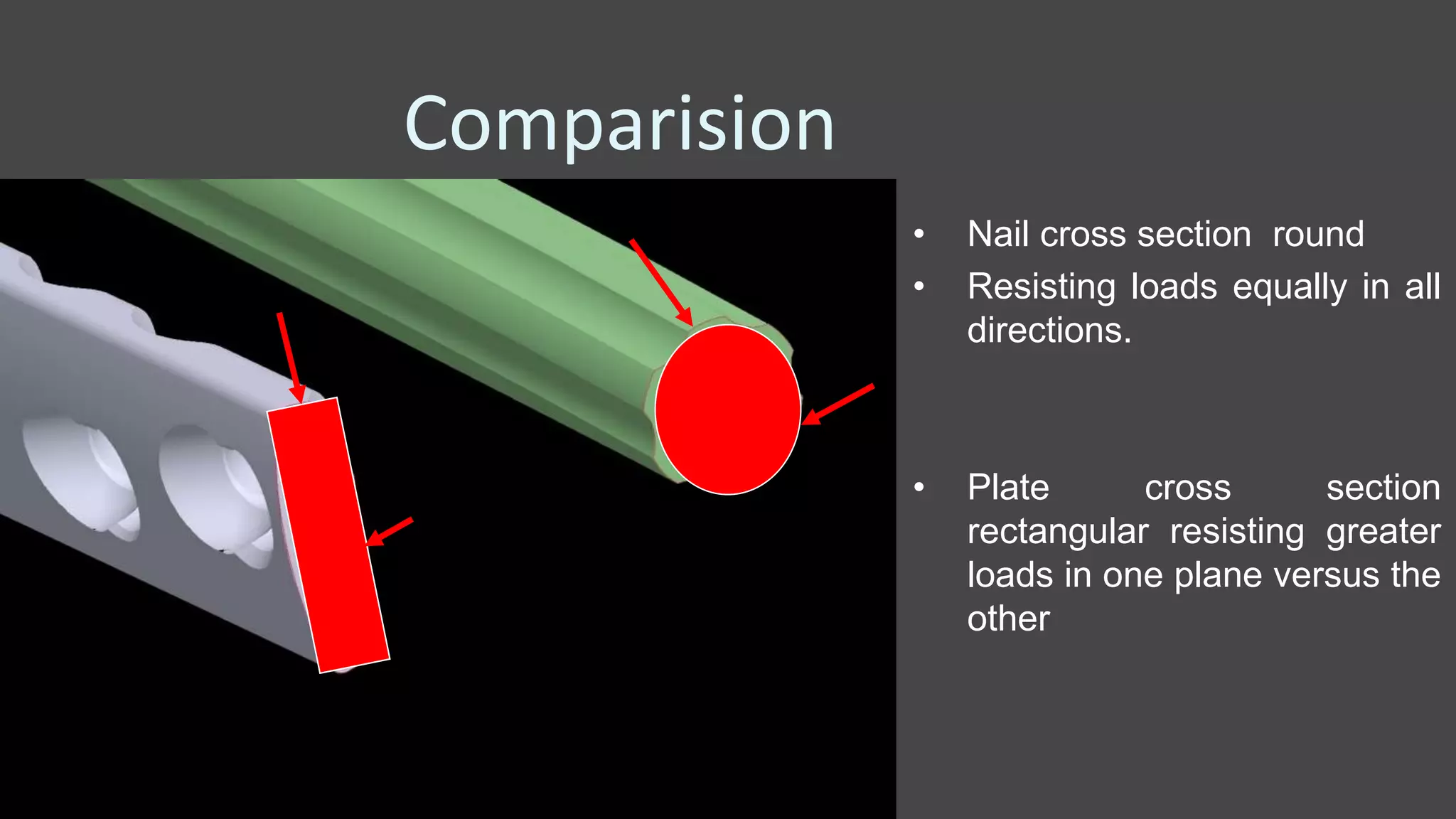
Comparision
• Nail cross section round
• Resisting loads equally in all
directions.
• Plate cross section
rectangular resisting greater
loads in one plane versus the
other
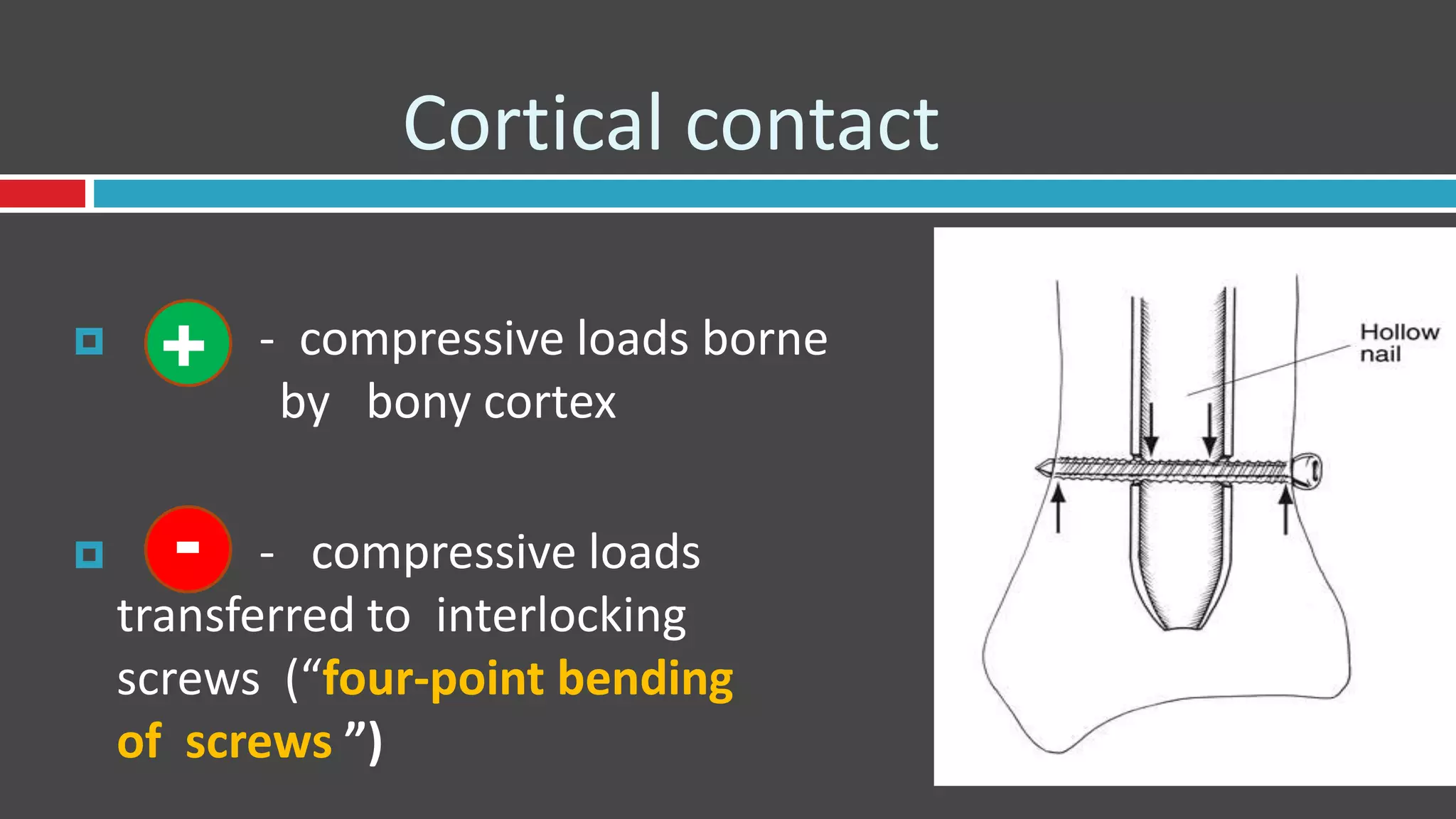
Cortical contact
 - compressive loads borne
by bony cortex
 - compressive loads
transferred to interlocking
screws (“four-point bending
of screws ”)
+
-
Ideal Intramedullary Nail
 Strong and stable - maintain alignment and position
 Prevent rotation - interlocking transfixing screws
 Promote union - contact-compression forces at fracture
surfaces
 Accessible for easy removal
Pre Requisites
 Adequate preoperative planning
 Patient tolerance to a major surgical procedure
 Availability of nails of suitable length and diameter
 Suitable instruments, trained assistants, and optimal hospital
conditions
 Closed nailing techniques - whenever possible
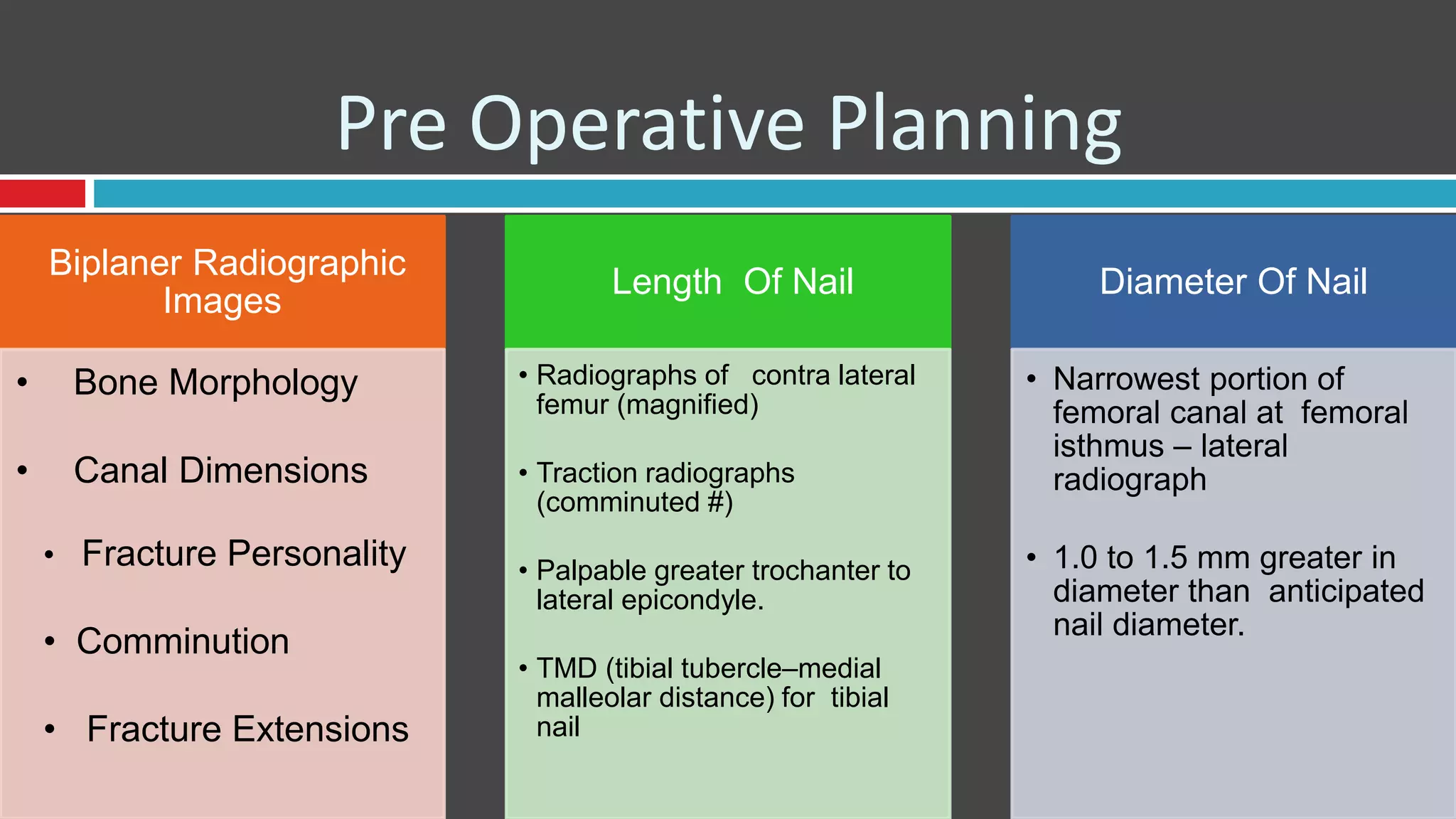
Pre Operative Planning
Biplaner Radiographic
Images
• Bone Morphology
• Canal Dimensions
• Fracture Personality
• Comminution
• Fracture Extensions
Length Of Nail
• Radiographs of contra lateral
femur (magnified)
• Traction radiographs
(comminuted #)
• Palpable greater trochanter to
lateral epicondyle.
• TMD (tibial tubercle–medial
malleolar distance) for tibial
nail
Diameter Of Nail
• Narrowest portion of
femoral canal at femoral
isthmus – lateral
radiograph
• 1.0 to 1.5 mm greater in
diameter than anticipated
nail diameter.
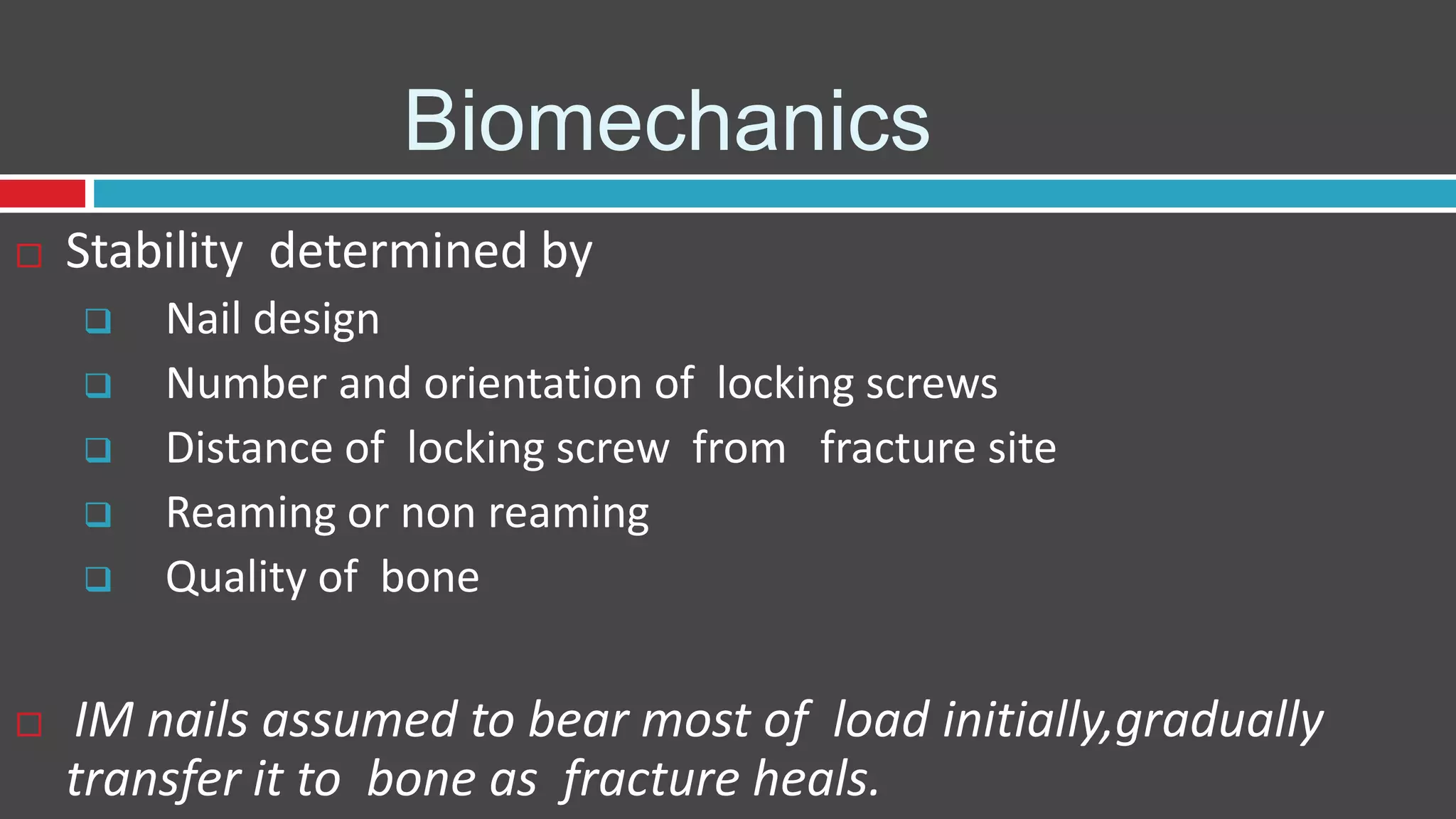
Nail Length
 Preoperative radiographs of fractured long bone
with proximal and distal joints
 AP radiograph of opposite normal limb at a tube
distance of 1meter
 Kuntscher measuring device :
 Ossimeter used to measure length and width
 Magnification is taken in to account
Biomechanics
 Stability determined by
 Nail design
 Number and orientation of locking screws
 Distance of locking screw from fracture site
 Reaming or non reaming
 Quality of bone
 IM nails assumed to bear most of load initially,gradually
transfer it to bone as fracture heals.
Nail Design
 Factors contributing to biomechanical profile :
 Material properties
 Cross-sectional shape
 Diameter
 Curves
 Length and working length
 Ends of nail
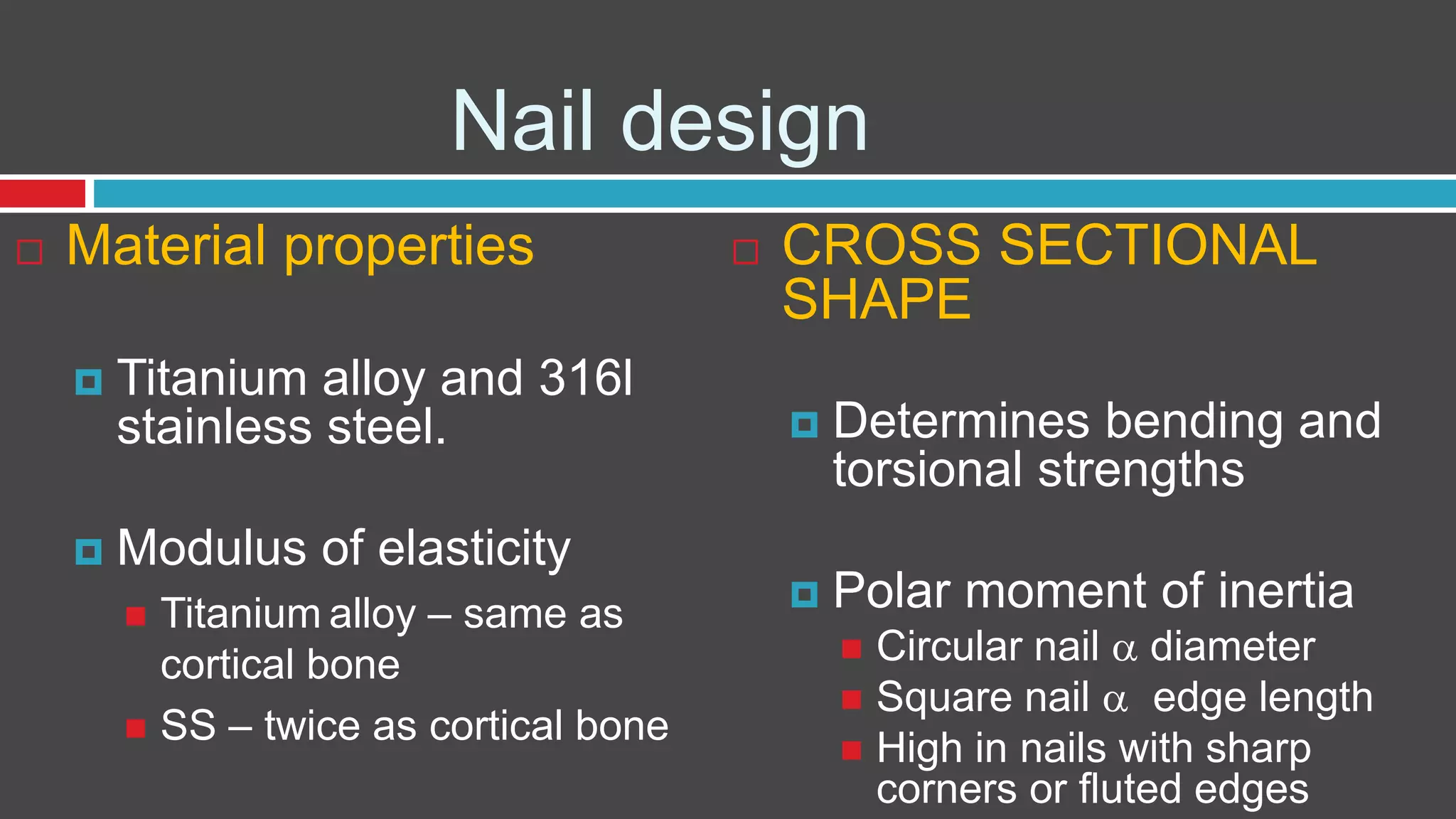
Nail design
 Material properties
 Titanium alloy and 316l
stainless steel.
 Modulus of elasticity
 Titanium alloy – same as
cortical bone
 SS – twice as cortical bone
 CROSS SECTIONAL
SHAPE
 Determines bending and
torsional strengths
 Polar moment of inertia
 Circular nail  diameter
 Square nail  edge length
 High in nails with sharp
corners or fluted edges
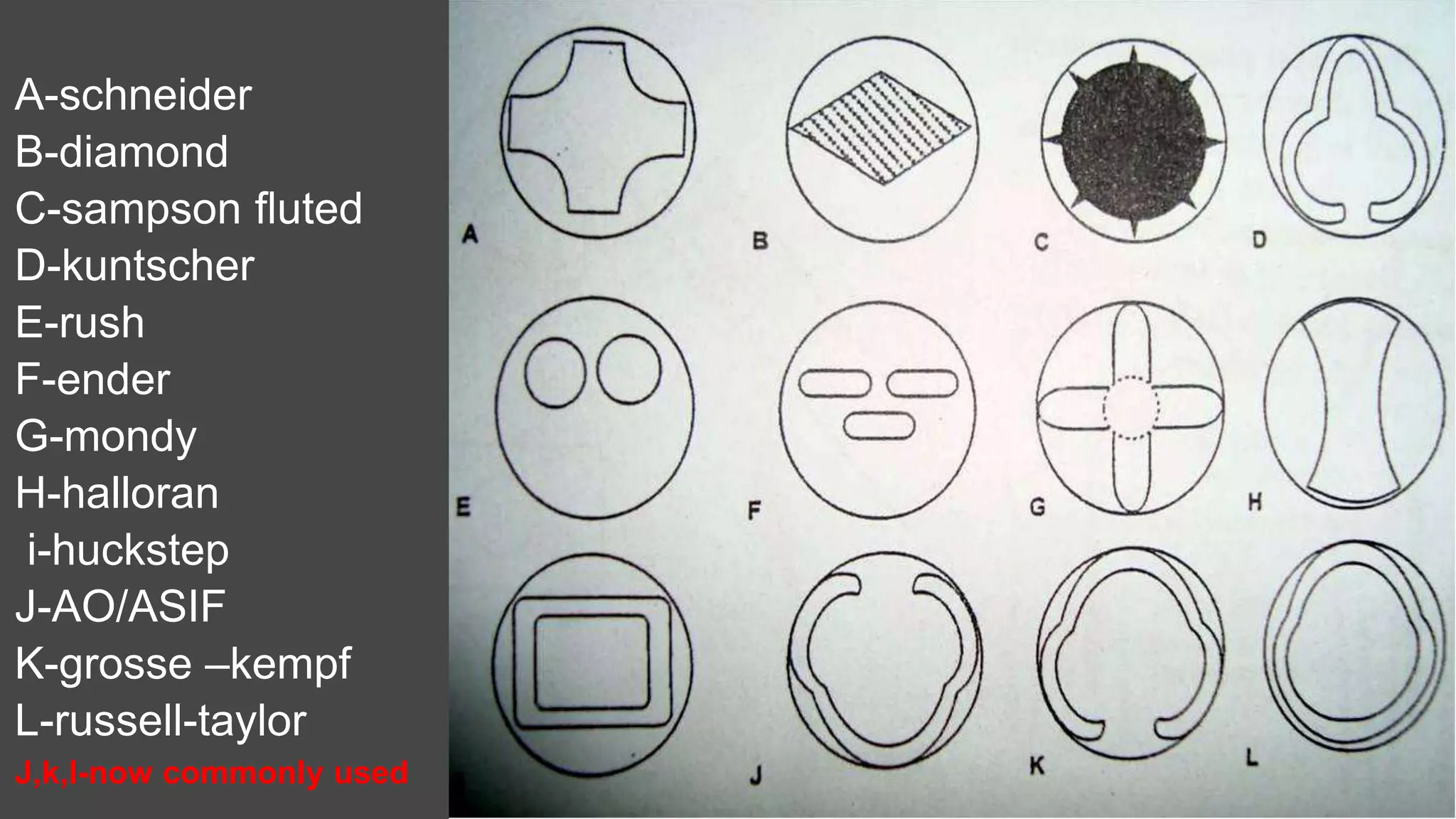
A-schneider
B-diamond
C-sampson fluted
D-kuntscher
E-rush
F-ender
G-mondy
H-halloran
i-huckstep
J-AO/ASIF
K-grosse –kempf
L-russell-taylor
J,k,l-now commonly used
Nail diameter
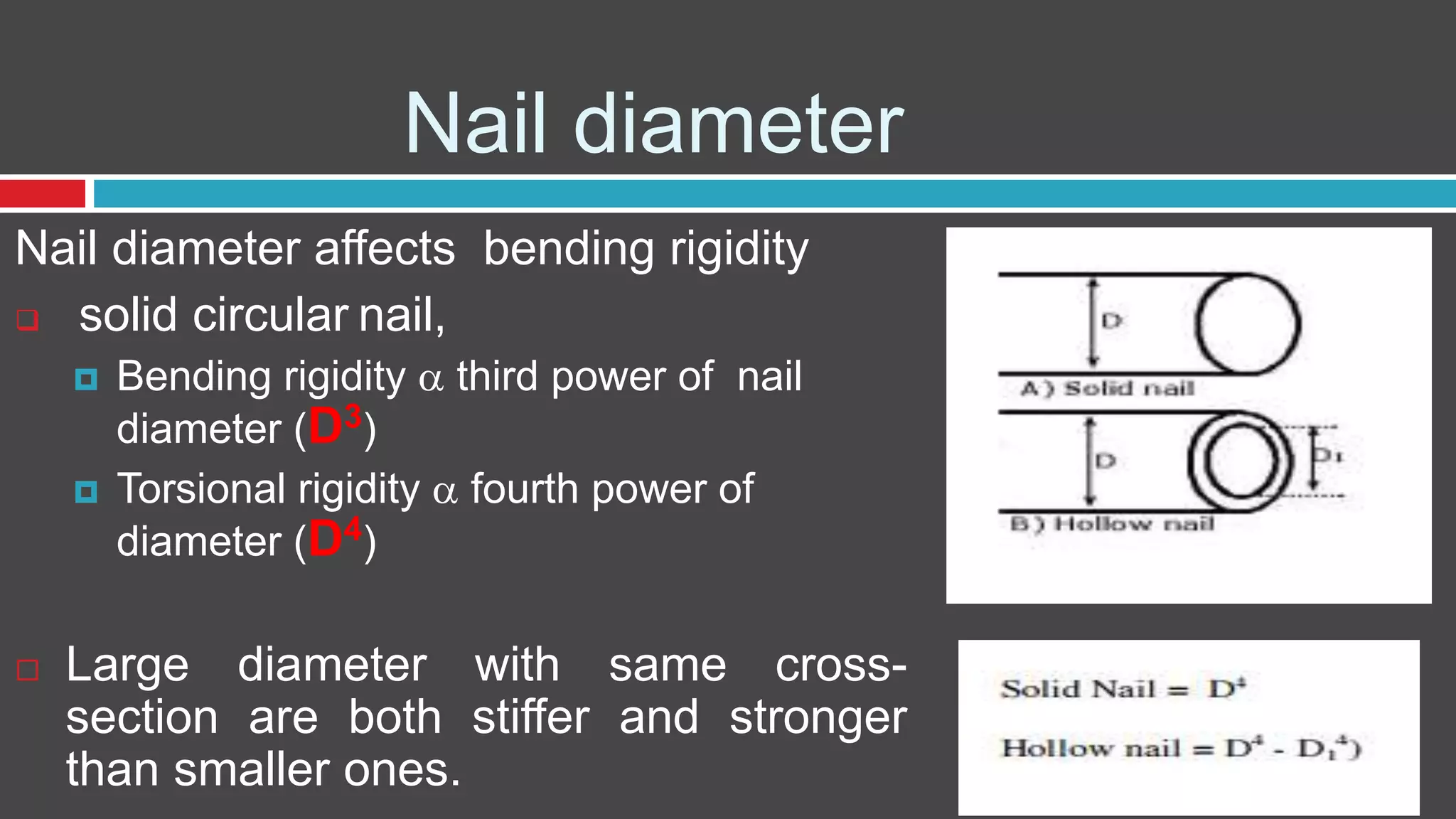
Nail diameter affects bending rigidity
 solid circular nail,
 Bending rigidity  third power of nail
diameter (D3)
 Torsional rigidity  fourth power of
diameter (D4)
 Large diameter with same cross-
section are both stiffer and stronger
than smaller ones.
Nail curves
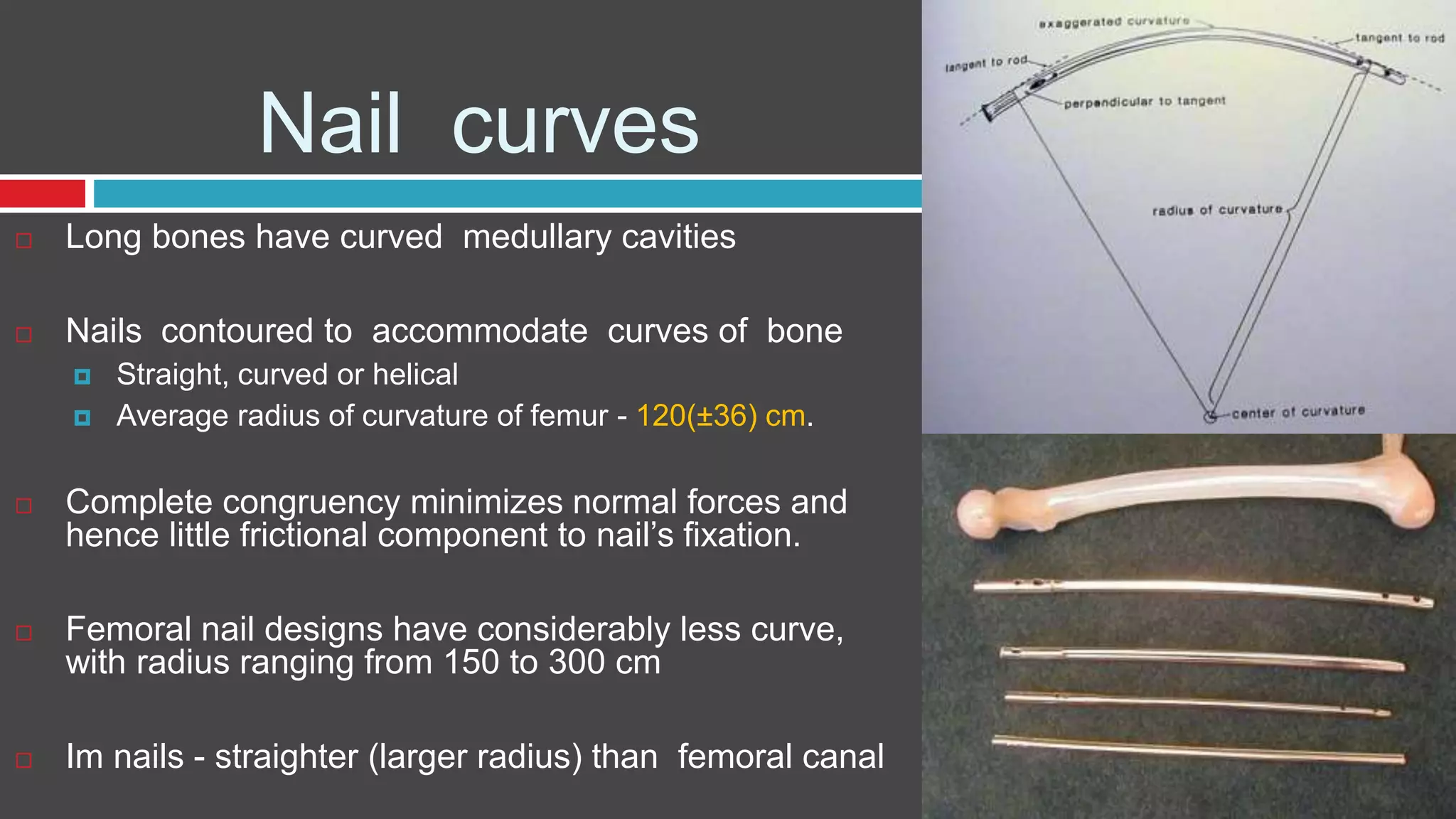
 Long bones have curved medullary cavities
 Nails contoured to accommodate curves of bone
 Straight, curved or helical
 Average radius of curvature of femur - 120(±36) cm.
 Complete congruency minimizes normal forces and
hence little frictional component to nail’s fixation.
 Femoral nail designs have considerably less curve,
with radius ranging from 150 to 300 cm
 Im nails - straighter (larger radius) than femoral canal
Nail curves
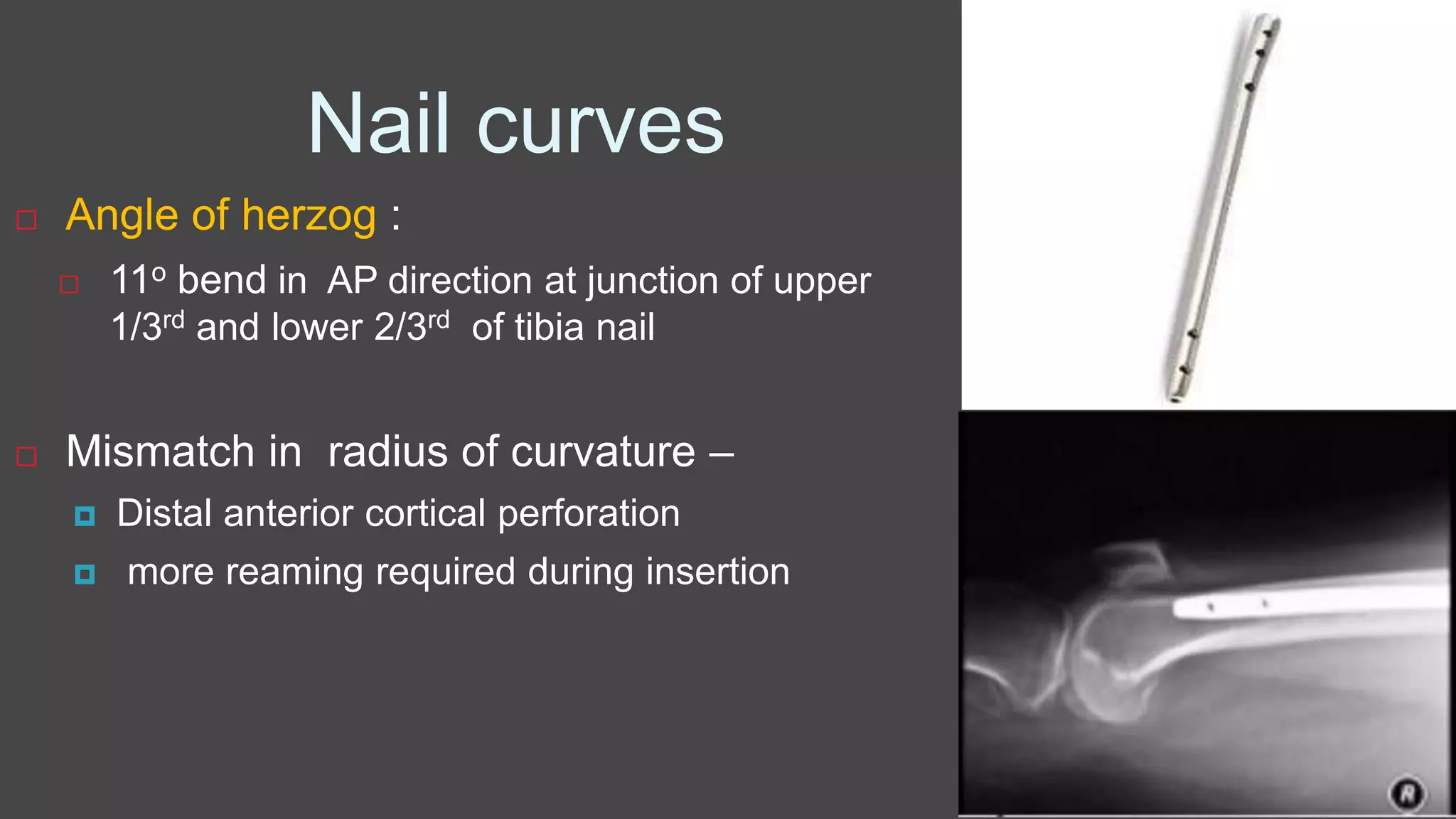
 Angle of herzog :
 11o bend in AP direction at junction of upper
1/3rd and lower 2/3rd of tibia nail
 Mismatch in radius of curvature –
 Distal anterior cortical perforation
 more reaming required during insertion
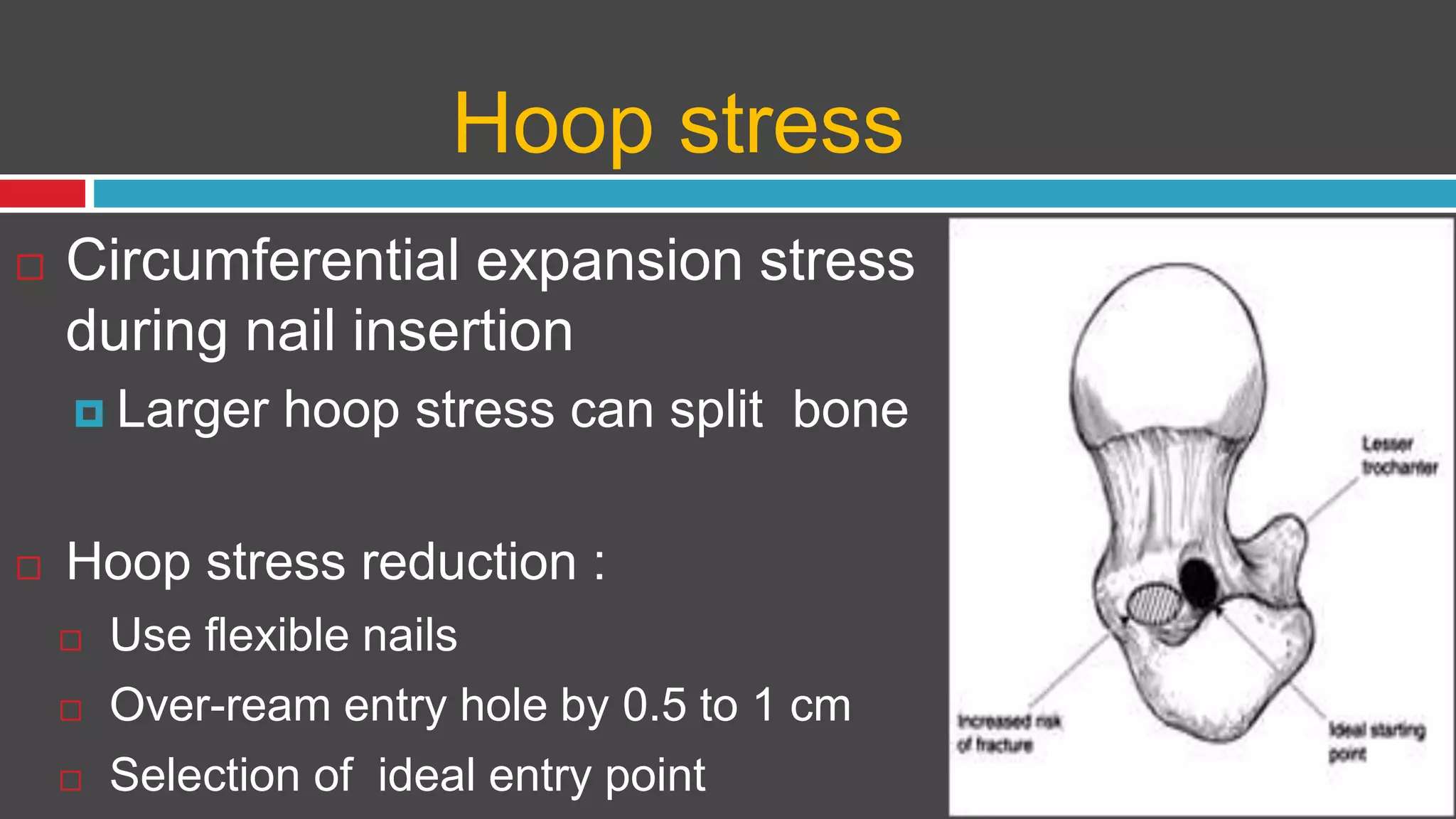
Hoop stress
 Circumferential expansion stress
during nail insertion
 Larger hoop stress can split bone
 Hoop stress reduction :
 Use flexible nails
 Over-ream entry hole by 0.5 to 1 cm
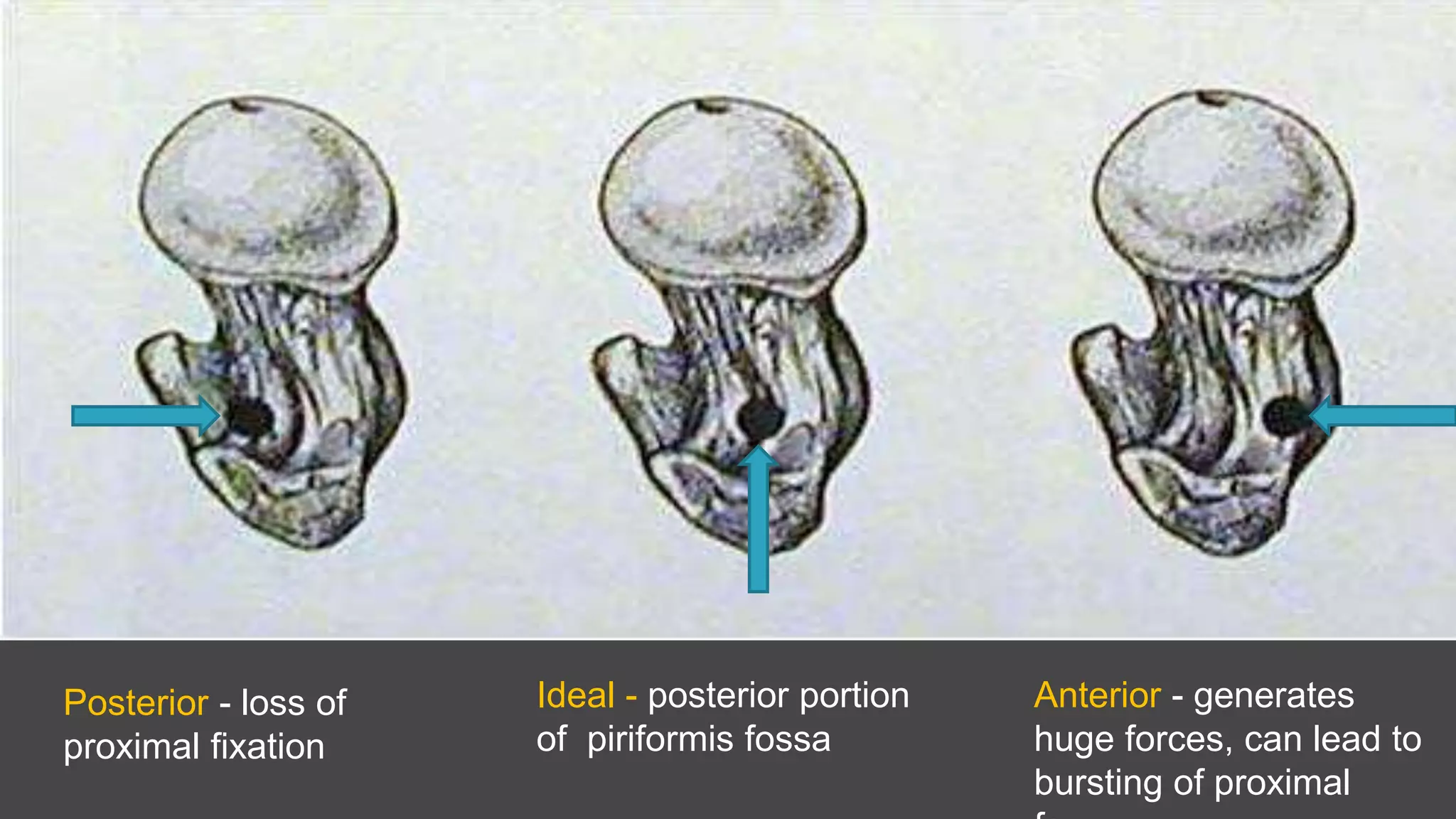
 Selection of ideal entry point
Posterior - loss of
proximal fixation
Ideal - posterior portion
of piriformis fossa
Anterior - generates
huge forces, can lead to
bursting of proximal
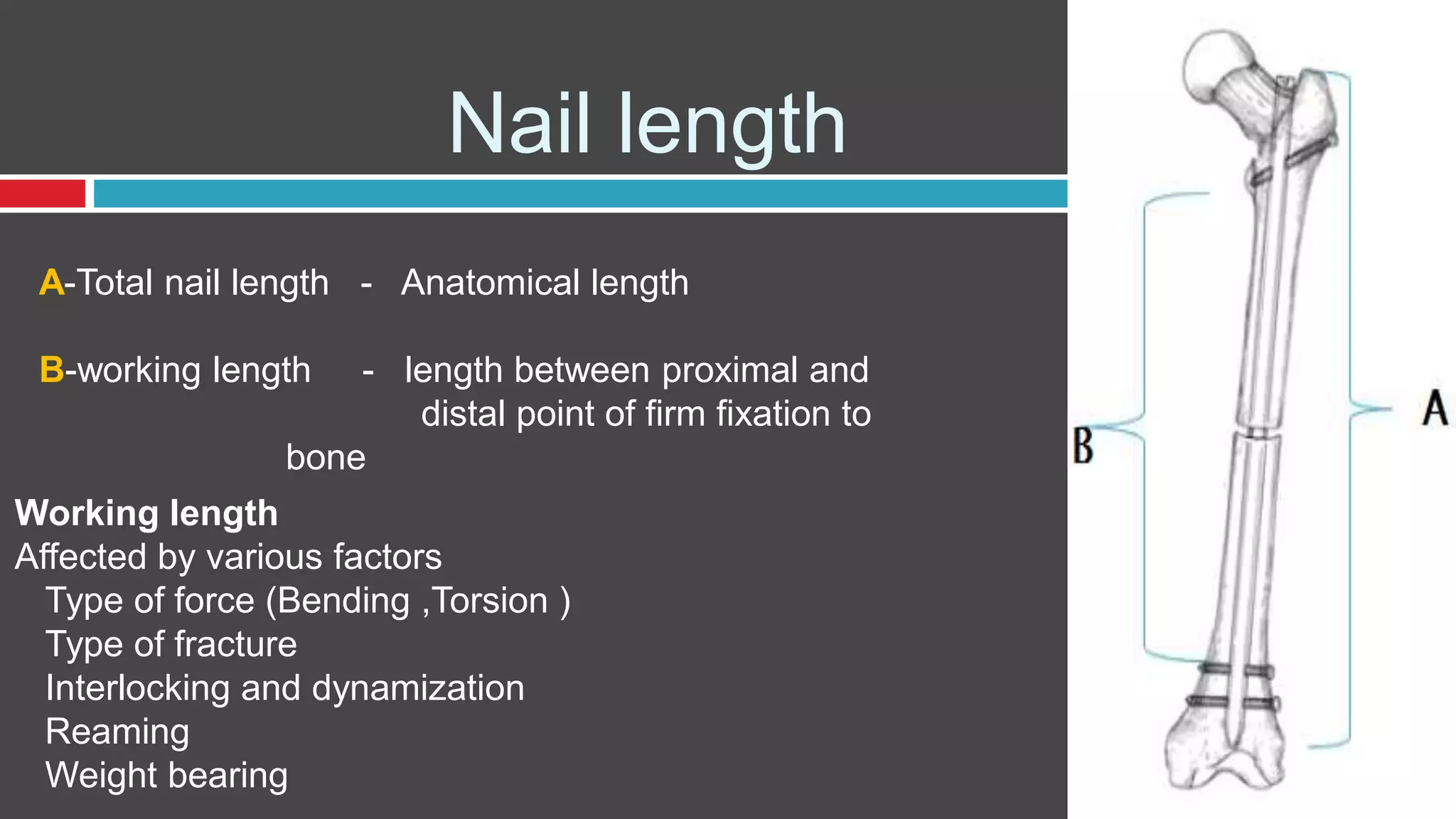
Nail length
A-Total nail length - Anatomical length
B-working length - length between proximal and
distal point of firm fixation to
bone
Working length
Affected by various factors
Type of force (Bending ,Torsion )
Type of fracture
Interlocking and dynamization
Reaming
Weight bearing
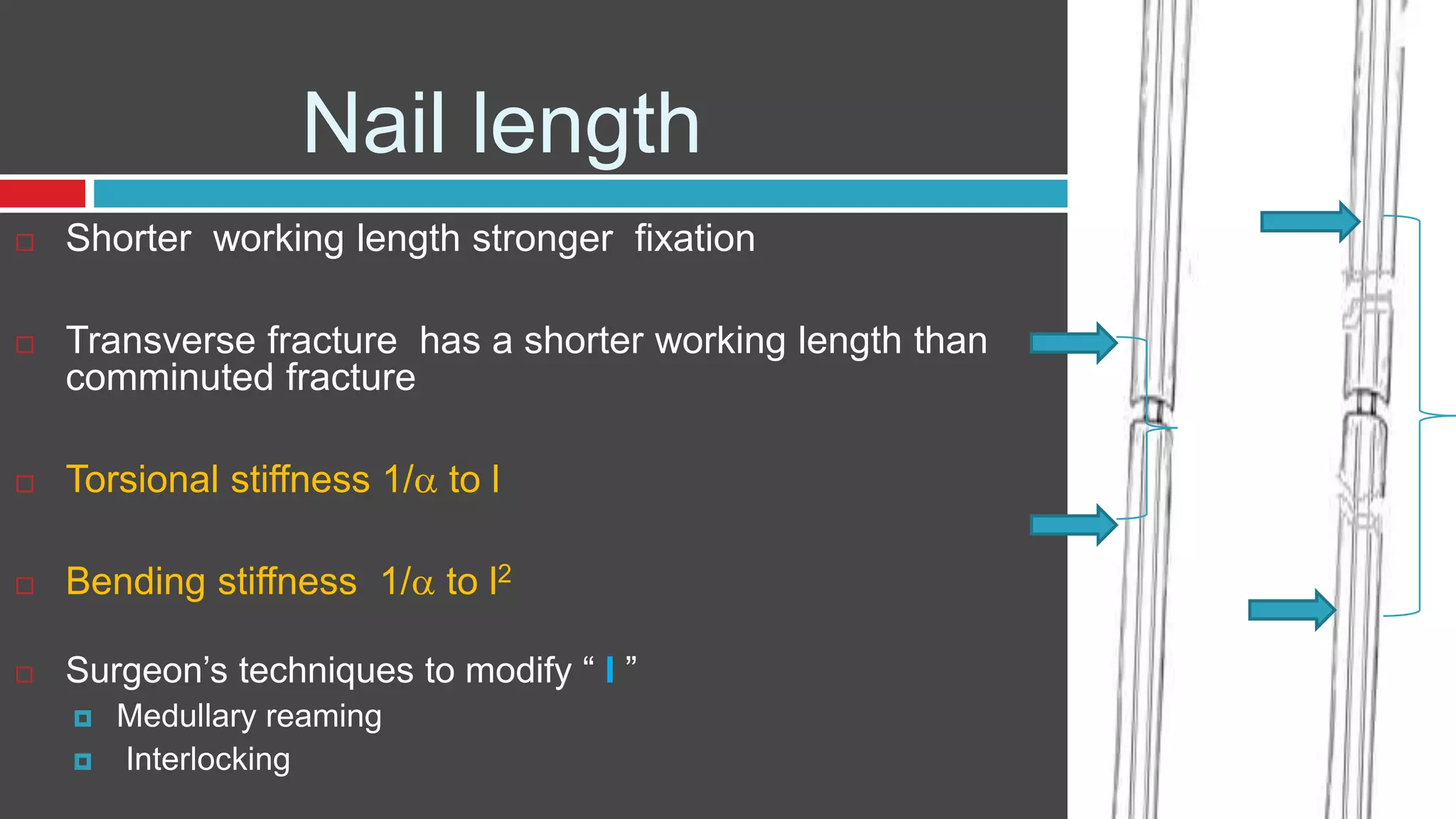
Nail length
 Shorter working length stronger fixation
 Transverse fracture has a shorter working length than
comminuted fracture
 Torsional stiffness 1/ to l
 Bending stiffness 1/ to l2
 Surgeon’s techniques to modify “ l ”
 Medullary reaming
 Interlocking
Extreme ends
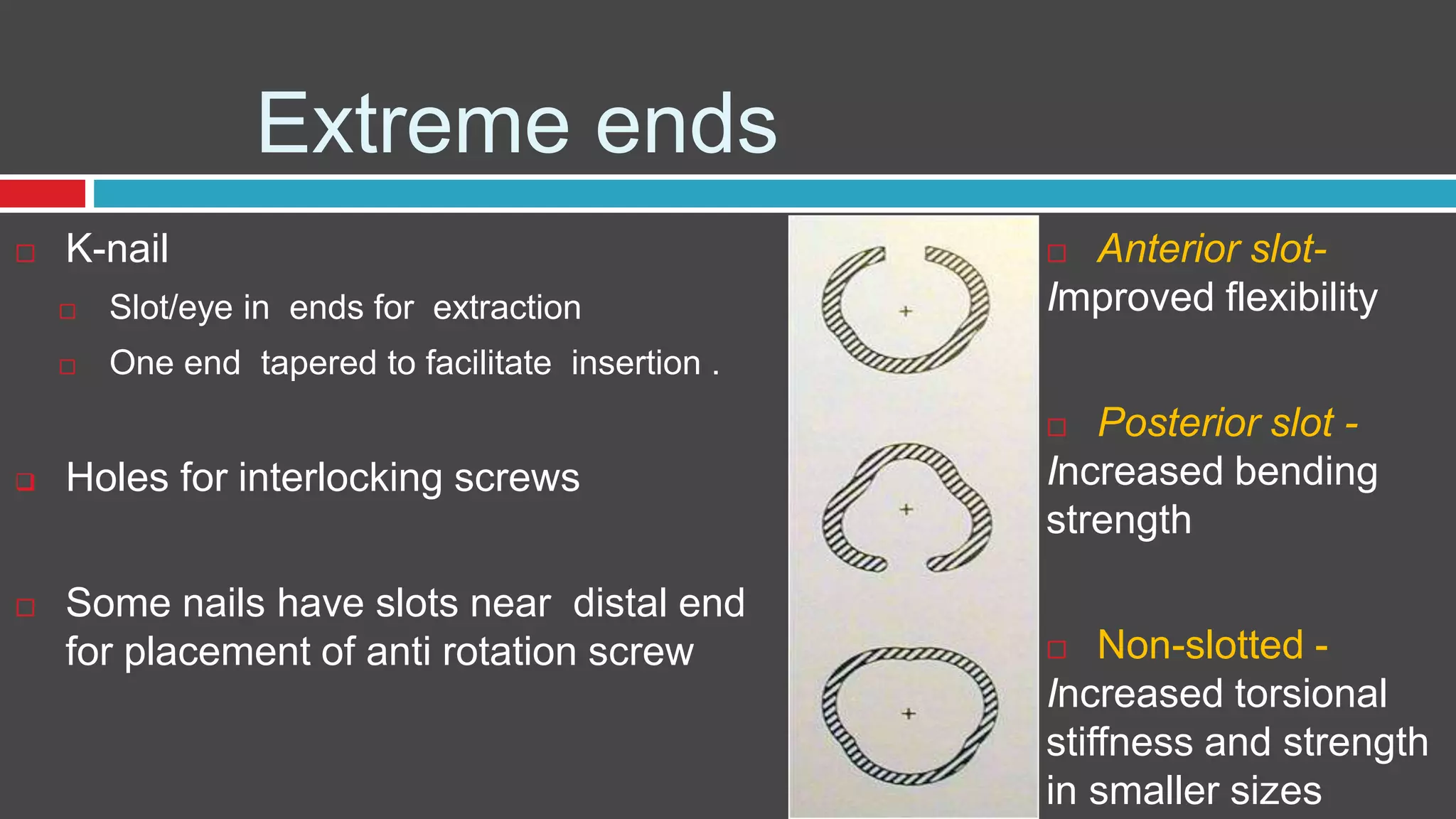
 K-nail
 Slot/eye in ends for extraction
 One end tapered to facilitate insertion .
 Holes for interlocking screws
 Some nails have slots near distal end
for placement of anti rotation screw
 Anterior slot-
Improved flexibility
 Posterior slot -
Increased bending
strength
 Non-slotted -
Increased torsional
stiffness and strength
in smaller sizes
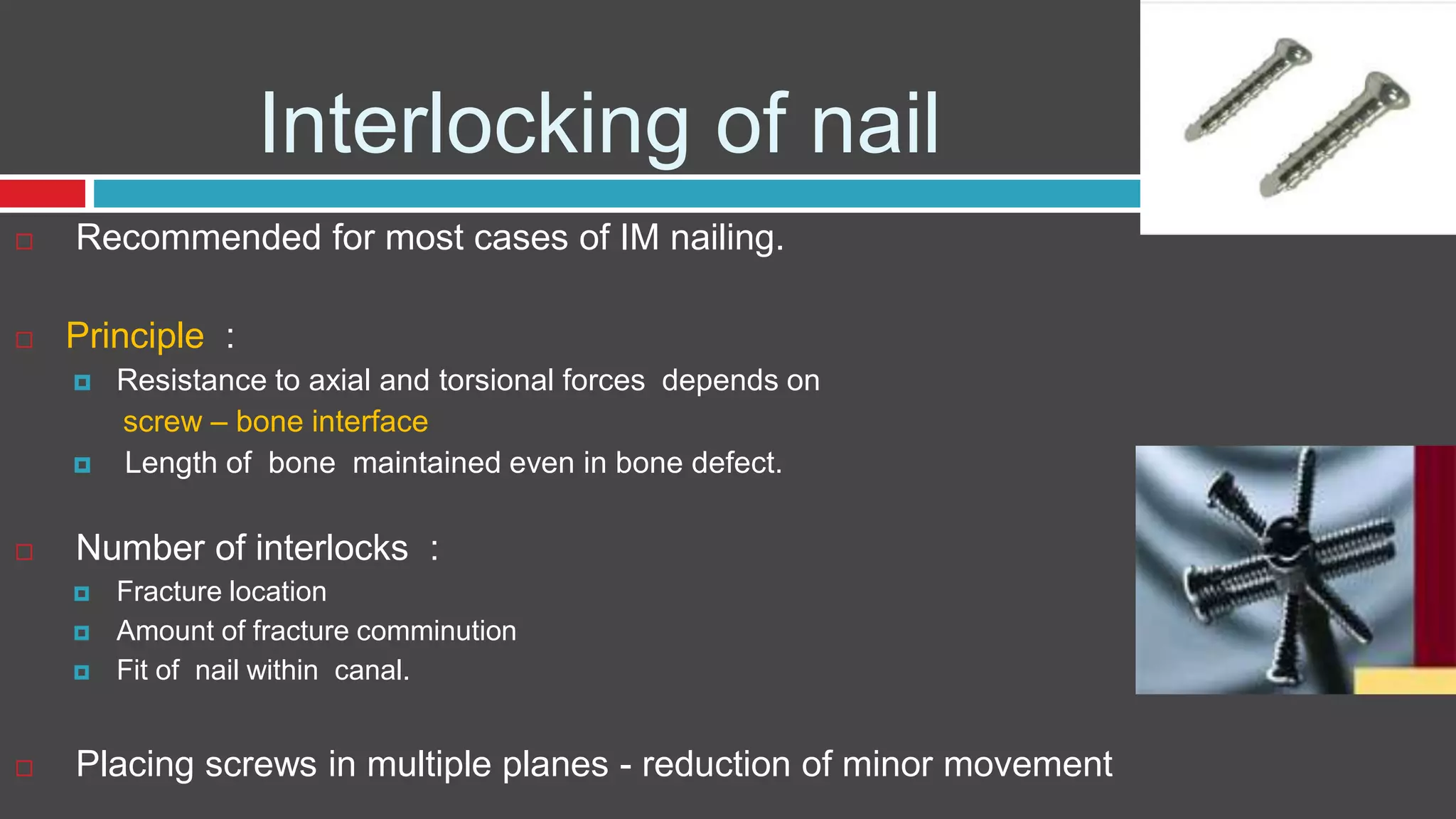
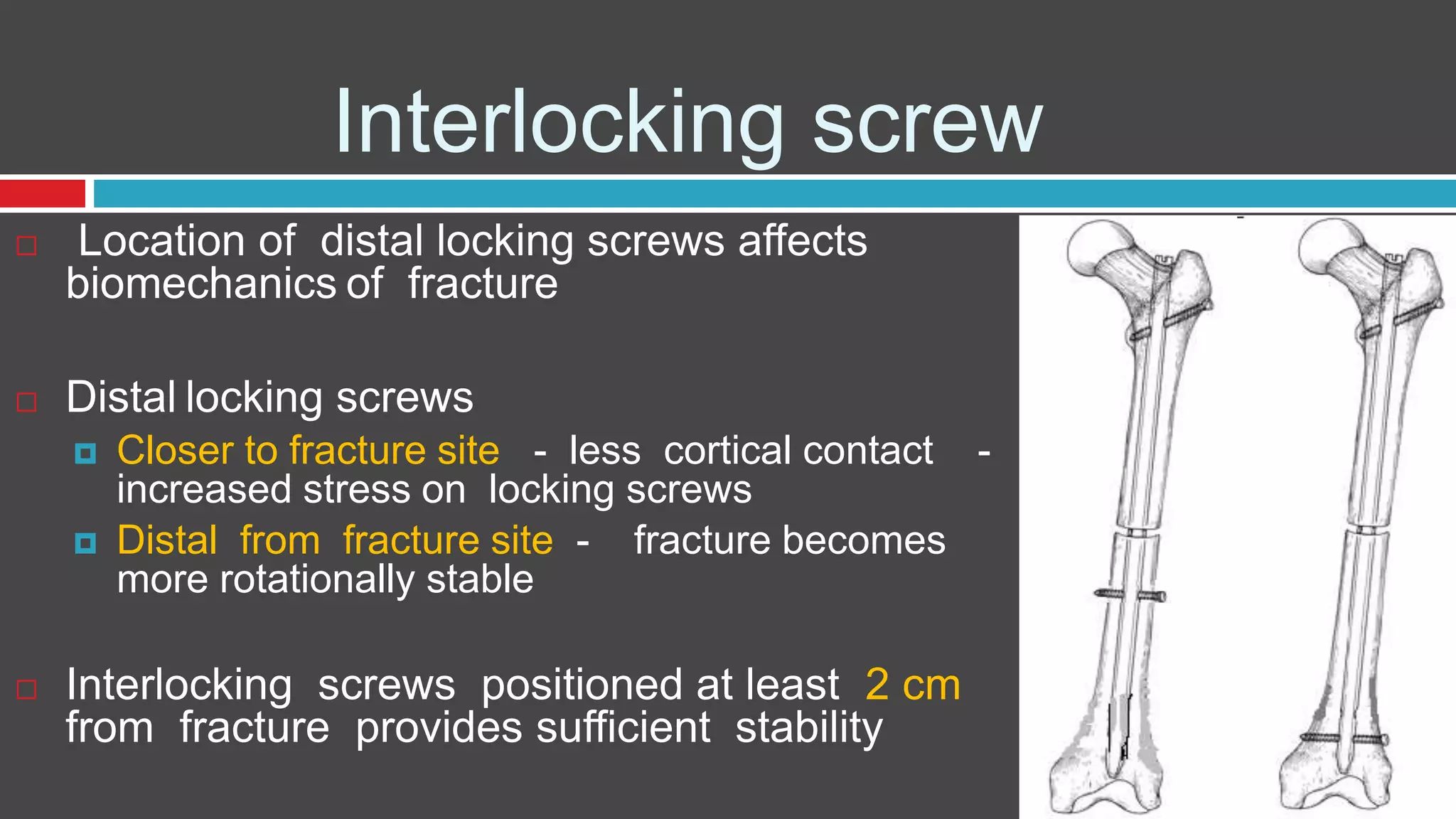
Interlocking of nail
 Recommended for most cases of IM nailing.
 Principle :
 Resistance to axial and torsional forces depends on
screw – bone interface
 Length of bone maintained even in bone defect.
 Number of interlocks :
 Fracture location
 Amount of fracture comminution
 Fit of nail within canal.
 Placing screws in multiple planes - reduction of minor movement
Interlocking screw
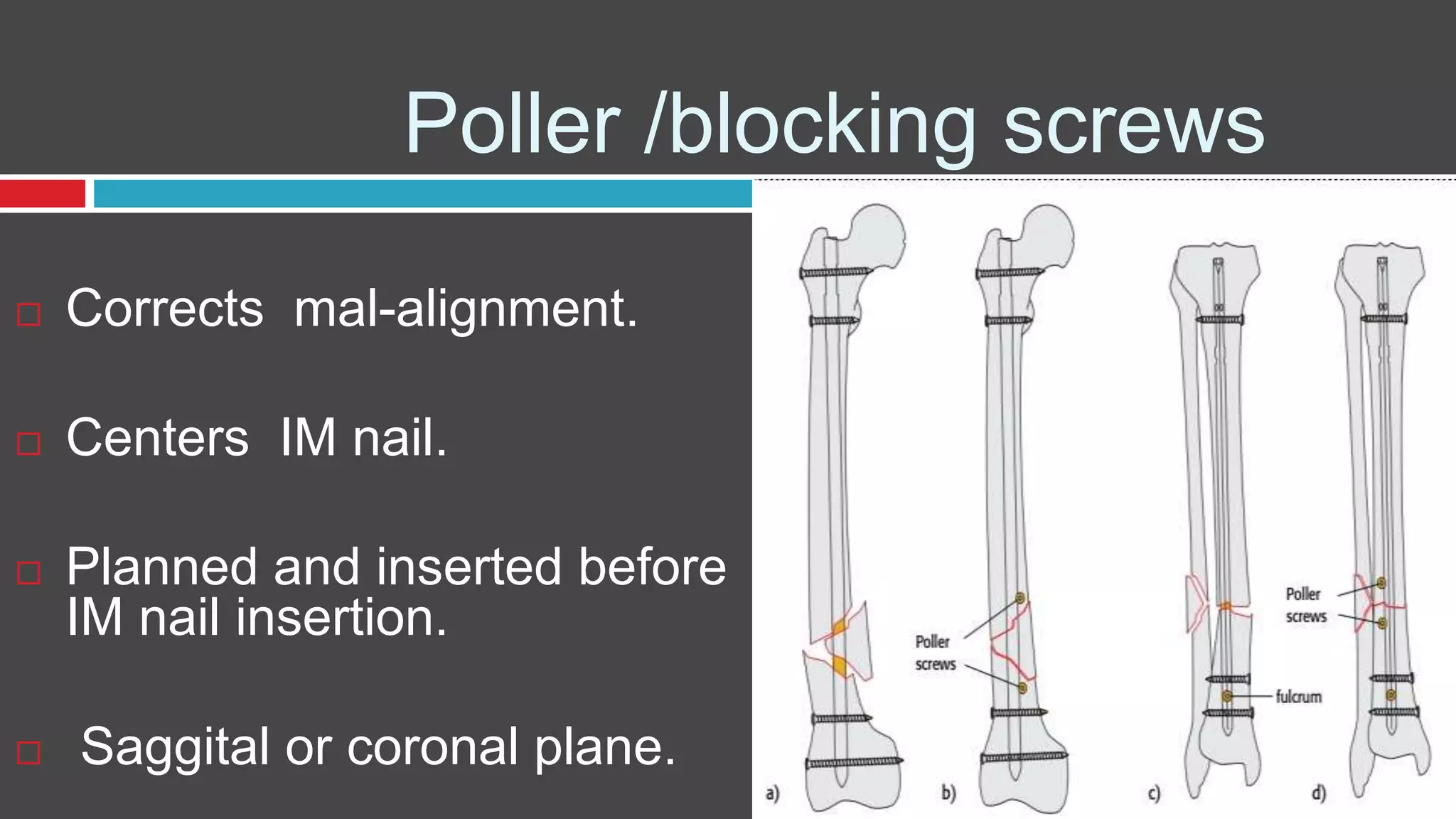
 Location of distal locking screws affects
biomechanics of fracture
 Distal locking screws
 Closer to fracture site - less cortical contact -
increased stress on locking screws
 Distal from fracture site - fracture becomes
more rotationally stable
 Interlocking screws positioned at least 2 cm
from fracture provides sufficient stability
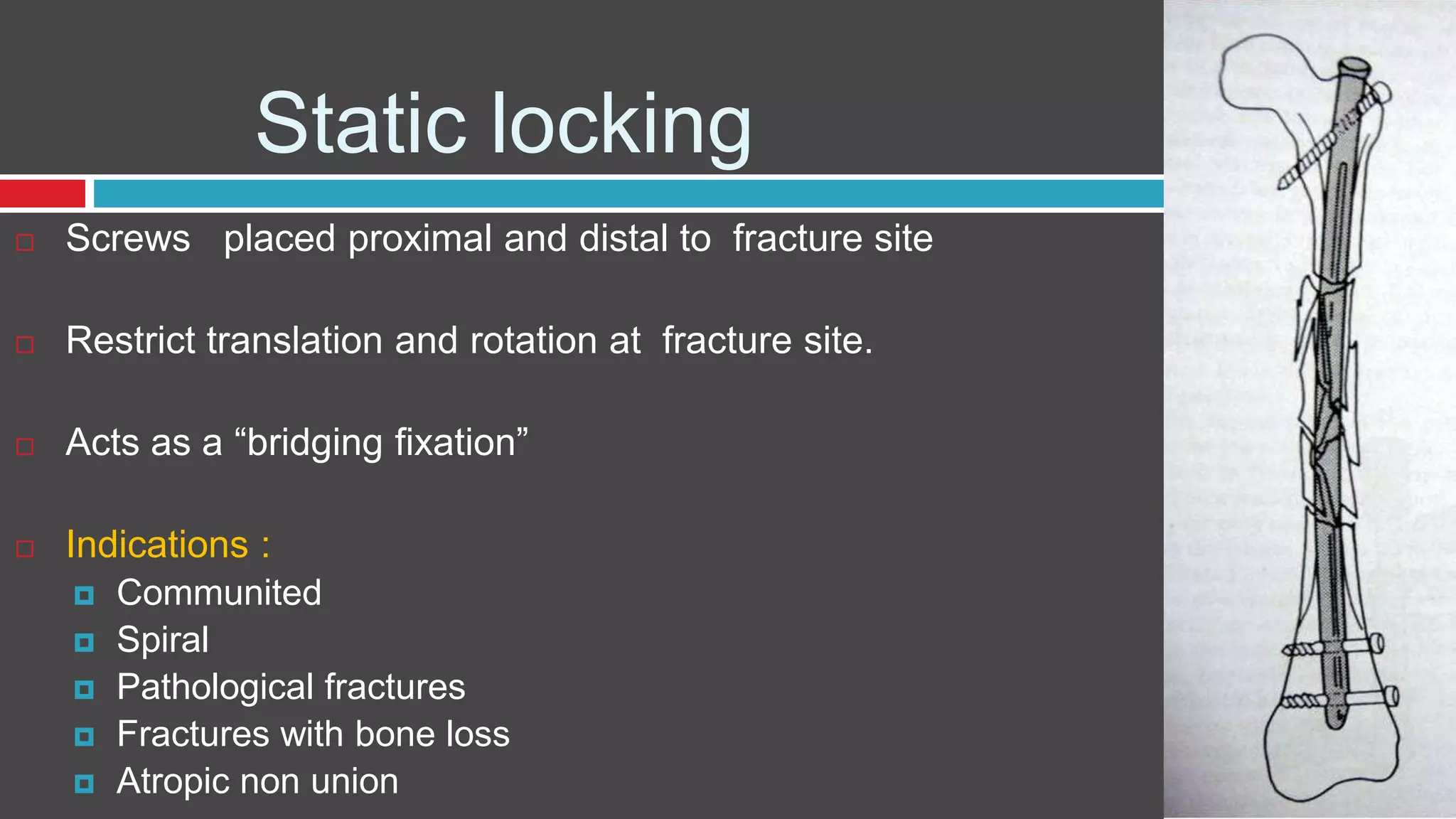
Poller /blocking screws
 Corrects mal-alignment.
 Centers IM nail.
 Planned and inserted before
IM nail insertion.
 Saggital or coronal plane.
Static locking
 Screws placed proximal and distal to fracture site
 Restrict translation and rotation at fracture site.
 Acts as a “bridging fixation”
 Indications :
 Communited
 Spiral
 Pathological fractures
 Fractures with bone loss
 Atropic non union
Dynamic locking
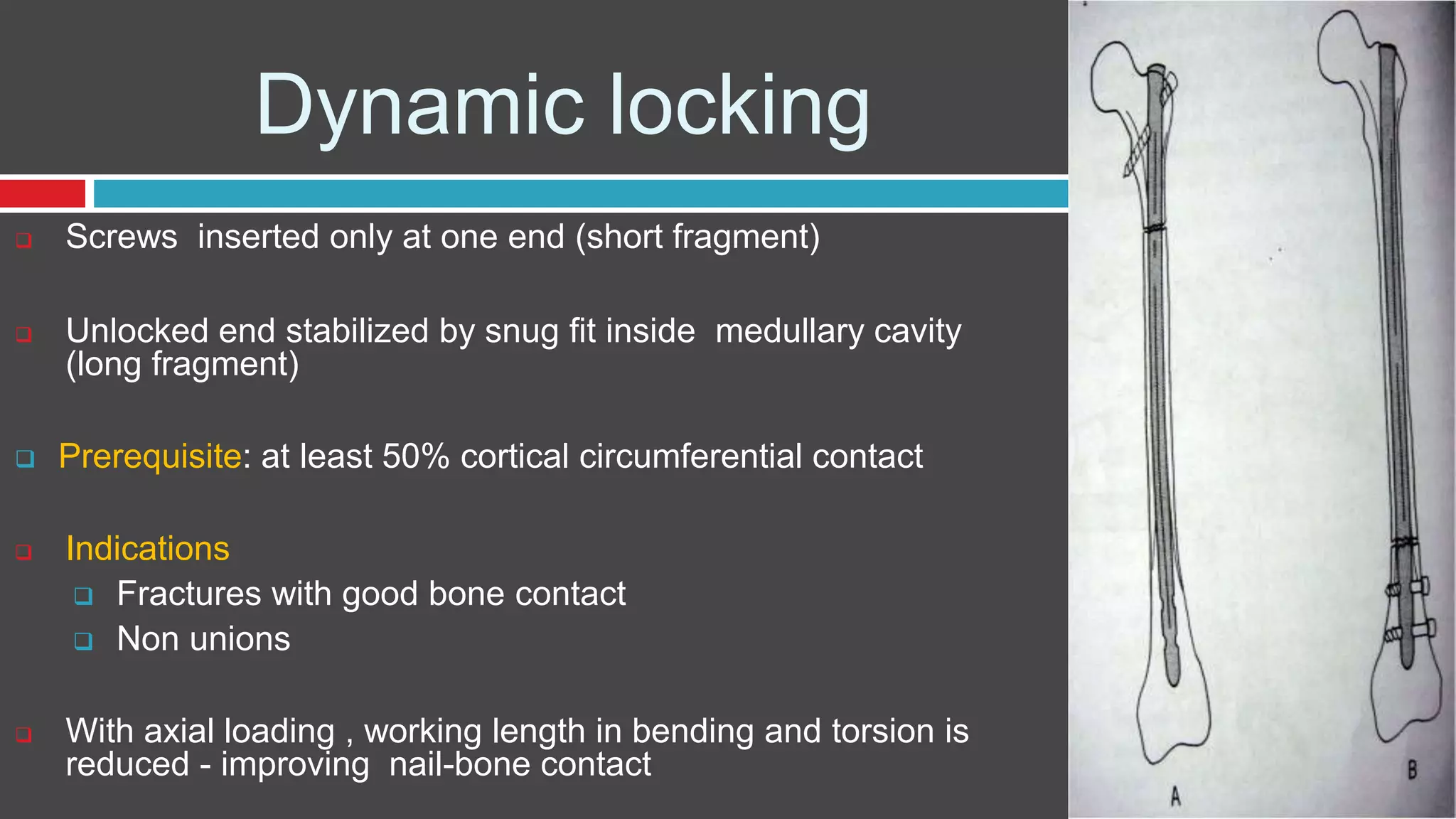
 Screws inserted only at one end (short fragment)
 Unlocked end stabilized by snug fit inside medullary cavity
(long fragment)
 Prerequisite: at least 50% cortical circumferential contact
 Indications
 Fractures with good bone contact
 Non unions
 With axial loading , working length in bending and torsion is
reduced - improving nail-bone contact
Dynamisation
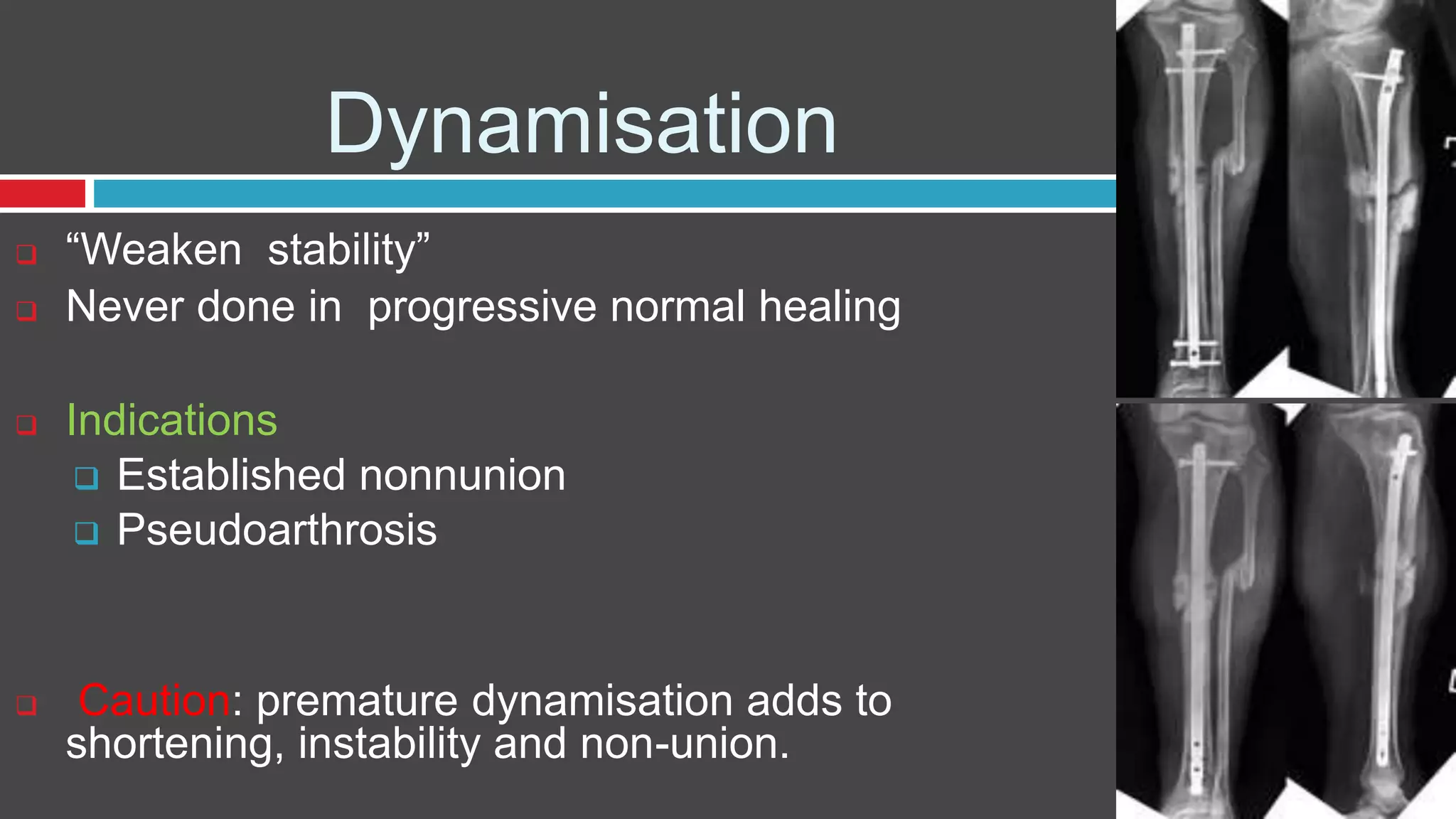
 “Weaken stability”
 Never done in progressive normal healing
 Indications
 Established nonnunion
 Pseudoarthrosis
 Caution: premature dynamisation adds to
shortening, instability and non-union.
Dynamisation
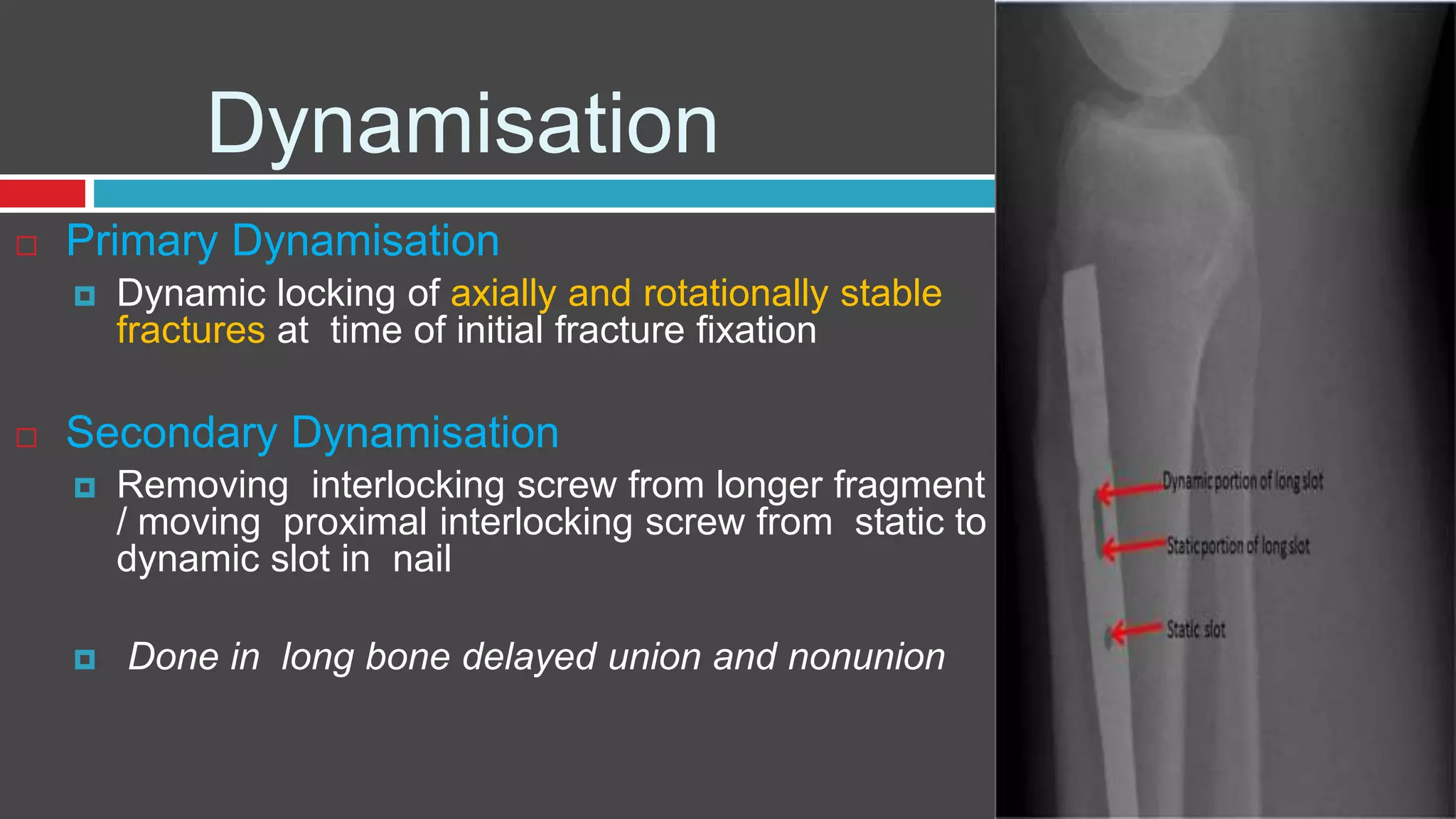
 Primary Dynamisation
 Dynamic locking of axially and rotationally stable
fractures at time of initial fracture fixation
 Secondary Dynamisation
 Removing interlocking screw from longer fragment
/ moving proximal interlocking screw from static to
dynamic slot in nail
 Done in long bone delayed union and nonunion
Reamed Versus Unreamed
 Endosteal thermo-necrosis & endosteal cortical blood supply disruption
 Minimized by using sharp reamers with deep cutting flutes.
 Reaming - slow and smooth.
 Endosteal blood supply regenerates rapidly - high healing rates in reamed
nails.
 No difference in infection rates
 No overall difference in time to union
Reamed Versus Unreamed
 Reamed nail :
 High chance of embolization of bone marrow fat to lungs but this phenomenon is limited &
transient
 Fat extravasation greatest during insertion of nail in medullary cavity
 Not dependent upon increased intra medullary pressure
 Reamed nailing generally report no statistical difference in pulmonary complications
as compared to unreamed nailing
Open intramedullary nailing
Primary indication :
 Failure to do closed nailing
 Nonunions
 Fractures requiring intramedullary fixation in existing
internal fixation device.
 Advantages :
 Less expensive equipment required than for closed nailing.
 No special fracture table / preliminary traction
 Absolute anatomical reduction
 Direct observation of bone - undisplaced / undetected comminution
 Improved rotational alignment and stability.
 Prevents torquing and twisting in segmental fractures
 In nonunions, opening of medullary canals of sclerotic bone is easier.
DISADVANTAGES :
Skin scars
Fracture hematoma evacuated.
 Bone shavings created by reaming medullary canal often are lost.
Infection rate increased.
 Rate of union decreased.
 If a locking nail is used, locking is difficult without image intensification
Nailing in open fractures
 If initial debridement adequate and timely , definitive stabilization with
reamed intramedullary nailing
 with severe soft tissue injuries that require a second debridement,
temporary external fixation reasonable
 increased risk of infection after use of external fixation pins longer than 2
weeks followed by reamed intramedullary nailing.
 Rapid initial management approach allows delayed conversion to a
medullary implant at 5 to 10 days.
Nailing in open fractures
 Fractures with delay in initial debridement of more than
8 hours - staged nailing.
 Acceptable complication rate (11 % infection rate in type
iii open fractures)
 No relationship between infection rate, non union with
timing of nailing or associated soft tissue injury
Aseptic non unions
 Without bone defects - primary im nailing or exchange
nailing if well aligned
 With bone defects - im nailing with bone grafting
 corticocancellous graft material - harvested with
ria(little donor morbidity)
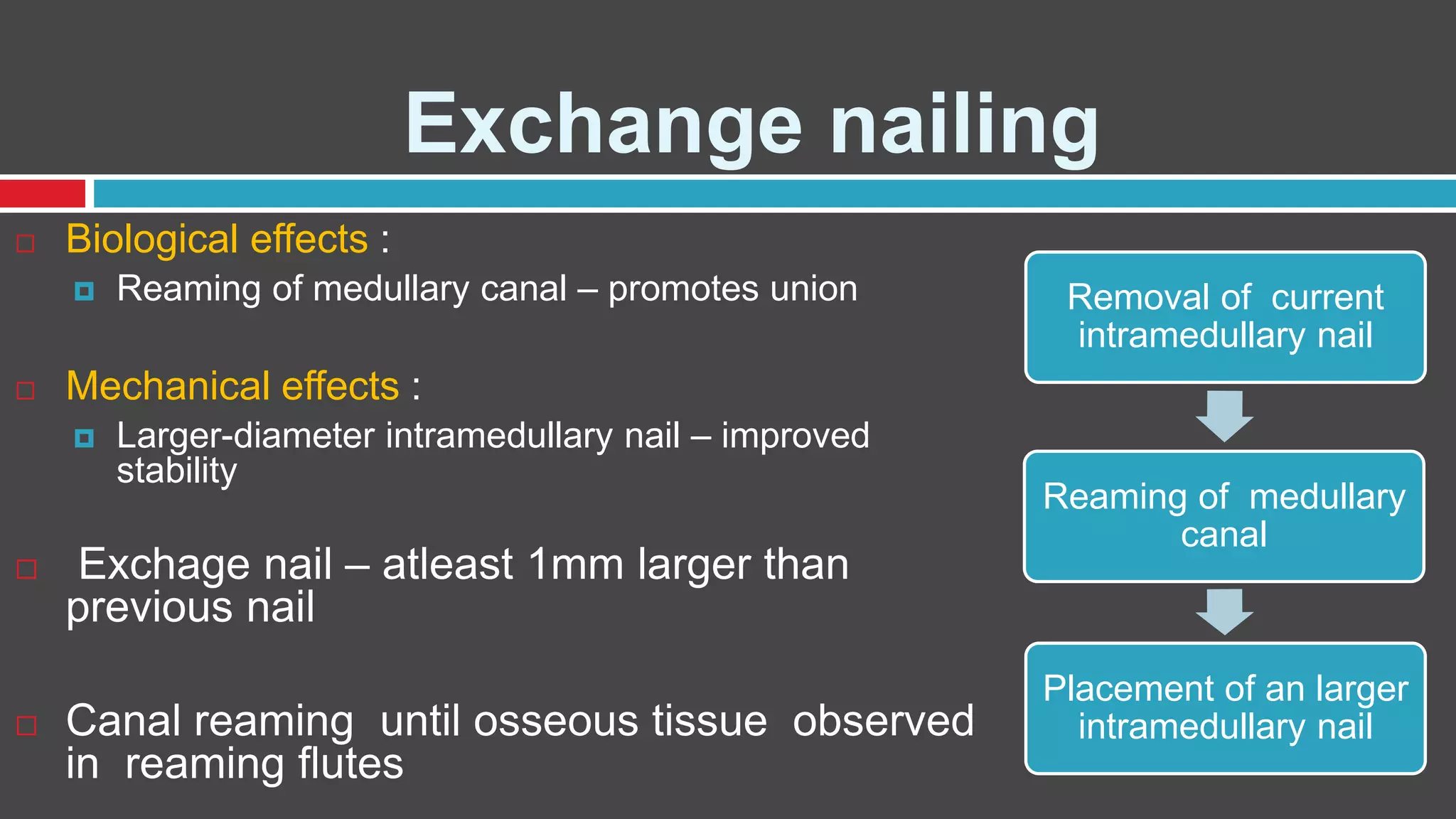
Exchange nailing
 Biological effects :
 Reaming of medullary canal – promotes union
 Mechanical effects :
 Larger-diameter intramedullary nail – improved
stability
 Exchage nail – atleast 1mm larger than
previous nail
 Canal reaming until osseous tissue observed
in reaming flutes
Removal of current
intramedullary nail
Reaming of medullary
canal
Placement of an larger
intramedullary nail
Septic non union
 Main aim - eradicating infection
 Osseous stability important in management of infected nonunion
 Stabilization with antibiotic impregnated cement coated nail after serial
debridement.
 Cement nail elute high concentration of antibiotic in local sites for up to 36 weeks.
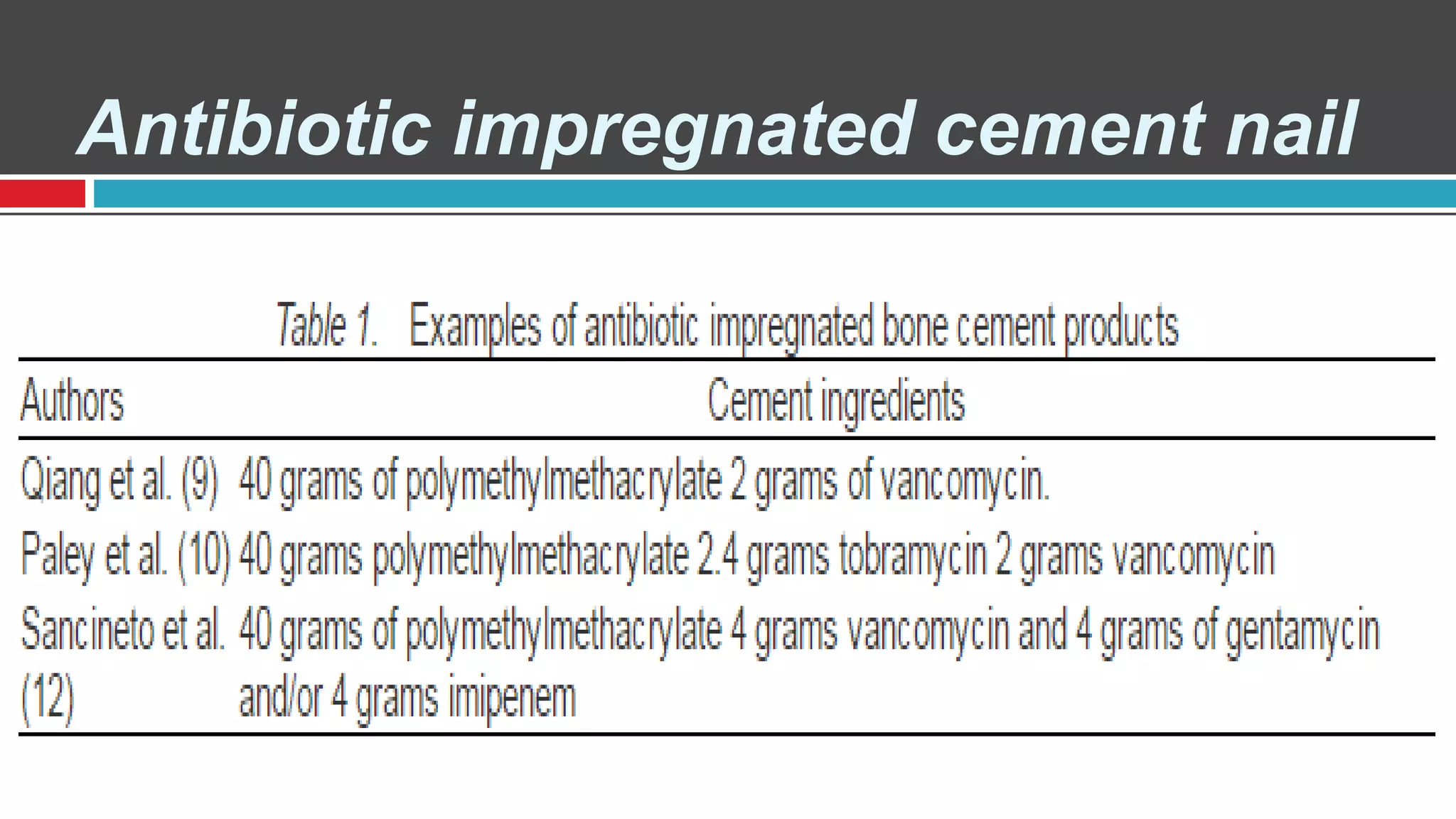
Antibiotic impregnated cement nail
Nailing in damage control orthopaedics (DCO)/early total care (ETC)
 In polytrauma , early femoral stabilization decreases incidence of
severe fat embolism and pulmonary complications (ARDS).
 Nailing with reaming will not increase pulmonary complications
 Early intramedullary nailing may be deleterious and is associated with
elevation of certain proinflammatory markers - (il)-6.
 Early external fixation of long bone fractures followed by delayed
intramedullary nailing – high risk patients.
Nailing in damage control orthopaedics (DCO)/early total care (ETC)
 50% (↓) in mortality patients who underwent femoral shaft
fracture stabilization beyond 12 hours
 This timing was hypothesized to allow for adequate
resuscitation
 Exact and optimal timing of femoral shaft fracture nailing
remains unclear in polytrauma(esp. Chest injuries)
Removal
 Timing controversial
 Indications :
 Patient request(after union)
 Pain, swelling secondary to backing out of implant.
 Infected nailing
 Full weight bearing immediately after removal
 Femoral nail removed after 24-36 months , tibial nail 18-24 months
Failure
 When fracture healing is delayed or nonunion occurs.
 IM nails usually fail in predictable patterns.
 Unlocked nails
 fail at fracture site or through a screw hole or slot.
 Locked nails
 screw breakage or fracturing of nail at locking hole sites(proximal
hole of distal interlocks )
Recent advances
 Biodegradable polymers
 Nickel-titanium shape-modifiable alloys
 can improve stability as they change shape after
insertion and recover curvature as they warm.
 IM nails coated with bmp
Conclusion
 Implant of choice in diaphyseal fractures
 Multiple factors determine final construct stiffness,
should be understood and considered when
choosing IM nail
 Ideal intramedullary nail is yet to be invented
Bibliography
 Campbell operative orthopaedics 12th edition
 Rockwood and green – fractures in adults 8th edition
 Elements of fracture fracture fixation – anand J.Thakur(3rd edition)
 History of intramedullary nailing ,matw R. Bong, M.D., Kenneth J.
Koval,m.D., And kenneth A. Egol, M.D., Bulletin of NYU hospital for
joint diseases • volume 64, numbers 3 & 4, 2006

Inra medullary nailing - basic concepts

  • 1.
    Dr.S.V.Hari krishnan PGT ,M.S .(Ortho) INTRAMEDULLARY NAILING BASIC CONCEPTS
  • 2.
    Learning Objectives  Introduction Evolution  Classification  Biomechanics  Applications  Special Circumstances  Recent Advances
  • 3.
    Introduction  Fracture stabilizedby one of two systems  Compression  Splinting  Intramedullary fixation - internal splinting  Splintage -micro motion between bone & implant  Relative stability without interfragmentary compression.  Entry point - distant from fracture site – hematoma retained.  Closed reduction and fixation (biological)
  • 4.
    Evolution 1st generation  Splints(1˚) Rotational stability minimal  Closed fit  Longitudinal slot along entire length  Eg –K nail , V nail 2nd generation • Locking screw - improved rotational stability • Non- slotted. • Eg-russel taylor nail, delta nail 3rd generation • Fit anatomically as much as possible • Aid insertion and stability • Titanium alloy • Eg-trigen nail, universal femoral nail nails with multiple curves ,multiple fixation systems • Tibial nail with malleolar fixation
  • 5.
    Classification  Entry Portals:  Centromedullary  K nail  Cephalomedullary  Gamma nail  Russell taylor nail  PFN  Condylocephalic nail  Ender nail Direction : Antegrade Retrograde
  • 6.
    Centromedullary Nails  Firstgeneration  Contained within medullary canal  Usually inserted from piriformis fossa  Proximal locking bolts - transverse or oblique in pertrochanter  Requires LT be attached to proximal fragment for adequate # stabilization
  • 7.
    Cephalomedullary Nails  secondgeneration nails  More efficient load transfer than SHS  Shorter lever arm of IM device decreases tensile strain on implant - low risk of implant failure  screws/blade inserted cephald into femoral head and neck.  Gamma nail  Recon nail
  • 8.
    C o nd y l o c e p h a l i c F i x a t i o n  Elastic stable intramedullary nailing (ESIN) - primary definitive paediatric fracture care .  3 – point fixation or bundle nailing.  Elastic and small - micro-motion for rapid fracture healing.  Flexible -insertion through a cortical window.  Examples :  Lottes nails  Rush pins  Ender nails  Morote nails  Nancy nails  Prevot nails  Bundle nails
  • 9.
    Opposite  Apexof curvature - at level of fracture site.  Nail diameter - 40% of narrowest medullary canal diameter  Entry point - opposite to one another  Used without reaming.  Commonest biomechanical error is lack of internal support.
  • 10.
     Schneider nail[ solid, four fluted cross section and self broaching ends.  Harris condylocephalic nail [curved in two planes, and designed for percutaneous, retrograde fixation of extra capsular hip fractures.  Lottes tibial nail specially curved to fit tibia, and has triflanged cross section.
  • 11.
    Ender Nails  Solidpins with oblique tip and an eye in flange at or end  Designed for percutaneous, closed treatment of extra capsular hip fractures
  • 12.
    Rush Nails  Intendedfor fractures of diaphyseal or metaphyseal fractures of long bones like femur, tibia, febula, humerus, radius and ulna.  Pointed tip facilitates easy insertion.  Curve at top prevents rotation and stabilizes fracture.
  • 13.
    Bundle Pinning  C-or S – shaped, act like spring.  Principle introduced by hackethal.  Many pins are inserted in to bone until jammed within medullary cavity to provide compression between nails and bone.  Bending movements neutralized, but telescoping and rotational torsion not prevented
  • 14.
    Applications  Diaphyseal fracturesof long bones  High proximal and low distal fractures of long bones  Floating hip, floating knee, floating elbow.  Aseptic and septic non-union  Osteoporotic long bone fractures  Pathological fractures  Open fractures up to grade IIIA
  • 15.
    Contraindications  Narrow andanomalous medullary canal  Open growth plates  Prior malunion - prevents nail placement  History of intramedullary infection  Associated ipsilateral femoral neck or acetabular fracture (relative)
  • 16.
    Mechanics (K Nail) Elastic deformation or “elastic locking” of nail within medullary canal  Adequate friction of nail in both fracture fragments  To achieve elastic impingement-  “V” profile or even better “clover-leaf” design.
  • 17.
     Compressible intwo directions  Directions right angles to each other V Nail Clover Leaf Nail  Compressible in only one direction
  • 18.
    Elastic Compressibility OfClover – Leaf Nail
  • 19.
    Solid Nail ElasticNail  Not occupy full width of medullary canal  Nail with elastic cross section adjust to constrictions of medullary canal.
  • 20.
    Grosse – Kempfnail Russell – Taylor nail Brooker–Wills nail
  • 21.
  • 22.
    D F = ForceBending moment = F x D D PlateIM Nail Bending moment for plate greater due to force being applied over larger distance. D = distance from force to implant.
  • 23.
    Comparision • Nail crosssection round • Resisting loads equally in all directions. • Plate cross section rectangular resisting greater loads in one plane versus the other
  • 24.
    Cortical contact  -compressive loads borne by bony cortex  - compressive loads transferred to interlocking screws (“four-point bending of screws ”) + -
  • 25.
    Ideal Intramedullary Nail Strong and stable - maintain alignment and position  Prevent rotation - interlocking transfixing screws  Promote union - contact-compression forces at fracture surfaces  Accessible for easy removal
  • 26.
    Pre Requisites  Adequatepreoperative planning  Patient tolerance to a major surgical procedure  Availability of nails of suitable length and diameter  Suitable instruments, trained assistants, and optimal hospital conditions  Closed nailing techniques - whenever possible
  • 27.
    Pre Operative Planning BiplanerRadiographic Images • Bone Morphology • Canal Dimensions • Fracture Personality • Comminution • Fracture Extensions Length Of Nail • Radiographs of contra lateral femur (magnified) • Traction radiographs (comminuted #) • Palpable greater trochanter to lateral epicondyle. • TMD (tibial tubercle–medial malleolar distance) for tibial nail Diameter Of Nail • Narrowest portion of femoral canal at femoral isthmus – lateral radiograph • 1.0 to 1.5 mm greater in diameter than anticipated nail diameter.
  • 28.
    Nail Length  Preoperativeradiographs of fractured long bone with proximal and distal joints  AP radiograph of opposite normal limb at a tube distance of 1meter  Kuntscher measuring device :  Ossimeter used to measure length and width  Magnification is taken in to account
  • 29.
    Biomechanics  Stability determinedby  Nail design  Number and orientation of locking screws  Distance of locking screw from fracture site  Reaming or non reaming  Quality of bone  IM nails assumed to bear most of load initially,gradually transfer it to bone as fracture heals.
  • 30.
    Nail Design  Factorscontributing to biomechanical profile :  Material properties  Cross-sectional shape  Diameter  Curves  Length and working length  Ends of nail
  • 31.
    Nail design  Materialproperties  Titanium alloy and 316l stainless steel.  Modulus of elasticity  Titanium alloy – same as cortical bone  SS – twice as cortical bone  CROSS SECTIONAL SHAPE  Determines bending and torsional strengths  Polar moment of inertia  Circular nail  diameter  Square nail  edge length  High in nails with sharp corners or fluted edges
  • 32.
  • 33.
    Nail diameter Nail diameteraffects bending rigidity  solid circular nail,  Bending rigidity  third power of nail diameter (D3)  Torsional rigidity  fourth power of diameter (D4)  Large diameter with same cross- section are both stiffer and stronger than smaller ones.
  • 34.
    Nail curves  Longbones have curved medullary cavities  Nails contoured to accommodate curves of bone  Straight, curved or helical  Average radius of curvature of femur - 120(±36) cm.  Complete congruency minimizes normal forces and hence little frictional component to nail’s fixation.  Femoral nail designs have considerably less curve, with radius ranging from 150 to 300 cm  Im nails - straighter (larger radius) than femoral canal
  • 35.
    Nail curves  Angleof herzog :  11o bend in AP direction at junction of upper 1/3rd and lower 2/3rd of tibia nail  Mismatch in radius of curvature –  Distal anterior cortical perforation  more reaming required during insertion
  • 36.
    Hoop stress  Circumferentialexpansion stress during nail insertion  Larger hoop stress can split bone  Hoop stress reduction :  Use flexible nails  Over-ream entry hole by 0.5 to 1 cm  Selection of ideal entry point
  • 37.
    Posterior - lossof proximal fixation Ideal - posterior portion of piriformis fossa Anterior - generates huge forces, can lead to bursting of proximal
  • 38.
    Nail length A-Total naillength - Anatomical length B-working length - length between proximal and distal point of firm fixation to bone Working length Affected by various factors Type of force (Bending ,Torsion ) Type of fracture Interlocking and dynamization Reaming Weight bearing
  • 39.
    Nail length  Shorterworking length stronger fixation  Transverse fracture has a shorter working length than comminuted fracture  Torsional stiffness 1/ to l  Bending stiffness 1/ to l2  Surgeon’s techniques to modify “ l ”  Medullary reaming  Interlocking
  • 40.
    Extreme ends  K-nail Slot/eye in ends for extraction  One end tapered to facilitate insertion .  Holes for interlocking screws  Some nails have slots near distal end for placement of anti rotation screw  Anterior slot- Improved flexibility  Posterior slot - Increased bending strength  Non-slotted - Increased torsional stiffness and strength in smaller sizes
  • 41.
    Interlocking of nail Recommended for most cases of IM nailing.  Principle :  Resistance to axial and torsional forces depends on screw – bone interface  Length of bone maintained even in bone defect.  Number of interlocks :  Fracture location  Amount of fracture comminution  Fit of nail within canal.  Placing screws in multiple planes - reduction of minor movement
  • 42.
    Interlocking screw  Locationof distal locking screws affects biomechanics of fracture  Distal locking screws  Closer to fracture site - less cortical contact - increased stress on locking screws  Distal from fracture site - fracture becomes more rotationally stable  Interlocking screws positioned at least 2 cm from fracture provides sufficient stability
  • 43.
    Poller /blocking screws Corrects mal-alignment.  Centers IM nail.  Planned and inserted before IM nail insertion.  Saggital or coronal plane.
  • 44.
    Static locking  Screwsplaced proximal and distal to fracture site  Restrict translation and rotation at fracture site.  Acts as a “bridging fixation”  Indications :  Communited  Spiral  Pathological fractures  Fractures with bone loss  Atropic non union
  • 45.
    Dynamic locking  Screwsinserted only at one end (short fragment)  Unlocked end stabilized by snug fit inside medullary cavity (long fragment)  Prerequisite: at least 50% cortical circumferential contact  Indications  Fractures with good bone contact  Non unions  With axial loading , working length in bending and torsion is reduced - improving nail-bone contact
  • 46.
    Dynamisation  “Weaken stability” Never done in progressive normal healing  Indications  Established nonnunion  Pseudoarthrosis  Caution: premature dynamisation adds to shortening, instability and non-union.
  • 47.
    Dynamisation  Primary Dynamisation Dynamic locking of axially and rotationally stable fractures at time of initial fracture fixation  Secondary Dynamisation  Removing interlocking screw from longer fragment / moving proximal interlocking screw from static to dynamic slot in nail  Done in long bone delayed union and nonunion
  • 48.
    Reamed Versus Unreamed Endosteal thermo-necrosis & endosteal cortical blood supply disruption  Minimized by using sharp reamers with deep cutting flutes.  Reaming - slow and smooth.  Endosteal blood supply regenerates rapidly - high healing rates in reamed nails.  No difference in infection rates  No overall difference in time to union
  • 49.
    Reamed Versus Unreamed Reamed nail :  High chance of embolization of bone marrow fat to lungs but this phenomenon is limited & transient  Fat extravasation greatest during insertion of nail in medullary cavity  Not dependent upon increased intra medullary pressure  Reamed nailing generally report no statistical difference in pulmonary complications as compared to unreamed nailing
  • 50.
    Open intramedullary nailing Primaryindication :  Failure to do closed nailing  Nonunions  Fractures requiring intramedullary fixation in existing internal fixation device.
  • 51.
     Advantages : Less expensive equipment required than for closed nailing.  No special fracture table / preliminary traction  Absolute anatomical reduction  Direct observation of bone - undisplaced / undetected comminution  Improved rotational alignment and stability.  Prevents torquing and twisting in segmental fractures  In nonunions, opening of medullary canals of sclerotic bone is easier.
  • 52.
    DISADVANTAGES : Skin scars Fracturehematoma evacuated.  Bone shavings created by reaming medullary canal often are lost. Infection rate increased.  Rate of union decreased.  If a locking nail is used, locking is difficult without image intensification
  • 53.
    Nailing in openfractures  If initial debridement adequate and timely , definitive stabilization with reamed intramedullary nailing  with severe soft tissue injuries that require a second debridement, temporary external fixation reasonable  increased risk of infection after use of external fixation pins longer than 2 weeks followed by reamed intramedullary nailing.  Rapid initial management approach allows delayed conversion to a medullary implant at 5 to 10 days.
  • 54.
    Nailing in openfractures  Fractures with delay in initial debridement of more than 8 hours - staged nailing.  Acceptable complication rate (11 % infection rate in type iii open fractures)  No relationship between infection rate, non union with timing of nailing or associated soft tissue injury
  • 55.
    Aseptic non unions Without bone defects - primary im nailing or exchange nailing if well aligned  With bone defects - im nailing with bone grafting  corticocancellous graft material - harvested with ria(little donor morbidity)
  • 56.
    Exchange nailing  Biologicaleffects :  Reaming of medullary canal – promotes union  Mechanical effects :  Larger-diameter intramedullary nail – improved stability  Exchage nail – atleast 1mm larger than previous nail  Canal reaming until osseous tissue observed in reaming flutes Removal of current intramedullary nail Reaming of medullary canal Placement of an larger intramedullary nail
  • 57.
    Septic non union Main aim - eradicating infection  Osseous stability important in management of infected nonunion  Stabilization with antibiotic impregnated cement coated nail after serial debridement.  Cement nail elute high concentration of antibiotic in local sites for up to 36 weeks.
  • 58.
  • 59.
    Nailing in damagecontrol orthopaedics (DCO)/early total care (ETC)  In polytrauma , early femoral stabilization decreases incidence of severe fat embolism and pulmonary complications (ARDS).  Nailing with reaming will not increase pulmonary complications  Early intramedullary nailing may be deleterious and is associated with elevation of certain proinflammatory markers - (il)-6.  Early external fixation of long bone fractures followed by delayed intramedullary nailing – high risk patients.
  • 60.
    Nailing in damagecontrol orthopaedics (DCO)/early total care (ETC)  50% (↓) in mortality patients who underwent femoral shaft fracture stabilization beyond 12 hours  This timing was hypothesized to allow for adequate resuscitation  Exact and optimal timing of femoral shaft fracture nailing remains unclear in polytrauma(esp. Chest injuries)
  • 61.
    Removal  Timing controversial Indications :  Patient request(after union)  Pain, swelling secondary to backing out of implant.  Infected nailing  Full weight bearing immediately after removal  Femoral nail removed after 24-36 months , tibial nail 18-24 months
  • 62.
    Failure  When fracturehealing is delayed or nonunion occurs.  IM nails usually fail in predictable patterns.  Unlocked nails  fail at fracture site or through a screw hole or slot.  Locked nails  screw breakage or fracturing of nail at locking hole sites(proximal hole of distal interlocks )
  • 63.
    Recent advances  Biodegradablepolymers  Nickel-titanium shape-modifiable alloys  can improve stability as they change shape after insertion and recover curvature as they warm.  IM nails coated with bmp
  • 64.
    Conclusion  Implant ofchoice in diaphyseal fractures  Multiple factors determine final construct stiffness, should be understood and considered when choosing IM nail  Ideal intramedullary nail is yet to be invented
  • 65.
    Bibliography  Campbell operativeorthopaedics 12th edition  Rockwood and green – fractures in adults 8th edition  Elements of fracture fracture fixation – anand J.Thakur(3rd edition)  History of intramedullary nailing ,matw R. Bong, M.D., Kenneth J. Koval,m.D., And kenneth A. Egol, M.D., Bulletin of NYU hospital for joint diseases • volume 64, numbers 3 & 4, 2006

Editor's Notes

  • #8 controlled fracture impaction is maintained
  • #9 Nonreamed nails are actually not nails but pins. ir mechanical characteristics and use are different from IM nails. y are of smaller diameter and are more elastic. ir flexibility allows insertion through a cortical window. re are many different types of flexible nails, best known are:- Lottes nails - Tibia Rush pins – for all long bones of body Ender nails
  • #10  required precurve should be approximately 3 times diameter of a long bone at its narrowest point. Part of biomechanical stability is provided by intact muscle envelope surrounding long bone. beaked or hooked ends to allow satisfactory sliding down on insertion along inner surface of diaphysis without impacting opposite cortex. Two nails of same diameter and similarly prebent to be used. Insertion points that do not lie opposite to one anor produce differing internal tension and imbalance of fracture stability and fixation.  avoid early weight bearing following use of TENs in treatment of paediatric femoral fracture due to pain and muscle spasm in immediate period after surgery. We recommend start of weight bearing to be delayed until appearance of early callus formation at three to four weeks time following fixation. This in fact will furr support TENs that function eventually will become redundant once callus fully consolidate.
  • #14  equilibrium between tensioned pin and bone with its attached soft tissues will hold alignment
  • #22 Various types of load act on an IM nail: torsion, compression, tension and bending Physiologic loading is a combination of all se forces Various types of load act on an IM nail: torsion, compression, tension and bending
  • #26 It should be strong enough and provide sufficient stability to maintain alignment and position, including prevention of rotation; it should include interlocking transfixing screws as necessary. It should be constructed so that contact-compression forces can impact fracture surfaces, a desirable physiological stimulus to union. It should be placed so that it is accessible for easy removal; attachments are provided to facilitate removal
  • #32 Modulus is ability to resist deformation in tension cross-sectional shape of nail ,Diameter determines its bending and torsional strengths( Resistance of a structure to torsion or twisting force is called polar movement of inertia ) Circular nail has polar movement of inertia proportional to its diameter, in square nail its proportional to edge length Nails with Sharp corners or fluted edges has more polar movement inertia Cloverleaf design resist bending most effectively .Presence of slot reduces torsional strength . It is more rigid when slot is placed in tensile side
  • #33 Cloverleaf design resist bending most effectively Presence of slot reduces torsional strength It is most rigid when slot is placed in tensile side (anterolateral) Slot in compression side  buckling
  • #34  diameter of a nail should always be measured with a circular guage. In reamed nailing, width of nail is better determined by feel of reamers than by radiographic measurements, although approximate size to be used can be determined from preoperative radiographs.
  • #35 Governs how easily a nail can be inserted as well as bone/ nail mismatch, in turn influences stability of fixation of nail in bone.
  • #36 Biomechanically, unlocked nails attain stability by a curvature mismatch between bone and nail, inducing a longitudinal interference fit.
  • #37 When inserting nail , axial force is necessary as nail must bend to fit curvature of medularly canal . insertion force generates hoop stress in bone ( Circumferential expansion stress ) Greater insertion force higher hoop stress. Larger hoop stress can split bone
  • #39 -Length of a nail spanning fracture site from its distal point of fixation in proximal fragment to proximal point of fixation in distal fragment Un supported portion of nail between two major fragments
  • #40 Surgeon’s Techniques to modify L 1.Medullary reaming Prepares uniform canal improves nail-bone contact Decreases L 2. Interlocking Fixing nail to bone at specific points Medullary reaming prepares a uniform canal and improves nail- bone fixation Towards the fracture,thus reducing the working length.
  • #42 The principle of interlocking nailing is different. The nail is locked to the bone by inserting screws through the bone and the screw holes. The resistance to axial and torsional forces is mainly dependent on the screw – bone interface, and the length of the bone is maintained even if there is a bone defect. Stability depends on the locking screw diameter for a given nail diameter. In general, 4 to 5 mm for humeral nails and 5 to 6 mm for tibial and femoral nails. Nail hole size should not exceed 50% of the nail diameter. Interlocking screws undergo four-point bending loads, with higher screw stresses seen at the most distal locking sites Oblique ( angled to nail axis, not 90°) proximal locking screws appear to increase the stability of proximal tibia fractures compared with transverse ( 90° to nail axis) locking screws. However, oblique or transverse orientation of the distal screws in distal-third tibia fractures has minimal effect on stability
  • #43 To improve the screw hold, different techniques have been invented. Vecsei suggested a dowel bolt for fixation in osteoporotic bone. A similar technique is the so – called modular screw, where the locking screw is inserted into bilaterally placed screws with a high thread depth. The aim of this technique is to increase the surface area with the bone. Some nails have a twisted blade instead of the proximal interlocking screw. In the distal femur, interlocking with a bladelike device has been shown to be 41% stiffer and 20% stronger than with conventional locking bolts. The number and orientation of the interlocking screws influence the stability of the nail – bone construct.
  • #49 Medullary canal is more or less like an hour-glass than a perfect cylinder. Reaming is an attempt to make the canal of uniform size to adapt the bone to the nail. The size of the canal limits the size of the nailIM reaming can act to increase the contact area between the nail and cortical bone by smoothing internal surfaces. When the nail is the same size as the reamer, 1 mm of reaming can increase the contact area by 38% . Reaming reduces the working length and increase the stability. More reaming allows insertion of a larger-diameter nail, which provides more rigidity in bending and torsion. Biomechanically, reamed nails provide better fixation stability than do unreamed nails Most nail require overreaming from 0.5 to 2mm over the size of the nail, depending on the type of nail, the configuration of the fracture, and the canal of the bone
  • #63  With all metallic implants, there is a relative race between bone healing and implant failure.
  • #65 Spectrum of indications has been extended by newer invention and techniques