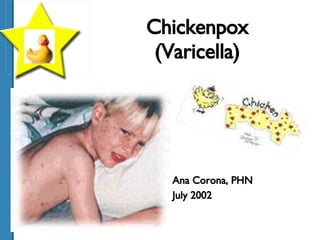
Chickenpox (Varicella) Ana Corona, PHN July 2002
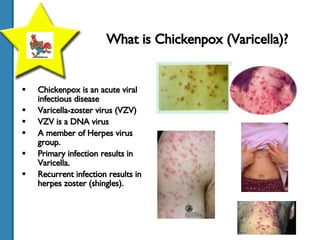
What is Chickenpox (Varicella)? Chickenpox is an acute viral infectious disease Varicella-zoster virus (VZV) VZV is a DNA virus A member of Herpes virus group. Primary infection results in Varicella. Recurrent infection results in herpes zoster (shingles).
Pathogenesis of Varicella Infection of skin and appearance of  vesicular rash Secondary Viremia  Primary Viremia Viral replication in liver, spleen,  and other organs Infection of conjunctivae and/or  mucosa of the upper respiratory tract Viral replication in regional lymph  nodes Day 14 Days 10 – 12 Day 4 – 6 Day 0 – 3
Clinical Features Mild prodrome (fever, malaise) for 1-2 days Successive crops (2-4 days) of pruritic vesicles Generally appear first on head; most concentrated on trunk Can spread over the entire body causing between 250 to 500  itchy blisters Generally mild in healthy children
What is The Chickenpox Illness Like? Chickenpox most commonly causes an illness that lasts about 5-10 days.  Children usually miss 5 or 6 days of school or childcare due to chickenpox.  1 child in 10 has a complication from chickenpox serious enough to visit a health care provider Including infected skin lesions and other infections. Dehydration from vomiting or diarrhea Exacerbation of asthma More serious complications such as pneumonia
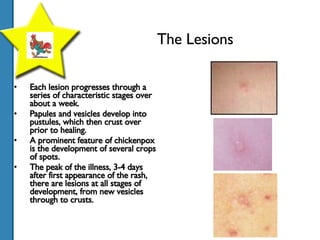
The Lesions  Each lesion progresses through a series of characteristic stages over about a week. Papules and vesicles develop into pustules, which then crust over prior to healing. A prominent feature of chickenpox is the development of several crops of spots. The peak of the illness, 3-4 days after first appearance of the rash, there are lesions at all stages of development, from new vesicles through to crusts.
Transmission: How do you get Chickenpox? Acquired by inhaling virus-containing particles, trapped in tiny droplets released into the air from the nose or throat of an infected person.  The virus (VZV) enters the body by infecting cells in the respiratory tract.  It spreads to many other parts of the body, including the skin, where it causes the characteristic rash. A person with chickenpox is contagious 1-2 days before the rash appears and until all blisters have formed scabs. It takes from 10-21 days after contact with an infected person for someone to develop chickenpox
Incubation period and prodromal illness   The wide range commonly quoted for the incubation period:  7-23 days. Time of contact and true source of infection may be difficult to pinpoint.  General constitutional symptoms sometimes precede the rash. This is called a prodrome. Young children generally have either no or a very mild prodrome. Older children and adults: the prodrome may be more pronounced.  Symptoms include fever (which may precede the rash by up to 6 days), headache, backache and sore throat
The Stages of Chickenpox Incubation Period  Usually (14-17 days) Prodrome (1 – 3 days) Vesicles Pustules  Scabs  Recovery typically 7 days after  rash appears (ranges 5 - 35 days)
Herpes Zoster (Shingles) Reactivation of Varicella Zoster Virus Associated with:  Aging Immunosuppression Intrauterine exposure Varicella at <18 month of age
Can chickenpox be caught from someone with Herpes Zoster (Shingles)? Yes.  The rash of shingles contains VZV particles, just like the rash of chickenpox.  Shingles carries a small risk of transmitting chickenpox to someone who has not had chickenpox before.  An infant might acquire chickenpox by very close contact with a grandparent with shingles The risk of transmission is low - because VZV is not excreted from the throat during shingles.
Complications Bacterial infection of lesions CNS manifestations Pneumonia (rare in children) Hospitalization: 3 per 1000 cases Death: 1 per 60,000 cases
Groups at Increased Risk of Complications Normal Adults Immunocompromised persons Newborns with maternal rash onset within 5 days before to 48 hours after delivery
Chickenpox during pregnancy may result in: Congenital Varicella syndrome Severe Varicella syndrome Risk of neonatal death
Congenital Varicella Syndrome Results from maternal infection during pregnancy Period of risk may extend through first 20 weeks of pregnancy Atrophy of extremity with skin scarring, low birth weight, eye and neurologic abnormalities Risk appears to be small (<2%)
Laboratory Diagnosis Laboratory diagnosis is not routinely required Useful if confirmation of the diagnosis or determination of susceptibility is necessary Most frequent source of isolation is vesicular fluid Stained smears from vesicular scrapings (Tzanck Smear). Serology Tests for Varicella IgM antibody ELISA and Latex Agglutination (LA) useful in screening for varicella immunity
Can you get chickenpox more than once?   Yes But it is uncommon to do so. For most people, one infection is thought to confer lifelong immunity.
Management  Interventions designed to minimize fever and discomfort:  Antipyretic medicines Cool baths and soothing lotions  Chickenpox is not usually treated with a specific antiviral compound owing to its short duration and generally mild, uncomplicated nature.  Antiviral medication may be appropriate for older patients, in whom the disease tends to be more severe.
Acyclovir Therapy Healthy nonpregnant persons  > 13 years of age Children >12 months with chronic cutaneous or pulmonary disorders or on salicylate therapy Children receiving short intermittent or aerosolized steroids IV in Immunocompromised children and adults with viral-mediated complications Not recommended for post-exposure prophylaxis
What home treatments are available for chickenpox?   Fingernails trimmed short Calamine lotion and Aveeno (oatmeal) baths may help relieve some of the itching Aspirin or aspirin-containing products to relieve your child's fever are not recommended. The use of aspirin has been associated with development of Reye syndrome (a severe disease affecting all organs - most seriously affecting the liver and brain, that may cause death). The use of non aspirin medications such as acetaminophen is recommended.
Complications Certain groups of persons are more likely to have more serious illness with complications.  These include adults, infants, adolescents and people with weak immune systems from either illnesses or from medications such a long-term steroids.
What Complications Result From Varicella?   The most common complications are: Bacterial infections of the skin and soft tissues in children Septicemia Toxic Shock Syndrome Necrotizing Fascitis Osteomyelitis Bacterial pneumonia Septic arthritis. 
Complications: Continued Varicella is a well described risk factor for invasive group A streptococcus infections.  Other complications: Cerebellar ataxia Encephalitis Hemorrhagic complications leading to bleeding disorders including disseminated intravascular coagulation (DIC).
Morbidity and mortality Since 1999, states have been encouraged to report chickenpox deaths to CDC.  In 1999 and 2000, CDC received reports that showed that deaths from chickenpox continue to occur in healthy, unvaccinated children and adults.  Most of the healthy adults who died from chickenpox contracted the disease from their unvaccinated children.
How serious a disease is varicella?   Prior to the availability of varicella vaccine there were approximately 4 million cases of varicella a year in the U.S.  Many health care providers are not aware that 11,000 hospitalizations and 100 deaths occurred every year in the United States before varicella vaccine became available. The majority of deaths and complications occurred in previously healthy individuals.
When is it necessary to go to the doctor for treatment?   If a fever lasts longer than 4 days or rises above 102 ºF.  Lesions which become very red, warm, tender, or is leaking pus may mean there is a bacterial infection.  Lethargy Difficulty walking Stiff neck Severe Vomiting Difficulty breathing Severe cough.
Can chickenpox be prevented ?  Yes, chickenpox can  now be prevented by vaccination
Varicella Vaccine 1 dose (<13 years of age) Schedule  >7 years Duration of Immunity 95% (range 65%-100%) Efficacy Live Virus (Oka-Merck strain) Composition
Varicella Vaccine Recommendations Routine vaccination at 12 to 18 months of age Recommended for all susceptible children by the 13 th  birthday Persons  > 13 years of age without history of Varicella Two doses separated by 4 – 8 weeks
Varicella Vaccine: Post-exposure Prophylaxis Varicella vaccine is recommended for use in susceptible person after exposure to Varicella 70% - 100% effective if given within 72 hours of exposure Not effective if >5 days but will produce immunity if not infected
Varicella Vaccine: Adverse Reactions Injection site complaints:  20% Rash: 3% - 4% May be maculopapular rather than vesicular Average 5 lesions Systemic reactions uncommon
Zoster Following Vaccination Most cases in children Risk from wild virus 4 to 5 times higher than from vaccine virus Mild illness without complications
Varicella Vaccine: Contraindications and Precautions Severe allergy to vaccine component or prior dose of vaccine Pregnancy Immunosuppression Moderate or severe acute illness Recent blood product Immunocompromised persons should not be vaccinated Vaccinate persons with humoral immunodeficiency
Varicella Zoster Immune Globulin (VZIG) May modify or prevent disease if given <96 hours after exposure Indications: Immunocompromised persons Newborn of mothers with onset 5 days before to 2 days after birth Premature infants with postnatal exposure Susceptible adults and pregnant women
What problems can occur after chickenpox vaccination?   Soreness, redness, or swelling at injection site is the most common side effect, occurring about 20% of the time.  A very mild rash or several small bumps can result in about 1% to 4% of vaccine recipients. It may be possible for someone who gets a rash from chickenpox vaccine to give vaccine strain chickenpox to another person.  The vaccine may cause a mild fever 2 weeks after vaccination.  Seizures usually caused by fever may occur in less than 1 in 1000 vaccine recipients.
Have serious reactions ever occurred from the chickenpox vaccine?   After distribution of the first 10 million doses of the vaccine, reports of serious adverse events after vaccination Seizures, encephalitis, pneumonia, ataxia and anaphylaxis have been very rare, occurring approximately 1 for every 50,000 doses given
What should I do if there is a serious reaction after chickenpox vaccination?   Call health care provider or 911 right away.  Write down what happened and the date and time it happened.  Ask your health care provider or health department to file a Vaccine Adverse Event Report Form or you can call (800) 822-7967 (toll-free).
Vaccine Birth Defects There is a theoretical risk that when administered one month prior to, or during, pregnancy, the vaccine may cause birth defects similar to those that can occur from natural chickenpox: Limb abnormalities Abnormal brain development Mental Retardation Scarring of the skin and eye abnormalities
Why not allow children to acquire natural infection and offer vaccine only to susceptible adolescents and adults? Approximately 60% of hospitalizations and 40% of deaths due to varicella occur in children less than 10 years of age. The majority of this morbidity is preventable by vaccination.
Continued  Children miss an average of 5-6 days of school when they have varicella Caregivers miss 3-4 days of work to care for their sick children.  The majority of adults who acquire varicella and persons at high risk for severe disease who are not eligible for vaccination, contract the disease from unvaccinated children.
Evaluation of Patient Education Materials Free No cost Cost Easy access from medical office, DHS Availability Easy to read 5 th  – 6 th  grade reading level Readability Provide useful information  Prevention  Usefulness
Evaluation of Community Resources Free Immunizations Payment for services Immunization Clinics  Easy access Accessibility of services Unimmunized population against chickenpox Population served Information on preventive measures Immunizations Services offered
Community Resources  Keepkidshealthy.com: http://visit.referralware.com/2/FreeOffer.jsp Information on Shingles: CDC:  http://www.cdc.gov/nip/diseases/varicella/faqs-gen-shingles.htm Varicella Vaccination in Pregnancy Registry:  1 (800) 986-8999 Varicella Vaccine Information: 1 (800) 9VARIVAX Information on acyclovir therapy  http://www.aap.org/family/chckpox.htm Prevention of Varicella: Updated Recommendations of the Advisory Committee on Immunization Practices (ACIP) http://www.cdc.gov/epo/mmwr/preview/mmwrhtml/rr4806a1.htm Immunization Action Coalition:  www.immunize.org Merck:  www.chickenpoxinfo.com National Immunization Program website:  http://www.cdc.gov/nip Vaccine Adverse Event Report (800) 822-7967  Los Angeles County Department of Health Services Clinics: 313 N. Figueroa St. Los Angeles, CA 90012:  [email_address]
Question A 6-year-old boy receiving prednisolone 2 mg/kg for asthma comes to the clinic the day he develops varicella rash. Which of the following is the required treatment?  A: Varicella-zoster immune globulin (VZIG)  B: Acyclovir  C: Varicella vaccine  D: All of the above  E: None of the above
Answer The correct answer is B: VZIG and vaccine are effective if given within 3-4 days of exposure but are ineffective once the varicella rash has appeared.  Children on systemic steroids are at high risk for complications and should receive acyclovir
Quiz: True or False? 2.  Varicella spread can be prevented by isolating all children with Varicella rash.  ANSWER False: The disease is infectious 2 days before the rash appears.  Children also may acquire the disease from adults with herpes zoster
References Atkinson, W. Wolfe, C. & Humiston, S. (2000). Epidemiology and prevention of vaccine-preventable diseases (6 th  ed.). Centers for Disease Control and Prevention. Centers for Disease Control and Prevention:  http://www.cdc.gov Immunization Action Coalition:  www.immunize.org Merck, (1999). Chickenpox: A disease worth preventing. Merck & Co., Inc. Varicella from Pediatrics:  http://author.emedicine.com/PED/topic2385.htm
Any Questions?

Chickenpox Presentation

  • 1.
    Chickenpox (Varicella) AnaCorona, PHN July 2002
  • 2.
    What is Chickenpox(Varicella)? Chickenpox is an acute viral infectious disease Varicella-zoster virus (VZV) VZV is a DNA virus A member of Herpes virus group. Primary infection results in Varicella. Recurrent infection results in herpes zoster (shingles).
  • 3.
    Pathogenesis of VaricellaInfection of skin and appearance of vesicular rash Secondary Viremia Primary Viremia Viral replication in liver, spleen, and other organs Infection of conjunctivae and/or mucosa of the upper respiratory tract Viral replication in regional lymph nodes Day 14 Days 10 – 12 Day 4 – 6 Day 0 – 3
  • 4.
    Clinical Features Mildprodrome (fever, malaise) for 1-2 days Successive crops (2-4 days) of pruritic vesicles Generally appear first on head; most concentrated on trunk Can spread over the entire body causing between 250 to 500 itchy blisters Generally mild in healthy children
  • 5.
    What is TheChickenpox Illness Like? Chickenpox most commonly causes an illness that lasts about 5-10 days. Children usually miss 5 or 6 days of school or childcare due to chickenpox. 1 child in 10 has a complication from chickenpox serious enough to visit a health care provider Including infected skin lesions and other infections. Dehydration from vomiting or diarrhea Exacerbation of asthma More serious complications such as pneumonia
  • 6.
    The Lesions Each lesion progresses through a series of characteristic stages over about a week. Papules and vesicles develop into pustules, which then crust over prior to healing. A prominent feature of chickenpox is the development of several crops of spots. The peak of the illness, 3-4 days after first appearance of the rash, there are lesions at all stages of development, from new vesicles through to crusts.
  • 7.
    Transmission: How doyou get Chickenpox? Acquired by inhaling virus-containing particles, trapped in tiny droplets released into the air from the nose or throat of an infected person. The virus (VZV) enters the body by infecting cells in the respiratory tract. It spreads to many other parts of the body, including the skin, where it causes the characteristic rash. A person with chickenpox is contagious 1-2 days before the rash appears and until all blisters have formed scabs. It takes from 10-21 days after contact with an infected person for someone to develop chickenpox
  • 8.
    Incubation period andprodromal illness The wide range commonly quoted for the incubation period: 7-23 days. Time of contact and true source of infection may be difficult to pinpoint. General constitutional symptoms sometimes precede the rash. This is called a prodrome. Young children generally have either no or a very mild prodrome. Older children and adults: the prodrome may be more pronounced. Symptoms include fever (which may precede the rash by up to 6 days), headache, backache and sore throat
  • 9.
    The Stages ofChickenpox Incubation Period Usually (14-17 days) Prodrome (1 – 3 days) Vesicles Pustules Scabs Recovery typically 7 days after rash appears (ranges 5 - 35 days)
  • 10.
    Herpes Zoster (Shingles)Reactivation of Varicella Zoster Virus Associated with: Aging Immunosuppression Intrauterine exposure Varicella at <18 month of age
  • 11.
    Can chickenpox becaught from someone with Herpes Zoster (Shingles)? Yes. The rash of shingles contains VZV particles, just like the rash of chickenpox. Shingles carries a small risk of transmitting chickenpox to someone who has not had chickenpox before. An infant might acquire chickenpox by very close contact with a grandparent with shingles The risk of transmission is low - because VZV is not excreted from the throat during shingles.
  • 12.
    Complications Bacterial infectionof lesions CNS manifestations Pneumonia (rare in children) Hospitalization: 3 per 1000 cases Death: 1 per 60,000 cases
  • 13.
    Groups at IncreasedRisk of Complications Normal Adults Immunocompromised persons Newborns with maternal rash onset within 5 days before to 48 hours after delivery
  • 14.
    Chickenpox during pregnancymay result in: Congenital Varicella syndrome Severe Varicella syndrome Risk of neonatal death
  • 15.
    Congenital Varicella SyndromeResults from maternal infection during pregnancy Period of risk may extend through first 20 weeks of pregnancy Atrophy of extremity with skin scarring, low birth weight, eye and neurologic abnormalities Risk appears to be small (<2%)
  • 16.
    Laboratory Diagnosis Laboratorydiagnosis is not routinely required Useful if confirmation of the diagnosis or determination of susceptibility is necessary Most frequent source of isolation is vesicular fluid Stained smears from vesicular scrapings (Tzanck Smear). Serology Tests for Varicella IgM antibody ELISA and Latex Agglutination (LA) useful in screening for varicella immunity
  • 17.
    Can you getchickenpox more than once? Yes But it is uncommon to do so. For most people, one infection is thought to confer lifelong immunity.
  • 18.
    Management Interventionsdesigned to minimize fever and discomfort: Antipyretic medicines Cool baths and soothing lotions Chickenpox is not usually treated with a specific antiviral compound owing to its short duration and generally mild, uncomplicated nature. Antiviral medication may be appropriate for older patients, in whom the disease tends to be more severe.
  • 19.
    Acyclovir Therapy Healthynonpregnant persons > 13 years of age Children >12 months with chronic cutaneous or pulmonary disorders or on salicylate therapy Children receiving short intermittent or aerosolized steroids IV in Immunocompromised children and adults with viral-mediated complications Not recommended for post-exposure prophylaxis
  • 20.
    What home treatmentsare available for chickenpox? Fingernails trimmed short Calamine lotion and Aveeno (oatmeal) baths may help relieve some of the itching Aspirin or aspirin-containing products to relieve your child's fever are not recommended. The use of aspirin has been associated with development of Reye syndrome (a severe disease affecting all organs - most seriously affecting the liver and brain, that may cause death). The use of non aspirin medications such as acetaminophen is recommended.
  • 21.
    Complications Certain groupsof persons are more likely to have more serious illness with complications. These include adults, infants, adolescents and people with weak immune systems from either illnesses or from medications such a long-term steroids.
  • 22.
    What Complications ResultFrom Varicella? The most common complications are: Bacterial infections of the skin and soft tissues in children Septicemia Toxic Shock Syndrome Necrotizing Fascitis Osteomyelitis Bacterial pneumonia Septic arthritis. 
  • 23.
    Complications: Continued Varicellais a well described risk factor for invasive group A streptococcus infections. Other complications: Cerebellar ataxia Encephalitis Hemorrhagic complications leading to bleeding disorders including disseminated intravascular coagulation (DIC).
  • 24.
    Morbidity and mortalitySince 1999, states have been encouraged to report chickenpox deaths to CDC. In 1999 and 2000, CDC received reports that showed that deaths from chickenpox continue to occur in healthy, unvaccinated children and adults. Most of the healthy adults who died from chickenpox contracted the disease from their unvaccinated children.
  • 25.
    How serious adisease is varicella? Prior to the availability of varicella vaccine there were approximately 4 million cases of varicella a year in the U.S. Many health care providers are not aware that 11,000 hospitalizations and 100 deaths occurred every year in the United States before varicella vaccine became available. The majority of deaths and complications occurred in previously healthy individuals.
  • 26.
    When is itnecessary to go to the doctor for treatment? If a fever lasts longer than 4 days or rises above 102 ºF. Lesions which become very red, warm, tender, or is leaking pus may mean there is a bacterial infection. Lethargy Difficulty walking Stiff neck Severe Vomiting Difficulty breathing Severe cough.
  • 27.
    Can chickenpox beprevented ? Yes, chickenpox can now be prevented by vaccination
  • 28.
    Varicella Vaccine 1dose (<13 years of age) Schedule >7 years Duration of Immunity 95% (range 65%-100%) Efficacy Live Virus (Oka-Merck strain) Composition
  • 29.
    Varicella Vaccine RecommendationsRoutine vaccination at 12 to 18 months of age Recommended for all susceptible children by the 13 th birthday Persons > 13 years of age without history of Varicella Two doses separated by 4 – 8 weeks
  • 30.
    Varicella Vaccine: Post-exposureProphylaxis Varicella vaccine is recommended for use in susceptible person after exposure to Varicella 70% - 100% effective if given within 72 hours of exposure Not effective if >5 days but will produce immunity if not infected
  • 31.
    Varicella Vaccine: AdverseReactions Injection site complaints: 20% Rash: 3% - 4% May be maculopapular rather than vesicular Average 5 lesions Systemic reactions uncommon
  • 32.
    Zoster Following VaccinationMost cases in children Risk from wild virus 4 to 5 times higher than from vaccine virus Mild illness without complications
  • 33.
    Varicella Vaccine: Contraindicationsand Precautions Severe allergy to vaccine component or prior dose of vaccine Pregnancy Immunosuppression Moderate or severe acute illness Recent blood product Immunocompromised persons should not be vaccinated Vaccinate persons with humoral immunodeficiency
  • 34.
    Varicella Zoster ImmuneGlobulin (VZIG) May modify or prevent disease if given <96 hours after exposure Indications: Immunocompromised persons Newborn of mothers with onset 5 days before to 2 days after birth Premature infants with postnatal exposure Susceptible adults and pregnant women
  • 35.
    What problems canoccur after chickenpox vaccination? Soreness, redness, or swelling at injection site is the most common side effect, occurring about 20% of the time. A very mild rash or several small bumps can result in about 1% to 4% of vaccine recipients. It may be possible for someone who gets a rash from chickenpox vaccine to give vaccine strain chickenpox to another person. The vaccine may cause a mild fever 2 weeks after vaccination. Seizures usually caused by fever may occur in less than 1 in 1000 vaccine recipients.
  • 36.
    Have serious reactionsever occurred from the chickenpox vaccine? After distribution of the first 10 million doses of the vaccine, reports of serious adverse events after vaccination Seizures, encephalitis, pneumonia, ataxia and anaphylaxis have been very rare, occurring approximately 1 for every 50,000 doses given
  • 37.
    What should Ido if there is a serious reaction after chickenpox vaccination? Call health care provider or 911 right away. Write down what happened and the date and time it happened. Ask your health care provider or health department to file a Vaccine Adverse Event Report Form or you can call (800) 822-7967 (toll-free).
  • 38.
    Vaccine Birth DefectsThere is a theoretical risk that when administered one month prior to, or during, pregnancy, the vaccine may cause birth defects similar to those that can occur from natural chickenpox: Limb abnormalities Abnormal brain development Mental Retardation Scarring of the skin and eye abnormalities
  • 39.
    Why not allowchildren to acquire natural infection and offer vaccine only to susceptible adolescents and adults? Approximately 60% of hospitalizations and 40% of deaths due to varicella occur in children less than 10 years of age. The majority of this morbidity is preventable by vaccination.
  • 40.
    Continued Childrenmiss an average of 5-6 days of school when they have varicella Caregivers miss 3-4 days of work to care for their sick children. The majority of adults who acquire varicella and persons at high risk for severe disease who are not eligible for vaccination, contract the disease from unvaccinated children.
  • 41.
    Evaluation of PatientEducation Materials Free No cost Cost Easy access from medical office, DHS Availability Easy to read 5 th – 6 th grade reading level Readability Provide useful information Prevention Usefulness
  • 42.
    Evaluation of CommunityResources Free Immunizations Payment for services Immunization Clinics Easy access Accessibility of services Unimmunized population against chickenpox Population served Information on preventive measures Immunizations Services offered
  • 43.
    Community Resources Keepkidshealthy.com: http://visit.referralware.com/2/FreeOffer.jsp Information on Shingles: CDC: http://www.cdc.gov/nip/diseases/varicella/faqs-gen-shingles.htm Varicella Vaccination in Pregnancy Registry: 1 (800) 986-8999 Varicella Vaccine Information: 1 (800) 9VARIVAX Information on acyclovir therapy http://www.aap.org/family/chckpox.htm Prevention of Varicella: Updated Recommendations of the Advisory Committee on Immunization Practices (ACIP) http://www.cdc.gov/epo/mmwr/preview/mmwrhtml/rr4806a1.htm Immunization Action Coalition: www.immunize.org Merck: www.chickenpoxinfo.com National Immunization Program website: http://www.cdc.gov/nip Vaccine Adverse Event Report (800) 822-7967 Los Angeles County Department of Health Services Clinics: 313 N. Figueroa St. Los Angeles, CA 90012: [email_address]
  • 44.
    Question A 6-year-oldboy receiving prednisolone 2 mg/kg for asthma comes to the clinic the day he develops varicella rash. Which of the following is the required treatment? A: Varicella-zoster immune globulin (VZIG) B: Acyclovir C: Varicella vaccine D: All of the above E: None of the above
  • 45.
    Answer The correctanswer is B: VZIG and vaccine are effective if given within 3-4 days of exposure but are ineffective once the varicella rash has appeared. Children on systemic steroids are at high risk for complications and should receive acyclovir
  • 46.
    Quiz: True orFalse? 2. Varicella spread can be prevented by isolating all children with Varicella rash. ANSWER False: The disease is infectious 2 days before the rash appears. Children also may acquire the disease from adults with herpes zoster
  • 47.
    References Atkinson, W.Wolfe, C. & Humiston, S. (2000). Epidemiology and prevention of vaccine-preventable diseases (6 th ed.). Centers for Disease Control and Prevention. Centers for Disease Control and Prevention: http://www.cdc.gov Immunization Action Coalition: www.immunize.org Merck, (1999). Chickenpox: A disease worth preventing. Merck & Co., Inc. Varicella from Pediatrics: http://author.emedicine.com/PED/topic2385.htm
  • 48.