Second genetic code
Overlapping
and
Split genes
CONTENTS
• Introduction
• Second genetic code
• overlapping genes
• split genes
Introduction
• In prokaryotes, the coding sequences of genes are
continuous. i.e, uninterrupted with a very few exceptions.
• In addition, the genes are organised into groups, each such
groups forms a single transcription unit. i.e, operon
• Generally, the different genes occur as discrete unit
separate from each other , but some prokaryotic genes
may be overlapping.
• Eukaryotic genes present some interesting organisations.
Such as split genes, Overlapping genes , pseudogenes etc.
Second Genetic Code
• An imprecise term that sometimes refers to the nature of
the amino acid residues of a protien which determine its
secondary and tertiary structure, and sometimes to the
features of tRNA molecule that make it recognizable by
one amino acid synthase but not by others.
• During 1988-89, this problem of interaction of specific
tRNAs with corresponding amino acy 1 RNA synthetase
enzymes (aaRSs) for aminoacylation of tRNAs (transfer of
amino acid to tRNA) was described as the second genetic
code.
• Although we generally say that individual codons are
meant for specific amino acids, we should recognize the
fact that in reality, codons do not specify amino acids,
instead they specify tRNA molecules, which in turm
specify amino acids with the help of enzymes called ‘
amino acyl RNA synthetases’ (aaRSs).
• X-ray crystallographic structures of several ‘tRNA-
synthetase complexes’ representing intermediates in the
formation of ‘amino-acyl tRNAs’ have been studied.
• the most important of these is a complex between
‘glutamy I-tRNA synthetase’ with tRNAgln (tRNA for
glutamine) and ATP.
• It was shown that there are multiple points of contact all
along the inner side of the L-shaped structure of tRNA,
which help in recognition of tRNA by synthetase enzyme
and in the formation of linkage between tRNA and amino
acid .
Second Half of the Genetic code
• The ‘second Half of the genetic code’ refers to the of a
‘protein folding’ problem or to the rules, which govern the
formation of a three dimensional structure from the
primary structure (amino acid sequence ) of a protien.
• This problem also received attention of molecular
biologists during 1980s and 1990s, when the phrase ‘the
second half of Genetic code’ was popular.
• The problem continues to be important and is now more
often described as ‘protein folding’ problem.
Importants of Second genetic code
• Second genetic code led to the burgeoning field of genetic
engineering in which the genetic material of cells is altered
to tailor make proteins, such as those used as medicines to
treat diabetics and heart diseases.
• The newly deciphered code plays a key role in a later step
in protein synthesis.
• The newly revealed code helps explain a crucial aspect of
protein synthesis : the attraction of building blocks,
amino acids , to genetic materials inside the cell.
Overlapping Genes
• An overlapping gene is a gene whose expressible
nucleotide sequence partially overlaps with the
expressible nucleotide sequence of another in this way, a
nucleotide sequence may make a contribution to the
function of one or more gene products.
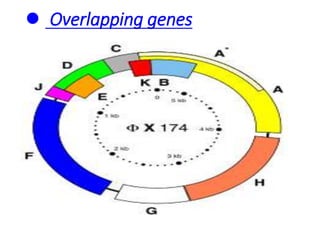
• Bacteriophage X174 contains a single stranded DNA
approximately 5400 nucleotides in length.the genome of
X174 consists of nine cistrons.
• From the information about proteins coded, an estimate
could be made of the number of nucleotides required.
• This estimated of number of nucleotides exceeds 6000
which is much higher than the actual number of
nucleotides presented i.e., 5400.
• Therefore,it was difficult to explain how these proteins
could by synthesized from a DNA Segment which is not
long enough to code for the required number of amino
acids.
• On detailed study of the system,it was discovered that
sequences in the segment could be utilized by two
different cistrons coding for different proteins.
• Such overlapping of cistrons will be theoretically possible
if the two cistrons have to function at different times and
their nucleotide sequence are translated in two different
reading frames.
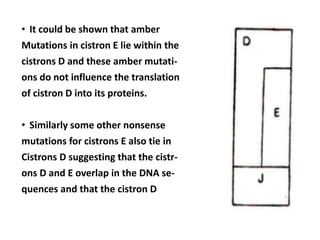
• In 1976, Barrell and his co- workers discovered that in
X174 , having nine cistrons ( A, B,C, D, E, J ,F,G,H) , cistron
E is presented between D and J and that the cistron E
overlaps cistron D.
 Overlapping genes
• It could be shown that amber
Mutations in cistron E lie within the
cistrons D and these amber mutati-
ons do not influence the translation
of cistron D into its proteins.
• Similarly some other nonsense
mutations for cistrons E also tie in
Cistrons D suggesting that the cistr-
ons D and E overlap in the DNA se-
quences and that the cistron D
and E are translated in two different reading frames so that
amber codon in mRNA of one cistron will not be read as
termination codon during the translation of mRNA of the
other cistron.
Split Genes
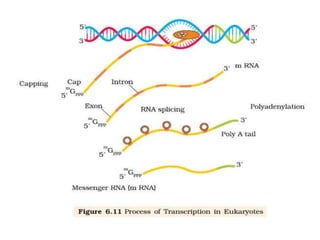
• Genes with interrupted sequence of nucleotides are
referred to as split genes.
• Usually a gene has a continuous sequence of nucleotides.
• In other words, there is no interruption in the nucleotides
sequence of a gene.such nucleotide sequence codes for a
particular single polypeptide chain.
• However, it was were observed that the sequence of
nucleotides was not contains in case of some genes,the
sequences of nucleotides were interrupted by
intervening sequences.
• Split genes were independently discovered by Richard J.
Roberts and Philip A. Sharp in 1977,for which they
shared the 1993 Nobel prize in Physiology or Medicine.
• The first observations of interrupted genes, i.e, genes in
which there are noncoding intron sequences between the
coding exon sequences ,were made in animal viruses in
1977.
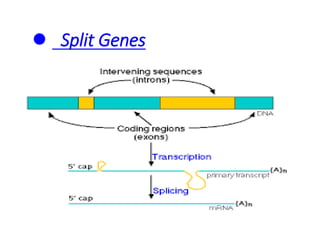
• Split Genes have two types of sequences:
1 ) Normal sequences. ( exons)
2 ) Interrupted sequence ( introns)
1) Normal sequence:
This represents the sequence of nucleotides which are
included in the mRNA is translated from DNA of split
gene.these sequences code for a particular polypeptides
chain and are known as exons.
 Split Genes
2) Interrupted sequence ( introns) :
• The intervening or interrupted sequences of split gene
are known as introns. These sequences do not code for
any peptide chain. Moreover, interrupted sequences are
not included into mRNA which is transcribed from DNA of
split genes.
Important features of split genes.
• Each interrupted gene begin's with an exon and ends with an
exon.
• The exons occur in the same precise order in the mRNA in
which they occur in the gene.
• The same interrupted gene organisation is consistently
presented in all the tissues of organisms.
• most introns are blocked in all reading frames. i.e,
termination codons occur frequently in their three reading
frames. Therefore, most introns fo not seem to have coding
functions.
Significance of split genes
• The significance of split organisation of eukaryotic genes is
not clear.
• In some cases, different exons of a gene code for different
active regions of the protein molecule e.g.in the case of
antibodies. Thus, it has been suggested that introns are
relics of evolutionary processes that brought together
different ancestral genes to form new larger genes. It is
also possible that some introns have been introduced
within certain exons during evolution.
• Introns may also provide for increased recombination rates
between exons of a gene and thus may be of some
significance in genetic variation.
• Introns are known to code for enzymes involved in the
processing of hn RNA. ( heterogeneous RNA).
References
• Fundamentals of Biochemistry,
By :- Dr. J.l. Jain
Dr. Sunjay Jain
Nitin jain
• Genetics
By: P. K. Gupta
• WWW. Google.com
• https://www.genescript.com>secondary gene...
Second genetic code overlapping and split genes

Second genetic code overlapping and split genes

  • 1.
  • 2.
    CONTENTS • Introduction • Secondgenetic code • overlapping genes • split genes
  • 3.
    Introduction • In prokaryotes,the coding sequences of genes are continuous. i.e, uninterrupted with a very few exceptions. • In addition, the genes are organised into groups, each such groups forms a single transcription unit. i.e, operon • Generally, the different genes occur as discrete unit separate from each other , but some prokaryotic genes may be overlapping.
  • 4.
    • Eukaryotic genespresent some interesting organisations. Such as split genes, Overlapping genes , pseudogenes etc.
  • 5.
    Second Genetic Code •An imprecise term that sometimes refers to the nature of the amino acid residues of a protien which determine its secondary and tertiary structure, and sometimes to the features of tRNA molecule that make it recognizable by one amino acid synthase but not by others. • During 1988-89, this problem of interaction of specific tRNAs with corresponding amino acy 1 RNA synthetase enzymes (aaRSs) for aminoacylation of tRNAs (transfer of amino acid to tRNA) was described as the second genetic code.
  • 6.
    • Although wegenerally say that individual codons are meant for specific amino acids, we should recognize the fact that in reality, codons do not specify amino acids, instead they specify tRNA molecules, which in turm specify amino acids with the help of enzymes called ‘ amino acyl RNA synthetases’ (aaRSs). • X-ray crystallographic structures of several ‘tRNA- synthetase complexes’ representing intermediates in the formation of ‘amino-acyl tRNAs’ have been studied. • the most important of these is a complex between ‘glutamy I-tRNA synthetase’ with tRNAgln (tRNA for glutamine) and ATP.
  • 7.
    • It wasshown that there are multiple points of contact all along the inner side of the L-shaped structure of tRNA, which help in recognition of tRNA by synthetase enzyme and in the formation of linkage between tRNA and amino acid .
  • 8.
    Second Half ofthe Genetic code • The ‘second Half of the genetic code’ refers to the of a ‘protein folding’ problem or to the rules, which govern the formation of a three dimensional structure from the primary structure (amino acid sequence ) of a protien. • This problem also received attention of molecular biologists during 1980s and 1990s, when the phrase ‘the second half of Genetic code’ was popular. • The problem continues to be important and is now more often described as ‘protein folding’ problem.
  • 9.
    Importants of Secondgenetic code • Second genetic code led to the burgeoning field of genetic engineering in which the genetic material of cells is altered to tailor make proteins, such as those used as medicines to treat diabetics and heart diseases. • The newly deciphered code plays a key role in a later step in protein synthesis. • The newly revealed code helps explain a crucial aspect of protein synthesis : the attraction of building blocks, amino acids , to genetic materials inside the cell.
  • 10.
    Overlapping Genes • Anoverlapping gene is a gene whose expressible nucleotide sequence partially overlaps with the expressible nucleotide sequence of another in this way, a nucleotide sequence may make a contribution to the function of one or more gene products. • Bacteriophage X174 contains a single stranded DNA approximately 5400 nucleotides in length.the genome of X174 consists of nine cistrons.
  • 11.
    • From theinformation about proteins coded, an estimate could be made of the number of nucleotides required. • This estimated of number of nucleotides exceeds 6000 which is much higher than the actual number of nucleotides presented i.e., 5400. • Therefore,it was difficult to explain how these proteins could by synthesized from a DNA Segment which is not long enough to code for the required number of amino acids.
  • 12.
    • On detailedstudy of the system,it was discovered that sequences in the segment could be utilized by two different cistrons coding for different proteins. • Such overlapping of cistrons will be theoretically possible if the two cistrons have to function at different times and their nucleotide sequence are translated in two different reading frames. • In 1976, Barrell and his co- workers discovered that in X174 , having nine cistrons ( A, B,C, D, E, J ,F,G,H) , cistron E is presented between D and J and that the cistron E overlaps cistron D.
  • 13.
  • 14.
    • It couldbe shown that amber Mutations in cistron E lie within the cistrons D and these amber mutati- ons do not influence the translation of cistron D into its proteins. • Similarly some other nonsense mutations for cistrons E also tie in Cistrons D suggesting that the cistr- ons D and E overlap in the DNA se- quences and that the cistron D
  • 15.
    and E aretranslated in two different reading frames so that amber codon in mRNA of one cistron will not be read as termination codon during the translation of mRNA of the other cistron.
  • 16.
    Split Genes • Geneswith interrupted sequence of nucleotides are referred to as split genes. • Usually a gene has a continuous sequence of nucleotides. • In other words, there is no interruption in the nucleotides sequence of a gene.such nucleotide sequence codes for a particular single polypeptide chain.
  • 17.
    • However, itwas were observed that the sequence of nucleotides was not contains in case of some genes,the sequences of nucleotides were interrupted by intervening sequences. • Split genes were independently discovered by Richard J. Roberts and Philip A. Sharp in 1977,for which they shared the 1993 Nobel prize in Physiology or Medicine. • The first observations of interrupted genes, i.e, genes in which there are noncoding intron sequences between the coding exon sequences ,were made in animal viruses in 1977.
  • 18.
    • Split Geneshave two types of sequences: 1 ) Normal sequences. ( exons) 2 ) Interrupted sequence ( introns) 1) Normal sequence: This represents the sequence of nucleotides which are included in the mRNA is translated from DNA of split gene.these sequences code for a particular polypeptides chain and are known as exons.
  • 19.
  • 21.
    2) Interrupted sequence( introns) : • The intervening or interrupted sequences of split gene are known as introns. These sequences do not code for any peptide chain. Moreover, interrupted sequences are not included into mRNA which is transcribed from DNA of split genes.
  • 22.
    Important features ofsplit genes. • Each interrupted gene begin's with an exon and ends with an exon. • The exons occur in the same precise order in the mRNA in which they occur in the gene. • The same interrupted gene organisation is consistently presented in all the tissues of organisms. • most introns are blocked in all reading frames. i.e, termination codons occur frequently in their three reading frames. Therefore, most introns fo not seem to have coding functions.
  • 23.
    Significance of splitgenes • The significance of split organisation of eukaryotic genes is not clear. • In some cases, different exons of a gene code for different active regions of the protein molecule e.g.in the case of antibodies. Thus, it has been suggested that introns are relics of evolutionary processes that brought together different ancestral genes to form new larger genes. It is also possible that some introns have been introduced within certain exons during evolution.
  • 24.
    • Introns mayalso provide for increased recombination rates between exons of a gene and thus may be of some significance in genetic variation. • Introns are known to code for enzymes involved in the processing of hn RNA. ( heterogeneous RNA).
  • 25.
    References • Fundamentals ofBiochemistry, By :- Dr. J.l. Jain Dr. Sunjay Jain Nitin jain • Genetics By: P. K. Gupta • WWW. Google.com • https://www.genescript.com>secondary gene...