Eman Salah
alrawas
Fatma Ali
alshanfari
Ghada Ghali
What is the memory?
•In psychology, memory is the process in
, andstored,encodedwhich information is
. Encoding allows information thatretrieved
is from the outside world to reach our
senses in the forms of chemical and
physical stimuli..
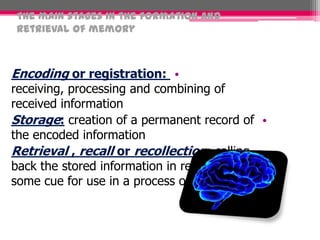
The main stages in the formation and
retrieval of memory
•or registration:Encoding
receiving, processing and combining of
received information
•creation of a permanent record of:torageS
the encoded information
•: callingrecollectionorrecall,Retrieval
back the stored information in response to
some cue for use in a process or activity
1-Sensory memory
•HoldsSensory memory
sensory information for a few
seconds or less after an item is
perceived.
2-Short-term memory
•Short-term memory allows recall for a period
of several seconds to a minute without
rehearsal.
•Short-term memory is believed to rely mostly
on an acoustic code for storing
information, and to a lesser extent a visual
code.
3-Long-term memory
•The storage in sensory memory and short-term
memory generally have a strictly limited capacity
and duration, which means that information is not
retained indefinitely.
•Long-term memories, on the other hand, are
maintained by more stable and permanent changes
in neural connections widely spread throughout the
brain.
Types of human memory
Working memory
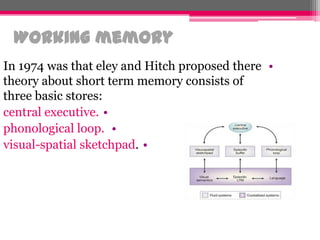
•In 1974 was that eley and Hitch proposed there
theory about short term memory consists of
three basic stores:
•central executive.
•phonological loop.
•visual-spatial sketchpad.
•Thank you

Human memory

  • 1.
  • 2.
    What is thememory? •In psychology, memory is the process in , andstored,encodedwhich information is . Encoding allows information thatretrieved is from the outside world to reach our senses in the forms of chemical and physical stimuli..
  • 3.
    The main stagesin the formation and retrieval of memory •or registration:Encoding receiving, processing and combining of received information •creation of a permanent record of:torageS the encoded information •: callingrecollectionorrecall,Retrieval back the stored information in response to some cue for use in a process or activity
  • 4.
    1-Sensory memory •HoldsSensory memory sensoryinformation for a few seconds or less after an item is perceived.
  • 5.
    2-Short-term memory •Short-term memoryallows recall for a period of several seconds to a minute without rehearsal. •Short-term memory is believed to rely mostly on an acoustic code for storing information, and to a lesser extent a visual code.
  • 6.
    3-Long-term memory •The storagein sensory memory and short-term memory generally have a strictly limited capacity and duration, which means that information is not retained indefinitely. •Long-term memories, on the other hand, are maintained by more stable and permanent changes in neural connections widely spread throughout the brain.
  • 7.
  • 9.
    Working memory •In 1974was that eley and Hitch proposed there theory about short term memory consists of three basic stores: •central executive. •phonological loop. •visual-spatial sketchpad.
  • 10.