Morphology
Discussion Flow:
What is “morphology”?
What is a “word”?
Morphemes
How is morphology studied?
 Further Distinctions
o The term morphology is Greek and is a makeup
of morph- meaning 'shape, form', and -ology which
means 'the study of something'.
o Therefore, it is the study of the structure of something;
the term is not just use in linguistics, but it is also used
in BIOLOGY- as the scientific study of forms and
structure of animals and plants.
What is
MORPHOLOGY?
In GEOLOGY as the study of formation and
evolution of rocks and land forms.
But we are going to stick to morphology in
linguistics, which is being defined as the
scientific study of forms and structure of
WORDS in a language.
Studies the formation of words from smaller units
called morphemes.
If morphology is the study of the
internal structure of words, we need to
define the word ”WORD” before we can
continue.......
Morphology
 Morphology as a sub-
discipline of linguistics
was named for the first
time in 1859 by the
German linguist August
Schleicher who used the
term for the study of the
form of words.
What is a word?
A reliable definition of words is that
they are the smallest independent
units of language.
They are independent in that they do not
depend on other words which means
that they can be separated from other
units and can change position.
Consider the sentence:
1.The man looked at the horses.
-The plural ending –s in horses is
dependent on the noun horse to
receive meaning and can therefore not
be a word. Horses however, is a word,
as it can occur in other positions in
the sentence or stand on its own.
Consider the sentence:
2.The horses looked at the man.
- What is the man looking at?
- Horses.
Words are thus both independent since
they can be separated from other words
and move around in sentences, and the
smallest units of language since they are
the only units of language for which this is
possible.
Morphemes
 In linguistics, a morpheme is the smallest component
of word, or other linguistic unit, that
has semantic meaning. The term is used as part of the
branch of linguistics known as morpheme-based
morphology. A morpheme is composed byphoneme(s)
(the smallest linguistically distinctive units of sound)
in spoken language, and by grapheme(s) (the smallest
units of written language) in written language.
 The concept of word and morpheme are different, a morpheme
may or may not stand alone. One or several morphemes
compose a word. A morpheme is free if it can stand alone
(ex: "one", "possible"), or bound if it is used exclusively alongside
a free morpheme (ex: "im" in impossible). Its actual phonetic
representation is themorph, with the different morphs ("in-",
"im-") representing the same morpheme being grouped as
its allomorphs.
 The word "unbreakable" has three morphemes: "un-", a bound
morpheme; "break", a free morpheme; and "-able", a bound
morpheme. "un-" is also a prefix, "-able" is asuffix. Both "un-"
and "-able" are affixes.
 The morpheme plural-s has the morph "-s", /s/, in cats (/kæts/),
but "-es", /ɨz/, indishes (/dɪʃɨz/), and even the voiced "-s", /z/,
in dogs (/dɒɡz/). "-s". These are allomorphs.
Complex words
 A word made up of two or more morphemes. Contrast
with monomorphemic word.
 "[W]e say that bookishness is a complex word, whose
immediate components arebookish and -ness, which
we can express in shorthand by spelling the word with
dashes between each morph: book-ish-ness. The
process of dividing a word into morphs is
calledparsing.”
 morphology lecture
 ‘lecture which has something to do with morphology’
 lecture = head of compound, morphology = modifier
 Compound with head = endocentric
 Meaning of compound determined regularly from meanings of
elements
 Compounding is recursive:
 (14) morphology class room change announcement (procedures
(review (committee (chairman
 (. . . )
 (15) blackbird
 N
 A N
 black bird
Three approaches
 Morpheme based
 Lexeme based
 Word based
Morpheme based
 In morpheme-based morphology, word forms are analyzed as
arrangements of morphemes. A morpheme is defined as the
minimal meaningful unit of a language. In a word such
as independently, the morphemes are said to be in-, depend, -ent,
and ly; depend is the root and the other morphemes are, in this
case, derivational affixes.[5] In words such as dogs, dog is the root
and the -s is an inflectional morpheme. In its simplest and most
naïve form, this way of analyzing word forms, called "item-and-
arrangement", treats words as if they were made of morphemes
put after each other ("concatenated") like beads on a string. More
recent and sophisticated approaches, such as distributed
morphology, seek to maintain the idea of the morpheme while
accommodating non-concatenative, analogical, and other
processes that have proven problematic for item-and-
arrangement theories and similar approaches.
Lexeme based
 Lexeme-based morphology usually takes what is called
an "item-and-process" approach. Instead of analyzing
a word form as a set of morphemes arranged in
sequence, a word form is said to be the result of
applying rules that alter a word-form or stem in order
to produce a new one. An inflectional rule takes a
stem, changes it as is required by the rule, and outputs
a word form; a derivational rule takes a stem, changes
it as per its own requirements, and outputs a derived
stem; a compounding rule takes word forms, and
similarly outputs a compound stem.
WORD BASED
also referred to as 'word and
radigm' approach. This method relies
the fact that generalizations exist
tween the forms of inflectional
tterns. More simply that words can be
tegorized based on the patterns that
ey fit into.
WHAT IS INFINITIVE?
An infinitive is the most basic
verb form in all languages. In
English, it is always preceded by
"to," as in "to run," "to love," and
"to travel." Verbs in the infinitive
form indicate what the action is
but nothing about who is doing
the action at what point in time.
1. As a Base for Conjugations
All of the indicative and some of the
subjunctive start with the infinitive. As
you will see in many verb references, the
first step to conjugating involves "the
stem of the infinitive." To find the stem,
simply take off the infinitive ending (-ar, -
er, or -ir).
amar (to love) -> amo
comer (to eat) -> como, comes
abrir (to open) -> abro, abres
2. As a noun
. In English, the gerund (verbs
that end in -ing) is used in these
instances, but not in Spanish
where the gerund is only used in
expressing continuous actions
such as the present progressive.
(Speaking Spanish is fun.)
(Taking pictures is prohibited.)
 3. After a Conjugated Verb
 Infinitives can be used many different
ways with or without prepositions to
express the idea of "to do" something.
 (We are going to dance.)
 (You have to take out the trash.)
 (I want to leave for the party.)
 (I like to draw.)
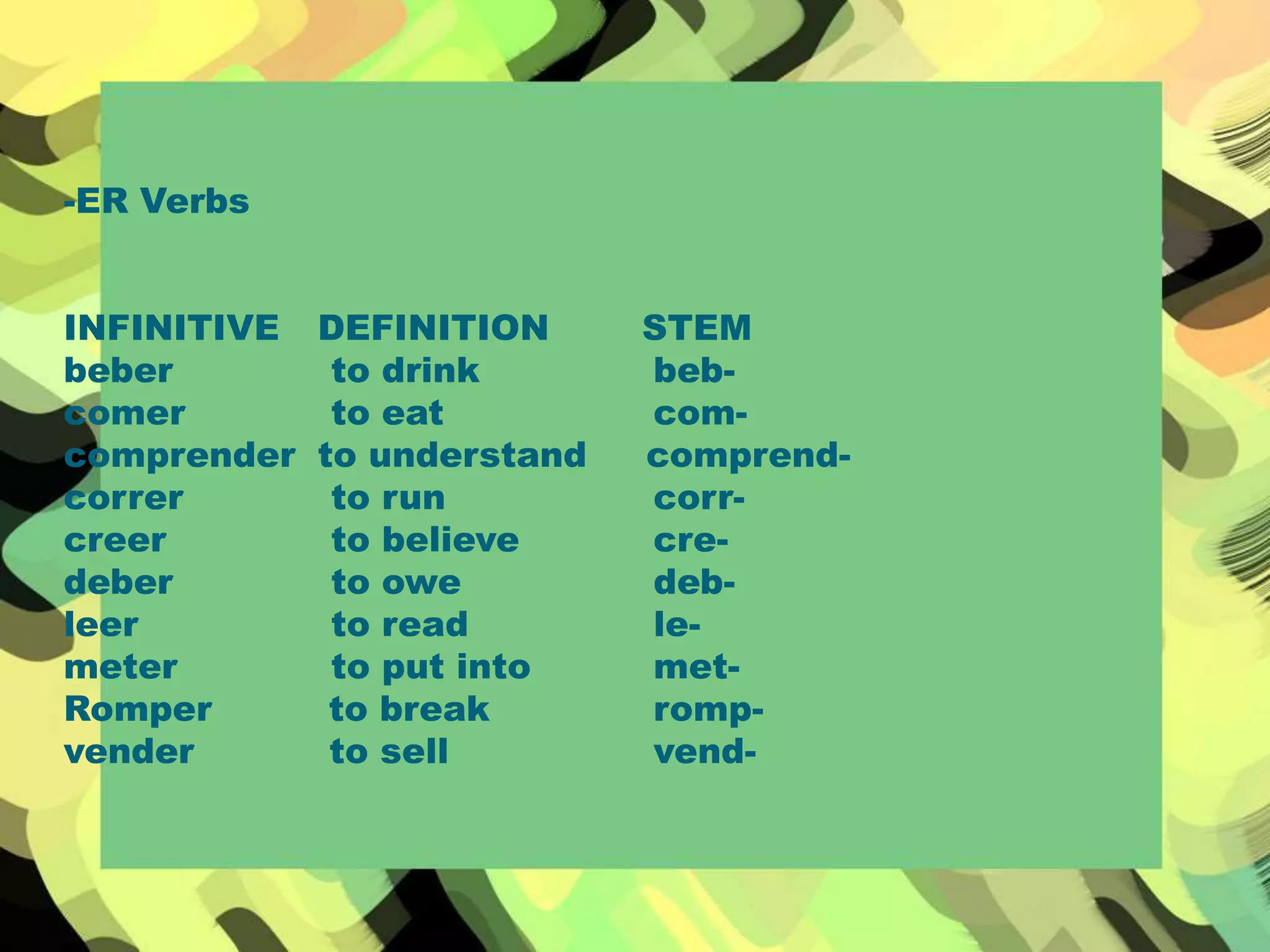
-ER Verbs
INFINITIVE DEFINITION STEM
beber to drink beb-
comer to eat com-
comprender to understand comprend-
correr to run corr-
creer to believe cre-
deber to owe deb-
leer to read le-
meter to put into met-
Romper to break romp-
vender to sell vend-
 Exercises
 Write the stem for each infinitive given.
 Example: bailar -> bail
 estudiar
 hablar
 comprar
 entrar
 aprender
 correr
 beber
 escribir
 vivir
 decidir
Inflectional
&
Derivational
INFLECTIONAL
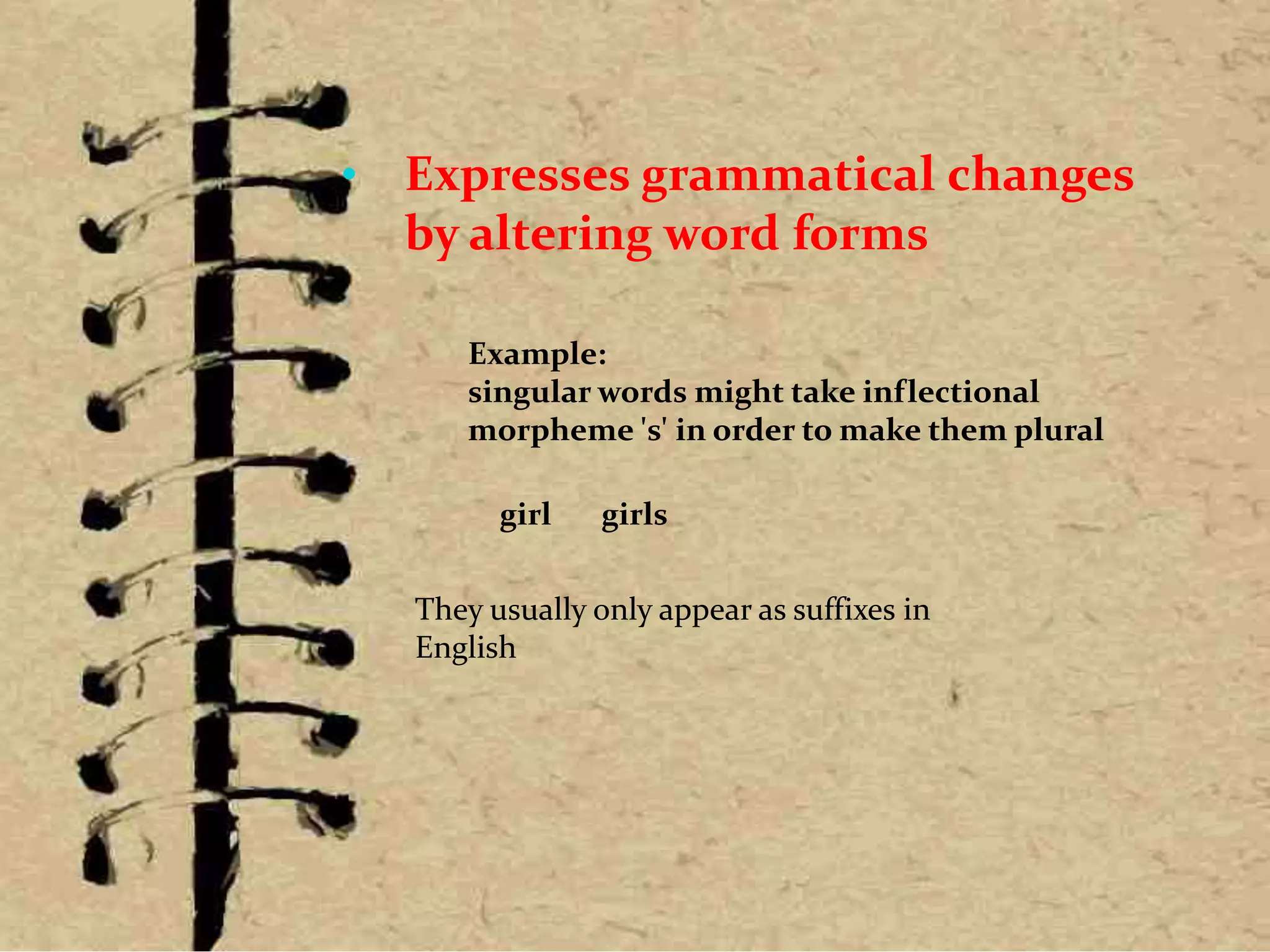
• Expresses grammatical changes
by altering word forms
Example:
singular words might take inflectional
morpheme 's' in order to make them plural
girl girls
They usually only appear as suffixes in
English
 Create word forms of a lexeme
 A subset of the functional categories which
govern syntactic relations in sentences
Morphology

Morphology

  • 1.
  • 2.
    Discussion Flow: What is“morphology”? What is a “word”? Morphemes How is morphology studied?  Further Distinctions
  • 3.
    o The termmorphology is Greek and is a makeup of morph- meaning 'shape, form', and -ology which means 'the study of something'. o Therefore, it is the study of the structure of something; the term is not just use in linguistics, but it is also used in BIOLOGY- as the scientific study of forms and structure of animals and plants. What is MORPHOLOGY?
  • 4.
    In GEOLOGY asthe study of formation and evolution of rocks and land forms. But we are going to stick to morphology in linguistics, which is being defined as the scientific study of forms and structure of WORDS in a language. Studies the formation of words from smaller units called morphemes.
  • 5.
    If morphology isthe study of the internal structure of words, we need to define the word ”WORD” before we can continue.......
  • 6.
    Morphology  Morphology asa sub- discipline of linguistics was named for the first time in 1859 by the German linguist August Schleicher who used the term for the study of the form of words.
  • 7.
    What is aword? A reliable definition of words is that they are the smallest independent units of language. They are independent in that they do not depend on other words which means that they can be separated from other units and can change position.
  • 8.
    Consider the sentence: 1.Theman looked at the horses. -The plural ending –s in horses is dependent on the noun horse to receive meaning and can therefore not be a word. Horses however, is a word, as it can occur in other positions in the sentence or stand on its own.
  • 9.
    Consider the sentence: 2.Thehorses looked at the man. - What is the man looking at? - Horses. Words are thus both independent since they can be separated from other words and move around in sentences, and the smallest units of language since they are the only units of language for which this is possible.
  • 10.
    Morphemes  In linguistics,a morpheme is the smallest component of word, or other linguistic unit, that has semantic meaning. The term is used as part of the branch of linguistics known as morpheme-based morphology. A morpheme is composed byphoneme(s) (the smallest linguistically distinctive units of sound) in spoken language, and by grapheme(s) (the smallest units of written language) in written language.
  • 11.
     The conceptof word and morpheme are different, a morpheme may or may not stand alone. One or several morphemes compose a word. A morpheme is free if it can stand alone (ex: "one", "possible"), or bound if it is used exclusively alongside a free morpheme (ex: "im" in impossible). Its actual phonetic representation is themorph, with the different morphs ("in-", "im-") representing the same morpheme being grouped as its allomorphs.  The word "unbreakable" has three morphemes: "un-", a bound morpheme; "break", a free morpheme; and "-able", a bound morpheme. "un-" is also a prefix, "-able" is asuffix. Both "un-" and "-able" are affixes.  The morpheme plural-s has the morph "-s", /s/, in cats (/kæts/), but "-es", /ɨz/, indishes (/dɪʃɨz/), and even the voiced "-s", /z/, in dogs (/dɒɡz/). "-s". These are allomorphs.
  • 12.
    Complex words  Aword made up of two or more morphemes. Contrast with monomorphemic word.  "[W]e say that bookishness is a complex word, whose immediate components arebookish and -ness, which we can express in shorthand by spelling the word with dashes between each morph: book-ish-ness. The process of dividing a word into morphs is calledparsing.”
  • 13.
     morphology lecture ‘lecture which has something to do with morphology’  lecture = head of compound, morphology = modifier  Compound with head = endocentric  Meaning of compound determined regularly from meanings of elements  Compounding is recursive:  (14) morphology class room change announcement (procedures (review (committee (chairman  (. . . )  (15) blackbird  N  A N  black bird
  • 14.
    Three approaches  Morphemebased  Lexeme based  Word based
  • 15.
    Morpheme based  Inmorpheme-based morphology, word forms are analyzed as arrangements of morphemes. A morpheme is defined as the minimal meaningful unit of a language. In a word such as independently, the morphemes are said to be in-, depend, -ent, and ly; depend is the root and the other morphemes are, in this case, derivational affixes.[5] In words such as dogs, dog is the root and the -s is an inflectional morpheme. In its simplest and most naïve form, this way of analyzing word forms, called "item-and- arrangement", treats words as if they were made of morphemes put after each other ("concatenated") like beads on a string. More recent and sophisticated approaches, such as distributed morphology, seek to maintain the idea of the morpheme while accommodating non-concatenative, analogical, and other processes that have proven problematic for item-and- arrangement theories and similar approaches.
  • 16.
    Lexeme based  Lexeme-basedmorphology usually takes what is called an "item-and-process" approach. Instead of analyzing a word form as a set of morphemes arranged in sequence, a word form is said to be the result of applying rules that alter a word-form or stem in order to produce a new one. An inflectional rule takes a stem, changes it as is required by the rule, and outputs a word form; a derivational rule takes a stem, changes it as per its own requirements, and outputs a derived stem; a compounding rule takes word forms, and similarly outputs a compound stem.
  • 17.
  • 18.
    also referred toas 'word and radigm' approach. This method relies the fact that generalizations exist tween the forms of inflectional tterns. More simply that words can be tegorized based on the patterns that ey fit into.
  • 19.
  • 20.
    An infinitive isthe most basic verb form in all languages. In English, it is always preceded by "to," as in "to run," "to love," and "to travel." Verbs in the infinitive form indicate what the action is but nothing about who is doing the action at what point in time.
  • 21.
    1. As aBase for Conjugations All of the indicative and some of the subjunctive start with the infinitive. As you will see in many verb references, the first step to conjugating involves "the stem of the infinitive." To find the stem, simply take off the infinitive ending (-ar, - er, or -ir). amar (to love) -> amo comer (to eat) -> como, comes abrir (to open) -> abro, abres
  • 22.
    2. As anoun . In English, the gerund (verbs that end in -ing) is used in these instances, but not in Spanish where the gerund is only used in expressing continuous actions such as the present progressive. (Speaking Spanish is fun.) (Taking pictures is prohibited.)
  • 23.
     3. Aftera Conjugated Verb  Infinitives can be used many different ways with or without prepositions to express the idea of "to do" something.  (We are going to dance.)  (You have to take out the trash.)  (I want to leave for the party.)  (I like to draw.)
  • 24.
    -ER Verbs INFINITIVE DEFINITIONSTEM beber to drink beb- comer to eat com- comprender to understand comprend- correr to run corr- creer to believe cre- deber to owe deb- leer to read le- meter to put into met- Romper to break romp- vender to sell vend-
  • 25.
     Exercises  Writethe stem for each infinitive given.  Example: bailar -> bail  estudiar  hablar  comprar  entrar  aprender  correr  beber  escribir  vivir  decidir
  • 26.
  • 27.
  • 28.
    • Expresses grammaticalchanges by altering word forms Example: singular words might take inflectional morpheme 's' in order to make them plural girl girls They usually only appear as suffixes in English
  • 29.
     Create wordforms of a lexeme  A subset of the functional categories which govern syntactic relations in sentences