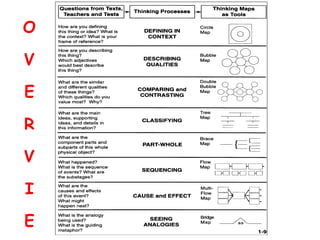
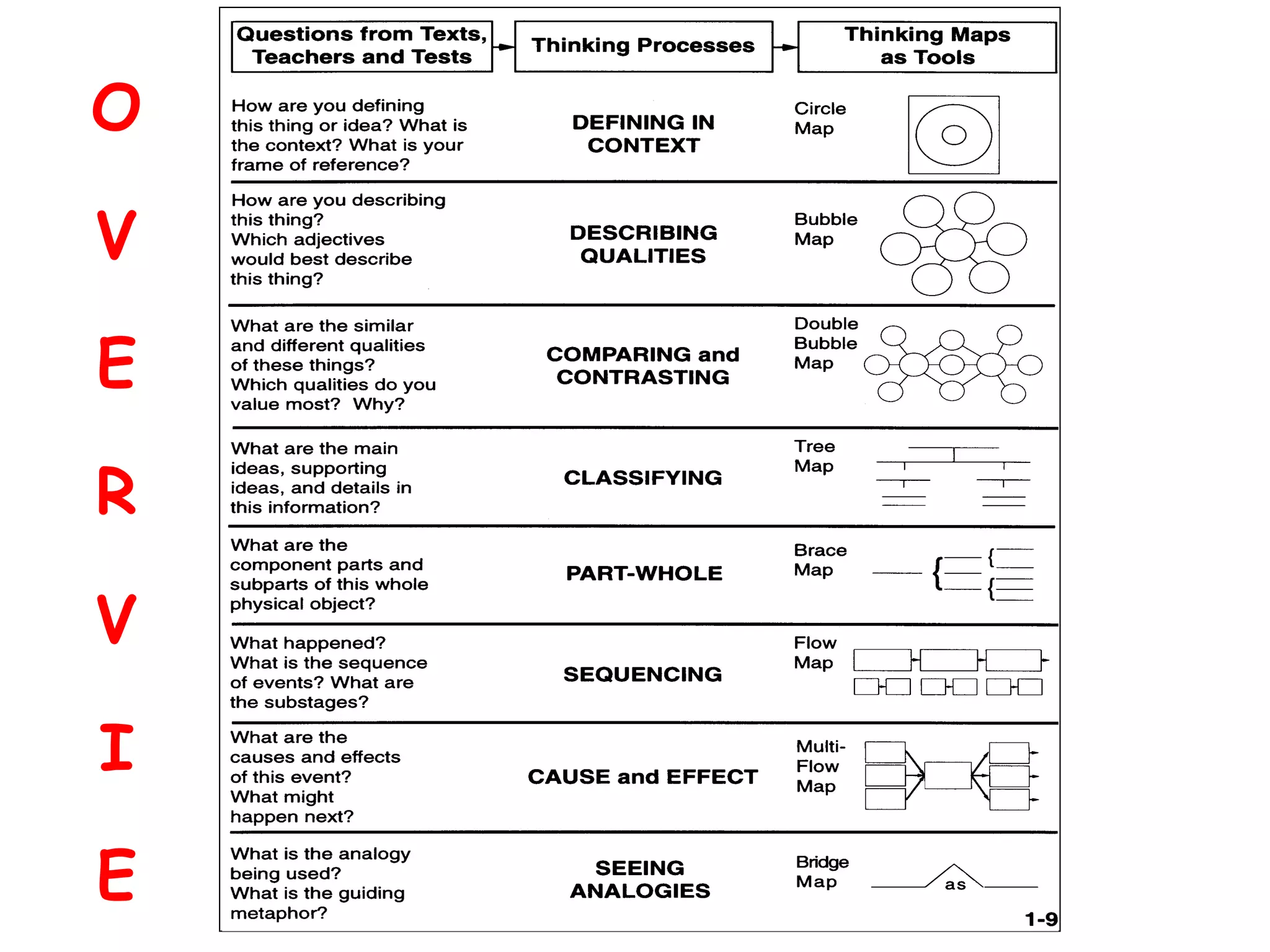
O V E R V I E W
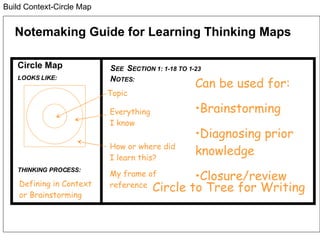
Build Context-Circle Map Defining in Context or Brainstorming Can be used for: Brainstorming Diagnosing prior knowledge Closure/review Circle to Tree for Writing Notemaking Guide for Learning Thinking Maps Circle Map LOOKS LIKE: THINKING PROCESS: S EE  S ECTION 1: 1-18 TO 1-23 N OTES: Topic Everything I know How or where did I learn this? My frame of reference
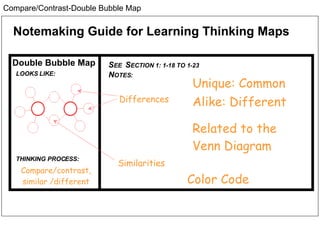
Compare/Contrast-Double Bubble Map Notemaking Guide for Learning Thinking Maps Double Bubble Map LOOKS LIKE: THINKING PROCESS: S EE  S ECTION 1: 1-18 TO 1-23 N OTES: Compare/contrast, similar /different Unique: Common Related to the Venn Diagram Alike: Different Similarities Differences Color Code
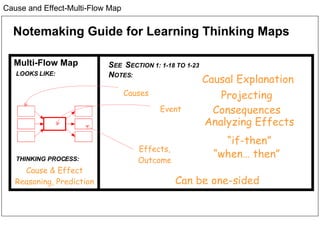
Cause and Effect-Multi-Flow Map Notemaking Guide for Learning Thinking Maps Multi-Flow Map LOOKS LIKE: THINKING PROCESS: S EE  S ECTION 1: 1-18 TO 1-23 N OTES: Cause & Effect Reasoning, Prediction Causal Explanation Causes Event Effects, Outcome Projecting Consequences Analyzing Effects “ if-then” “ when… then” Can be one-sided
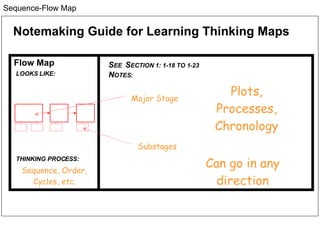
Sequence-Flow Map Notemaking Guide for Learning Thinking Maps Flow Map LOOKS LIKE: THINKING PROCESS: S EE  S ECTION 1: 1-18 TO 1-23 N OTES: Sequence, Order, Cycles, etc. Plots, Processes, Chronology Major Stage Substages Can go in any direction
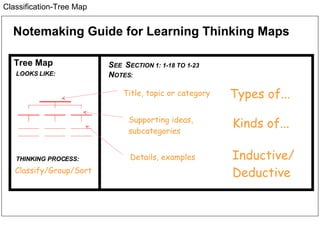
Classification-Tree Map Notemaking Guide for Learning Thinking Maps Tree Map LOOKS LIKE: THINKING PROCESS: S EE  S ECTION 1: 1-18 TO 1-23 N OTES: Classify/Group/Sort Types of... Kinds of... Title, topic or category Supporting ideas, subcategories Details, examples Inductive/Deductive
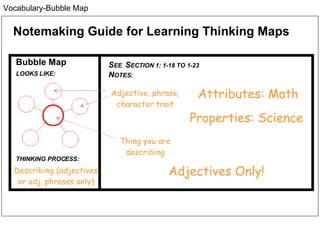
Vocabulary-Bubble Map Notemaking Guide for Learning Thinking Maps Bubble Map LOOKS LIKE: THINKING PROCESS: S EE  S ECTION 1: 1-18 TO 1-23 N OTES: Describing (adjectives or adj. phrases only) Attributes: Math Properties: Science Adjective, phrase, character trait Thing you are describing Adjectives Only!
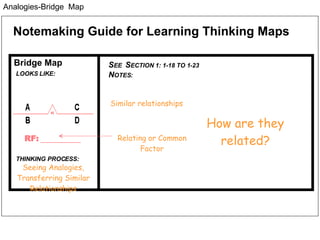
Analogies-Bridge  Map Notemaking Guide for Learning Thinking Maps Bridge Map LOOKS LIKE: THINKING PROCESS: S EE  S ECTION 1: 1-18 TO 1-23 N OTES: Seeing Analogies, Transferring Similar Relationships How are they related? RF:  __________ Similar relationships Relating or Common Factor
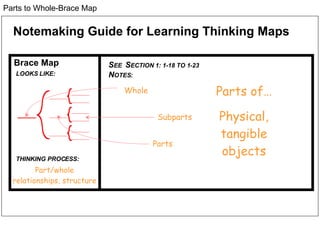
Parts to Whole-Brace Map Notemaking Guide for Learning Thinking Maps Brace Map LOOKS LIKE: THINKING PROCESS: S EE  S ECTION 1: 1-18 TO 1-23 N OTES: Part/whole relationships, structure Parts of… Physical, tangible objects Whole Parts Subparts

Structured Thinking Skills

  • 1.
    O V ER V I E W
  • 2.
    Build Context-Circle MapDefining in Context or Brainstorming Can be used for: Brainstorming Diagnosing prior knowledge Closure/review Circle to Tree for Writing Notemaking Guide for Learning Thinking Maps Circle Map LOOKS LIKE: THINKING PROCESS: S EE S ECTION 1: 1-18 TO 1-23 N OTES: Topic Everything I know How or where did I learn this? My frame of reference
  • 3.
    Compare/Contrast-Double Bubble MapNotemaking Guide for Learning Thinking Maps Double Bubble Map LOOKS LIKE: THINKING PROCESS: S EE S ECTION 1: 1-18 TO 1-23 N OTES: Compare/contrast, similar /different Unique: Common Related to the Venn Diagram Alike: Different Similarities Differences Color Code
  • 4.
    Cause and Effect-Multi-FlowMap Notemaking Guide for Learning Thinking Maps Multi-Flow Map LOOKS LIKE: THINKING PROCESS: S EE S ECTION 1: 1-18 TO 1-23 N OTES: Cause & Effect Reasoning, Prediction Causal Explanation Causes Event Effects, Outcome Projecting Consequences Analyzing Effects “ if-then” “ when… then” Can be one-sided
  • 5.
    Sequence-Flow Map NotemakingGuide for Learning Thinking Maps Flow Map LOOKS LIKE: THINKING PROCESS: S EE S ECTION 1: 1-18 TO 1-23 N OTES: Sequence, Order, Cycles, etc. Plots, Processes, Chronology Major Stage Substages Can go in any direction
  • 6.
    Classification-Tree Map NotemakingGuide for Learning Thinking Maps Tree Map LOOKS LIKE: THINKING PROCESS: S EE S ECTION 1: 1-18 TO 1-23 N OTES: Classify/Group/Sort Types of... Kinds of... Title, topic or category Supporting ideas, subcategories Details, examples Inductive/Deductive
  • 7.
    Vocabulary-Bubble Map NotemakingGuide for Learning Thinking Maps Bubble Map LOOKS LIKE: THINKING PROCESS: S EE S ECTION 1: 1-18 TO 1-23 N OTES: Describing (adjectives or adj. phrases only) Attributes: Math Properties: Science Adjective, phrase, character trait Thing you are describing Adjectives Only!
  • 8.
    Analogies-Bridge MapNotemaking Guide for Learning Thinking Maps Bridge Map LOOKS LIKE: THINKING PROCESS: S EE S ECTION 1: 1-18 TO 1-23 N OTES: Seeing Analogies, Transferring Similar Relationships How are they related? RF: __________ Similar relationships Relating or Common Factor
  • 9.
    Parts to Whole-BraceMap Notemaking Guide for Learning Thinking Maps Brace Map LOOKS LIKE: THINKING PROCESS: S EE S ECTION 1: 1-18 TO 1-23 N OTES: Part/whole relationships, structure Parts of… Physical, tangible objects Whole Parts Subparts

Editor's Notes

  • #2 Tell teachers to look at page 1-9. This is a key page that summarizes common cognitive questions found in textbooks and on state tests; the 8 basic thought processes; the name of the map; the picture of the map. This page is often duplicated and given to students to put in their notebooks. It is also a page that is sent home to parents so that they will understand the tools their children will be using at school.