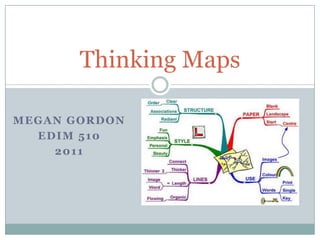
Thinking Maps

MEGAN GORDON
  EDIM 510
    2011
What are Thinking Maps?

 Visual way to organize thinking and learning in a
  concise way.
 8 kinds of thinking maps are based on 8
  fundamental thinking processes such as comparing
  and contrasting, sequencing, classifying, and
  cause-effect reasoning.
 For improving the basics of reading, writing, and
  mathematics as well as for problem-solving and
  the development of higher-order thinking abilities .
Why use Thinking Maps?

 Students learn more effectively and with greater
    retention
   Thought processes are cross curricular
   Gauge student prior knowledge
   Student performance can be tracked accurately over
    time
   Skills can carry across students’ academic careers
   Lifelong thinking tools
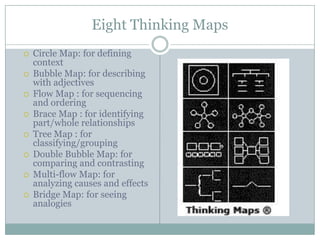
Eight Thinking Maps
   Circle Map: for defining
    context
   Bubble Map: for describing
    with adjectives
   Flow Map : for sequencing
    and ordering
   Brace Map : for identifying
    part/whole relationships
   Tree Map : for
    classifying/grouping
   Double Bubble Map: for
    comparing and contrasting
   Multi-flow Map: for
    analyzing causes and effects
   Bridge Map: for seeing
    analogies
Thinking Maps vs. Graphic Organizers

                           Similarities:
Both thinking/mind maps and graphic organizers are visual
tools useful for teaching and assessment. Both are highly
successful and have concrete patterns.
                           Differences:
Thinking Maps                     Graphic Organizers
•Based on fundamental             •Based on isolated tasks
thinking skills                   •determined forms
•Flexible forms                   •Difficult to transfer to other
•Transfers easily across          subjects
subjects                          •Teacher oriented
•Student centered
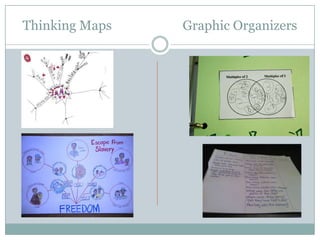
Thinking Maps   Graphic Organizers
Thinking Map Steps

1. Determine the type of thinking
2. Decide on the information to put in your
     map
3.   Draw the outline of the map.
4.   Add information
5.   Study the information.
6.   Create more than one thinking map about
     a given topic.
References

 http://www.flickr.com/photos/brandijordan/561677456
    3/
   http://www.flickr.com/photos/jeanlouis_zimmermann/
    3041475977/
   http://www.flickr.com/photos/luigimengato/513158098
    7/
   http://www.mapthemind.com/thinkingmaps/what_are_
    tm.html#what
   http://www.flickr.com/photos/jimmiehomeschoolmom/
    3820231914/
   http://www.flickr.com/photos/mrsdkrebs/6078016953/

Thinking maps

  • 1.
  • 2.
    What are ThinkingMaps?  Visual way to organize thinking and learning in a concise way.  8 kinds of thinking maps are based on 8 fundamental thinking processes such as comparing and contrasting, sequencing, classifying, and cause-effect reasoning.  For improving the basics of reading, writing, and mathematics as well as for problem-solving and the development of higher-order thinking abilities .
  • 3.
    Why use ThinkingMaps?  Students learn more effectively and with greater retention  Thought processes are cross curricular  Gauge student prior knowledge  Student performance can be tracked accurately over time  Skills can carry across students’ academic careers  Lifelong thinking tools
  • 4.
    Eight Thinking Maps  Circle Map: for defining context  Bubble Map: for describing with adjectives  Flow Map : for sequencing and ordering  Brace Map : for identifying part/whole relationships  Tree Map : for classifying/grouping  Double Bubble Map: for comparing and contrasting  Multi-flow Map: for analyzing causes and effects  Bridge Map: for seeing analogies
  • 5.
    Thinking Maps vs.Graphic Organizers Similarities: Both thinking/mind maps and graphic organizers are visual tools useful for teaching and assessment. Both are highly successful and have concrete patterns. Differences: Thinking Maps Graphic Organizers •Based on fundamental •Based on isolated tasks thinking skills •determined forms •Flexible forms •Difficult to transfer to other •Transfers easily across subjects subjects •Teacher oriented •Student centered
  • 6.
    Thinking Maps Graphic Organizers
  • 7.
    Thinking Map Steps 1.Determine the type of thinking 2. Decide on the information to put in your map 3. Draw the outline of the map. 4. Add information 5. Study the information. 6. Create more than one thinking map about a given topic.
  • 8.
    References  http://www.flickr.com/photos/brandijordan/561677456 3/  http://www.flickr.com/photos/jeanlouis_zimmermann/ 3041475977/  http://www.flickr.com/photos/luigimengato/513158098 7/  http://www.mapthemind.com/thinkingmaps/what_are_ tm.html#what  http://www.flickr.com/photos/jimmiehomeschoolmom/ 3820231914/  http://www.flickr.com/photos/mrsdkrebs/6078016953/