INTRODUCTION TO CONCEPT
MAPPING
INTRODUCTION TO CONCEPT MAPPING
• Used as a learning and teaching technique, concept mapping
visually illustrates the relationships between concepts and
ideas. Often represented in circles or boxes, concepts are
linked by words and phrases that explain the connection
between the ideas, helping students organize and structure
their thoughts to further understand information and discover
new relationships. Most concept maps represent a
hierarchical structure, with the overall, broad concept first with
connected sub-topics, more specific concepts, following.
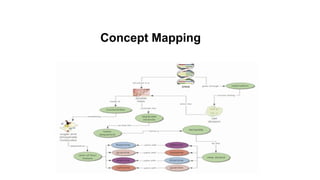
Concept Mapping
DEFINITION OF A CONCEPT MAP
• A concept map is a type of
graphic organizer used to help students
organize and represent knowledge of a
subject. Concept maps begin with a main
idea (or concept) and then branch out to
show how that main idea can be broken
down into specific topics
BENEFITS OF CONCEPT MAPPING
•Concept mapping serves several purposes for learners:
 Helping students brainstorm and generate new ideas
 Encouraging students to discover new concepts and the
propositions that connect them
 Allowing students to more clearly communicate ideas,
thoughts and information
 Helping students integrate new concepts with older concepts
 Enabling students to gain enhanced knowledge of any topic
and evaluate the information
HOW TO BUILD A CONCEPT MAP
• Concept maps are typically hierarchical, with the
subordinate concepts stemming from the main
concept or idea. This type of graphic organizer
however, always allows change and new concepts
to be added. The Rubber Sheet Analogy states that
concept positions on a map can continuously
change, while always maintaining the same
relationship with the other ideas on the map.
START WITH A MAIN IDEA, TOPIC, OR ISSUE TO
FOCUS ON.
• A helpful way to determine the context of
your concept map is to choose a focus
question—something that needs to be solved
or a conclusion that needs to be reached.
Once a topic or question is decided on, that
will help with the hierarchical structure of the
concept map.
THEN DETERMINE THE KEY CONCEPTS
• Find the key concepts that connect and relate to
your main idea and rank them; most general,
inclusive concepts come first, then link to smaller,
more specific concepts.
FINISH BY CONNECTING CONCEPTS--
CREATING LINKING PHRASES AND WORDS
• Once the basic links between the concepts are
created, add cross-links, which connect concepts in
different areas of the map, to further illustrate the
relationships and strengthen student’s understanding
and knowledge on the topic.
C O N C E P T M A P S I N E D U C AT I O N
• When created correctly and thoroughly,
concept mapping is a powerful way for students to reach
high levels of cognitive performance. A concept map is
also not just a learning tool, but an ideal evaluation tool for
educators measuring the growth of and assessing student
learning. As students create concept maps, they reiterate
ideas using their own words and help identify incorrect
ideas and concepts; educators are able to see what
students do not understand, providing an accurate,
objective way to evaluate areas in which students do not
yet grasp concepts fully.
C O N C E P T M A P S I N E D U C AT I O N
• Inspiration Software®’s Inspiration®, Kidspiration® and
Webspiration Classroom™ service all contain Diagram
Views that makes it easy for students to create concept
maps; students are able to add new concepts and links
as they see fit. Inspiration, Kidspiration and Webspiration
Classroom also come with a variety of concept map
examples, templates and lesson plans to show how
concept mapping and the use of other graphic
organizers can easily be integrated into the curriculum to
enhance learning, comprehension and writing skills.
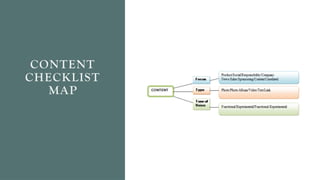
CONTENT
CHECKLIST
MAP
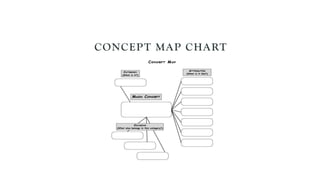
CONCEPT MAP CHART
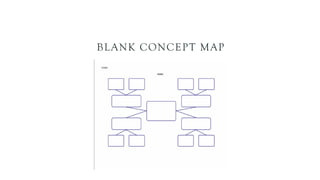
BLANK CONCEPT MAP

Introduction to Concept Mapping In digital media

  • 1.
  • 2.
    INTRODUCTION TO CONCEPTMAPPING • Used as a learning and teaching technique, concept mapping visually illustrates the relationships between concepts and ideas. Often represented in circles or boxes, concepts are linked by words and phrases that explain the connection between the ideas, helping students organize and structure their thoughts to further understand information and discover new relationships. Most concept maps represent a hierarchical structure, with the overall, broad concept first with connected sub-topics, more specific concepts, following.
  • 3.
  • 4.
    DEFINITION OF ACONCEPT MAP • A concept map is a type of graphic organizer used to help students organize and represent knowledge of a subject. Concept maps begin with a main idea (or concept) and then branch out to show how that main idea can be broken down into specific topics
  • 5.
    BENEFITS OF CONCEPTMAPPING •Concept mapping serves several purposes for learners:  Helping students brainstorm and generate new ideas  Encouraging students to discover new concepts and the propositions that connect them  Allowing students to more clearly communicate ideas, thoughts and information  Helping students integrate new concepts with older concepts  Enabling students to gain enhanced knowledge of any topic and evaluate the information
  • 6.
    HOW TO BUILDA CONCEPT MAP • Concept maps are typically hierarchical, with the subordinate concepts stemming from the main concept or idea. This type of graphic organizer however, always allows change and new concepts to be added. The Rubber Sheet Analogy states that concept positions on a map can continuously change, while always maintaining the same relationship with the other ideas on the map.
  • 7.
    START WITH AMAIN IDEA, TOPIC, OR ISSUE TO FOCUS ON. • A helpful way to determine the context of your concept map is to choose a focus question—something that needs to be solved or a conclusion that needs to be reached. Once a topic or question is decided on, that will help with the hierarchical structure of the concept map.
  • 8.
    THEN DETERMINE THEKEY CONCEPTS • Find the key concepts that connect and relate to your main idea and rank them; most general, inclusive concepts come first, then link to smaller, more specific concepts.
  • 9.
    FINISH BY CONNECTINGCONCEPTS-- CREATING LINKING PHRASES AND WORDS • Once the basic links between the concepts are created, add cross-links, which connect concepts in different areas of the map, to further illustrate the relationships and strengthen student’s understanding and knowledge on the topic.
  • 10.
    C O NC E P T M A P S I N E D U C AT I O N • When created correctly and thoroughly, concept mapping is a powerful way for students to reach high levels of cognitive performance. A concept map is also not just a learning tool, but an ideal evaluation tool for educators measuring the growth of and assessing student learning. As students create concept maps, they reiterate ideas using their own words and help identify incorrect ideas and concepts; educators are able to see what students do not understand, providing an accurate, objective way to evaluate areas in which students do not yet grasp concepts fully.
  • 11.
    C O NC E P T M A P S I N E D U C AT I O N • Inspiration Software®’s Inspiration®, Kidspiration® and Webspiration Classroom™ service all contain Diagram Views that makes it easy for students to create concept maps; students are able to add new concepts and links as they see fit. Inspiration, Kidspiration and Webspiration Classroom also come with a variety of concept map examples, templates and lesson plans to show how concept mapping and the use of other graphic organizers can easily be integrated into the curriculum to enhance learning, comprehension and writing skills.
  • 12.
  • 13.
  • 14.