Getting More out of Graphic Organizers Pam Glover, 2009
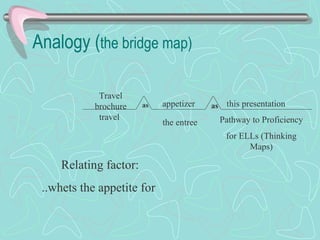
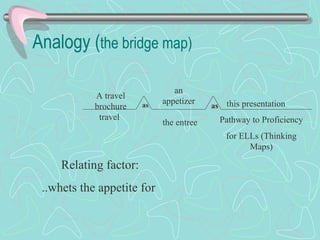
Analogy ( the bridge map) as Travel brochure travel appetizer the entree as this presentation Pathway to Proficiency for ELLs (Thinking Maps) Relating factor: ..whets the appetite for
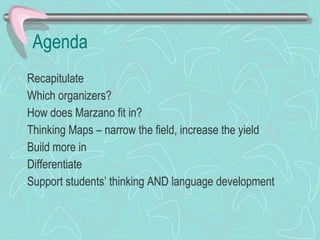
Agenda Recapitulate Which organizers?  How does Marzano fit in? Thinking Maps – narrow the field, increase the yield Build more in Differentiate  Support students’ thinking AND language development
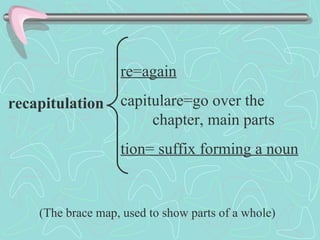
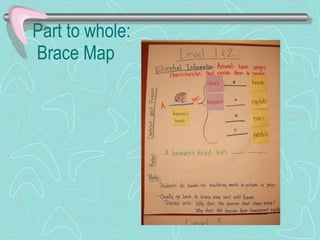
recapitulation re=again capitulare=go over the  chapter, main parts tion= suffix forming a noun (The brace map, used to show parts of a whole)
Brainstorm on the organizer of your choice: A Groups : How do you and your students use graphic organizers?  B Groups :What cognitive functions do graphic organizers support? C Groups : What linguistic features/functions do organizers support?
How do we use organizers? To take notes To help students organize their learning and thinking To scaffold writing
The BIG idea is..  that the power of a graphic organizer is in its transformation.  Do your students know how to speak off the map, and write off the map? Can they take an idea and express it using different cognitive skills, on different maps?
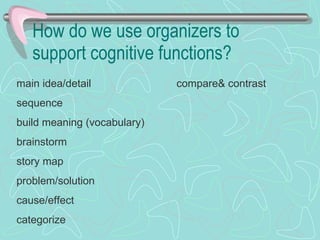
How do we use organizers to support cognitive functions? main idea/detail compare& contrast sequence build meaning (vocabulary) brainstorm story map problem/solution cause/effect categorize
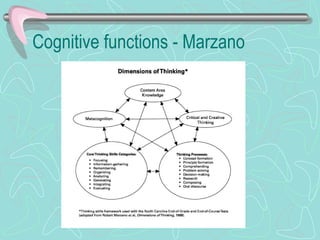
Cognitive functions - Marzano
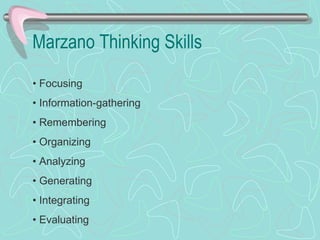
Marzano Thinking Skills •  Focusing •  Information-gathering •  Remembering •  Organizing •  Analyzing •  Generating •  Integrating •  Evaluating
Thinking Maps – What are they? a “language of visual patterns each based on a fundamental thinking process” based on work of Marzano, and David Hyerle (Thinking Maps: A Language for Learning, 2007) narrow the field of 400+ organizers to 8, which allows students to master them and apply them across any content area and thinking skill are intentionally applied to scaffold English language proficiency support language function and the correlating grammatical feature
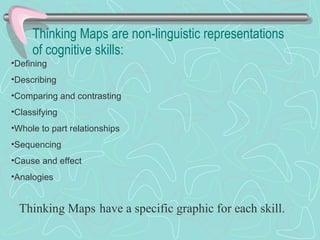
Thinking Maps are non-linguistic representations of cognitive skills: Defining Describing Comparing and contrasting Classifying Whole to part relationships Sequencing Cause and effect Analogies Thinking Maps   have a specific graphic for each skill.
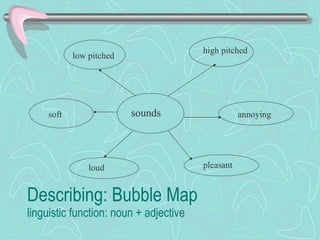
Describing: Bubble Map linguistic function: noun + adjective sounds low pitched high pitched pleasant annoying loud soft
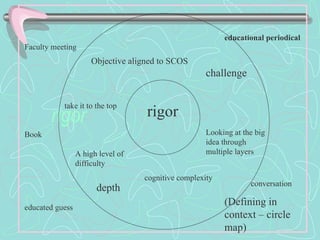
rigor Objective aligned to SCOS A high level of difficulty depth challenge Looking at the big idea through multiple layers take it to the top cognitive complexity Faculty meeting Book educated guess educational periodical conversation (Defining in context – circle map) rigor
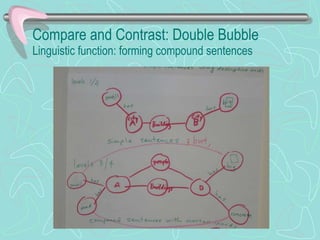
Compare and Contrast: Double Bubble Linguistic function: forming compound sentences
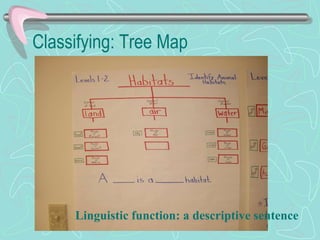
Classifying: Tree Map Linguistic function: a descriptive sentence
Part to whole:  Brace Map
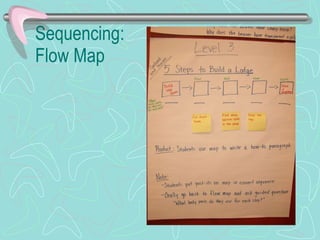
Sequencing:  Flow Map
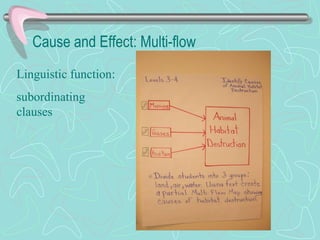
Cause and Effect: Multi-flow Linguistic function: subordinating clauses
Analogy ( the bridge map) as A travel brochure travel an appetizer the entree as this presentation Pathway to Proficiency for ELLs (Thinking Maps) Relating factor: ..whets the appetite for
Get more out of organizers. Build more in.  grammatical support visual cues for prosody model the syntax nuances of meaning picture clues
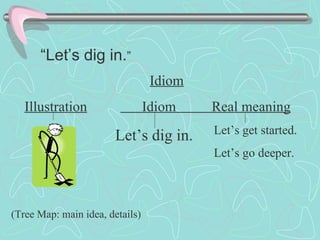
“ Let’s dig in. ” Idiom Illustration   Idiom  Real meaning Let’s dig in. Let’s get started. Let’s go deeper.  (Tree Map: main idea, details)
LoP (Language of Pedagogy): I can extend and adapt a Bubble Map to meet the needs of ELLs using the WIDA standards.
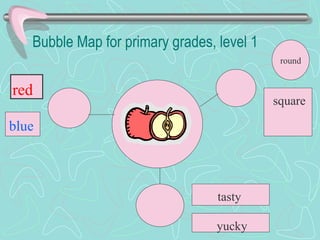
Bubble Maps used for describing grammatical feature : noun+adjectives
WIDA level 1, entering, can: point Match pictures and statements Answer wh- questions Label draw
Bubble Map for primary grades, level 1 red red blue square tasty yucky round
WIDA level 2, beginning, can:   sort Follow two step directions Match  Describe Restate facts Locate and classify information list
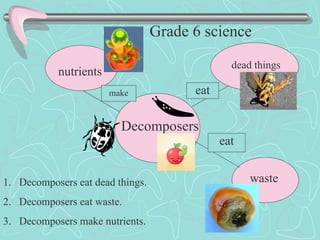
Decomposers dead things waste nutrients eat eat make Decomposers eat dead things. Decomposers eat waste. Decomposers make nutrients.  Grade 6 science
Your turn. Think of the lesson plan you created this week.Choose WIDA level 1 or 2, and then what lingusitic function or grammatical feature the lesson dictates. Create a bubble map for this lesson.  Hang onto your bubble map for a gallery walk later.
LoP (Language of Pedagogy): I can extend and adapt a Double Bubble Map to meet the needs of ELLs using the WIDA standards.
WIDA level 3, developing, can: locate, select and order information  categorize Sequence Describe processes Identify main ideas Produce basic expository writing  Compare/contrast retell
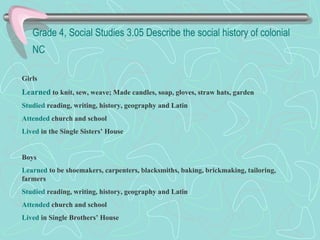
Grade 4, Social Studies 3.05 Describe the social history of colonial NC   Girls Learned  to knit, sew, weave; Made candles, soap, gloves, straw hats, garden  Studied  reading, writing, history, geography and Latin Attended  church and school Lived  in the Single Sisters’ House Boys Learned  to be shoemakers, carpenters, blacksmiths, baking, brickmaking, tailoring, farmers Studied  reading, writing, history, geography and Latin Attended  church and school Lived  in Single Brothers’ House
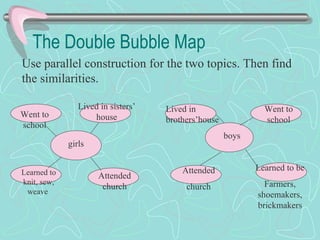
The Double Bubble Map Use parallel construction for the two topics. Then find the similarities. girls boys Went to school Went to school Learned to knit, sew, weave  Learned to be Farmers, shoemakers, brickmakers Lived in sisters’ house Lived in brothers’house Attended church Attended church
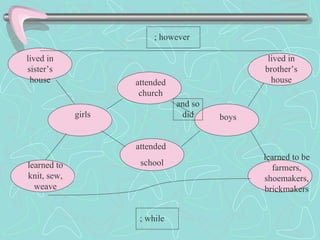
girls boys attended church attended  school lived in sister’s house lived in brother’s house learned to knit, sew, weave learned to be farmers, shoemakers, brickmakers ; however ; while and so did
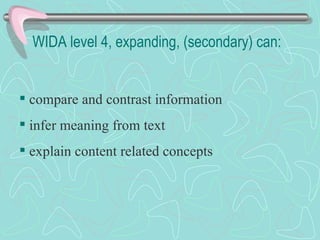
WIDA level 4, expanding, (secondary) can: compare and contrast information infer meaning from text explain content related concepts
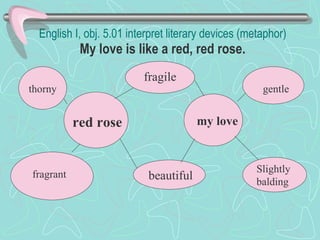
English I, obj. 5.01 interpret literary devices (metaphor) My love is like a red, red rose. red rose thorny fragrant my love gentle Slightly balding fragile beautiful
Your turn. Think of the lesson plan you created this week.Choose WIDA level 3 or 4, and then what lingusitic function or grammatical feature the lesson dictates. Create a double bubble map for this lesson.  Share your maps at your table, and choose a sample of each type of map to hang on the wall for a gallery walk.
If you want more...
This training will be for 8 sessions, each 1.5 hours long. Plus homework, it will be 20 contact hours, or 2.0 credits. These can be used toward the new requirement of 3.0 credits in your licensed area. Please email me if you are interested.  [email_address]

Thinking Maps

  • 1.
    Getting More outof Graphic Organizers Pam Glover, 2009
  • 2.
    Analogy ( thebridge map) as Travel brochure travel appetizer the entree as this presentation Pathway to Proficiency for ELLs (Thinking Maps) Relating factor: ..whets the appetite for
  • 3.
    Agenda Recapitulate Whichorganizers? How does Marzano fit in? Thinking Maps – narrow the field, increase the yield Build more in Differentiate Support students’ thinking AND language development
  • 4.
    recapitulation re=again capitulare=goover the chapter, main parts tion= suffix forming a noun (The brace map, used to show parts of a whole)
  • 5.
    Brainstorm on theorganizer of your choice: A Groups : How do you and your students use graphic organizers? B Groups :What cognitive functions do graphic organizers support? C Groups : What linguistic features/functions do organizers support?
  • 6.
    How do weuse organizers? To take notes To help students organize their learning and thinking To scaffold writing
  • 7.
    The BIG ideais.. that the power of a graphic organizer is in its transformation. Do your students know how to speak off the map, and write off the map? Can they take an idea and express it using different cognitive skills, on different maps?
  • 8.
    How do weuse organizers to support cognitive functions? main idea/detail compare& contrast sequence build meaning (vocabulary) brainstorm story map problem/solution cause/effect categorize
  • 9.
  • 10.
    Marzano Thinking Skills• Focusing • Information-gathering • Remembering • Organizing • Analyzing • Generating • Integrating • Evaluating
  • 11.
    Thinking Maps –What are they? a “language of visual patterns each based on a fundamental thinking process” based on work of Marzano, and David Hyerle (Thinking Maps: A Language for Learning, 2007) narrow the field of 400+ organizers to 8, which allows students to master them and apply them across any content area and thinking skill are intentionally applied to scaffold English language proficiency support language function and the correlating grammatical feature
  • 12.
    Thinking Maps arenon-linguistic representations of cognitive skills: Defining Describing Comparing and contrasting Classifying Whole to part relationships Sequencing Cause and effect Analogies Thinking Maps have a specific graphic for each skill.
  • 13.
    Describing: Bubble Maplinguistic function: noun + adjective sounds low pitched high pitched pleasant annoying loud soft
  • 14.
    rigor Objective alignedto SCOS A high level of difficulty depth challenge Looking at the big idea through multiple layers take it to the top cognitive complexity Faculty meeting Book educated guess educational periodical conversation (Defining in context – circle map) rigor
  • 15.
    Compare and Contrast:Double Bubble Linguistic function: forming compound sentences
  • 16.
    Classifying: Tree MapLinguistic function: a descriptive sentence
  • 17.
    Part to whole: Brace Map
  • 18.
  • 19.
    Cause and Effect:Multi-flow Linguistic function: subordinating clauses
  • 20.
    Analogy ( thebridge map) as A travel brochure travel an appetizer the entree as this presentation Pathway to Proficiency for ELLs (Thinking Maps) Relating factor: ..whets the appetite for
  • 21.
    Get more outof organizers. Build more in. grammatical support visual cues for prosody model the syntax nuances of meaning picture clues
  • 22.
    “ Let’s digin. ” Idiom Illustration Idiom Real meaning Let’s dig in. Let’s get started. Let’s go deeper. (Tree Map: main idea, details)
  • 23.
    LoP (Language ofPedagogy): I can extend and adapt a Bubble Map to meet the needs of ELLs using the WIDA standards.
  • 24.
    Bubble Maps usedfor describing grammatical feature : noun+adjectives
  • 25.
    WIDA level 1,entering, can: point Match pictures and statements Answer wh- questions Label draw
  • 26.
    Bubble Map forprimary grades, level 1 red red blue square tasty yucky round
  • 27.
    WIDA level 2,beginning, can: sort Follow two step directions Match Describe Restate facts Locate and classify information list
  • 28.
    Decomposers dead thingswaste nutrients eat eat make Decomposers eat dead things. Decomposers eat waste. Decomposers make nutrients. Grade 6 science
  • 29.
    Your turn. Thinkof the lesson plan you created this week.Choose WIDA level 1 or 2, and then what lingusitic function or grammatical feature the lesson dictates. Create a bubble map for this lesson. Hang onto your bubble map for a gallery walk later.
  • 30.
    LoP (Language ofPedagogy): I can extend and adapt a Double Bubble Map to meet the needs of ELLs using the WIDA standards.
  • 31.
    WIDA level 3,developing, can: locate, select and order information categorize Sequence Describe processes Identify main ideas Produce basic expository writing Compare/contrast retell
  • 32.
    Grade 4, SocialStudies 3.05 Describe the social history of colonial NC Girls Learned to knit, sew, weave; Made candles, soap, gloves, straw hats, garden Studied reading, writing, history, geography and Latin Attended church and school Lived in the Single Sisters’ House Boys Learned to be shoemakers, carpenters, blacksmiths, baking, brickmaking, tailoring, farmers Studied reading, writing, history, geography and Latin Attended church and school Lived in Single Brothers’ House
  • 33.
    The Double BubbleMap Use parallel construction for the two topics. Then find the similarities. girls boys Went to school Went to school Learned to knit, sew, weave Learned to be Farmers, shoemakers, brickmakers Lived in sisters’ house Lived in brothers’house Attended church Attended church
  • 34.
    girls boys attendedchurch attended school lived in sister’s house lived in brother’s house learned to knit, sew, weave learned to be farmers, shoemakers, brickmakers ; however ; while and so did
  • 35.
    WIDA level 4,expanding, (secondary) can: compare and contrast information infer meaning from text explain content related concepts
  • 36.
    English I, obj.5.01 interpret literary devices (metaphor) My love is like a red, red rose. red rose thorny fragrant my love gentle Slightly balding fragile beautiful
  • 37.
    Your turn. Thinkof the lesson plan you created this week.Choose WIDA level 3 or 4, and then what lingusitic function or grammatical feature the lesson dictates. Create a double bubble map for this lesson. Share your maps at your table, and choose a sample of each type of map to hang on the wall for a gallery walk.
  • 38.
    If you wantmore...
  • 39.
    This training willbe for 8 sessions, each 1.5 hours long. Plus homework, it will be 20 contact hours, or 2.0 credits. These can be used toward the new requirement of 3.0 credits in your licensed area. Please email me if you are interested. [email_address]

Editor's Notes

  • #4 Today is the appetizer to when your appetite for the entrée. I’ll be offering a small group professional learning group worth 20 contact hours, 2.0 ceus in ESL, detailing the Thinking Maps applied to ELLs.
  • #6 15 minutes: Brainstorm, create a graphic organizer, choose your “curator”. Tape the posters up, do a gallery walk.
  • #9 Take a piece of paper and number from 1-9. In triads, list as many as you can. Then ask the others at the table to share their list. Add anything you didn’t get. This keeps everyone responsible to participate not only in the brainstorming, but in the sharing out.
  • #13 Not a one to one correspondence to Marzano’s thinking skills, but overlap and include all of Marzano’s skills
  • #14 This is an introduction – just a quick sampling of all 8 types. Linguistic function: noun + adjective
  • #16 Linguistic function: compound sentences with transitions but, and
  • #17 Used to summarize main idea and detail Lingusitic function: giving an example
  • #18 Started with whole to part, then scaffolded with the article, verb, and adjectives
  • #19 Language function: secquence with transitional words
  • #27 It’s manipulative in that students choose one of the two adjectives, which can be supported by illustrations.
  • #29 The rectangles are the verb that connects the subject to the descriptor. We can “read” the organizer to create sentences. You could even add the punctuation to make the conventions clear.
  • #30 Indicate what wall, have masking tape ready.
  • #33 These are reorganized notes straight from the Social Studies text.
  • #34 Working from the text, we’ve sorted the main idea and details onto two bubble maps. It’s easy to see that they both went to school and church, but they learned different things and lived in different houses. Now we can easily rearrange the information onto one map. Describing each main idea separately makes for a fuller comparison than it does when students are trying to compare and contrast at once time.
  • #35 For level 4, expanding, I’ve added the conjunctions to help students write more complex sentences.
  • #38 Creator stands by their map, others circulate. (separate by grade clusters)