Applying Models of
     Thinking
     An Informative Parental
          Presentation
Dear Parents,
   Thank you for allowing me to
touch your children’s lives on this
educational journey. The purpose
of this presentation is to show you
how the models of thinking are
applied.
                      Sincerely,
                         Miss Dozier
You will understand how to
apply……..
   Bloom’s Taxonomy of Thinking Skills
   Demonstrated Thinking Skills
   Bloom’s Revised Taxonomy in
    Project Planning and Assessment
   Marzano’s Dimensions of Learning
   Costa and Kallick’s 16 Habit of Mind
Bloom’s Taxonomy of
Thinking Skills: Processes
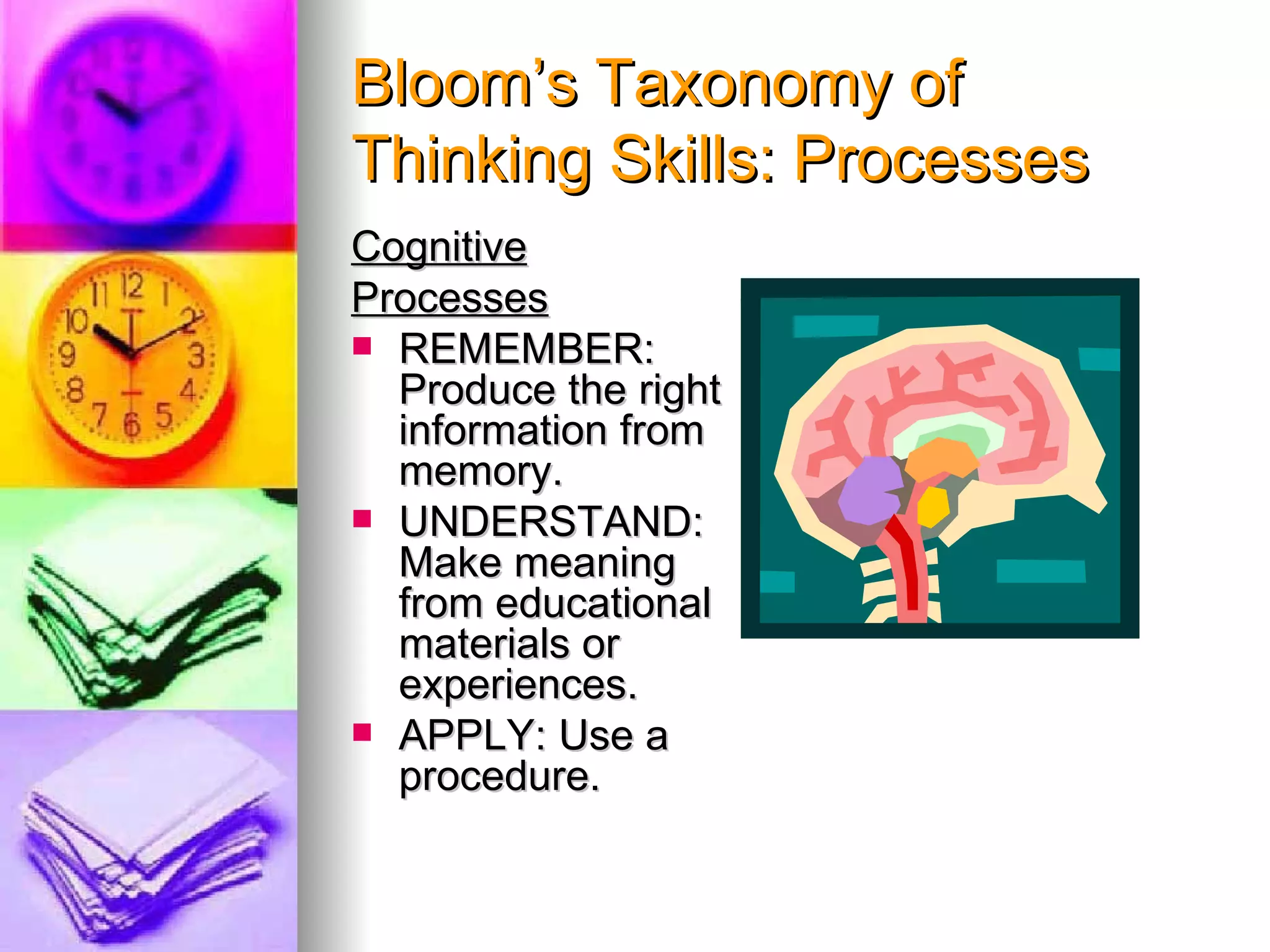
Cognitive
Processes
 REMEMBER:
  Produce the right
  information from
  memory.
 UNDERSTAND:
  Make meaning
  from educational
  materials or
  experiences.
 APPLY: Use a
  procedure.
Bloom’s Taxonomy of
Thinking Skills: Processes
   ANALZE: Break a concept down
    into its parts and describe how
    the parts relate to the whole
   EVALUATE: Make judgments
    based on criteria and standards
   CREATE: Put pieces together to
    form something new or
    recognize components of a new
    structure
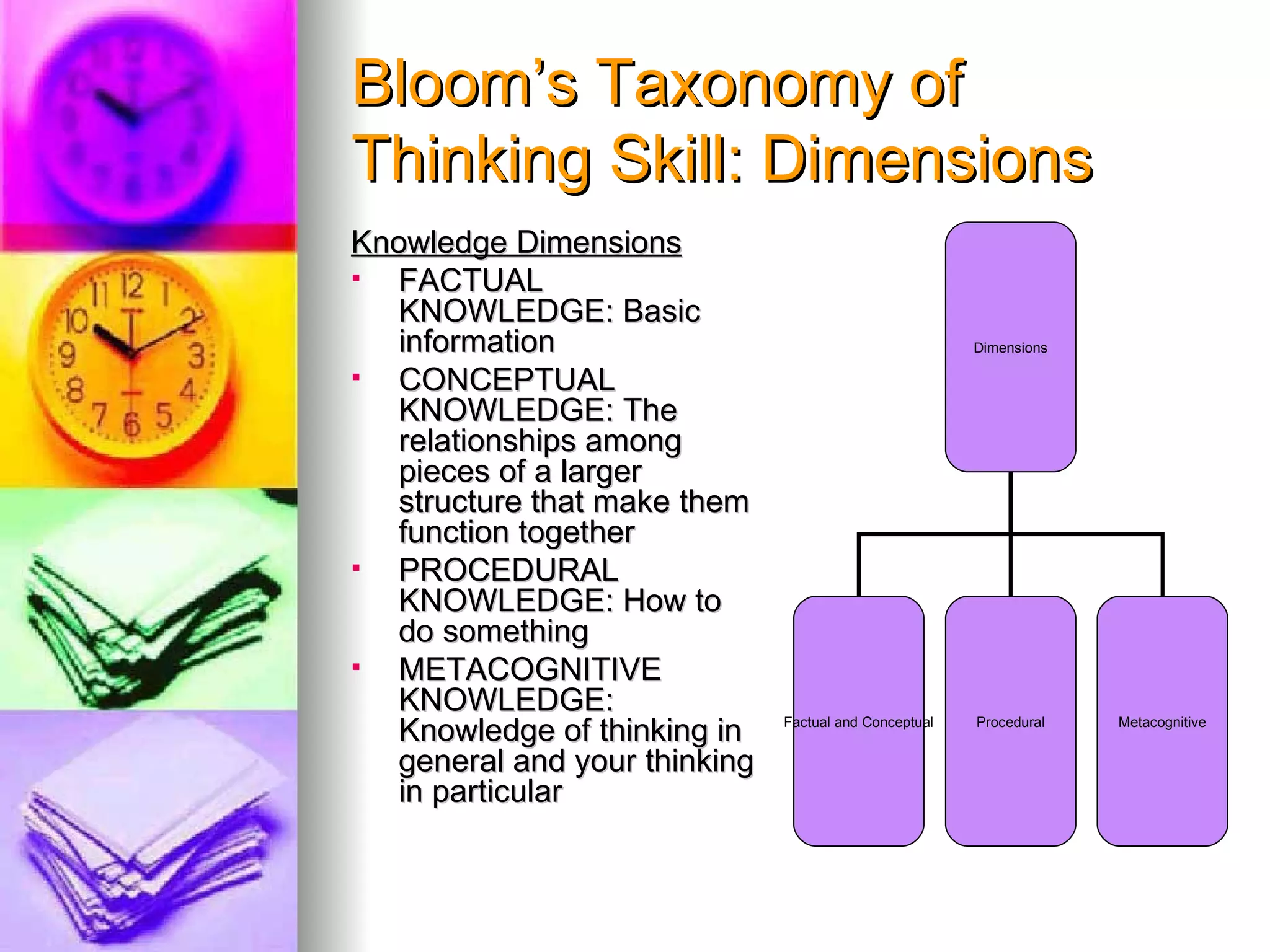
Bloom’s Taxonomy of
Thinking Skill: Dimensions
Knowledge Dimensions
  FACTUAL
   KNOWLEDGE: Basic
   information                                          Dimensions

  CONCEPTUAL
   KNOWLEDGE: The
   relationships among
   pieces of a larger
   structure that make them
   function together
  PROCEDURAL
   KNOWLEDGE: How to
   do something
  METACOGNITIVE
   KNOWLEDGE:
   Knowledge of thinking in    Factual and Conceptual   Procedural   Metacognitive


   general and your thinking
   in particular
Application of Cognitive
Processes and Knowledge
Dimensions
    6 Cognitive Processes :
o    1. REMEMBER (Examples)
     Recognize-True/False
     Recall- Reproduce chemical formulas
o    2. UNDERSTAND (Examples)
    Interpreting-Draw a diagram (digestive system)
    Exemplifying-Name a mammal in our area.
    Classifying-Group animals into their proper species.
    Summarizing-List the key points in process of
     mitosis.
    Inferring-Use context clues for unfamiliar words
    Comparing-Use a Venn diagram to demonstrate
     how plant and animal cells are similar and different.
    Explaining-Draw a diagram explaining the two types
     of circulation.
Application of Cognitive
Processes and Knowledge
Dimensions
o    3. APPLY (Examples)
     Executing-Add significant digits
     Implementing- Design an experiment to see how
      plants grow in different kinds of soil.
o    4. ANALYZE (Examples)
    Differentiating- List the important information in a
     mathematical word problem and cross out the
     unimportant information.
    Organizing-Make a diagram showing the way plants
     and animals interact in an area.
    Attributing-Read letters to determine the author’s
     view on an issue.
o    5. Evaluate (Examples)
    Checking- Review project plan steps.
    Critiquing- Co-develop a rubric and judge if material
     meets the criteria
Application of Cognitive
Processes and Dimensions
o     6. Create (Examples)
Generating- Generate scientific hypotheses
Planning- Outline a research paper on Darwin’s views on
  evolution.
Producing- Build a habitat for local water fowl.
     4 Knowledge Dimensions:
o     1. Factual Knowledge
Knowledge of terminology- Vocabulary terms
Knowledge of specific details and elements-Components of a
   food chain
o     2. Conceptual Knowledge
    Knowledge of classifications/categories- Species of animals
     Knowledge of principles/generalizations- Mendel’s Law of Segregation
     Knowledge of theories, models, and structures-Theory of Evolution
o   3. Procedural Knowledge
    Subject Specific Skills/Algorithms- Procedure for
    solving metric problems
    Subject Specific Techniques/Methods- Scientific
    method
    Criteria when to Use the Appropriate
    Procedures-Methods for experiments
o   4. Metacognitive Knowledge
    Strategic- Reading Comprehension Strategies
    Cognitive Tasks-Reading demands of books
    Self-Knowledge-Need for diagram to understand
    processes
Demonstrated Thinking Skills
   Remembering- Defining and listing
   Understanding-Assess, restate, and
    identify
   Applying- Calculating using equations,
    contrast possibilities, and demonstrate
    math/science principles
   Analyzing- Pictures, Tables/Diagrams,
    options (discuss), and generalizations
    (make)
   Evaluating- Assess validity, support
    guesses, and tests guesses
   Creating- Build models, propose new ways,
    and work backwards
Bloom’s Taxonomy in Project
  Planning and Student
  Assessment
 2 Videos:


    1.Promoting Higher Level Thinking Skills: Using
       Bloom's Taxonomy with SoftChalk (Part 1)

     http://www.youtube.com/watch?v=6grRsLm8eww


 2.Promoting Higher Level Thinking Skills: Using
    Bloom's Taxonomy with SoftChalk (Part 1)
 http://www.youtube.com/watch?v=h-vvZbDz09w
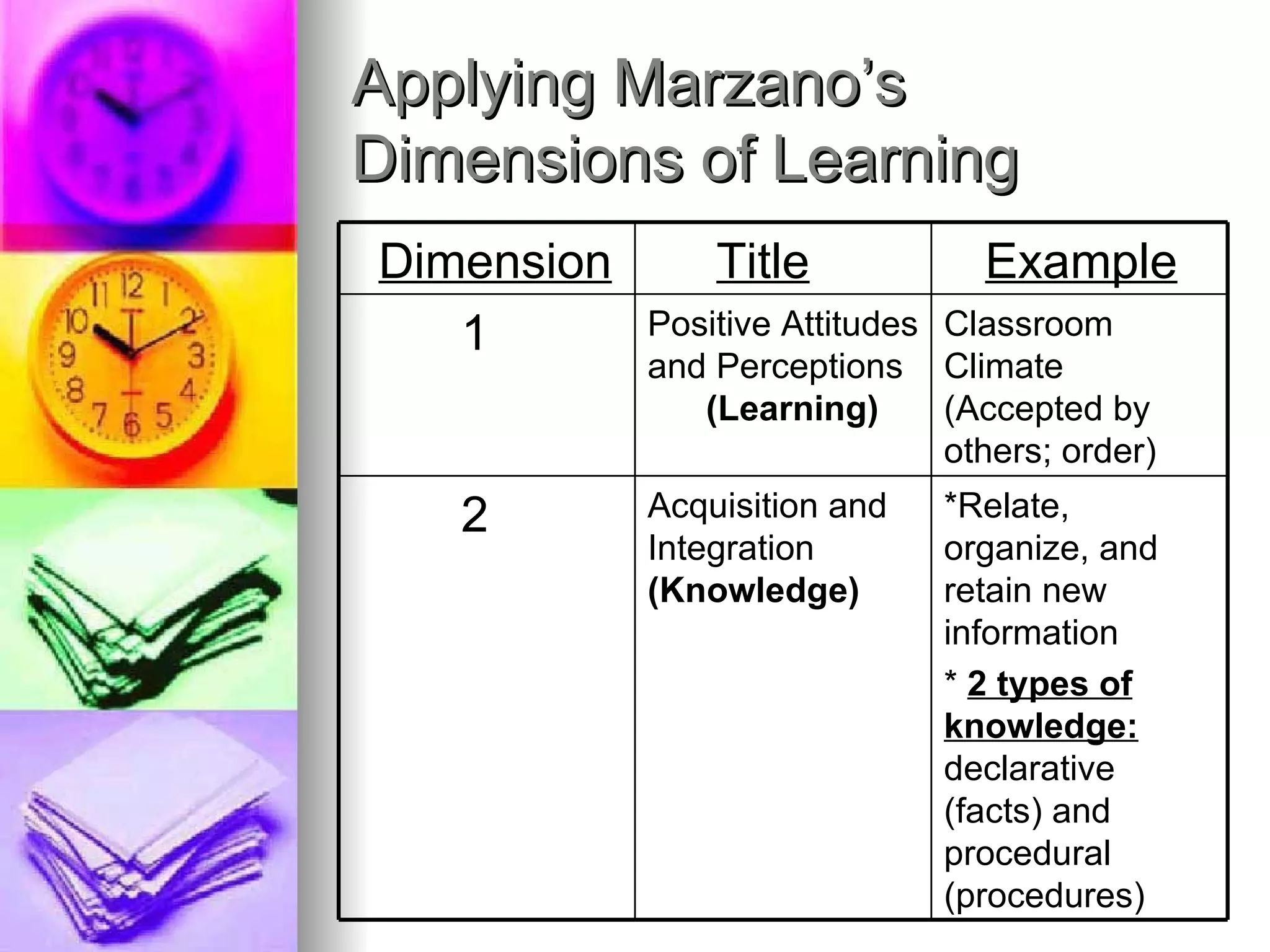
Applying Marzano’s
Dimensions of Learning
Dimension       Title            Example
   1        Positive Attitudes Classroom
            and Perceptions Climate
               (Learning)      (Accepted by
                               others; order)
   2        Acquisition and    *Relate,
            Integration        organize, and
            (Knowledge)        retain new
                               information
                               * 2 types of
                               knowledge:
                               declarative
                               (facts) and
                               procedural
                               (procedures)
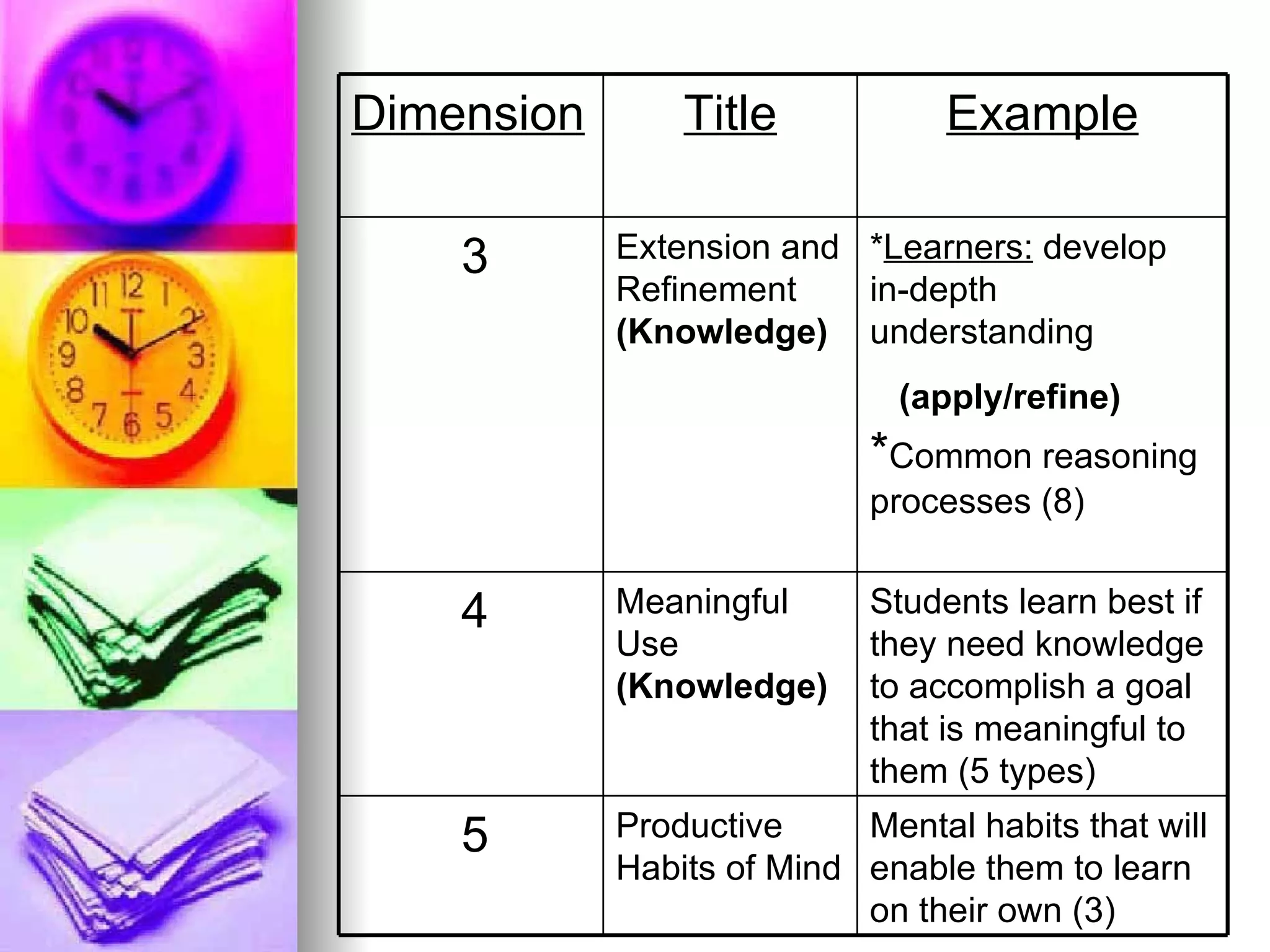
Dimension       Title            Example

    3       Extension and *Learners: develop
            Refinement    in-depth
            (Knowledge) understanding
                              (apply/refine)
                            *Common reasoning
                            processes (8)


    4       Meaningful      Students learn best if
            Use             they need knowledge
            (Knowledge)     to accomplish a goal
                            that is meaningful to
                            them (5 types)
    5       Productive     Mental habits that will
            Habits of Mind enable them to learn
                           on their own (3)
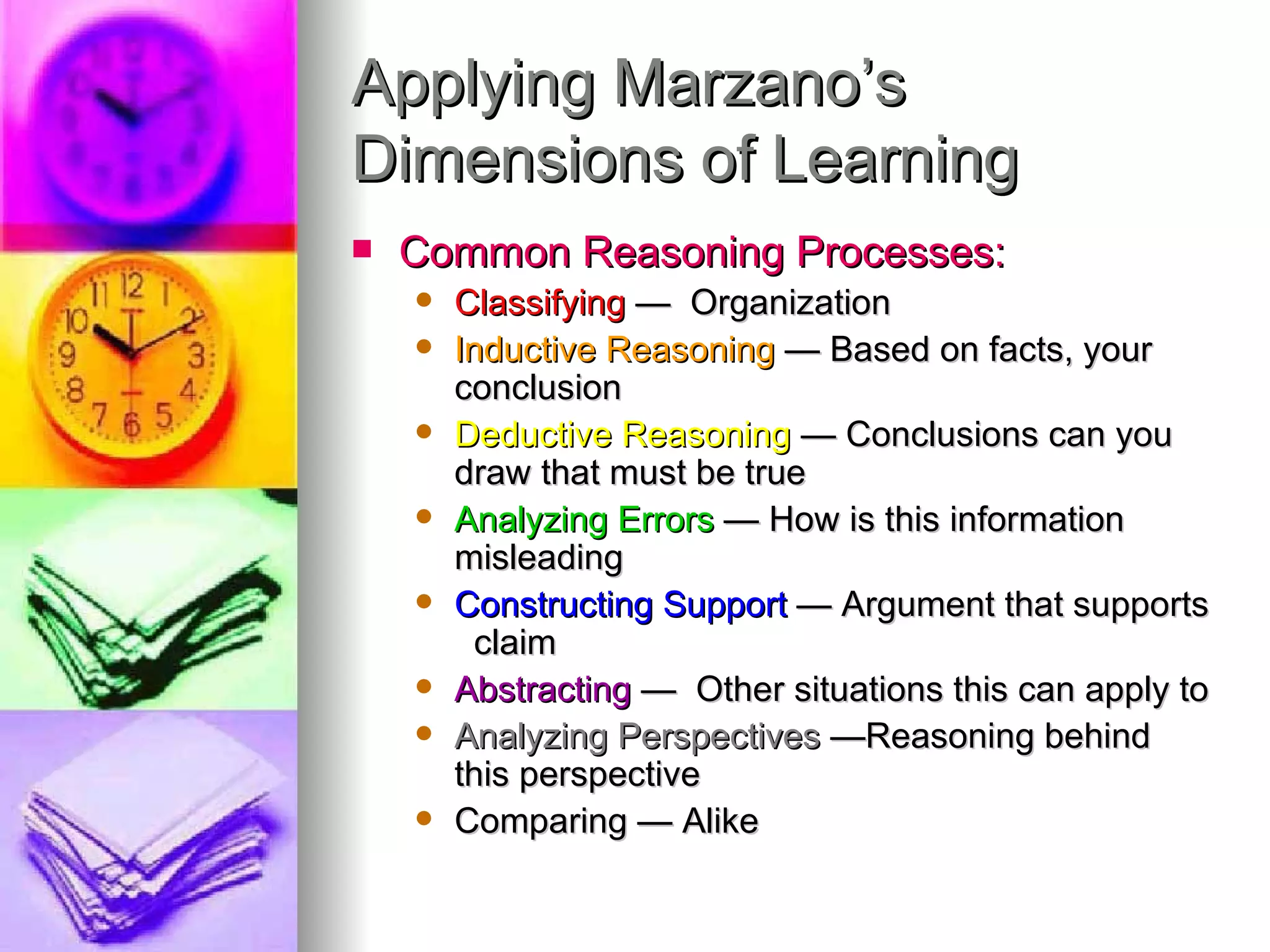
Applying Marzano’s
Dimensions of Learning
   Common Reasoning Processes:
       Classifying — Organization
       Inductive Reasoning — Based on facts, your
        conclusion
       Deductive Reasoning — Conclusions can you
        draw that must be true
       Analyzing Errors — How is this information
        misleading
       Constructing Support — Argument that supports
         claim
       Abstracting — Other situations this can apply to
       Analyzing Perspectives —Reasoning behind
        this perspective
       Comparing — Alike
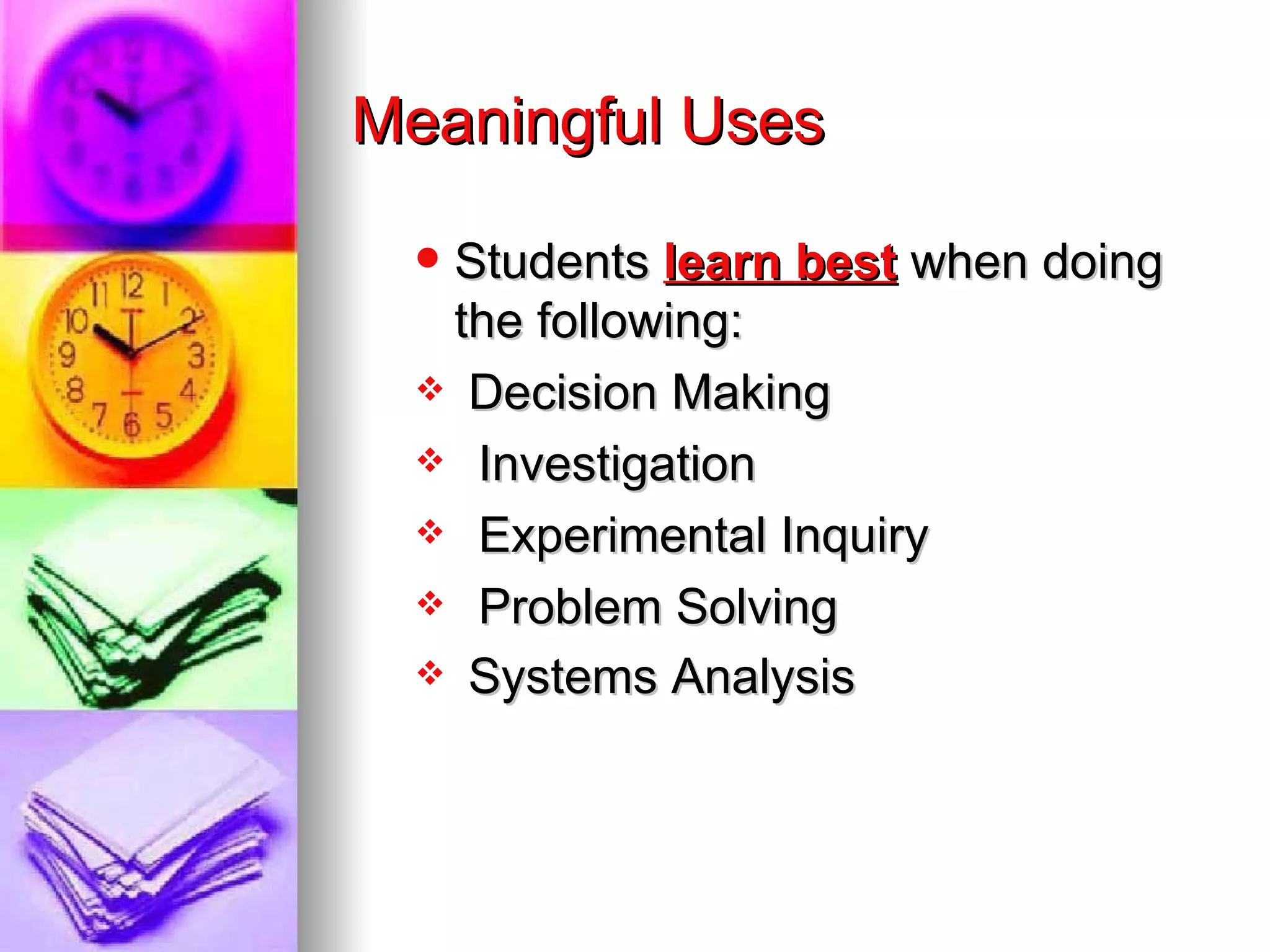
Meaningful Uses

  Students learn best when doing
   the following:
   Decision Making

   Investigation

   Experimental Inquiry

   Problem Solving

   Systems Analysis
Productive Habits

   Pupils can learn on their own with
   the following mental skills:
   Critical Thinking

   Creative Thinking

   Self-Regulation—Metacognition
Costa and Kallick's 16 Habits of
Mind
    Name of Habit              Description
2.   Persisting             2.   Sustain a problem
3.   Managing Impulsivity        solving process
4.   Listen to others       3.   Think before acting
     (empathy and           4.   Listen, empathize,
     understanding)              and understand
5.   Thinking flexibly           views
6.   Think about thinking   5.   Change mind
                                 because of additional
7.   Strive for accuracy         data
     and precision
                            6.   Develop, maintain,
                                 and reflect;Aware of
                                 actions; explain
                                 actions
                            7.   Value craftmanship
Costa and Kallick's 16 Habits of
Mind
7. Questioning and
     Posing Problems-
     Asking ?s and filling
     in gaps between
     known and unknown
8.Applying Past
     Knowledge to New
     Situations-Get
     meaning from one
     experience, carry it,
     and apply it
9. Thinking and
     Communicating
     (Clarity and
     Precision)-Writing
     and orally
     communicating with
     precise language
Costa and Kallick's 16 Habits of Mind
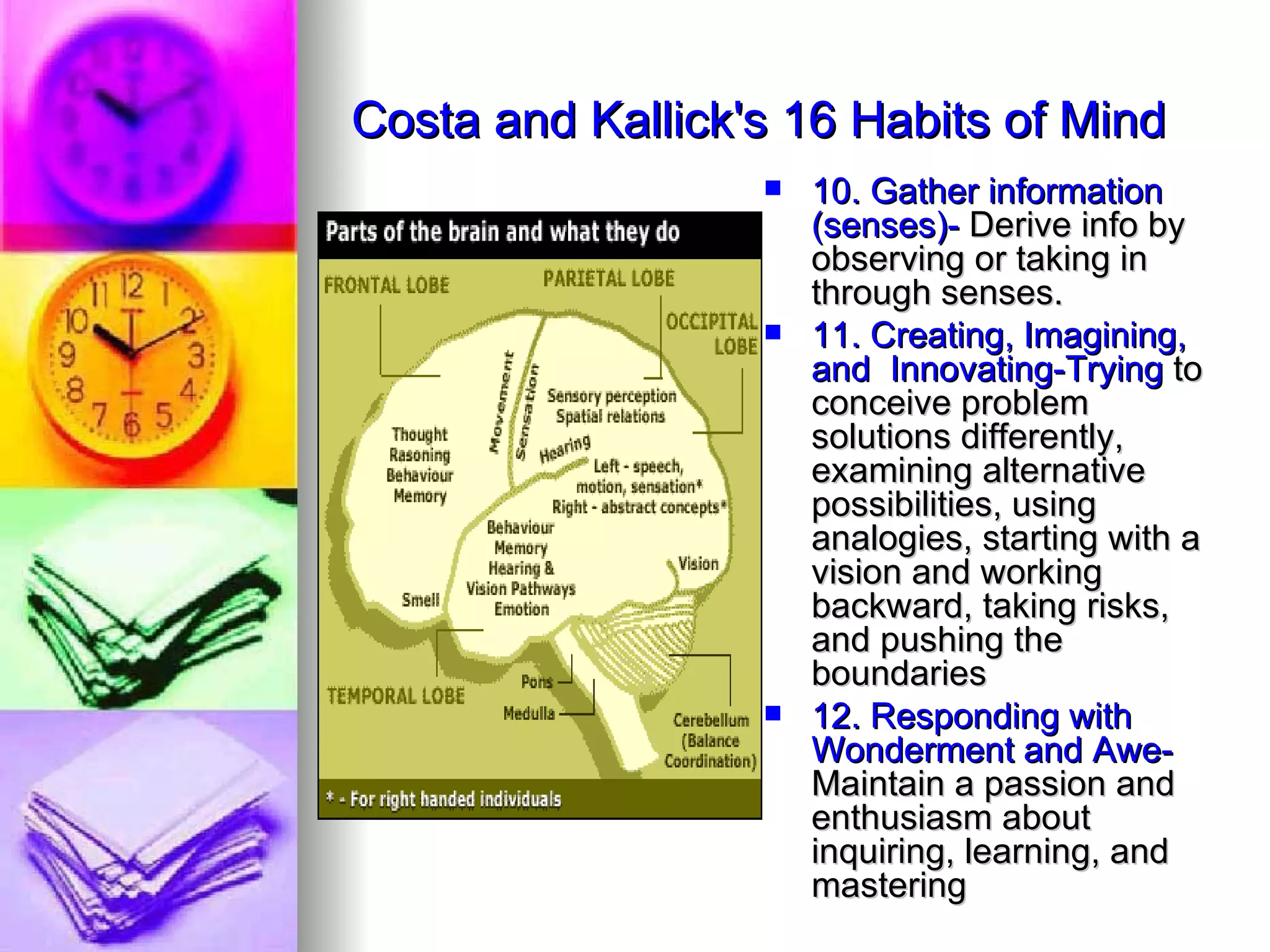
                     10. Gather information
                      (senses)- Derive info by
                      observing or taking in
                      through senses.
                     11. Creating, Imagining,
                      and Innovating-Trying to
                      conceive problem
                      solutions differently,
                      examining alternative
                      possibilities, using
                      analogies, starting with a
                      vision and working
                      backward, taking risks,
                      and pushing the
                      boundaries
                     12. Responding with
                      Wonderment and Awe-
                      Maintain a passion and
                      enthusiasm about
                      inquiring, learning, and
                      mastering
Costa and Kallick's 16 Habits of
Mind
   13.Taking Responsible Risks-Accept
    uncertainty as part of the normal process
   14.Finding Humor- Using humor and
    laughter to liberate creativity and provoke
    higher-level thinking skills
   15. Thinking Interdependently- Think in
    concert with others. Ability to justify ideas
    and to test feasibility. Willingness to accept
    the feedback
   16. Learning Continuously-Constantly
    searching (better ways), striving for
    improvement, always growing, learning,
    and improving themselves

Applying models of thinking powerpoint

  • 1.
    Applying Models of Thinking An Informative Parental Presentation
  • 2.
    Dear Parents, Thank you for allowing me to touch your children’s lives on this educational journey. The purpose of this presentation is to show you how the models of thinking are applied. Sincerely, Miss Dozier
  • 3.
    You will understandhow to apply……..  Bloom’s Taxonomy of Thinking Skills  Demonstrated Thinking Skills  Bloom’s Revised Taxonomy in Project Planning and Assessment  Marzano’s Dimensions of Learning  Costa and Kallick’s 16 Habit of Mind
  • 4.
    Bloom’s Taxonomy of ThinkingSkills: Processes Cognitive Processes  REMEMBER: Produce the right information from memory.  UNDERSTAND: Make meaning from educational materials or experiences.  APPLY: Use a procedure.
  • 5.
    Bloom’s Taxonomy of ThinkingSkills: Processes  ANALZE: Break a concept down into its parts and describe how the parts relate to the whole  EVALUATE: Make judgments based on criteria and standards  CREATE: Put pieces together to form something new or recognize components of a new structure
  • 6.
    Bloom’s Taxonomy of ThinkingSkill: Dimensions Knowledge Dimensions  FACTUAL KNOWLEDGE: Basic information Dimensions  CONCEPTUAL KNOWLEDGE: The relationships among pieces of a larger structure that make them function together  PROCEDURAL KNOWLEDGE: How to do something  METACOGNITIVE KNOWLEDGE: Knowledge of thinking in Factual and Conceptual Procedural Metacognitive general and your thinking in particular
  • 7.
    Application of Cognitive Processesand Knowledge Dimensions  6 Cognitive Processes : o 1. REMEMBER (Examples) Recognize-True/False Recall- Reproduce chemical formulas o 2. UNDERSTAND (Examples) Interpreting-Draw a diagram (digestive system) Exemplifying-Name a mammal in our area. Classifying-Group animals into their proper species. Summarizing-List the key points in process of mitosis. Inferring-Use context clues for unfamiliar words Comparing-Use a Venn diagram to demonstrate how plant and animal cells are similar and different. Explaining-Draw a diagram explaining the two types of circulation.
  • 8.
    Application of Cognitive Processesand Knowledge Dimensions o 3. APPLY (Examples) Executing-Add significant digits Implementing- Design an experiment to see how plants grow in different kinds of soil. o 4. ANALYZE (Examples) Differentiating- List the important information in a mathematical word problem and cross out the unimportant information. Organizing-Make a diagram showing the way plants and animals interact in an area. Attributing-Read letters to determine the author’s view on an issue. o 5. Evaluate (Examples) Checking- Review project plan steps. Critiquing- Co-develop a rubric and judge if material meets the criteria
  • 9.
    Application of Cognitive Processesand Dimensions o 6. Create (Examples) Generating- Generate scientific hypotheses Planning- Outline a research paper on Darwin’s views on evolution. Producing- Build a habitat for local water fowl.  4 Knowledge Dimensions: o 1. Factual Knowledge Knowledge of terminology- Vocabulary terms Knowledge of specific details and elements-Components of a food chain o 2. Conceptual Knowledge Knowledge of classifications/categories- Species of animals Knowledge of principles/generalizations- Mendel’s Law of Segregation Knowledge of theories, models, and structures-Theory of Evolution
  • 10.
    o 3. Procedural Knowledge Subject Specific Skills/Algorithms- Procedure for solving metric problems Subject Specific Techniques/Methods- Scientific method Criteria when to Use the Appropriate Procedures-Methods for experiments o 4. Metacognitive Knowledge Strategic- Reading Comprehension Strategies Cognitive Tasks-Reading demands of books Self-Knowledge-Need for diagram to understand processes
  • 11.
    Demonstrated Thinking Skills  Remembering- Defining and listing  Understanding-Assess, restate, and identify  Applying- Calculating using equations, contrast possibilities, and demonstrate math/science principles  Analyzing- Pictures, Tables/Diagrams, options (discuss), and generalizations (make)  Evaluating- Assess validity, support guesses, and tests guesses  Creating- Build models, propose new ways, and work backwards
  • 12.
    Bloom’s Taxonomy inProject Planning and Student Assessment  2 Videos: 1.Promoting Higher Level Thinking Skills: Using Bloom's Taxonomy with SoftChalk (Part 1)  http://www.youtube.com/watch?v=6grRsLm8eww 2.Promoting Higher Level Thinking Skills: Using Bloom's Taxonomy with SoftChalk (Part 1)  http://www.youtube.com/watch?v=h-vvZbDz09w
  • 13.
    Applying Marzano’s Dimensions ofLearning Dimension Title Example 1 Positive Attitudes Classroom and Perceptions Climate (Learning) (Accepted by others; order) 2 Acquisition and *Relate, Integration organize, and (Knowledge) retain new information * 2 types of knowledge: declarative (facts) and procedural (procedures)
  • 14.
    Dimension Title Example 3 Extension and *Learners: develop Refinement in-depth (Knowledge) understanding (apply/refine) *Common reasoning processes (8) 4 Meaningful Students learn best if Use they need knowledge (Knowledge) to accomplish a goal that is meaningful to them (5 types) 5 Productive Mental habits that will Habits of Mind enable them to learn on their own (3)
  • 15.
    Applying Marzano’s Dimensions ofLearning  Common Reasoning Processes:  Classifying — Organization  Inductive Reasoning — Based on facts, your conclusion  Deductive Reasoning — Conclusions can you draw that must be true  Analyzing Errors — How is this information misleading  Constructing Support — Argument that supports claim  Abstracting — Other situations this can apply to  Analyzing Perspectives —Reasoning behind this perspective  Comparing — Alike
  • 16.
    Meaningful Uses Students learn best when doing the following:  Decision Making  Investigation  Experimental Inquiry  Problem Solving  Systems Analysis
  • 17.
    Productive Habits  Pupils can learn on their own with the following mental skills:  Critical Thinking  Creative Thinking  Self-Regulation—Metacognition
  • 18.
    Costa and Kallick's16 Habits of Mind  Name of Habit  Description 2. Persisting 2. Sustain a problem 3. Managing Impulsivity solving process 4. Listen to others 3. Think before acting (empathy and 4. Listen, empathize, understanding) and understand 5. Thinking flexibly views 6. Think about thinking 5. Change mind because of additional 7. Strive for accuracy data and precision 6. Develop, maintain, and reflect;Aware of actions; explain actions 7. Value craftmanship
  • 19.
    Costa and Kallick's16 Habits of Mind 7. Questioning and Posing Problems- Asking ?s and filling in gaps between known and unknown 8.Applying Past Knowledge to New Situations-Get meaning from one experience, carry it, and apply it 9. Thinking and Communicating (Clarity and Precision)-Writing and orally communicating with precise language
  • 20.
    Costa and Kallick's16 Habits of Mind  10. Gather information (senses)- Derive info by observing or taking in through senses.  11. Creating, Imagining, and Innovating-Trying to conceive problem solutions differently, examining alternative possibilities, using analogies, starting with a vision and working backward, taking risks, and pushing the boundaries  12. Responding with Wonderment and Awe- Maintain a passion and enthusiasm about inquiring, learning, and mastering
  • 21.
    Costa and Kallick's16 Habits of Mind  13.Taking Responsible Risks-Accept uncertainty as part of the normal process  14.Finding Humor- Using humor and laughter to liberate creativity and provoke higher-level thinking skills  15. Thinking Interdependently- Think in concert with others. Ability to justify ideas and to test feasibility. Willingness to accept the feedback  16. Learning Continuously-Constantly searching (better ways), striving for improvement, always growing, learning, and improving themselves