Energy Systems
Energy Systems
EXPECTATIONS
This lesson will help you to:
• Know the meaning of Energy System
• Identify the different kinds of Energy
Systems
• Discuss the importance of Energy
System in dance
• Perform a excercise where energy
systems can be used.
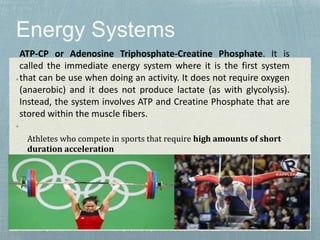
ATP-CP or Adenosine Triphosphate-Creatine Phosphate. It is
called the immediate energy system where it is the first system
that can be use when doing an activity. It does not require oxygen
(anaerobic) and it does not produce lactate (as with glycolysis).
Instead, the system involves ATP and Creatine Phosphate that are
stored within the muscle fibers.
Athletes who compete in sports that require high amounts of short
duration acceleration
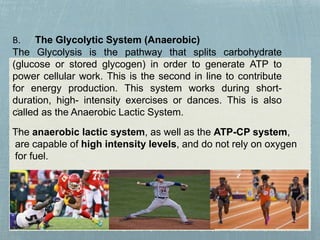
B. The Glycolytic System (Anaerobic)
The Glycolysis is the pathway that splits carbohydrate
(glucose or stored glycogen) in order to generate ATP to
power cellular work. This is the second in line to contribute
for energy production. This system works during short-
duration, high- intensity exercises or dances. This is also
called as the Anaerobic Lactic System.
The anaerobic lactic system, as well as the ATP-CP system,
are capable of high intensity levels, and do not rely on oxygen
for fuel.
The Oxidative System (Aerobic)
The aerobic system is the most utilized of the three. It provides energy for
low intensity
activities that last anywhere from two minutes to a few hours. Unlike the
other two systems,
the aerobic system requires oxygen and takes much longer to overload.
Sports and activities
that use continuous sustained efforts such as long-distance swimming,
crew (rowing) and sea
kayaking rely on the aerobic system.
The energy system of our body works in different ways in
which it generates fuel and uses it as an energy to
perform a certain task. We all know that in able for our
body to work, all we must do is to eat.
The food that we eat gives as the energy to do work and to
accomplish something. These food serves as the fuel of our
body
Energy systems in our body includes the ATP-CP
System, Glycolysis, and Oxidative. In the previous
grade level, these energy systems were discussed in
the concept of exercise and sports
Energy Systems in the Body
The human body uses energy from food to fuel
movement and essential body functions, but the
body cells don't get energy directly from food. After
food is digested, the carbohydrates, protein and fat
break down into simple compounds -- glucose,
amino acids and fatty acids -- which are absorbed
into the blood and transported to various cells
throughout the body. Within these cells, and from
these energy sources, adenosine triphosphate (ATP) is
formed to provide fuel.
ATP-PC System
The body needs a continuous supply of ATP
for energy -- whether the energy is needed
for lifting weights, walking, thinking or even
texting
This system is anaerobic, which means it does
not use oxygen. The ATP-PC system utilizes
the relatively small amount of ATP already
stored in the muscle for this immediate energy
source.
Lactic Acid System
The lactic acid system, also called the anaerobic
glycolysis system, produces energy from
muscle glycogen -- the storage form of glucose.
Glycolysis, or the breakdown of glycogen into
glucose, can occur in the presence or absence of
oxygen.
The lactic acid system fuels relatively short
periods -- a few minutes -- of high-intensity
muscle activity, but the accumulation of lactic
acid can cause fatigue and a burning sensation
in the muscles.
Aerobic System
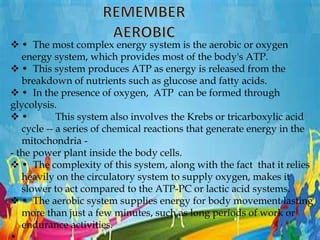
The most complex energy system is the aerobic or
oxygen energy system, which provides most of the
body's ATP. This system produces ATP as energy is
released from the breakdown of nutrients such as
glucose and fatty acids. In the presence of oxygen, ATP
can be formed through glycolysis.
This system also involves the Krebs or tricarboxylic
acid cycle -- a series of chemical reactions that
generate energy in the mitochondria -- the power
plant inside the body cells. The complexity of this
system, along with the fact that it relies heavily on the
circulatory system to supply oxygen, makes it slower
to act compared to the ATP-PC or lactic acid systems.
ATP-CP
 • The body needs a continuous supply of ATP for energy -
- whether the energy is needed for lifting weights, walking,
thinking or even texting.
 • It's also the unit of energy that fuels metabolism, or the
biochemical reactions that support and maintain life.
 • For short and intense movement lasting less than
10 seconds, the body mainly uses the ATP-PC, or creatine
phosphate system.
 This system is anaerobic, which means it does not use
oxygen. The ATP-PC system utilizes the relatively small
amount of ATP already stored in the muscle for this
immediate energy source.
• The lactic acid system, also called the anaerobic
glycolysis system, produces energy from muscle glycogen --
the storage form of glucose.
• Glycolysis, or the breakdown of glycogen into glucose,
can occur in the presence or absence of oxygen.
• When inadequate oxygen is available, the
series of reactions that transforms glucose into ATP causes
lactic acid to be produced -- in efforts to make more ATP.
• The lactic acid system fuels relatively short periods
-- a few minutes -- of high- intensity muscle activity, but the
accumulation of lactic acid can cause fatigue and a burning
sensation in the muscles.
 • The most complex energy system is the aerobic or oxygen
energy system, which provides most of the body's ATP.
 • This system produces ATP as energy is released from the
breakdown of nutrients such as glucose and fatty acids.
 • In the presence of oxygen, ATP can be formed through
glycolysis.
 • This system also involves the Krebs or tricarboxylic acid
cycle -- a series of chemical reactions that generate energy in the
mitochondria -
- the power plant inside the body cells.
 • The complexity of this system, along with the fact that it relies
heavily on the circulatory system to supply oxygen, makes it
slower to act compared to the ATP-PC or lactic acid systems.
 • The aerobic system supplies energy for body movement lasting
more than just a few minutes, such as long periods of work or
endurance activities.
•
CHECKINGYOURUNDERSTANDING
1. An energy system that uses oxygen is called ______
2. ATP-CP stands for _ _
3. There are three energy systems namely _, _ , _ _
4. Food serves as the to provide the energy that our body needs.
5. __ occurs when our body is working hard.
6. Weightlifting and shot-put are examples of energy system
7. Immediate energy system is also called as _
8. __ is the most complex energy system
9. __ is the source of ATP during aerobic activities
10.Mitochondria are referred as the
Choose the letter of the best answer. Write the chosen letter on a separate
sheet of paper.
1. There are three basic energy system, except one
A. Anerobic a-lactic system C. Aerobic system
B. Anaerobic lactic system D. Adrenaline System
2. It is an energy system that requires high amount of short duration
A. Anerobic a-lactic system C. Aerobic lactic system
B. Anaerobic lactic system D. Adrenaline system
3. The ATP-CP stands for
A. Adenosine Triphosphate-Creatine Phosphate
B. Adrenalin Trisphosphate-Creatine Phosphate
C. Aerobic Triphosphate-Creatine Phosphate
D. None of the Above
4. Glycolytic system is also known as:
A. ATP-CP C. Adrenaline System
B. Anaerobic lactic system D. Aerobic system
5. What kind of energy system is being used when doing a slow but
powerful movements in a dance?
A. ATP-CP C. Aerobic system
B. Anaerobic lactic system D. Adrenaline system
6. It is the energy system that uses oxygen.
A. Lactid Acid System C. ATP-CP
B. Aerobic System D. Glycolytic system
7. It is an energy system that is considered to be as the immediate
system
A. ATP-CP C. Lactic acid system
B. Glycolytic System D. Aerobic system
8. Mostly, what kind of energy system is being used in dancing?
A. ATP-CP C. Aerobic system
B. Lactic Acid System D. Glycolytic system
9. It is the primary source of ATP during aerobic activities
A. Lactic Acid System C. Oxidative system
B. ATP-CP D. Glycolytic system
10. The body stores ATP in muscle in a form of _.
A. Oxygen C. Glycogen
B. Water D. None of the above

energy system.pptx

  • 1.
  • 2.
    Energy Systems EXPECTATIONS This lessonwill help you to: • Know the meaning of Energy System • Identify the different kinds of Energy Systems • Discuss the importance of Energy System in dance • Perform a excercise where energy systems can be used.
  • 3.
    ATP-CP or AdenosineTriphosphate-Creatine Phosphate. It is called the immediate energy system where it is the first system that can be use when doing an activity. It does not require oxygen (anaerobic) and it does not produce lactate (as with glycolysis). Instead, the system involves ATP and Creatine Phosphate that are stored within the muscle fibers. Athletes who compete in sports that require high amounts of short duration acceleration
  • 4.
    B. The GlycolyticSystem (Anaerobic) The Glycolysis is the pathway that splits carbohydrate (glucose or stored glycogen) in order to generate ATP to power cellular work. This is the second in line to contribute for energy production. This system works during short- duration, high- intensity exercises or dances. This is also called as the Anaerobic Lactic System. The anaerobic lactic system, as well as the ATP-CP system, are capable of high intensity levels, and do not rely on oxygen for fuel.
  • 5.
    The Oxidative System(Aerobic) The aerobic system is the most utilized of the three. It provides energy for low intensity activities that last anywhere from two minutes to a few hours. Unlike the other two systems, the aerobic system requires oxygen and takes much longer to overload. Sports and activities that use continuous sustained efforts such as long-distance swimming, crew (rowing) and sea kayaking rely on the aerobic system.
  • 6.
    The energy systemof our body works in different ways in which it generates fuel and uses it as an energy to perform a certain task. We all know that in able for our body to work, all we must do is to eat. The food that we eat gives as the energy to do work and to accomplish something. These food serves as the fuel of our body
  • 7.
    Energy systems inour body includes the ATP-CP System, Glycolysis, and Oxidative. In the previous grade level, these energy systems were discussed in the concept of exercise and sports
  • 8.
    Energy Systems inthe Body The human body uses energy from food to fuel movement and essential body functions, but the body cells don't get energy directly from food. After food is digested, the carbohydrates, protein and fat break down into simple compounds -- glucose, amino acids and fatty acids -- which are absorbed into the blood and transported to various cells throughout the body. Within these cells, and from these energy sources, adenosine triphosphate (ATP) is formed to provide fuel.
  • 9.
    ATP-PC System The bodyneeds a continuous supply of ATP for energy -- whether the energy is needed for lifting weights, walking, thinking or even texting This system is anaerobic, which means it does not use oxygen. The ATP-PC system utilizes the relatively small amount of ATP already stored in the muscle for this immediate energy source.
  • 10.
    Lactic Acid System Thelactic acid system, also called the anaerobic glycolysis system, produces energy from muscle glycogen -- the storage form of glucose. Glycolysis, or the breakdown of glycogen into glucose, can occur in the presence or absence of oxygen. The lactic acid system fuels relatively short periods -- a few minutes -- of high-intensity muscle activity, but the accumulation of lactic acid can cause fatigue and a burning sensation in the muscles.
  • 11.
    Aerobic System The mostcomplex energy system is the aerobic or oxygen energy system, which provides most of the body's ATP. This system produces ATP as energy is released from the breakdown of nutrients such as glucose and fatty acids. In the presence of oxygen, ATP can be formed through glycolysis. This system also involves the Krebs or tricarboxylic acid cycle -- a series of chemical reactions that generate energy in the mitochondria -- the power plant inside the body cells. The complexity of this system, along with the fact that it relies heavily on the circulatory system to supply oxygen, makes it slower to act compared to the ATP-PC or lactic acid systems.
  • 12.
    ATP-CP  • Thebody needs a continuous supply of ATP for energy - - whether the energy is needed for lifting weights, walking, thinking or even texting.  • It's also the unit of energy that fuels metabolism, or the biochemical reactions that support and maintain life.  • For short and intense movement lasting less than 10 seconds, the body mainly uses the ATP-PC, or creatine phosphate system.  This system is anaerobic, which means it does not use oxygen. The ATP-PC system utilizes the relatively small amount of ATP already stored in the muscle for this immediate energy source.
  • 13.
    • The lacticacid system, also called the anaerobic glycolysis system, produces energy from muscle glycogen -- the storage form of glucose. • Glycolysis, or the breakdown of glycogen into glucose, can occur in the presence or absence of oxygen. • When inadequate oxygen is available, the series of reactions that transforms glucose into ATP causes lactic acid to be produced -- in efforts to make more ATP. • The lactic acid system fuels relatively short periods -- a few minutes -- of high- intensity muscle activity, but the accumulation of lactic acid can cause fatigue and a burning sensation in the muscles.
  • 14.
     • Themost complex energy system is the aerobic or oxygen energy system, which provides most of the body's ATP.  • This system produces ATP as energy is released from the breakdown of nutrients such as glucose and fatty acids.  • In the presence of oxygen, ATP can be formed through glycolysis.  • This system also involves the Krebs or tricarboxylic acid cycle -- a series of chemical reactions that generate energy in the mitochondria - - the power plant inside the body cells.  • The complexity of this system, along with the fact that it relies heavily on the circulatory system to supply oxygen, makes it slower to act compared to the ATP-PC or lactic acid systems.  • The aerobic system supplies energy for body movement lasting more than just a few minutes, such as long periods of work or endurance activities. •
  • 15.
    CHECKINGYOURUNDERSTANDING 1. An energysystem that uses oxygen is called ______ 2. ATP-CP stands for _ _ 3. There are three energy systems namely _, _ , _ _ 4. Food serves as the to provide the energy that our body needs. 5. __ occurs when our body is working hard. 6. Weightlifting and shot-put are examples of energy system 7. Immediate energy system is also called as _ 8. __ is the most complex energy system 9. __ is the source of ATP during aerobic activities 10.Mitochondria are referred as the
  • 16.
    Choose the letterof the best answer. Write the chosen letter on a separate sheet of paper. 1. There are three basic energy system, except one A. Anerobic a-lactic system C. Aerobic system B. Anaerobic lactic system D. Adrenaline System 2. It is an energy system that requires high amount of short duration A. Anerobic a-lactic system C. Aerobic lactic system B. Anaerobic lactic system D. Adrenaline system 3. The ATP-CP stands for A. Adenosine Triphosphate-Creatine Phosphate B. Adrenalin Trisphosphate-Creatine Phosphate C. Aerobic Triphosphate-Creatine Phosphate D. None of the Above 4. Glycolytic system is also known as: A. ATP-CP C. Adrenaline System B. Anaerobic lactic system D. Aerobic system 5. What kind of energy system is being used when doing a slow but powerful movements in a dance? A. ATP-CP C. Aerobic system B. Anaerobic lactic system D. Adrenaline system
  • 17.
    6. It isthe energy system that uses oxygen. A. Lactid Acid System C. ATP-CP B. Aerobic System D. Glycolytic system 7. It is an energy system that is considered to be as the immediate system A. ATP-CP C. Lactic acid system B. Glycolytic System D. Aerobic system 8. Mostly, what kind of energy system is being used in dancing? A. ATP-CP C. Aerobic system B. Lactic Acid System D. Glycolytic system 9. It is the primary source of ATP during aerobic activities A. Lactic Acid System C. Oxidative system B. ATP-CP D. Glycolytic system 10. The body stores ATP in muscle in a form of _. A. Oxygen C. Glycogen B. Water D. None of the above