7
Lesson Plan in Physical Education and Health 11
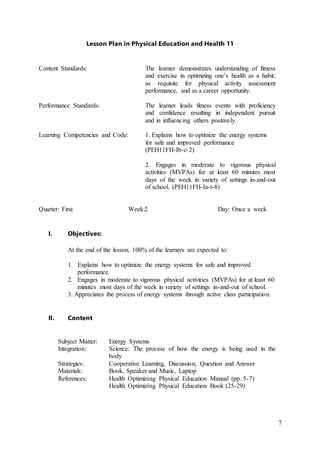
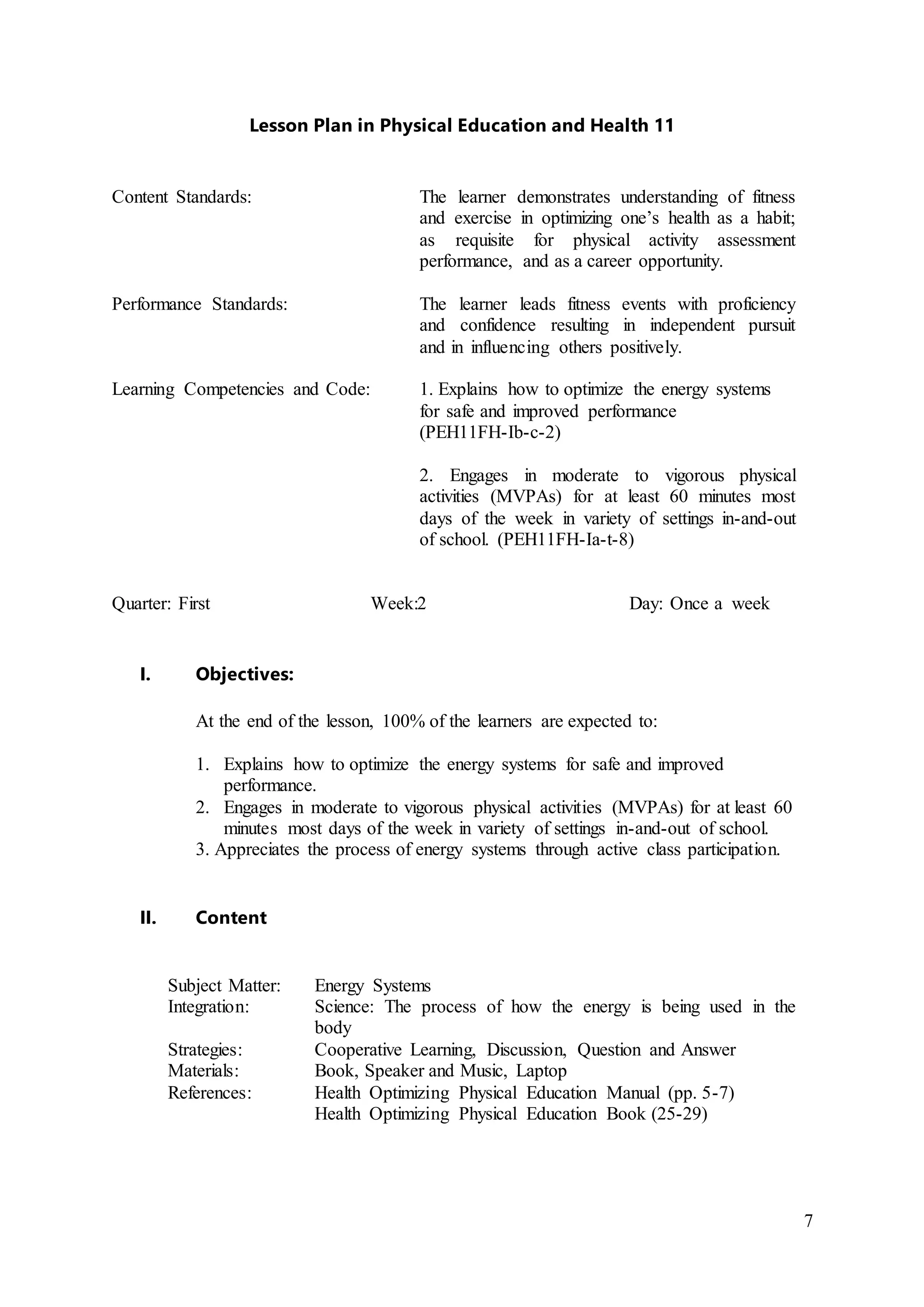
Content Standards: The learner demonstrates understanding of fitness
and exercise in optimizing one’s health as a habit;
as requisite for physical activity assessment
performance, and as a career opportunity.
Performance Standards: The learner leads fitness events with proficiency
and confidence resulting in independent pursuit
and in influencing others positively.
Learning Competencies and Code: 1. Explains how to optimize the energy systems
for safe and improved performance
(PEH11FH-Ib-c-2)
2. Engages in moderate to vigorous physical
activities (MVPAs) for at least 60 minutes most
days of the week in variety of settings in-and-out
of school. (PEH11FH-Ia-t-8)
Quarter: First Week:2 Day: Once a week
I. Objectives:
At the end of the lesson, 100% of the learners are expected to:
1. Explains how to optimize the energy systems for safe and improved
performance.
2. Engages in moderate to vigorous physical activities (MVPAs) for at least 60
minutes most days of the week in variety of settings in-and-out of school.
3. Appreciates the process of energy systems through active class participation.
II. Content
Subject Matter: Energy Systems
Integration: Science: The process of how the energy is being used in the
body
Strategies: Cooperative Learning, Discussion, Question and Answer
Materials: Book, Speaker and Music, Laptop
References: Health Optimizing Physical Education Manual (pp. 5-7)
Health Optimizing Physical Education Book (25-29)
8
III. Learning Tasks
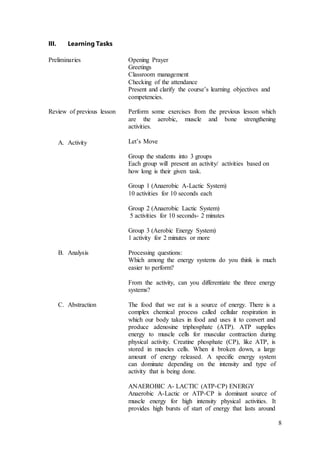
Preliminaries Opening Prayer
Greetings
Classroom management
Checking of the attendance
Present and clarify the course’s learning objectives and
competencies.
Review of previous lesson Perform some exercises from the previous lesson which
are the aerobic, muscle and bone strengthening
activities.
A. Activity Let’s Move
Group the students into 3 groups
Each group will present an activity/ activities based on
how long is their given task.
Group 1 (Anaerobic A-Lactic System)
10 activities for 10 seconds each
Group 2 (Anaerobic Lactic System)
5 activities for 10 seconds- 2 minutes
Group 3 (Aerobic Energy System)
1 activity for 2 minutes or more
B. Analysis Processing questions:
Which among the energy systems do you think is much
easier to perform?
From the activity, can you differentiate the three energy
systems?
C. Abstraction The food that we eat is a source of energy. There is a
complex chemical process called cellular respiration in
which our body takes in food and uses it to convert and
produce adenosine triphosphate (ATP). ATP supplies
energy to muscle cells for muscular contraction during
physical activity. Creatine phosphate (CP), like ATP, is
stored in muscles cells. When it broken down, a large
amount of energy released. A specific energy system
can dominate depending on the intensity and type of
activity that is being done.
ANAEROBIC A- LACTIC (ATP-CP) ENERGY
Anaerobic A-Lactic or ATP-CP is dominant source of
muscle energy for high intensity physical activities. It
provides high bursts of start of energy that lasts around
9
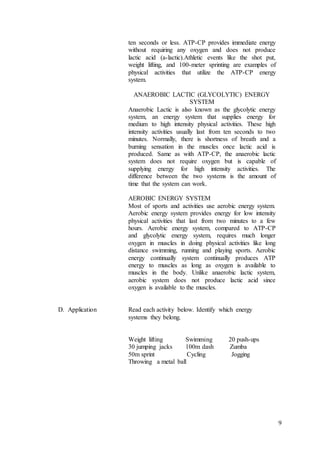
ten seconds or less. ATP-CP provides immediate energy
without requiring any oxygen and does not produce
lactic acid (a-lactic).Athletic events like the shot put,
weight lifting, and 100-meter sprinting are examples of
physical activities that utilize the ATP-CP energy
system.
ANAEROBIC LACTIC (GLYCOLYTIC) ENERGY
SYSTEM
Anaerobic Lactic is also known as the glycolytic energy
system, an energy system that supplies energy for
medium to high intensity physical activities. These high
intensity activities usually last from ten seconds to two
minutes. Normally, there is shortness of breath and a
burning sensation in the muscles once lactic acid is
produced. Same as with ATP-CP, the anaerobic lactic
system does not require oxygen but is capable of
supplying energy for high intensity activities. The
difference between the two systems is the amount of
time that the system can work.
AEROBIC ENERGY SYSTEM
Most of sports and activities use aerobic energy system.
Aerobic energy system provides energy for low intensity
physical activities that last from two minutes to a few
hours. Aerobic energy system, compared to ATP-CP
and glycolytic energy system, requires much longer
oxygen in muscles in doing physical activities like long
distance swimming, running and playing sports. Aerobic
energy continually system continually produces ATP
energy to muscles as long as oxygen is available to
muscles in the body. Unlike anaerobic lactic system,
aerobic system does not produce lactic acid since
oxygen is available to the muscles.
D. Application Read each activity below. Identify which energy
systems they belong.
Weight lifting Swimming 20 push-ups
30 jumping jacks 100m dash Zumba
50m sprint Cycling Jogging
Throwing a metal ball
10
ATP-CP ANAEROBIC AEROBIC
GLYCOLYTIC
(0-10 sec.) (10 sec- 2 min) (2 min. or more)
Generalization: After the exercise routine, ask the
following questions to the students.
How will you differentiate anaerobic a-lactic and
anaerobic lactic system?
What do they have in common? Explain
How does the aerobic system work in our body? How
does it differ from 2 anaerobic systems? Explain
IV. Assessment/Evaluation
1. It is the body’s energy system that does not utilize oxygen.
A. Aerobic B. Anaerobic C. Metabolic D. Glycogen
2. What are the three types of energy systems that the body utilizes during physical
activity participation?
A. ATP-CP, Anaerobic Glycolytic, Aerobic
B. Immediate, Aerobic, Adenosine Triphosphate
C. Glycolytic, Anaerobic, Aerobic
D. Explosive, Anaerobic, Adenosine Triphosphate
3. The basic requirement for all body process, such as growth and development, transport
of substances between cells, repair of tissues and muscle contraction is known as?
A. Sleep B. Energy C. Food D. ATP-CP
4. The basic form of energy used by cells.
A. Fats C. Glucose
B. Glycogen D. Adenosine triphosphate
11
5. The energy system that is used when the intensity of the activity is low to moderate.
A. Aerobic B. Anaerobic C. Fat D. Explosive
6. If the duration of the activity is 10 seconds to 2 minutes, what energy system is used?
A. Aerobic C. ATP-CP
B. Anaerobic Glycolytic D. Explosive
7. Which of the following activities does NOT use ATP-CP energy system?
A. Picking up bags of groceries C. 40 meter sprint
B. 2 km. walk D. Track and field throwing events
8. The energy system that is used if the duration of the activity is less than 0 to 10 seconds
A. ATP-CP B. Exercise C. Anaerobic D. Aerobic
9. Which of the following energy system produces a burning sensation and lactic acid in
doing physical activities?
A. Anaerobic Lactic B. Glycolysis C. Immediate D. Oxidative
10. You are joining 5 kilometre fun run in a certain event. What energy you will use in
doing this activity?
A. Aerobic C. Glycolysis
B. B. Lactic Acid D. Anaerobic Glycolytic
V. Assignment/Enrichment
1.Fill in the table below to summarize what you have learned in Lesson 2. This will
help you to remember the important points that you need to learn.
2. For the activity next meeting, bring any art materials as well as printed research
Materials about stress sleep and stress management.
ENERGY
SYSTEMS
DURATION INTESITY LACTIC ACID
PRODUCTION
OXYGEN
REQUIREMENT
Anaerobic
A- Lactic
(ATP-CP)
Anaerobic
Glycolytic
Aerobic
12
Reflection:
A. No. of learners achieve 80%:
B. No. of learners who require additional activities for remediation:
C. Did the remedial lesson work?
D. No. of learners who have caught up the lesson:
E. No. of learners who continue to require remediation:
F. Which of my teaching strategies work well? Why did this work?
G. What difficulties did I encounter which my principal or supervisor help me
solve?
H. What motivation or localized materials did I use/discover which I wish to
share with other teacher?
A. No. of learners achieve 80%:

Dlp final final-energysystem(week 2)

  • 1.
    7 Lesson Plan inPhysical Education and Health 11 Content Standards: The learner demonstrates understanding of fitness and exercise in optimizing one’s health as a habit; as requisite for physical activity assessment performance, and as a career opportunity. Performance Standards: The learner leads fitness events with proficiency and confidence resulting in independent pursuit and in influencing others positively. Learning Competencies and Code: 1. Explains how to optimize the energy systems for safe and improved performance (PEH11FH-Ib-c-2) 2. Engages in moderate to vigorous physical activities (MVPAs) for at least 60 minutes most days of the week in variety of settings in-and-out of school. (PEH11FH-Ia-t-8) Quarter: First Week:2 Day: Once a week I. Objectives: At the end of the lesson, 100% of the learners are expected to: 1. Explains how to optimize the energy systems for safe and improved performance. 2. Engages in moderate to vigorous physical activities (MVPAs) for at least 60 minutes most days of the week in variety of settings in-and-out of school. 3. Appreciates the process of energy systems through active class participation. II. Content Subject Matter: Energy Systems Integration: Science: The process of how the energy is being used in the body Strategies: Cooperative Learning, Discussion, Question and Answer Materials: Book, Speaker and Music, Laptop References: Health Optimizing Physical Education Manual (pp. 5-7) Health Optimizing Physical Education Book (25-29)
  • 2.
    8 III. Learning Tasks PreliminariesOpening Prayer Greetings Classroom management Checking of the attendance Present and clarify the course’s learning objectives and competencies. Review of previous lesson Perform some exercises from the previous lesson which are the aerobic, muscle and bone strengthening activities. A. Activity Let’s Move Group the students into 3 groups Each group will present an activity/ activities based on how long is their given task. Group 1 (Anaerobic A-Lactic System) 10 activities for 10 seconds each Group 2 (Anaerobic Lactic System) 5 activities for 10 seconds- 2 minutes Group 3 (Aerobic Energy System) 1 activity for 2 minutes or more B. Analysis Processing questions: Which among the energy systems do you think is much easier to perform? From the activity, can you differentiate the three energy systems? C. Abstraction The food that we eat is a source of energy. There is a complex chemical process called cellular respiration in which our body takes in food and uses it to convert and produce adenosine triphosphate (ATP). ATP supplies energy to muscle cells for muscular contraction during physical activity. Creatine phosphate (CP), like ATP, is stored in muscles cells. When it broken down, a large amount of energy released. A specific energy system can dominate depending on the intensity and type of activity that is being done. ANAEROBIC A- LACTIC (ATP-CP) ENERGY Anaerobic A-Lactic or ATP-CP is dominant source of muscle energy for high intensity physical activities. It provides high bursts of start of energy that lasts around
  • 3.
    9 ten seconds orless. ATP-CP provides immediate energy without requiring any oxygen and does not produce lactic acid (a-lactic).Athletic events like the shot put, weight lifting, and 100-meter sprinting are examples of physical activities that utilize the ATP-CP energy system. ANAEROBIC LACTIC (GLYCOLYTIC) ENERGY SYSTEM Anaerobic Lactic is also known as the glycolytic energy system, an energy system that supplies energy for medium to high intensity physical activities. These high intensity activities usually last from ten seconds to two minutes. Normally, there is shortness of breath and a burning sensation in the muscles once lactic acid is produced. Same as with ATP-CP, the anaerobic lactic system does not require oxygen but is capable of supplying energy for high intensity activities. The difference between the two systems is the amount of time that the system can work. AEROBIC ENERGY SYSTEM Most of sports and activities use aerobic energy system. Aerobic energy system provides energy for low intensity physical activities that last from two minutes to a few hours. Aerobic energy system, compared to ATP-CP and glycolytic energy system, requires much longer oxygen in muscles in doing physical activities like long distance swimming, running and playing sports. Aerobic energy continually system continually produces ATP energy to muscles as long as oxygen is available to muscles in the body. Unlike anaerobic lactic system, aerobic system does not produce lactic acid since oxygen is available to the muscles. D. Application Read each activity below. Identify which energy systems they belong. Weight lifting Swimming 20 push-ups 30 jumping jacks 100m dash Zumba 50m sprint Cycling Jogging Throwing a metal ball
  • 4.
    10 ATP-CP ANAEROBIC AEROBIC GLYCOLYTIC (0-10sec.) (10 sec- 2 min) (2 min. or more) Generalization: After the exercise routine, ask the following questions to the students. How will you differentiate anaerobic a-lactic and anaerobic lactic system? What do they have in common? Explain How does the aerobic system work in our body? How does it differ from 2 anaerobic systems? Explain IV. Assessment/Evaluation 1. It is the body’s energy system that does not utilize oxygen. A. Aerobic B. Anaerobic C. Metabolic D. Glycogen 2. What are the three types of energy systems that the body utilizes during physical activity participation? A. ATP-CP, Anaerobic Glycolytic, Aerobic B. Immediate, Aerobic, Adenosine Triphosphate C. Glycolytic, Anaerobic, Aerobic D. Explosive, Anaerobic, Adenosine Triphosphate 3. The basic requirement for all body process, such as growth and development, transport of substances between cells, repair of tissues and muscle contraction is known as? A. Sleep B. Energy C. Food D. ATP-CP 4. The basic form of energy used by cells. A. Fats C. Glucose B. Glycogen D. Adenosine triphosphate
  • 5.
    11 5. The energysystem that is used when the intensity of the activity is low to moderate. A. Aerobic B. Anaerobic C. Fat D. Explosive 6. If the duration of the activity is 10 seconds to 2 minutes, what energy system is used? A. Aerobic C. ATP-CP B. Anaerobic Glycolytic D. Explosive 7. Which of the following activities does NOT use ATP-CP energy system? A. Picking up bags of groceries C. 40 meter sprint B. 2 km. walk D. Track and field throwing events 8. The energy system that is used if the duration of the activity is less than 0 to 10 seconds A. ATP-CP B. Exercise C. Anaerobic D. Aerobic 9. Which of the following energy system produces a burning sensation and lactic acid in doing physical activities? A. Anaerobic Lactic B. Glycolysis C. Immediate D. Oxidative 10. You are joining 5 kilometre fun run in a certain event. What energy you will use in doing this activity? A. Aerobic C. Glycolysis B. B. Lactic Acid D. Anaerobic Glycolytic V. Assignment/Enrichment 1.Fill in the table below to summarize what you have learned in Lesson 2. This will help you to remember the important points that you need to learn. 2. For the activity next meeting, bring any art materials as well as printed research Materials about stress sleep and stress management. ENERGY SYSTEMS DURATION INTESITY LACTIC ACID PRODUCTION OXYGEN REQUIREMENT Anaerobic A- Lactic (ATP-CP) Anaerobic Glycolytic Aerobic
  • 6.
    12 Reflection: A. No. oflearners achieve 80%: B. No. of learners who require additional activities for remediation: C. Did the remedial lesson work? D. No. of learners who have caught up the lesson: E. No. of learners who continue to require remediation: F. Which of my teaching strategies work well? Why did this work? G. What difficulties did I encounter which my principal or supervisor help me solve? H. What motivation or localized materials did I use/discover which I wish to share with other teacher? A. No. of learners achieve 80%: