Orthogonal Frequency Division
Multiple Access
(OFDMA)
Khaja Mohammad Shazzad
2
Outline
1. Background
 Multiple Access (MA) Methods
1. Orthogonal Frequency Division Multiplexing
(OFDM) Based Multiple Access (OFDMA)
 Orthogonality Principle
 OFDM
 OFDM-FDMA
1. Advantages and Disadvantages of OFDMA
2. Conclusion
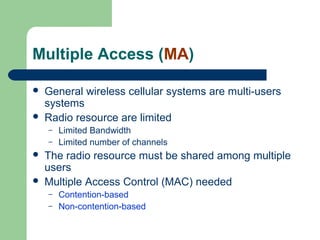
Multiple Access (MA)
 General wireless cellular systems are multi-users
systems
 Radio resource are limited
– Limited Bandwidth
– Limited number of channels
 The radio resource must be shared among multiple
users
 Multiple Access Control (MAC) needed
– Contention-based
– Non-contention-based
4
Contention-based
Multiple Access(MA)
 Contention-based
– Each terminal transmits in a decentralized way
– No central controller (Base stations or access points)
– Example:
 ALOHA
 Carrier Sensing Multiple Access (CSMA)
Standard:
– GSM [l] uses the slotted ALOHA in the terminal’s initial
access process
– IEEE 802.11 uses CSMA/CA based contention access
scheme
Non-contention-based
Multiple Access (MA)
 A logic controller (BS or AP) is needed to
coordinate the transmissions of all the terminals
 The controller informs each device when and on
which channel it can transmit
 Collisions can be avoided entirely
 Two Subdivisions
1. Non-channelization
2. Channelization
Non-channelization
Non-contention-based MA
 Terminals transmit sequentially using the same
channel
 Example:
– Polling based medium access
 Standard:
– IEEE 802.15(WPAN)
– IEEE 802.11(WLAN)
Channelization
Non-contention-based MA
 Terminals transmit simultaneously using different
channels
 Most commonly used protocols in cellular systems
 Example:
– 1. Time Division Multiple Access (TDMA)
– 2. Code Division Multiple Access( CDMA)
– 1. Frequency Division Multiple Access (FDMA)
 Standard
– 1. GSM (TDMA)
– 2. IS-95 (CDMA)
– 3. American Mobile Phone System, AMPS (FDMA)
8
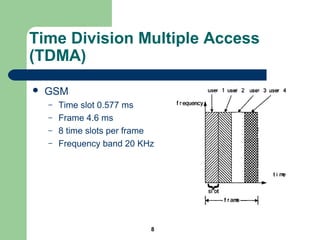
Time Division Multiple Access
(TDMA)
 GSM
– Time slot 0.577 ms
– Frame 4.6 ms
– 8 time slots per frame
– Frequency band 20 KHz
Code Division Multiple Access
(CDMA)
 IS-95
– Orthogonal Walsh codes
– 64 codes (channels)
– One pilot channel
– Seven paging channels
– 55 traffic channels
– Each carrier 1.25 MHz
Frequency Division Multiple Access
(FDMA)
 American Mobile Phone
System (AMPS)
– Total Bandwidth 25 MHz
– Each Channel 30 KHz
Orthogonal Frequency Division
Multiplexing (OFDM) Based Multiple
Access (OFDMA)
Orthogonality Principle
OFDM
OFDM-FDMA
12
Orthogonality Principle
 Vector space
– A, B and C vectors in
space are orthogonal to
each other
– A.B=B.C=C.A=0
– (A+B+C).A=(mod A)^2
– (A+B+C).B=(mod B)^2
– (A+B+C).C=(mod C)^2
A
B
C
Orthogonality Principle cont..
 Real Function space
0)()(
)cos()(
)sin()(
0)()(
)cos()(
)sin()(
21
2
1
=
=
=
=
=
=
∫
∫
+
+
dttftf
nwtNtf
mwtMtf
dttftf
wtBtf
wtAtf
n
T
m
n
m
T
τ
τ
τ
τ
Orthogonality Principle cont..
)2sin()sin()( wtwttf =
∫ =
≠∫ =
∈∀
T
0
0s(nwt)dtsin(mwt)co
nmwhere
T
0
0n(nwt)dtsin(mwt)si
Νm.n
Here mw and nw are called
m-th and n-th harmonics of
w respectively
15
Orthogonal Frequency Division
Multiplexing(OFDM)
 It is a special kind of FDM
 The spacing between carriers are such that
they are orthogonal to one another
 Therefore no need of guard band between
carriers.
 One example makes the thing clear
Example of OFDM
 Lets we have following information bits
– 1, 1, -1, -1, 1, 1, 1, -1, 1, -1, -1, -1, -1, 1, -1, -1, …
 Just converts the serials bits to parallel bits
C1 C2 C3 C4
1 1 -1 -1
1 1 1 -1
1 -1 -1 -1
-1 1 -1 -1
-1 1 1 -1
-1 -1 1 1
Example of OFDM cont..
Modulated signal for C1 Modulated signal for C2
Modulated signal for C3 Modulated signal for C4
Modulate each column with corresponding sub-carrier using BPSK
Example of OFDM cont..
 Final OFDM Signal = Sum of all signal
)2sin()()(
1
0
nttItV
N
n
n
π∑
−
=
=
Generated OFDM signal, V(t)
V(t)
OFDM-FDMA (OFDMA)
 Each terminal occupies
a subset of sub-carriers
 Subset is called an
OFDMA traffic channel
 Each traffic channel is
assigned exclusively to
one user at any time user1
user2
user3
user4
OFDM-FDMA (OFDMA)
 The IEEE 802.16e/ WiMax use OFDMA as
Multiple access technique
– Bandwidth options 1.25, 5, 10, or 20 MHz
– Entire bandwidth divided into 128, 512, 1024 or
2048 sub carriers
– 20 MHz bandwidth with 2048 sub carriers has 9.8
KHz spacing between sub carriers
OFDM-FDMA (System View)
22
Advantages of OFDMA
 Multi-user Diversity
– broadband signals experience frequency selective
fading
– OFDMA allows different users to transmit over
different portions of the broadband spectrum (traffic
channel)
– Different users perceive different channel qualities,
a deep faded channel for one user may still be
favorable to others
Advantages of OFDMA cont..
Multi-user Diversity
Advantages of OFDMA cont..
 Efficient use of Spectrum
4/3 Hz per symbol
6/5 Hz per symbol
Advantages of OFDMA cont..
 Receiver Simplicity
– It eliminates the intra-cell interference avoiding
CDMA type of multi-user detection
– Orthogonality of code destroyed by selective
fading
– Only FFT processor is required
 Bit Error Rate performance is better only in Fading
environment
Disadvantages of OFDMA
 Peak to average power
ratio (PAPR)
avg
P
tx
PAPR
2
)(
=
The large amplitude variation increases in-band noise and
increases the BER when the signal has to go through amplifier
nonlinearities.
27
Disadvantages of OFDMA cont..
 Synchronization
– Tight Synchronization between users are
required for FFT in receiver
– Pilot signals are used for synchronizations
 Co-channel interference
– Dealing with this is more complex in OFDM than in CDMA
– Dynamic channel allocation with advanced
coordination among adjacent base stations
28
Research issues and Conclusion
 Future works
– Peak-to-average power reduction in OFDM
– Timing and Frequency Synchronization
– Efficient digital signal processing Implementation of OFDM
– Multiple input/Multiple output (MIMO) OFDM
 Conclusion
– Different variations of OFDMA are proposed and
have different pros and cons
Thank You
Questions
or
Comments?

Ofdma

  • 1.
    Orthogonal Frequency Division MultipleAccess (OFDMA) Khaja Mohammad Shazzad
  • 2.
    2 Outline 1. Background  MultipleAccess (MA) Methods 1. Orthogonal Frequency Division Multiplexing (OFDM) Based Multiple Access (OFDMA)  Orthogonality Principle  OFDM  OFDM-FDMA 1. Advantages and Disadvantages of OFDMA 2. Conclusion
  • 3.
    Multiple Access (MA) General wireless cellular systems are multi-users systems  Radio resource are limited – Limited Bandwidth – Limited number of channels  The radio resource must be shared among multiple users  Multiple Access Control (MAC) needed – Contention-based – Non-contention-based
  • 4.
    4 Contention-based Multiple Access(MA)  Contention-based –Each terminal transmits in a decentralized way – No central controller (Base stations or access points) – Example:  ALOHA  Carrier Sensing Multiple Access (CSMA) Standard: – GSM [l] uses the slotted ALOHA in the terminal’s initial access process – IEEE 802.11 uses CSMA/CA based contention access scheme
  • 5.
    Non-contention-based Multiple Access (MA) A logic controller (BS or AP) is needed to coordinate the transmissions of all the terminals  The controller informs each device when and on which channel it can transmit  Collisions can be avoided entirely  Two Subdivisions 1. Non-channelization 2. Channelization
  • 6.
    Non-channelization Non-contention-based MA  Terminalstransmit sequentially using the same channel  Example: – Polling based medium access  Standard: – IEEE 802.15(WPAN) – IEEE 802.11(WLAN)
  • 7.
    Channelization Non-contention-based MA  Terminalstransmit simultaneously using different channels  Most commonly used protocols in cellular systems  Example: – 1. Time Division Multiple Access (TDMA) – 2. Code Division Multiple Access( CDMA) – 1. Frequency Division Multiple Access (FDMA)  Standard – 1. GSM (TDMA) – 2. IS-95 (CDMA) – 3. American Mobile Phone System, AMPS (FDMA)
  • 8.
    8 Time Division MultipleAccess (TDMA)  GSM – Time slot 0.577 ms – Frame 4.6 ms – 8 time slots per frame – Frequency band 20 KHz
  • 9.
    Code Division MultipleAccess (CDMA)  IS-95 – Orthogonal Walsh codes – 64 codes (channels) – One pilot channel – Seven paging channels – 55 traffic channels – Each carrier 1.25 MHz
  • 10.
    Frequency Division MultipleAccess (FDMA)  American Mobile Phone System (AMPS) – Total Bandwidth 25 MHz – Each Channel 30 KHz
  • 11.
    Orthogonal Frequency Division Multiplexing(OFDM) Based Multiple Access (OFDMA) Orthogonality Principle OFDM OFDM-FDMA
  • 12.
    12 Orthogonality Principle  Vectorspace – A, B and C vectors in space are orthogonal to each other – A.B=B.C=C.A=0 – (A+B+C).A=(mod A)^2 – (A+B+C).B=(mod B)^2 – (A+B+C).C=(mod C)^2 A B C
  • 13.
    Orthogonality Principle cont.. Real Function space 0)()( )cos()( )sin()( 0)()( )cos()( )sin()( 21 2 1 = = = = = = ∫ ∫ + + dttftf nwtNtf mwtMtf dttftf wtBtf wtAtf n T m n m T τ τ τ τ
  • 14.
    Orthogonality Principle cont.. )2sin()sin()(wtwttf = ∫ = ≠∫ = ∈∀ T 0 0s(nwt)dtsin(mwt)co nmwhere T 0 0n(nwt)dtsin(mwt)si Νm.n Here mw and nw are called m-th and n-th harmonics of w respectively
  • 15.
    15 Orthogonal Frequency Division Multiplexing(OFDM) It is a special kind of FDM  The spacing between carriers are such that they are orthogonal to one another  Therefore no need of guard band between carriers.  One example makes the thing clear
  • 16.
    Example of OFDM Lets we have following information bits – 1, 1, -1, -1, 1, 1, 1, -1, 1, -1, -1, -1, -1, 1, -1, -1, …  Just converts the serials bits to parallel bits C1 C2 C3 C4 1 1 -1 -1 1 1 1 -1 1 -1 -1 -1 -1 1 -1 -1 -1 1 1 -1 -1 -1 1 1
  • 17.
    Example of OFDMcont.. Modulated signal for C1 Modulated signal for C2 Modulated signal for C3 Modulated signal for C4 Modulate each column with corresponding sub-carrier using BPSK
  • 18.
    Example of OFDMcont..  Final OFDM Signal = Sum of all signal )2sin()()( 1 0 nttItV N n n π∑ − = = Generated OFDM signal, V(t) V(t)
  • 19.
    OFDM-FDMA (OFDMA)  Eachterminal occupies a subset of sub-carriers  Subset is called an OFDMA traffic channel  Each traffic channel is assigned exclusively to one user at any time user1 user2 user3 user4
  • 20.
    OFDM-FDMA (OFDMA)  TheIEEE 802.16e/ WiMax use OFDMA as Multiple access technique – Bandwidth options 1.25, 5, 10, or 20 MHz – Entire bandwidth divided into 128, 512, 1024 or 2048 sub carriers – 20 MHz bandwidth with 2048 sub carriers has 9.8 KHz spacing between sub carriers
  • 21.
  • 22.
    22 Advantages of OFDMA Multi-user Diversity – broadband signals experience frequency selective fading – OFDMA allows different users to transmit over different portions of the broadband spectrum (traffic channel) – Different users perceive different channel qualities, a deep faded channel for one user may still be favorable to others
  • 23.
    Advantages of OFDMAcont.. Multi-user Diversity
  • 24.
    Advantages of OFDMAcont..  Efficient use of Spectrum 4/3 Hz per symbol 6/5 Hz per symbol
  • 25.
    Advantages of OFDMAcont..  Receiver Simplicity – It eliminates the intra-cell interference avoiding CDMA type of multi-user detection – Orthogonality of code destroyed by selective fading – Only FFT processor is required  Bit Error Rate performance is better only in Fading environment
  • 26.
    Disadvantages of OFDMA Peak to average power ratio (PAPR) avg P tx PAPR 2 )( = The large amplitude variation increases in-band noise and increases the BER when the signal has to go through amplifier nonlinearities.
  • 27.
    27 Disadvantages of OFDMAcont..  Synchronization – Tight Synchronization between users are required for FFT in receiver – Pilot signals are used for synchronizations  Co-channel interference – Dealing with this is more complex in OFDM than in CDMA – Dynamic channel allocation with advanced coordination among adjacent base stations
  • 28.
    28 Research issues andConclusion  Future works – Peak-to-average power reduction in OFDM – Timing and Frequency Synchronization – Efficient digital signal processing Implementation of OFDM – Multiple input/Multiple output (MIMO) OFDM  Conclusion – Different variations of OFDMA are proposed and have different pros and cons
  • 29.