Hot & Cold 
Rolled Steel 
Farhan Asim 
B.Arch 3rd Year 
Ansal School of Architecture
STEEL SECTIONS 
• The steel sections most used in structural steelwork are standard hot-rolled steel 
universal beams and columns together with a range of tees, channels and angles. 
• Universal beams and columns are produced in a range of standard sizes and 
weights designated by serial sizes. Within each serial size, the inside dimensions 
between flanges and flange edge and web remain constant, and the overall 
dimensions and weights vary.
STEEL SECTIONS 
• This grouping of sections in serial sizes is convenient for production within a range 
of rolling sizes and for the selection of a suitable size and weight by the designer. 
• The deep web to flange dimensions of beams and the near similar flange to web 
dimensions of columns are chosen to suit the functions of the structural elements. 
• Because of the close similarity of the width of the flange to the web of column 
sections, they are sometimes known as ‘broad flange sections’.
Hot Rolled Section 
• The metallurgical process of Hot rolling, 
used mainly to produce sheet metal or 
simple cross sections from billets describes 
the method of when industrial metal is 
passed or deformed between a set of work 
rolls and the temperature of the metal is 
generally above its recrystallization 
temperature. 
• Hot rolling permits large deformations of the 
metal to be achieved with a low number of 
rolling cycles. 
• Hot rolling is primarily concerned with 
manipulating material shape and geometry 
rather than mechanical properties. 
• You’ll find hot rolled products like hot rolled 
steel bars in the welding and construction 
trades such as making railroad tracks, I-beams, 
and other steel construction 
materials that don’t require super precise 
shapes.
Cold Rolled Section 
• Cold rolled steel is manufactured at 
temperatures below its recrystallization 
temperature, typically at around room 
temperature. 
• Because the steel is manufactured at a 
much lower temperature, there’s no need to 
worry about the steel shrinking or changing 
form or appearance. 
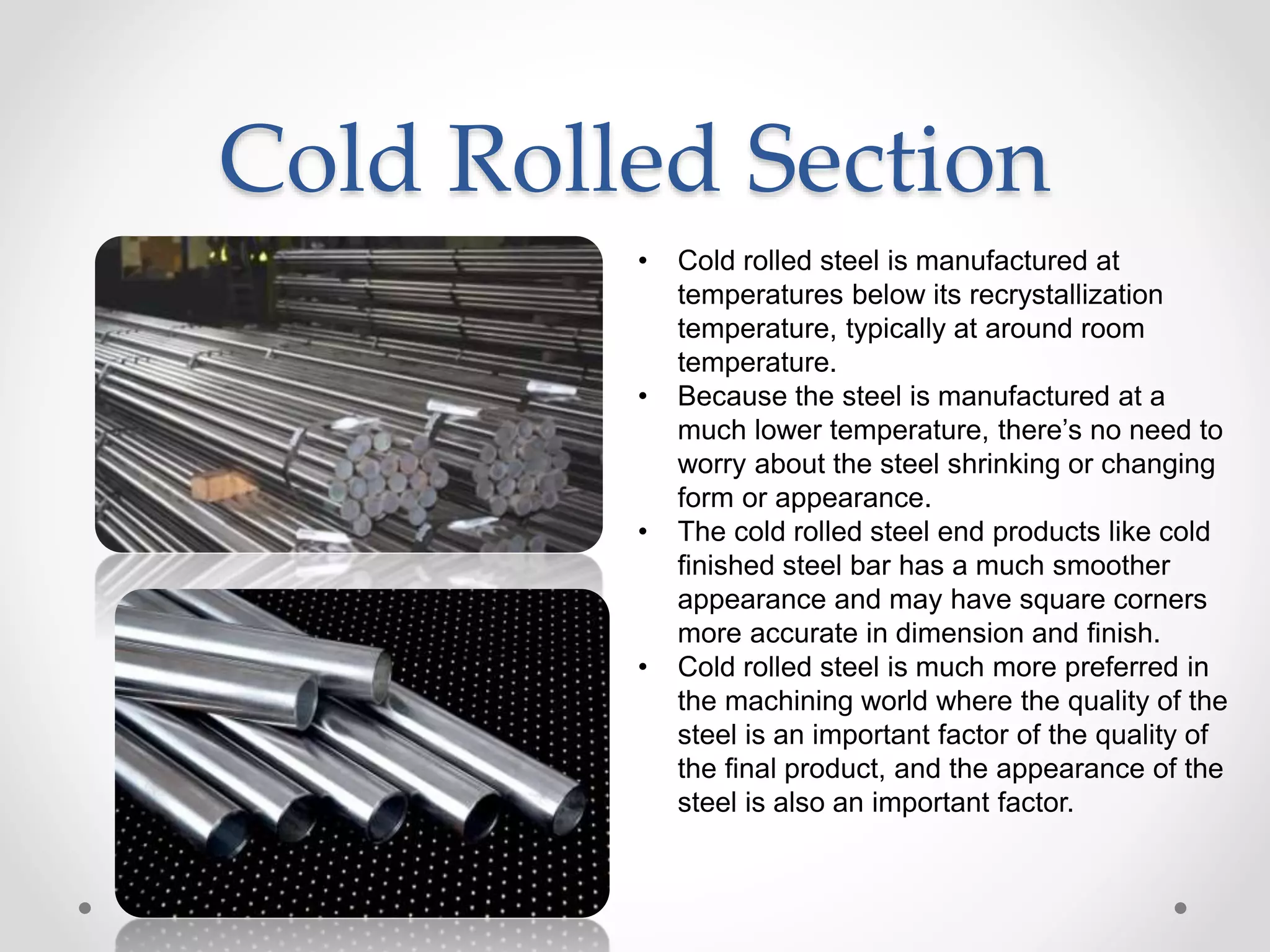
• The cold rolled steel end products like cold 
finished steel bar has a much smoother 
appearance and may have square corners 
more accurate in dimension and finish. 
• Cold rolled steel is much more preferred in 
the machining world where the quality of the 
steel is an important factor of the quality of 
the final product, and the appearance of the 
steel is also an important factor.
COMPANY BROCHURES 
Attachments with the presentation. 
• TATA STEEL 
• TATA TISCON 
• ESSAR HOT ROLLED STEEL 
• BHUSHAN STEEL
THANK YOU

Hot & cold rolled steel farhan

  • 1.
    Hot & Cold Rolled Steel Farhan Asim B.Arch 3rd Year Ansal School of Architecture
  • 2.
    STEEL SECTIONS •The steel sections most used in structural steelwork are standard hot-rolled steel universal beams and columns together with a range of tees, channels and angles. • Universal beams and columns are produced in a range of standard sizes and weights designated by serial sizes. Within each serial size, the inside dimensions between flanges and flange edge and web remain constant, and the overall dimensions and weights vary.
  • 3.
    STEEL SECTIONS •This grouping of sections in serial sizes is convenient for production within a range of rolling sizes and for the selection of a suitable size and weight by the designer. • The deep web to flange dimensions of beams and the near similar flange to web dimensions of columns are chosen to suit the functions of the structural elements. • Because of the close similarity of the width of the flange to the web of column sections, they are sometimes known as ‘broad flange sections’.
  • 4.
    Hot Rolled Section • The metallurgical process of Hot rolling, used mainly to produce sheet metal or simple cross sections from billets describes the method of when industrial metal is passed or deformed between a set of work rolls and the temperature of the metal is generally above its recrystallization temperature. • Hot rolling permits large deformations of the metal to be achieved with a low number of rolling cycles. • Hot rolling is primarily concerned with manipulating material shape and geometry rather than mechanical properties. • You’ll find hot rolled products like hot rolled steel bars in the welding and construction trades such as making railroad tracks, I-beams, and other steel construction materials that don’t require super precise shapes.
  • 5.
    Cold Rolled Section • Cold rolled steel is manufactured at temperatures below its recrystallization temperature, typically at around room temperature. • Because the steel is manufactured at a much lower temperature, there’s no need to worry about the steel shrinking or changing form or appearance. • The cold rolled steel end products like cold finished steel bar has a much smoother appearance and may have square corners more accurate in dimension and finish. • Cold rolled steel is much more preferred in the machining world where the quality of the steel is an important factor of the quality of the final product, and the appearance of the steel is also an important factor.
  • 6.
    COMPANY BROCHURES Attachmentswith the presentation. • TATA STEEL • TATA TISCON • ESSAR HOT ROLLED STEEL • BHUSHAN STEEL
  • 7.