

www.Examville.com Online practice tests, live classes, tutoring, study guides Q&A, premium content and more .
MEDIASTINUM
MEDIASTINUM Central compartment of the thoracic cavity Covered by mediastinal pleura Contents: all thoracic viscera EXCEPT lungs Extent:  Superior - thoracic inlet Inferior   - diaphragm Anterior  - sternum & costal  cartilages Posterior- bodies of thoracic  vertebrae
MEDIASTINUM Surrounded by blood and lymphatic vessels Lymph nodes, nerves and adipose tissues Looseness of structures enable mediastinum to accommodate changes in movement, volume & pressure in the thoracic cavity
Divisions of the Mediastinum SUPERIOR MEDIASTINUM Superior  -  thoracic inlet Inferior  -  transverse thoracic plane Anterior  -  sternal angle Posterior -  IV disc T4 & T5 INFERIOR MEDIASTINUM Superior – transverse thoracic      plane Inferior  -  diaphragm
Divisions of the Mediastinum INFERIOR MEDIASTINUM a.  ANTERIOR MEDIASTINUM   -  contains thymus remnant, lymph nodes & fats b.  MIDDLE MEDIASTINUM   - contains the heart & great vessels c.  POSTERIOR MEDIASTINUM   - contains esophagus, great vessels,vagus nerves & symphathetic trunks
Superior Mediastinum Contents: (Anterior – Posterior) 1.  Thymus gland - primary lymphoid organ located behind manubrium - puberty undergoes gradual involution 2.  Great Vessels Brachiocephalic Veins Superior Vena Cava - formed at level of 1 st  right costal cartilage  - enters right atrium at level of 3 rd  right costal   cartilage
 
 
Superior Mediastinum Contents: Arch of the Aorta -  starts behind 2 nd  right SC joint -  ends at 2 nd  left SC joint Branches: Brachiocephalic Trunk Left Common Carotid Artery Left Subclavian Artery
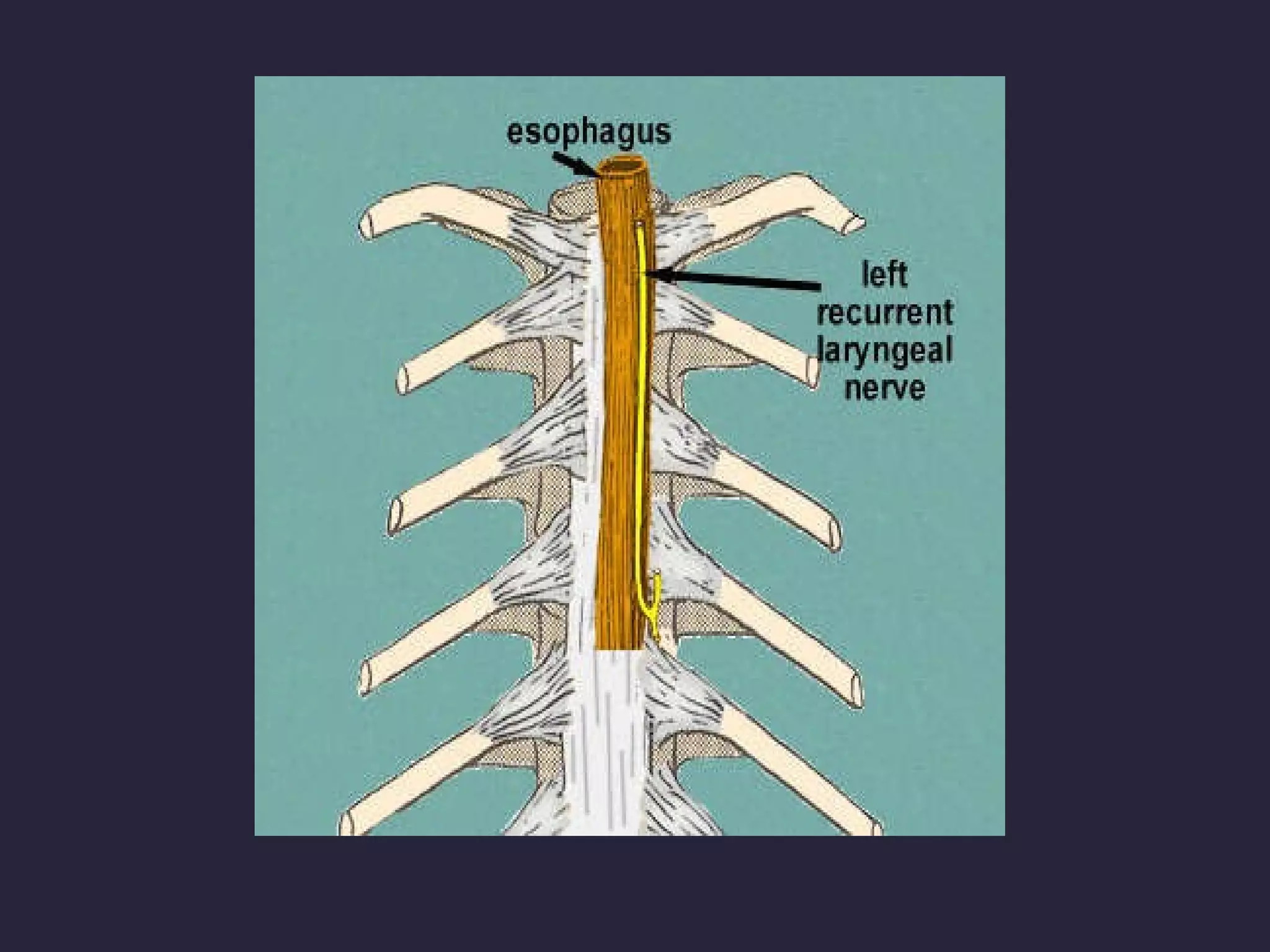
Superior Mediastinum Contents: 3.  Nerves Vagus & Phrenic Nerves Cardiac Plexus of Nerves Left Recurrent Laryngeal Nerve 4.  Trachea 5.  Esophagus 6.  Thoracic Duct 7.  Prevertebral Muscles


Anterior Mediastinum Smallest subdivision of the Inferior Mediastinum Boundaries: Anterior : body of sternum & trans thoracis muscles  Posterior : pericardium  Contents: Loose CT  (Sternopericardial Ligament)   Adipose tissue   Lymphatic Vessels & lymph nodes   Branches of Internal Thoracic Vessels
Posterior Mediastinum Boundaries: Anterior -  Pericardium & Diaphragm Posterior -  T5 to T12 vertebrae Contents: Thoracic Aorta Esophagus & Plexus Thoracic Duct Thoracic Sympathetic Trunks Post Mediastinal LN Thoracic Splanchnic Nerve Azygos & Hemiazygos Veins
Thoracic Aorta Branches: 1. Bronchial Arteries 5.  Esophageal Arteries 2. Pericardial Arteries 6.  Mediastinal Arteries 3. Post. Intercostal Arteries 7.  Subcostal Arteries 4. Superior Phrenic Arteries
Esophagus Course: Superior to Posterior Mediastinum Located behind: Arch of Aorta   Pericardium & Left Atrium Enters Esophageal Hiatus of the Diaphragm at level of T10 Anatomic Impressions or “Constrictions”: 1. Crossing with Aortic Arch 2. Crossing with Left Main Bronchus 3. Diaphragmatic Hiatus
Thoracic Duct Largest lymphatic channel in the body Originates from Cisterna Chyle in the abdomen & passes thru aortic hiatus of diaphragm at level of T12 Relations: Posterior : bodies of inferior 7 thoracic vertebrae   Anterior  : Esophagus   Left : Thoracic Aorta   Right  : Azygos Vein Conveys lymph from: Lower extremities Left side of thorax Pelvic Cavity Left side of H & N Abdominal Cavity Left upper limb
Lymph Nodes of the  Posterior Mediastinum Posterior Mediastinal Lymph Nodes - receives lymph from esophagus, posterior aspect of the pericardium & diaphragm & middle posterior ICS
Azygos Venous System of the Posterior Mediastinum Drains the back & thoracoabdominal walls and the mediastinal viscera Azygos Vein - forms a collateral pathway b/w SVC & IVC - passes to the right side of inferior 8 thoracic vertebrae - arches over the root of the right lung to enter the SVC - receives posterior intercostal veins, mediastinal, esophageal & bronchial veins
Azygos Venous System  of Posterior Mediastinum Hemiazygos Vein - arises on left side of the vertebral column to level of T9 - receives the inferior 3 PIV, inferior esophageal veins, small mediastinal veins Accessory Hemiazygos Vein - starts at medial end of 4 th  or 5 th  ICS  - descends on left of VC from T5 thru T8  - crosses to the right to join the Azygos Vein - receives 4 th  thru 8 th  IC Veins - communicates with Superior IC Vein which drains  1 st  thru 3 rd  ICS
Nerves of Posterior Mediastinum Thoracic Sympathetic Trunks - lie against  heads of ribs in superior thorax   costovertebral joints in midthorax   sides of vertebral bodies in lower thorax Lower Thoracic Splanchnic Nerves (Greater, Lesser and Least SN) - presynaptic fibers from 5 th  thru 12 th  sympathetic ganglia - sympathetic innervation for most abdominal viscera
It’s FREE to join. http://www.examville.com

Mediastinum

  • 1.
    www.Examville.com Online practicetests, live classes, tutoring, study guides Q&A, premium content and more .
  • 2.
  • 3.
    MEDIASTINUM Central compartmentof the thoracic cavity Covered by mediastinal pleura Contents: all thoracic viscera EXCEPT lungs Extent: Superior - thoracic inlet Inferior - diaphragm Anterior - sternum & costal cartilages Posterior- bodies of thoracic vertebrae
  • 4.
    MEDIASTINUM Surrounded byblood and lymphatic vessels Lymph nodes, nerves and adipose tissues Looseness of structures enable mediastinum to accommodate changes in movement, volume & pressure in the thoracic cavity
  • 5.
    Divisions of theMediastinum SUPERIOR MEDIASTINUM Superior - thoracic inlet Inferior - transverse thoracic plane Anterior - sternal angle Posterior - IV disc T4 & T5 INFERIOR MEDIASTINUM Superior – transverse thoracic plane Inferior - diaphragm
  • 6.
    Divisions of theMediastinum INFERIOR MEDIASTINUM a. ANTERIOR MEDIASTINUM - contains thymus remnant, lymph nodes & fats b. MIDDLE MEDIASTINUM - contains the heart & great vessels c. POSTERIOR MEDIASTINUM - contains esophagus, great vessels,vagus nerves & symphathetic trunks
  • 7.
    Superior Mediastinum Contents:(Anterior – Posterior) 1. Thymus gland - primary lymphoid organ located behind manubrium - puberty undergoes gradual involution 2. Great Vessels Brachiocephalic Veins Superior Vena Cava - formed at level of 1 st right costal cartilage - enters right atrium at level of 3 rd right costal cartilage
  • 8.
  • 9.
  • 10.
    Superior Mediastinum Contents:Arch of the Aorta - starts behind 2 nd right SC joint - ends at 2 nd left SC joint Branches: Brachiocephalic Trunk Left Common Carotid Artery Left Subclavian Artery
  • 11.
    Superior Mediastinum Contents:3. Nerves Vagus & Phrenic Nerves Cardiac Plexus of Nerves Left Recurrent Laryngeal Nerve 4. Trachea 5. Esophagus 6. Thoracic Duct 7. Prevertebral Muscles
  • 12.
  • 13.
  • 14.
  • 15.
  • 16.
  • 17.
    Anterior Mediastinum Smallestsubdivision of the Inferior Mediastinum Boundaries: Anterior : body of sternum & trans thoracis muscles Posterior : pericardium Contents: Loose CT (Sternopericardial Ligament) Adipose tissue Lymphatic Vessels & lymph nodes Branches of Internal Thoracic Vessels
  • 18.
    Posterior Mediastinum Boundaries:Anterior - Pericardium & Diaphragm Posterior - T5 to T12 vertebrae Contents: Thoracic Aorta Esophagus & Plexus Thoracic Duct Thoracic Sympathetic Trunks Post Mediastinal LN Thoracic Splanchnic Nerve Azygos & Hemiazygos Veins
  • 19.
    Thoracic Aorta Branches:1. Bronchial Arteries 5. Esophageal Arteries 2. Pericardial Arteries 6. Mediastinal Arteries 3. Post. Intercostal Arteries 7. Subcostal Arteries 4. Superior Phrenic Arteries
  • 20.
    Esophagus Course: Superiorto Posterior Mediastinum Located behind: Arch of Aorta Pericardium & Left Atrium Enters Esophageal Hiatus of the Diaphragm at level of T10 Anatomic Impressions or “Constrictions”: 1. Crossing with Aortic Arch 2. Crossing with Left Main Bronchus 3. Diaphragmatic Hiatus
  • 21.
    Thoracic Duct Largestlymphatic channel in the body Originates from Cisterna Chyle in the abdomen & passes thru aortic hiatus of diaphragm at level of T12 Relations: Posterior : bodies of inferior 7 thoracic vertebrae Anterior : Esophagus Left : Thoracic Aorta Right : Azygos Vein Conveys lymph from: Lower extremities Left side of thorax Pelvic Cavity Left side of H & N Abdominal Cavity Left upper limb
  • 22.
    Lymph Nodes ofthe Posterior Mediastinum Posterior Mediastinal Lymph Nodes - receives lymph from esophagus, posterior aspect of the pericardium & diaphragm & middle posterior ICS
  • 23.
    Azygos Venous Systemof the Posterior Mediastinum Drains the back & thoracoabdominal walls and the mediastinal viscera Azygos Vein - forms a collateral pathway b/w SVC & IVC - passes to the right side of inferior 8 thoracic vertebrae - arches over the root of the right lung to enter the SVC - receives posterior intercostal veins, mediastinal, esophageal & bronchial veins
  • 24.
    Azygos Venous System of Posterior Mediastinum Hemiazygos Vein - arises on left side of the vertebral column to level of T9 - receives the inferior 3 PIV, inferior esophageal veins, small mediastinal veins Accessory Hemiazygos Vein - starts at medial end of 4 th or 5 th ICS - descends on left of VC from T5 thru T8 - crosses to the right to join the Azygos Vein - receives 4 th thru 8 th IC Veins - communicates with Superior IC Vein which drains 1 st thru 3 rd ICS
  • 25.
    Nerves of PosteriorMediastinum Thoracic Sympathetic Trunks - lie against heads of ribs in superior thorax costovertebral joints in midthorax sides of vertebral bodies in lower thorax Lower Thoracic Splanchnic Nerves (Greater, Lesser and Least SN) - presynaptic fibers from 5 th thru 12 th sympathetic ganglia - sympathetic innervation for most abdominal viscera
  • 26.
    It’s FREE tojoin. http://www.examville.com