Structures of Thoracic
Cavity
Mediastinum
Dr. Rabia Inam Gandapore
Assistant Professor
Head of Department Anatomy
(Dentistry-BKCD)
B.D.S (SBDC), M.Phil. Anatomy (KMU),
Dip. Implant (Sharjah, Bangkok, ACHERS) ,
CHPE (KMU),CHR (KMU), Dip. Arts (Florence,
Italy)
Teaching Methodology
LGF (Long Group Format)
SGF (Short Group Format)
LGD (Long Group Discussion, Interactive discussion with
the use of models or diagrams)
SGD (Short Group)
SDL (Self-Directed Learning)
DSL (Directed-Self Learning)
PBL (Problem- Based Learning)
Online Teaching Method
Role Play
Demonstrations
Laboratory
Museum
Library (Computed Assisted Learning or E-Learning)
Assignments
Video tutorial method
Goal/Aim (Main Objective)
 Describe the origin, insertion & openings of the diaphragm
 Enlist the contents of the Superior, Anterior & Posterior
mediastinum.
Specific Learning Objectives (cognitive)
 At the end of the lecture the student will able to:
1. Describe the origin, insertion & openings of the diaphragm
2. Enlist the contents of the Superior, Anterior & Posterior
mediastinum.
Psychomotor Objective: (Guided
response)
 A student to draw labelled mediastinum.
Affective domain
To be able to display a good code of conduct and moral values in the
class.
To cooperate with the teacher and in groups with the colleagues.
To demonstrate a responsible behavior in the class and be punctual,
regular, attentive and on time in the class.
To be able to perform well in the class under the guidance and
supervision of the teacher.
Study the topic before entering the class.
Discuss among colleagues the topic under discussion in SGDs.
Participate in group activities and museum classes and follow the rules.
Volunteer to participate in psychomotor activities.
Listen to the teacher's instructions carefully and follow the guidelines.
Ask questions in the class by raising hand and avoid creating a
disturbance.
To be able to submit all assignments on time and get your sketch
logbooks checked.
Lesson contents
Clinical chair side question: Students will be asked if they
know what is the function of Outline:
 Activity 1 Describe the origin, insertion & openings of the
diaphragm
Activity 2 Enlist the contents of the Superior, Anterior &
Posterior mediastinum
Recommendations
Students assessment: MCQs, Flashcards, Diagrams labeling.
Learning resources: Langman’s T.W. Sadler, Laiq Hussain
Siddiqui, Snell Clinical Anatomy, Netter’s Atlas, BD Chaurasia’s
Human anatomy, Internet sources links.
Thoracic Cavity
• Chest cavity is bounded by
chest wall & below
by diaphragm
• It extends upward into root
of neck about one
fingerbreadth above
clavicle on each side
• Diaphragm, separates
Chest from abdominal
viscera
• Chest cavity can be divided
into a median partition, called
the mediastinum, & laterally
placed pleurae and lungs
Structures with in thoracic cavity
• Structures of cardiovascular system
o Heart
o Great vessels
• Thoracic aorta
• Pulmonary artery and all its branches
• Superior and inferior vena cava
• Pulmonary veins
• Azygos vein
• Structures of respiratory system
• Diaphragm
• trachea,
• Bronchi
• Lungs
• structures of digestive system
• Esophagus
• Endocrine glands including thymus gland,
Structures with inthoracic cavity
conti..
• Structures of nervous system
• Paired vagus nerves & paired sympathetic chains,
• Lymphatics including the thoracic duct
• Contains 3 potential spaces lined with mesothelium:
o Paired pleural cavities
o Pericardial cavity
• Mediastinum comprises those organs which lie in centre
of
chest between lungs.
• Contains two openings
• One at top: superior thoracic aperture also called
thoracic inlet
• A lower inferior thoracic aperture which is much
larger than the inlet
Mediastinum
• Central compartment of thoracic cavity, located between 2 pleural sacs
• Contains most of thoracic organs, & acts as a conduit for structures
traversing the thorax on their way into the abdomen
• Divided into two parts by an imaginary line that runs from the sternal angle
to the T4 vertebrae:
• Superior mediastinum: extends
upwards, terminating at superior
thoracic aperture
• Inferior mediastinum: extends
downwards, terminating at diaphragm
• It is further subdivided
into
• Anterior mediastinum
• middle
mediastinum
• Posterior
mediastinum.
Superior Mediastinum
Boundaries:
• In front manubrium sterni
• Behind first four thoracic vertebrae
• Laterally mediastinal pleura
• Superiorly plane of thoracic inlet
• Inferiorly imaginary line joining sternal angle and lower border of
T4
Contents:
Major mediastinal structures arranged
from anterior to posterior as
• Thymus
• Large veins
• Large arteries
• Trachea
• Esophagus
• Thoracic duct
Anterior Mediastinum
Borders:
• Lateral borders: Mediastinal pleura (part of parietal pleural
membrane)
• Anterior border: Body of sternum & transversus thoracis
muscles
• Posterior border: Pericardium
• Roof: Continuous with the superior mediastinum at the level of
sternal angle
• Floor: Diaphragm
Contents:
• Contain
s no
major
structur
es
• Acco
mmo
date
Anterior mediastinum Conti…
• In infants &children, thymus extends inferiorly into anterior
mediastinum
• However thymus recedes during puberty & is no longer present
in adulthood
Middle mediastinum
• Largest subdivision of inferior
mediastinum
• Anterior: Anterior margin of
pericardium
• Posterior: Posterior border of
pericardium
• Laterally: Mediastinal pleura
of lungs
• Superiorly: Imaginary line
extending between the
sternal angle and the T4
vertebrae
• Inferiorly: Superior surface of
diaphragm
Contents of middle Mediastinum
Organs
• Heart, and its protective sheath, pericardium
• Tracheal bifurcation
• Left & right main bronchi
Vessels
• Ascending aorta – first part of aorta, which arises from aortic orifice
• Moves upwards, exiting the fibrous pericardium and entering the
superior mediastinum – where it then becomes the aortic arch
• The ascending aorta gives rise to two branches; the left and right
coronary arteries
• Pulmonary trunk – gives rise to the left and right pulmonary arteries
• Superior vena cava – returns deoxygenated blood from the upper half of
the body. It is formed by the right and left brachiocephalic veins.
The great vessels of the middle mediastinum. Note how
only the origins of the vessels are contained within the
middle mediastinum
Nerves of middle mediastinum
• The cardiac plexus & phrenic nerves are both located within
the middle mediastinum
Cardiac plexus – a network of nerves located at the base of the heart,
containing sympathetic and parasympathetic fibres
• The sympathetic nerves are derived from the T1-
T4 segments of the
spinal cord
• The parasympathetic innervation is supplied by the vagus nerve
• The plexus can be subdivided into superficial and deep components.
Phrenic nerves (left and right) – mixed nerves
that provides motor innervation to the
diaphragm
• They arise in the neck, and descend
through the middle mediastinum to reach
the diaphragm
Lymphatics of middle mediastinum
• tracheobronchial lymph nodes are located within the
middle mediastinum
• They are a group of nodes associated with the
trachea and bronchi of the respiratory tract
• They form from the gathering of bronchial nodes
within the hila of the lungs
• Individual groups of nodes are connected via fine
lymphatic channels
Posterior mediastinum
Boundaries:
• Lateral: Mediastinal pleura (part of the parietal pleural
membrane).
• Anterior: Pericardium
• Roof: Imaginary line extending between the sternal angle and the
T4 vertebrae
• Posterior: T5-T12 vertebrae
• Floor: Diaphragm
Contents
Thoracic (descending) aorta
• A continuation of the arch of the aorta
• Begins at the lower edge of the T4 vertebra
• Descends through the posterior mediastinum to the left of the
vertebrae, becoming more medially located as it moves
• At the inferior border of T12, the thoracic aorta becomes
the abdominal aorta, and passes through the aortic hiatus
of the diaphragm
• Esophagus
• It passes into the posterior mediastinum from the superior
mediastinum, descending posteriorly to the arch of the aorta and
the heart
• Whilst initially positioned to the right, the oesophagus deviates to
the
left as it moves downwards
• It leaves the mediastinum via the oesophageal hiatus
of the diaphragm
e
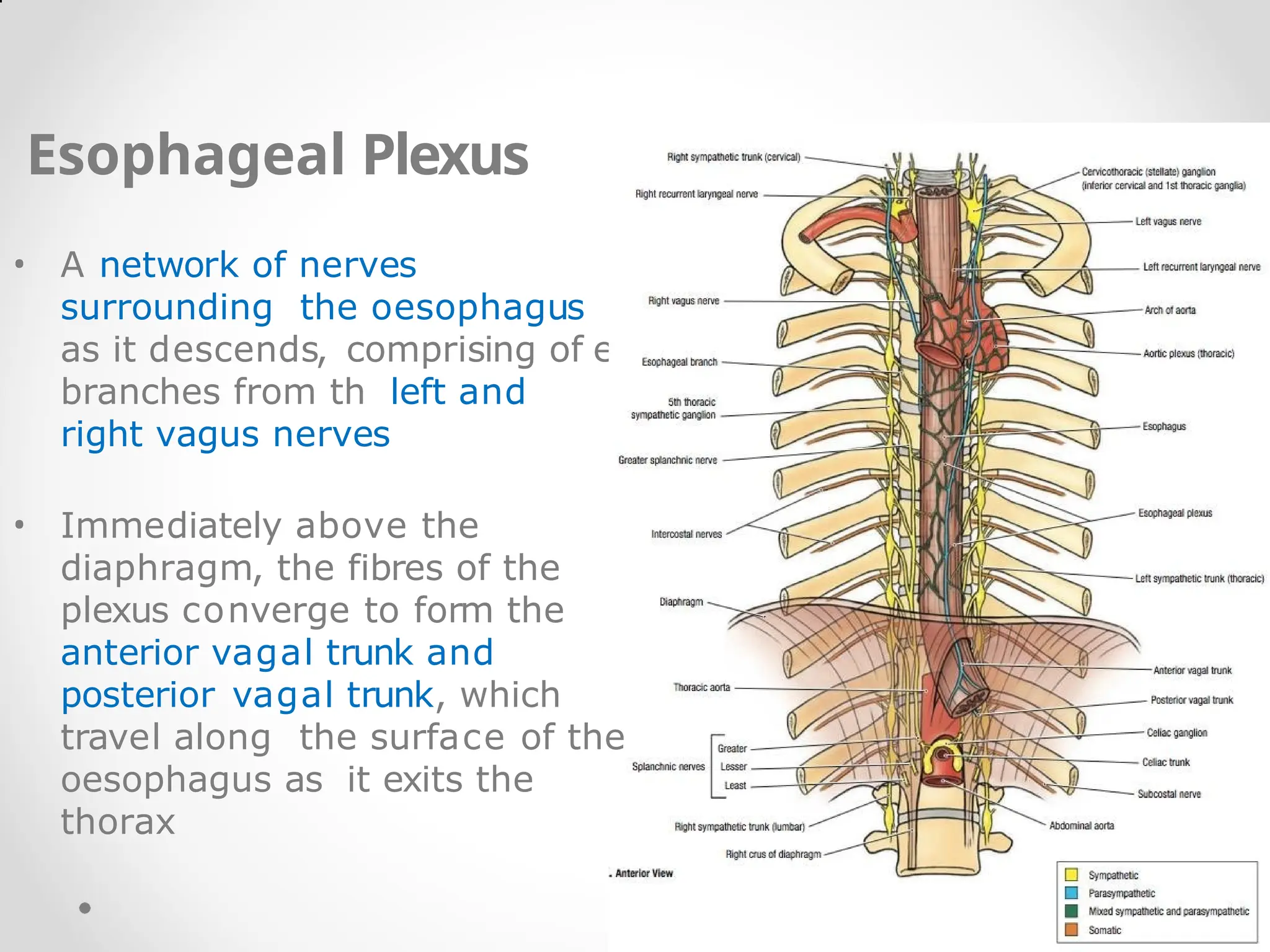
Esophageal Plexus
• A network of nerves
surrounding the oesophagus
as it descends, comprising of
branches from th left and
right vagus nerves
• Immediately above the
diaphragm, the fibres of the
plexus converge to form the
anterior vagal trunk and
posterior vagal trunk, which
travel along the surface of the
oesophagus as it exits the
thorax
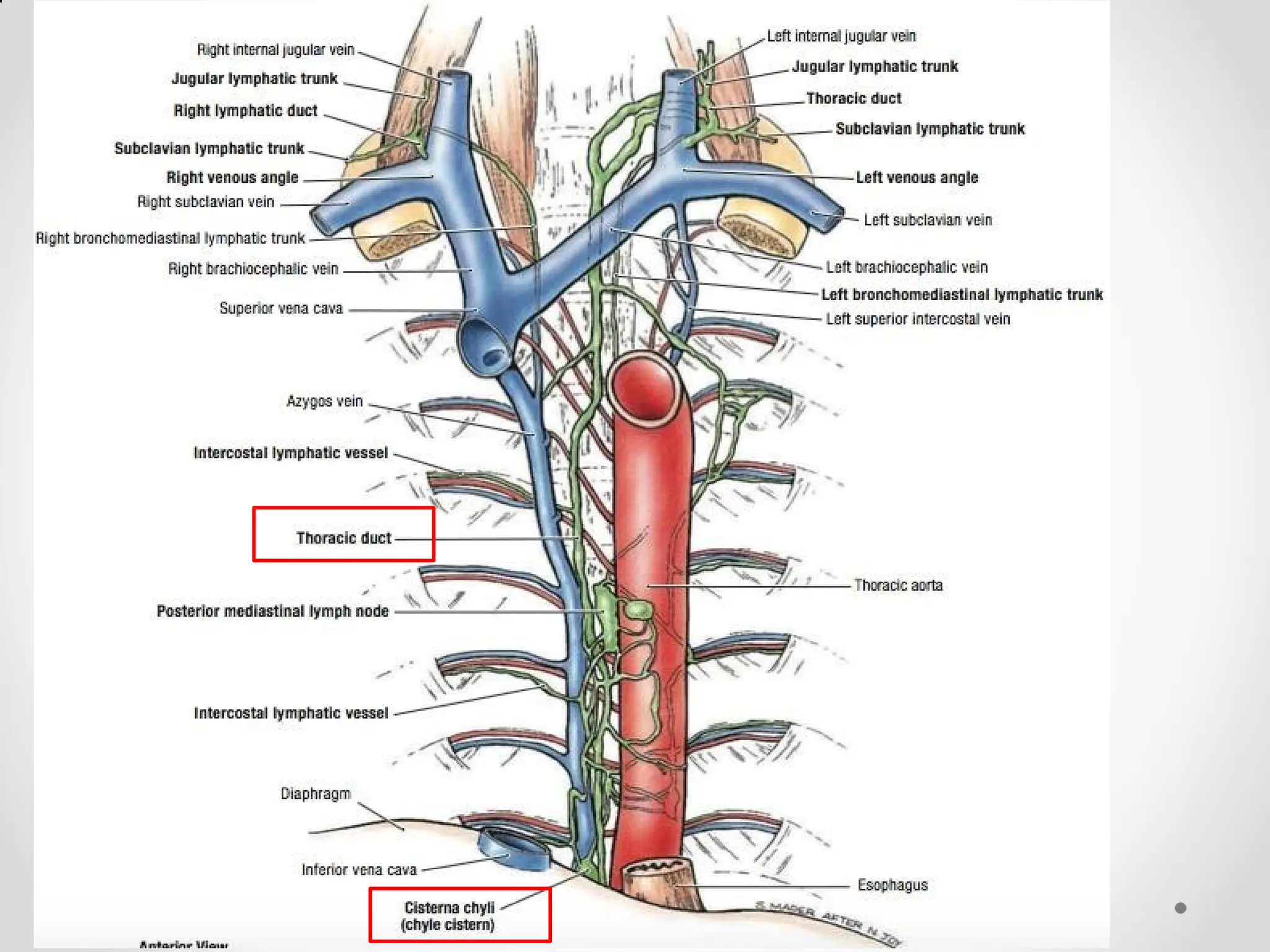
Thoracic Duct
• Largest lymphatic vessel in the body
• Allows the return of lymph from most of the body (all but the
right superior quadrant) into the venous system
• Originates from the cisterna chyli in the abdomen
• Enters the mediastinum through the aortic hiatus
• Ascends to lie directly anterior to the T6-T12 vertebrae,
before deviating left as it ascends into the superior
mediastinum
• Receives lymphatic drainage from the intercostal spaces and
neighbouring anatomical structures through a number of
branches
Azygous system of veins
• This venous network drains blood from the body walls and
mediastinal viscera, and empties into the superior vena cava
• Consists of three major veins:
• Azygos vein – Formed by the union of the right lumbar vein and the
right
subcostal vein
• It enters the mediastinum vi the aortic hiatus and drains into the
superior vena cava
• Hemiazygos vein – Formed by the union of the left lumbar vein and left
subcostal vein
• It enters the mediastinum through the left crus of the
diaphragm, ascending on the left side
• At the level of T8, it turns to the right and combines with the
azygos vein
• Accessory hemiazygos vein – Formed by the union of the fourth to
eighth
intercostal veins
Azygous veins
Sympathetic Trunks
• Paired bundles of nerves that extend from the base of the skull to
the coccyx
• In the thoracic region, these nerve bundles are known as the
thoracic sympathetic trunks
• As they descend through the thorax, they lie within the
posterior mediastinum
• Arising from these trunks are the lower thoracic splanchnic
nerves – they continue inferiorly to supply the viscera of the
abdomen
Clinical Relevance: Causes of
mediastinal masses
Thank You

Mediastinum By Dr Rabia Inam Gandapore.pptx

  • 1.
    Structures of Thoracic Cavity Mediastinum Dr.Rabia Inam Gandapore Assistant Professor Head of Department Anatomy (Dentistry-BKCD) B.D.S (SBDC), M.Phil. Anatomy (KMU), Dip. Implant (Sharjah, Bangkok, ACHERS) , CHPE (KMU),CHR (KMU), Dip. Arts (Florence, Italy)
  • 2.
    Teaching Methodology LGF (LongGroup Format) SGF (Short Group Format) LGD (Long Group Discussion, Interactive discussion with the use of models or diagrams) SGD (Short Group) SDL (Self-Directed Learning) DSL (Directed-Self Learning) PBL (Problem- Based Learning) Online Teaching Method Role Play Demonstrations Laboratory Museum Library (Computed Assisted Learning or E-Learning) Assignments Video tutorial method
  • 3.
    Goal/Aim (Main Objective) Describe the origin, insertion & openings of the diaphragm  Enlist the contents of the Superior, Anterior & Posterior mediastinum.
  • 4.
    Specific Learning Objectives(cognitive)  At the end of the lecture the student will able to: 1. Describe the origin, insertion & openings of the diaphragm 2. Enlist the contents of the Superior, Anterior & Posterior mediastinum.
  • 5.
    Psychomotor Objective: (Guided response) A student to draw labelled mediastinum.
  • 6.
    Affective domain To beable to display a good code of conduct and moral values in the class. To cooperate with the teacher and in groups with the colleagues. To demonstrate a responsible behavior in the class and be punctual, regular, attentive and on time in the class. To be able to perform well in the class under the guidance and supervision of the teacher. Study the topic before entering the class. Discuss among colleagues the topic under discussion in SGDs. Participate in group activities and museum classes and follow the rules. Volunteer to participate in psychomotor activities. Listen to the teacher's instructions carefully and follow the guidelines. Ask questions in the class by raising hand and avoid creating a disturbance. To be able to submit all assignments on time and get your sketch logbooks checked.
  • 7.
    Lesson contents Clinical chairside question: Students will be asked if they know what is the function of Outline:  Activity 1 Describe the origin, insertion & openings of the diaphragm Activity 2 Enlist the contents of the Superior, Anterior & Posterior mediastinum
  • 8.
    Recommendations Students assessment: MCQs,Flashcards, Diagrams labeling. Learning resources: Langman’s T.W. Sadler, Laiq Hussain Siddiqui, Snell Clinical Anatomy, Netter’s Atlas, BD Chaurasia’s Human anatomy, Internet sources links.
  • 9.
    Thoracic Cavity • Chestcavity is bounded by chest wall & below by diaphragm • It extends upward into root of neck about one fingerbreadth above clavicle on each side • Diaphragm, separates Chest from abdominal viscera • Chest cavity can be divided into a median partition, called the mediastinum, & laterally placed pleurae and lungs
  • 10.
    Structures with inthoracic cavity • Structures of cardiovascular system o Heart o Great vessels • Thoracic aorta • Pulmonary artery and all its branches • Superior and inferior vena cava • Pulmonary veins • Azygos vein • Structures of respiratory system • Diaphragm • trachea, • Bronchi • Lungs • structures of digestive system • Esophagus • Endocrine glands including thymus gland,
  • 11.
    Structures with inthoraciccavity conti.. • Structures of nervous system • Paired vagus nerves & paired sympathetic chains, • Lymphatics including the thoracic duct • Contains 3 potential spaces lined with mesothelium: o Paired pleural cavities o Pericardial cavity • Mediastinum comprises those organs which lie in centre of chest between lungs. • Contains two openings • One at top: superior thoracic aperture also called thoracic inlet • A lower inferior thoracic aperture which is much larger than the inlet
  • 16.
    Mediastinum • Central compartmentof thoracic cavity, located between 2 pleural sacs • Contains most of thoracic organs, & acts as a conduit for structures traversing the thorax on their way into the abdomen • Divided into two parts by an imaginary line that runs from the sternal angle to the T4 vertebrae: • Superior mediastinum: extends upwards, terminating at superior thoracic aperture • Inferior mediastinum: extends downwards, terminating at diaphragm • It is further subdivided into • Anterior mediastinum • middle mediastinum • Posterior mediastinum.
  • 20.
    Superior Mediastinum Boundaries: • Infront manubrium sterni • Behind first four thoracic vertebrae • Laterally mediastinal pleura • Superiorly plane of thoracic inlet • Inferiorly imaginary line joining sternal angle and lower border of T4 Contents: Major mediastinal structures arranged from anterior to posterior as • Thymus • Large veins • Large arteries • Trachea • Esophagus • Thoracic duct
  • 21.
    Anterior Mediastinum Borders: • Lateralborders: Mediastinal pleura (part of parietal pleural membrane) • Anterior border: Body of sternum & transversus thoracis muscles • Posterior border: Pericardium • Roof: Continuous with the superior mediastinum at the level of sternal angle • Floor: Diaphragm Contents: • Contain s no major structur es • Acco mmo date
  • 23.
    Anterior mediastinum Conti… •In infants &children, thymus extends inferiorly into anterior mediastinum • However thymus recedes during puberty & is no longer present in adulthood
  • 24.
    Middle mediastinum • Largestsubdivision of inferior mediastinum • Anterior: Anterior margin of pericardium • Posterior: Posterior border of pericardium • Laterally: Mediastinal pleura of lungs • Superiorly: Imaginary line extending between the sternal angle and the T4 vertebrae • Inferiorly: Superior surface of diaphragm
  • 26.
    Contents of middleMediastinum Organs • Heart, and its protective sheath, pericardium • Tracheal bifurcation • Left & right main bronchi Vessels • Ascending aorta – first part of aorta, which arises from aortic orifice • Moves upwards, exiting the fibrous pericardium and entering the superior mediastinum – where it then becomes the aortic arch • The ascending aorta gives rise to two branches; the left and right coronary arteries • Pulmonary trunk – gives rise to the left and right pulmonary arteries • Superior vena cava – returns deoxygenated blood from the upper half of the body. It is formed by the right and left brachiocephalic veins.
  • 27.
    The great vesselsof the middle mediastinum. Note how only the origins of the vessels are contained within the middle mediastinum
  • 30.
    Nerves of middlemediastinum • The cardiac plexus & phrenic nerves are both located within the middle mediastinum Cardiac plexus – a network of nerves located at the base of the heart, containing sympathetic and parasympathetic fibres • The sympathetic nerves are derived from the T1- T4 segments of the spinal cord • The parasympathetic innervation is supplied by the vagus nerve • The plexus can be subdivided into superficial and deep components. Phrenic nerves (left and right) – mixed nerves that provides motor innervation to the diaphragm • They arise in the neck, and descend through the middle mediastinum to reach the diaphragm
  • 31.
    Lymphatics of middlemediastinum • tracheobronchial lymph nodes are located within the middle mediastinum • They are a group of nodes associated with the trachea and bronchi of the respiratory tract • They form from the gathering of bronchial nodes within the hila of the lungs • Individual groups of nodes are connected via fine lymphatic channels
  • 32.
    Posterior mediastinum Boundaries: • Lateral:Mediastinal pleura (part of the parietal pleural membrane). • Anterior: Pericardium • Roof: Imaginary line extending between the sternal angle and the T4 vertebrae • Posterior: T5-T12 vertebrae • Floor: Diaphragm
  • 33.
    Contents Thoracic (descending) aorta •A continuation of the arch of the aorta • Begins at the lower edge of the T4 vertebra • Descends through the posterior mediastinum to the left of the vertebrae, becoming more medially located as it moves • At the inferior border of T12, the thoracic aorta becomes the abdominal aorta, and passes through the aortic hiatus of the diaphragm • Esophagus • It passes into the posterior mediastinum from the superior mediastinum, descending posteriorly to the arch of the aorta and the heart • Whilst initially positioned to the right, the oesophagus deviates to the left as it moves downwards
  • 35.
    • It leavesthe mediastinum via the oesophageal hiatus of the diaphragm
  • 37.
    e Esophageal Plexus • Anetwork of nerves surrounding the oesophagus as it descends, comprising of branches from th left and right vagus nerves • Immediately above the diaphragm, the fibres of the plexus converge to form the anterior vagal trunk and posterior vagal trunk, which travel along the surface of the oesophagus as it exits the thorax
  • 39.
    Thoracic Duct • Largestlymphatic vessel in the body • Allows the return of lymph from most of the body (all but the right superior quadrant) into the venous system • Originates from the cisterna chyli in the abdomen • Enters the mediastinum through the aortic hiatus • Ascends to lie directly anterior to the T6-T12 vertebrae, before deviating left as it ascends into the superior mediastinum • Receives lymphatic drainage from the intercostal spaces and neighbouring anatomical structures through a number of branches
  • 41.
    Azygous system ofveins • This venous network drains blood from the body walls and mediastinal viscera, and empties into the superior vena cava • Consists of three major veins: • Azygos vein – Formed by the union of the right lumbar vein and the right subcostal vein • It enters the mediastinum vi the aortic hiatus and drains into the superior vena cava • Hemiazygos vein – Formed by the union of the left lumbar vein and left subcostal vein • It enters the mediastinum through the left crus of the diaphragm, ascending on the left side • At the level of T8, it turns to the right and combines with the azygos vein • Accessory hemiazygos vein – Formed by the union of the fourth to eighth intercostal veins
  • 42.
  • 43.
    Sympathetic Trunks • Pairedbundles of nerves that extend from the base of the skull to the coccyx • In the thoracic region, these nerve bundles are known as the thoracic sympathetic trunks • As they descend through the thorax, they lie within the posterior mediastinum • Arising from these trunks are the lower thoracic splanchnic nerves – they continue inferiorly to supply the viscera of the abdomen
  • 45.
    Clinical Relevance: Causesof mediastinal masses
  • 46.