





Dr.Suad Al-Abri R5 Case Presentation
Case  24 yrs old lady  H/o  found unresponsive 30 min before presentation
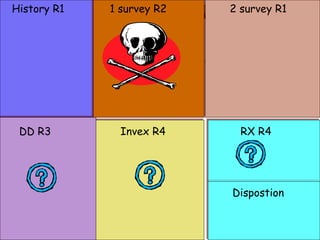
1 survey R2 2 survey R1  History R1   DD R3  Invex R4 RX R4 Dispostion
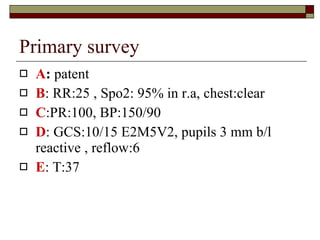
Primary survey  A :  patent B : RR:25 , Spo2: 95% in r.a, chest:clear C :PR:100, BP:150/90 D : GCS:10/15 E2M5V2, pupils 3 mm b/l reactive , reflow:6 E : T:37
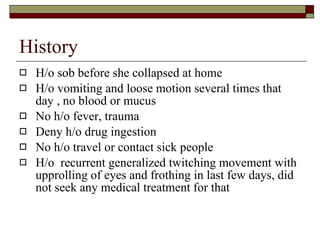
History  H/o sob before she collapsed at home H/o vomiting and loose motion several times that day , no blood or mucus No h/o fever, trauma  Deny h/o drug ingestion No h/o travel or contact sick people H/o  recurrent generalized twitching movement with upprolling of eyes and frothing in last few days, did not seek any medical treatment for that
PMH Diagnosed to have high BP for last 3 weeks and she is under investigation in LHC , referred to BPC physician to be started on medication All lab investigation ,ECG , CXR was done at that time and was normal She is checking her BP regularly at LHC and all her  readings are high
Exam Head: no signs of trauma Neck: no neck stiffness Chest: clear  CVS:s1,s2, no murmur p/a: obese , no tenderness CNS: no focal neurological deficit , GCS: 10/15 E2M5V2
Progress I was called to see one of my patients( Treatment room ) as she is having severe abdominal pain ECG,  VBG,bloods Investigation is being done  for our patient,
Resus bell rings I ran to the resus  My patient had tonic clonic convulsion Medical on call who was seeing other patient order 5 mg diazepam IV Seizure was aborted
Primary Survey 2 A :  she had lots of secretion with tongue obstruction with snoring , suctioning done , OP applied with 100% oxygen B : RR:35-40 , Spo2: 88% before  the above and picked upto 97% , auscultation b/l course crep C :PR:120, BP:160/100 D : GCS:9/15, pupils 4 mm b/l slugish reaction, reflow:8.4 E : T:38
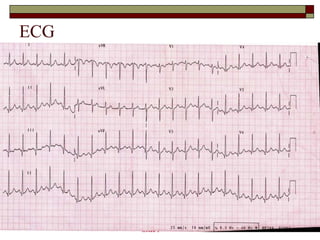
ECG
VBG PH: 7.01 , PCO2:16, PO2:55, HCO3:10 Na:140 , k:4 , cl:108  High AG metabolic acidosis with respiratory alkalosis
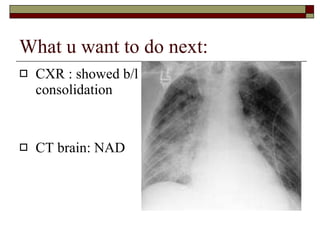
What u want to do next: CXR : showed b/l consolidation CT brain: NAD
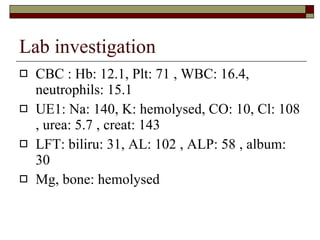
Lab investigation CBC : Hb: 12.1, Plt: 71 , WBC: 16.4, neutrophils: 15.1 UE1: Na: 140, K: hemolysed, CO: 10, Cl: 108 , urea: 5.7 , creat: 143 LFT: biliru: 31, AL: 102 , ALP: 58 , album: 30 Mg, bone: hemolysed
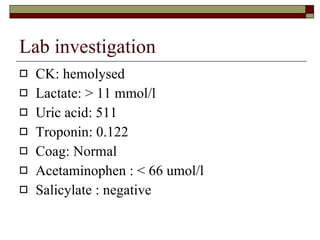
Lab investigation CK: hemolysed Lactate: > 11 mmol/l Uric acid: 511  Troponin: 0.122 Coag: Normal Acetaminophen : < 66 umol/l Salicylate : negative
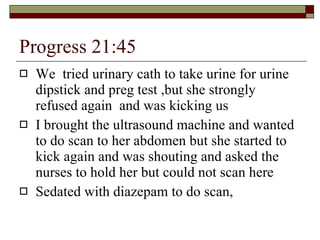
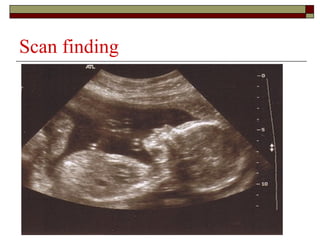
Progress 21:45 We  tried urinary cath to take urine for urine dipstick and preg test ,but she strongly refused again  and was kicking us I brought the ultrasound machine and wanted to do scan to her abdomen but she started to kick again and was shouting and asked the nurses to hold her but could not scan here Sedated with diazepam to do scan,
Scan finding
Progress 21:50 Anasthesia and ob/gy on call stat referral Mg sulphate 4 gm IV infusion over 20 min Hydralazine 5 mg iv bolus Labetolol 20 mg iv bolus Gyn started hydralazine infusion 2 mg/hr Mgso4 infusion at 1gm/hr
Admission progress Patient got intubated , admitted to ICU Termination of pregnancy was decided by gyn She was induced and passed the fetus by next morning  She remained in ICU  for 2days , extubated next day , and shifted to the ward Treated  with IV antibiotics for aspiration pneumonia for 7 days Discharged home in good condition with f/u
High risk emergency medicine  and   error reduction
 
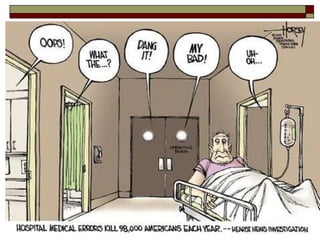
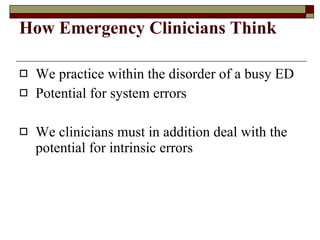
How Emergency Clinicians Think We practice within the disorder of a busy ED Potential for system errors We clinicians must in addition deal with the potential for intrinsic errors
 
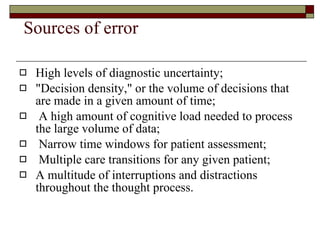
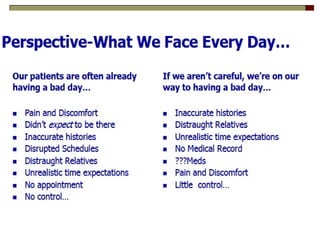
Sources of error  High levels of diagnostic uncertainty; &quot;Decision density,&quot; or the volume of decisions that are made in a given amount of time; A high amount of cognitive load needed to process the large volume of data; Narrow time windows for patient assessment; Multiple care transitions for any given patient;  A multitude of interruptions and distractions throughout the thought process.
 
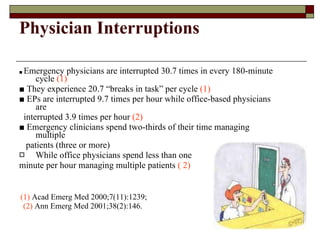
Physician Interruptions ■  Emergency physicians are interrupted 30.7 times in every 180-minute cycle  (1) ■  They experience 20.7 “breaks in task” per cycle  (1) ■  EPs are interrupted 9.7 times per hour while office-based physicians are interrupted 3.9 times per hour  (2) ■  Emergency clinicians spend two-thirds of their time managing multiple patients (three or more) While office physicians spend less than one  minute per hour managing multiple patients  ( 2) (1)  Acad Emerg Med 2000;7(11):1239; (2)  Ann Emerg Med 2001;38(2):146.
 
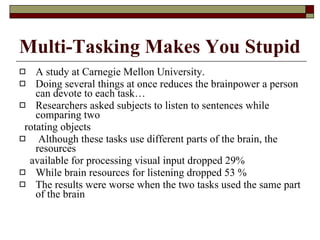
Multi-Tasking Makes You Stupid
Multi-Tasking Makes You Stupid A study at Carnegie Mellon University.  Doing several things at once reduces the brainpower a person can devote to each task… Researchers asked subjects to listen to sentences while comparing two rotating objects Although these tasks use different parts of the brain, the resources available for processing visual input dropped 29%  While brain resources for listening dropped 53 % The results were worse when the two tasks used the same part of the brain


Case presentation

  • 1.
    Dr.Suad Al-Abri R5Case Presentation
  • 2.
    Case 24yrs old lady H/o found unresponsive 30 min before presentation
  • 3.
    1 survey R22 survey R1 History R1 DD R3 Invex R4 RX R4 Dispostion
  • 4.
    Primary survey A : patent B : RR:25 , Spo2: 95% in r.a, chest:clear C :PR:100, BP:150/90 D : GCS:10/15 E2M5V2, pupils 3 mm b/l reactive , reflow:6 E : T:37
  • 5.
    History H/osob before she collapsed at home H/o vomiting and loose motion several times that day , no blood or mucus No h/o fever, trauma Deny h/o drug ingestion No h/o travel or contact sick people H/o recurrent generalized twitching movement with upprolling of eyes and frothing in last few days, did not seek any medical treatment for that
  • 6.
    PMH Diagnosed tohave high BP for last 3 weeks and she is under investigation in LHC , referred to BPC physician to be started on medication All lab investigation ,ECG , CXR was done at that time and was normal She is checking her BP regularly at LHC and all her readings are high
  • 7.
    Exam Head: nosigns of trauma Neck: no neck stiffness Chest: clear CVS:s1,s2, no murmur p/a: obese , no tenderness CNS: no focal neurological deficit , GCS: 10/15 E2M5V2
  • 8.
    Progress I wascalled to see one of my patients( Treatment room ) as she is having severe abdominal pain ECG, VBG,bloods Investigation is being done for our patient,
  • 9.
    Resus bell ringsI ran to the resus My patient had tonic clonic convulsion Medical on call who was seeing other patient order 5 mg diazepam IV Seizure was aborted
  • 10.
    Primary Survey 2A : she had lots of secretion with tongue obstruction with snoring , suctioning done , OP applied with 100% oxygen B : RR:35-40 , Spo2: 88% before the above and picked upto 97% , auscultation b/l course crep C :PR:120, BP:160/100 D : GCS:9/15, pupils 4 mm b/l slugish reaction, reflow:8.4 E : T:38
  • 11.
  • 12.
    VBG PH: 7.01, PCO2:16, PO2:55, HCO3:10 Na:140 , k:4 , cl:108 High AG metabolic acidosis with respiratory alkalosis
  • 13.
    What u wantto do next: CXR : showed b/l consolidation CT brain: NAD
  • 14.
    Lab investigation CBC: Hb: 12.1, Plt: 71 , WBC: 16.4, neutrophils: 15.1 UE1: Na: 140, K: hemolysed, CO: 10, Cl: 108 , urea: 5.7 , creat: 143 LFT: biliru: 31, AL: 102 , ALP: 58 , album: 30 Mg, bone: hemolysed
  • 15.
    Lab investigation CK:hemolysed Lactate: > 11 mmol/l Uric acid: 511 Troponin: 0.122 Coag: Normal Acetaminophen : < 66 umol/l Salicylate : negative
  • 16.
    Progress 21:45 We tried urinary cath to take urine for urine dipstick and preg test ,but she strongly refused again and was kicking us I brought the ultrasound machine and wanted to do scan to her abdomen but she started to kick again and was shouting and asked the nurses to hold her but could not scan here Sedated with diazepam to do scan,
  • 17.
  • 18.
    Progress 21:50 Anasthesiaand ob/gy on call stat referral Mg sulphate 4 gm IV infusion over 20 min Hydralazine 5 mg iv bolus Labetolol 20 mg iv bolus Gyn started hydralazine infusion 2 mg/hr Mgso4 infusion at 1gm/hr
  • 19.
    Admission progress Patientgot intubated , admitted to ICU Termination of pregnancy was decided by gyn She was induced and passed the fetus by next morning She remained in ICU for 2days , extubated next day , and shifted to the ward Treated with IV antibiotics for aspiration pneumonia for 7 days Discharged home in good condition with f/u
  • 20.
    High risk emergencymedicine and error reduction
  • 21.
  • 22.
    How Emergency CliniciansThink We practice within the disorder of a busy ED Potential for system errors We clinicians must in addition deal with the potential for intrinsic errors
  • 23.
  • 24.
    Sources of error High levels of diagnostic uncertainty; &quot;Decision density,&quot; or the volume of decisions that are made in a given amount of time; A high amount of cognitive load needed to process the large volume of data; Narrow time windows for patient assessment; Multiple care transitions for any given patient; A multitude of interruptions and distractions throughout the thought process.
  • 25.
  • 26.
    Physician Interruptions ■ Emergency physicians are interrupted 30.7 times in every 180-minute cycle (1) ■ They experience 20.7 “breaks in task” per cycle (1) ■ EPs are interrupted 9.7 times per hour while office-based physicians are interrupted 3.9 times per hour (2) ■ Emergency clinicians spend two-thirds of their time managing multiple patients (three or more) While office physicians spend less than one minute per hour managing multiple patients ( 2) (1) Acad Emerg Med 2000;7(11):1239; (2) Ann Emerg Med 2001;38(2):146.
  • 27.
  • 28.
  • 29.
    Multi-Tasking Makes YouStupid A study at Carnegie Mellon University. Doing several things at once reduces the brainpower a person can devote to each task… Researchers asked subjects to listen to sentences while comparing two rotating objects Although these tasks use different parts of the brain, the resources available for processing visual input dropped 29% While brain resources for listening dropped 53 % The results were worse when the two tasks used the same part of the brain
  • 30.
  • 31.
  • 32.
  • 33.