Conflict
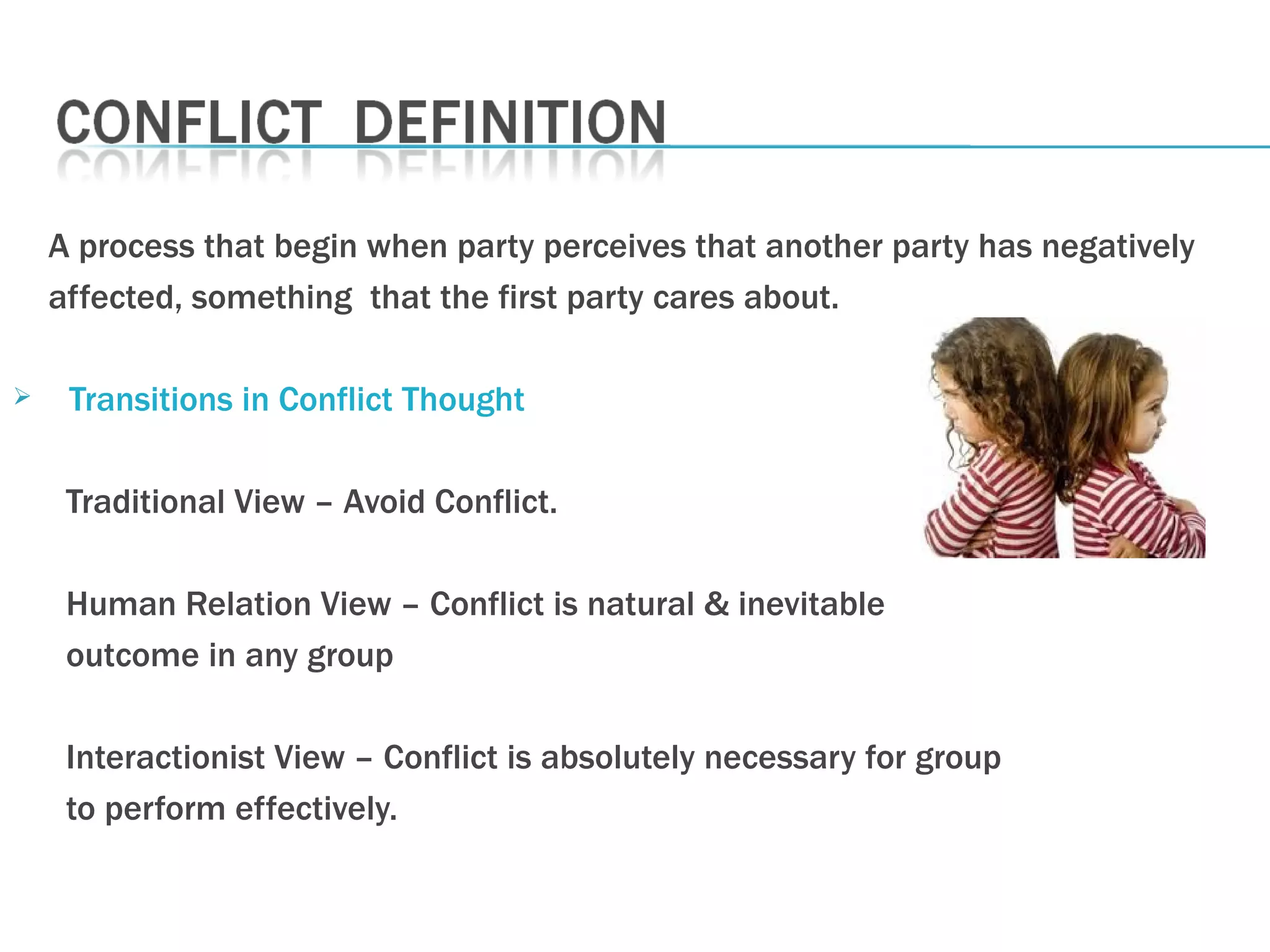
A process that begin when party perceives that another party has negatively  affected, something  that the first party cares about. Transitions in Conflict Thought Traditional View – Avoid Conflict. Human Relation View – Conflict is natural & inevitable outcome in any group Interactionist View – Conflict is absolutely necessary for group to perform effectively.
Conflict was viewed negatively.   It was used synonymously with violence – destruction irrationality -- Harmful and has to be avoided.   Consistent with group behavior attitude in the 1930 & 1940 Conflict is dysfunctional outcome resulting from poor communication,  lack of openness and trust between people, and the failure of managers to be responsive to the needs and aspirations of their employees. Conflict reduction results in high group of performance.
Conflict was natural occurrence in all groups.  Conflict cannot be eliminated, there are times when conflict may benefit a group’s performance. Human Relations view dominated conflict theory from 1940 – 1970. The Internactionist View of Conflict  It encourages conflict. Functional conflict  support the goal of the group and improve its performance Dysfunctional conflict hinders group performance
There are 3 types of conflict Task: relates to the content and goals of the work – Low to moderate level. Relationship: focus on interpersonal relationships -  High level. Process: relates to how the work gets done – Low level.
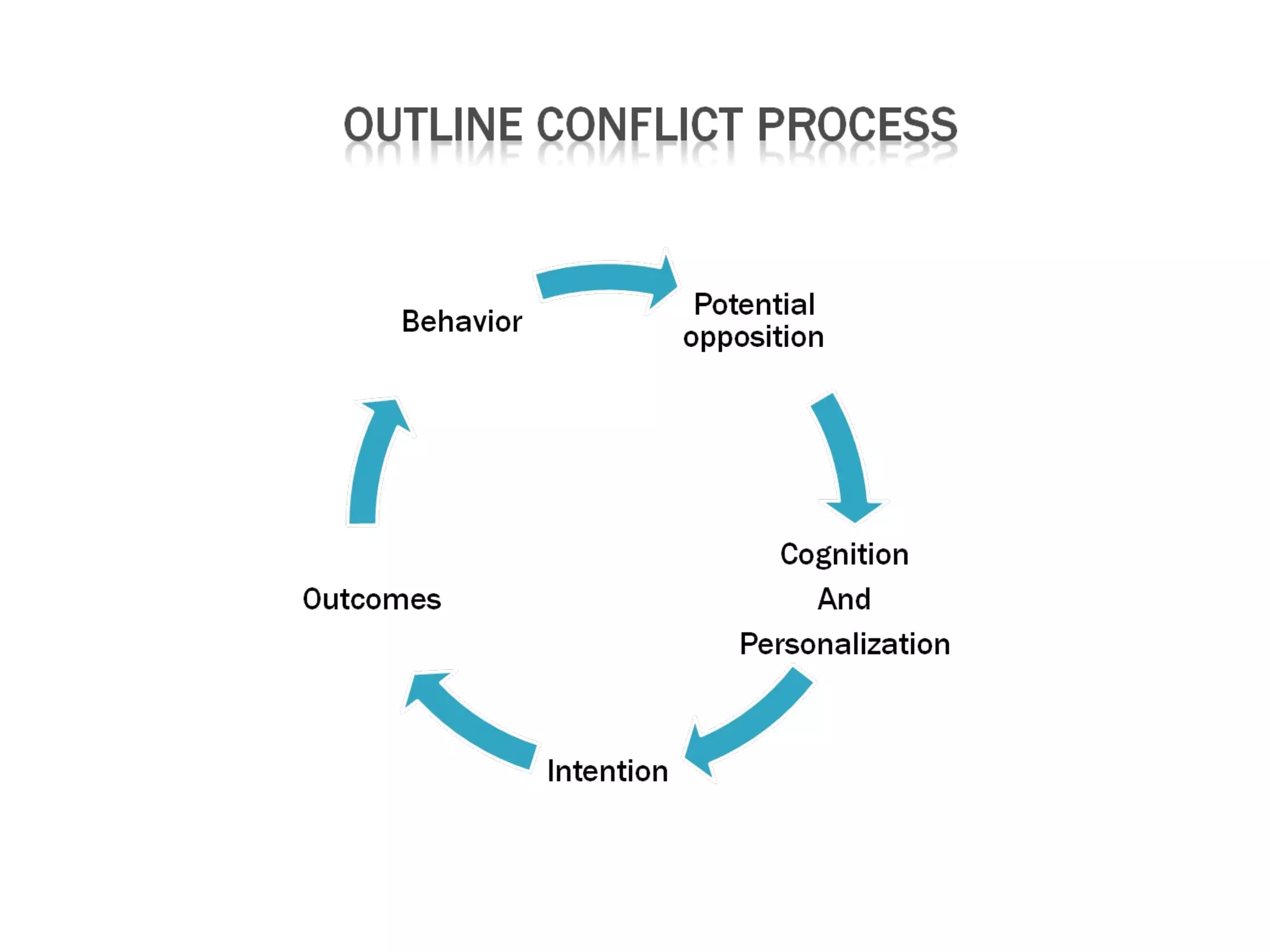
1. Potential Opposition or Incompatibility. The first step is the presence of conditions that create opportunity for conflict to arise. Causes or sources of conflict: Communication: The potential for conflict increases when either too or too much communication takes place. Structure: It is used to include variable. Personal variable: Include personality, emotion, values 2. Cognition and Personalization .
 
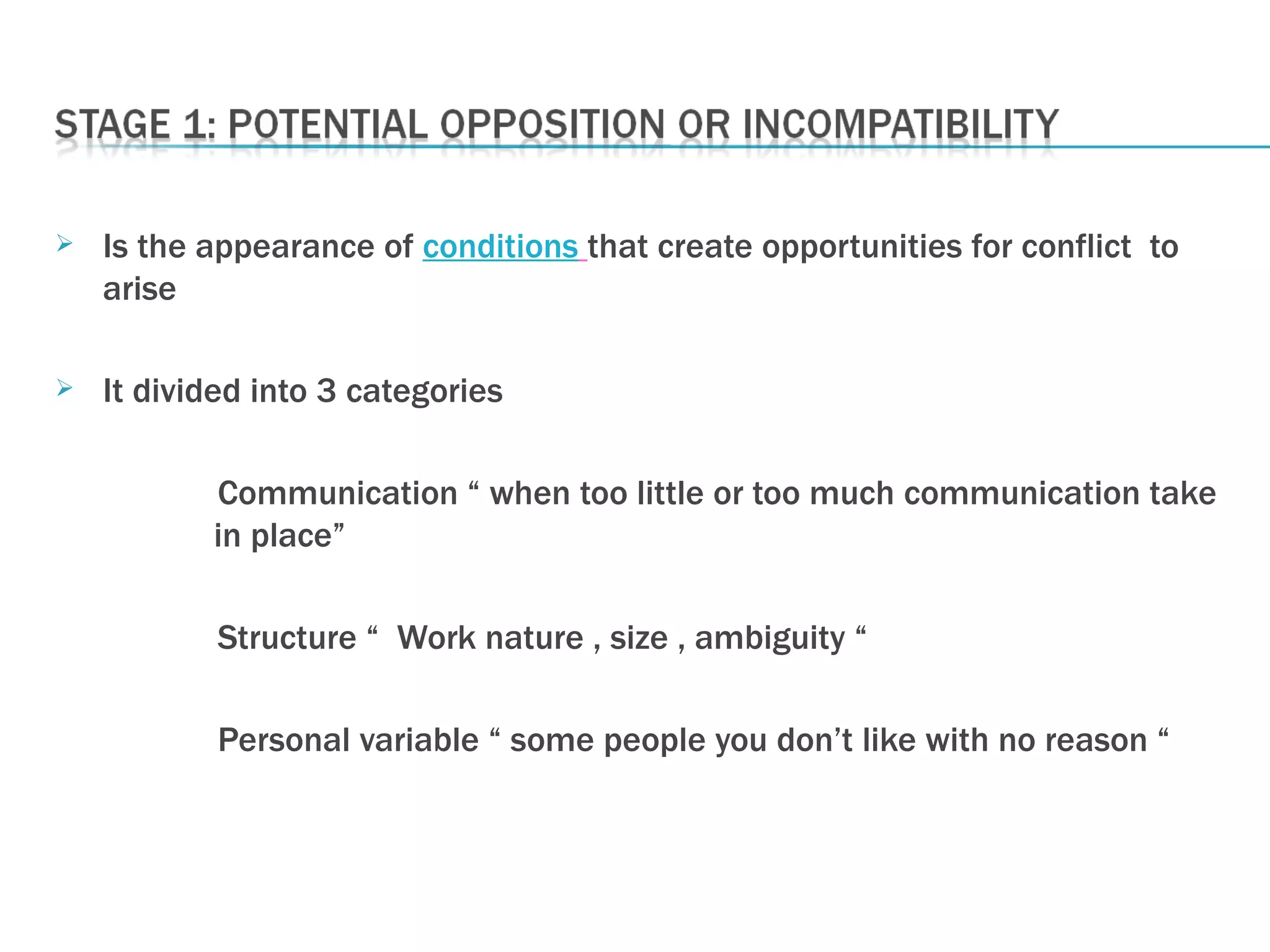
Is the appearance of  conditions   that create opportunities for conflict  to arise It divided into 3 categories  Communication “ when too little or too much communication take in place” Structure “  Work nature , size , ambiguity “ Personal variable “ some people you don’t like with no reason “
If one or more of previous points raise up , we reach this stage  Keep in mind 2 important things  The point when the parties decides what the conflict is about The emotions play a major role in shaping perception
 
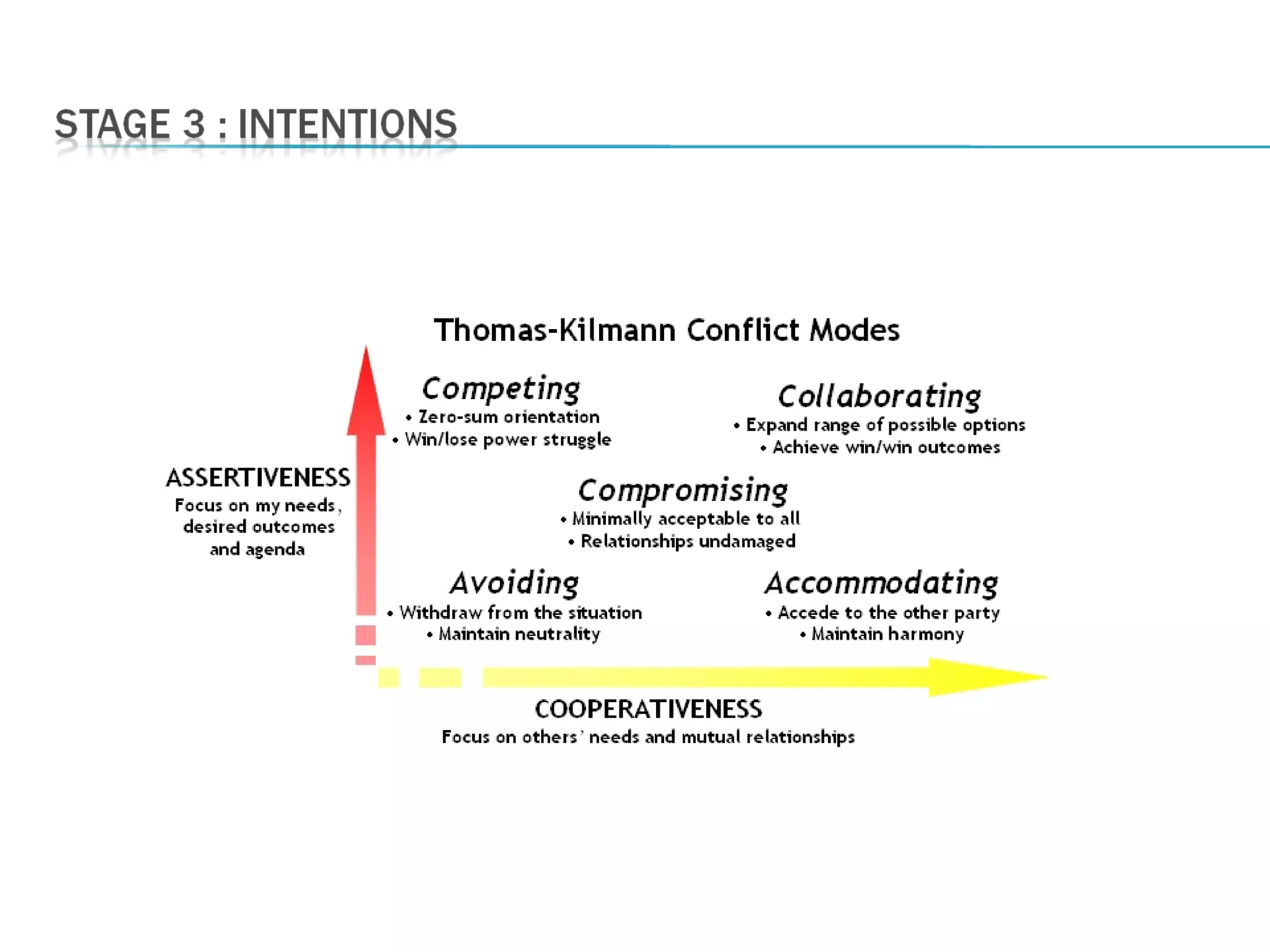
It includes the statement actions , and reactions made by the conflicting parties  According to many conflict management techniques  Problem solving Subordinate goals “ shared goals” Avoidance
According to behavior , the outcomes may be : functional , if the conflict improves the group’s performance “ Low or moderate conflict” or dysfunctional , if it hinders performance  Diversity can usually improve group performance and decision making
 
Is a process that occurs when two or more parties decide how to allocate scarce resources Bargaining Strategies There are two general approaches to negotiation : Distributive Bargaining  The most identifying  feature is that it operates under zero-sum conditions, that is any gain  I make is at your expense and vice versa. So the essence of distributive bargaining is negotiating over who gets what share of a fixed pie. Integrative Bargaining  Operates under the assumption that one or more settlements can create a win-win solution . Both parties must be engaged for it to work.
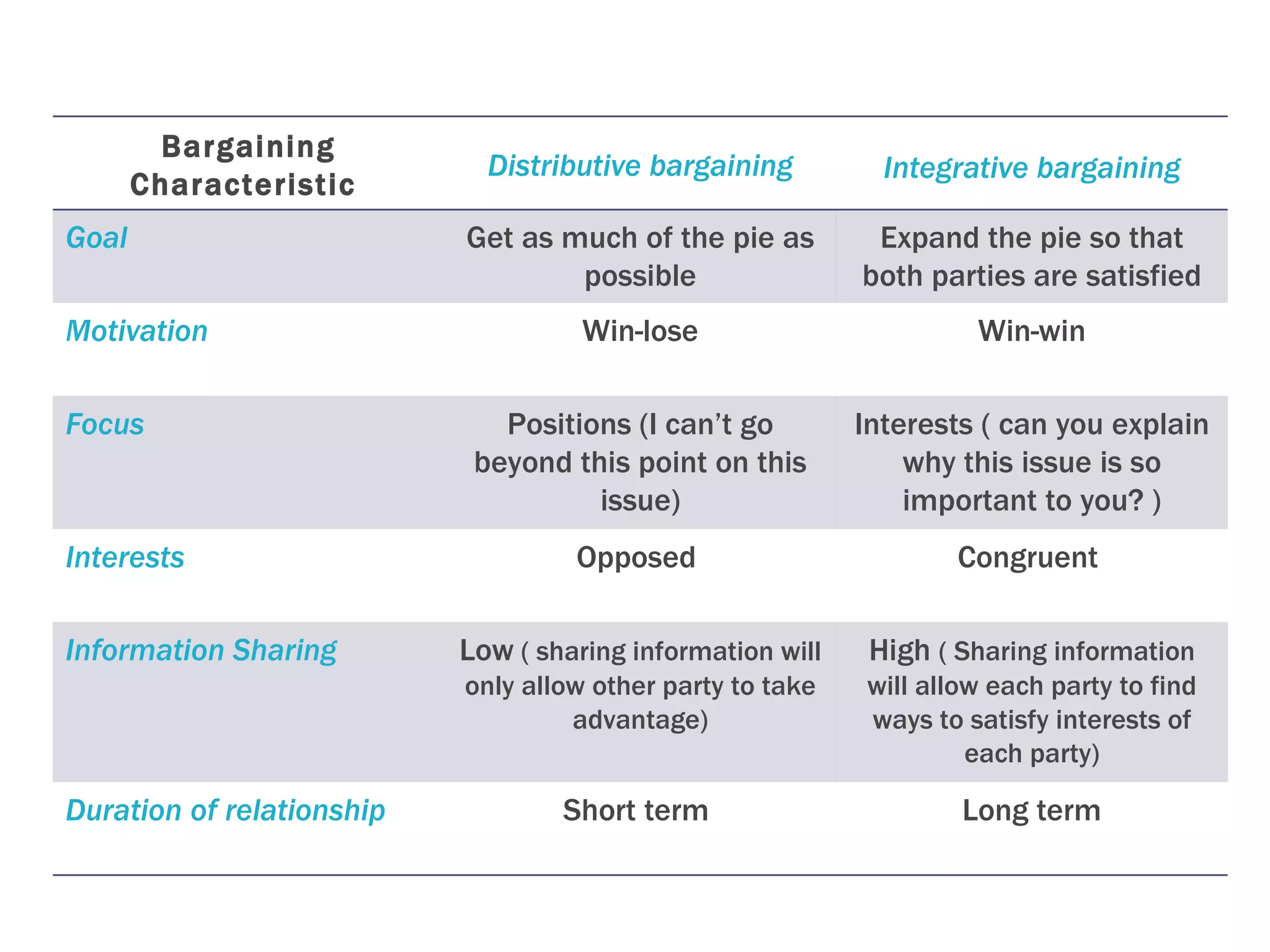
Bargaining Characteristic  Distributive bargaining Integrative bargaining Goal Get as much of the pie as possible Expand the pie so that both parties are satisfied Motivation  Win-lose Win-win Focus Positions (I can’t go beyond this point on this issue) Interests ( can you explain why this issue is so important to you? ) Interests Opposed  Congruent  Information Sharing Low  ( sharing information will only allow other party to take advantage) High  ( Sharing information will allow each party to find ways to satisfy interests of each party) Duration of relationship Short term  Long term
5 steps of the negotiation process 1- preparation and planning Make sure that your goal stays paramount in your discussions Put your goals in writing and develop a range of outcomes to keep your attention focused. Assess what you think  are the other party’s goals. Once you have gathered your information , use it to develop a strategy.
2-Definition of ground rules: During this phase , the parties will exchange their initial proposals or demands. At this phase you are ready to begin defining with the other party the ground rules and procedures  of the negotiation  itself  3-Clarification and justification:  At this phase both you and the other party will explain ,amplify , clarify and justify your original demands.
4-  Bargaining and problem solving: This is where both parties will undoubtedly need to make concessions. 5-Closure and implementation The final step in the negotiation process is formalizing the agreement that has been worked out and developing any procedures necessary for implementation  and  monitoring.
Three factors influence how effectively individuals negotiate : personality, mood & emotions , and gender. Personality traits in negotiation Negotiators who are agreeable or extraverted  aren’t very successful in distributive bargaining as they are  outgoing and friendly , they tend to share more information than  they should . So the best distributive bargainer appears to be a disagreeable introvert , someone more interested in his or her own outcomes than in pleasing the other party  and having a pleasant  social  exchange .
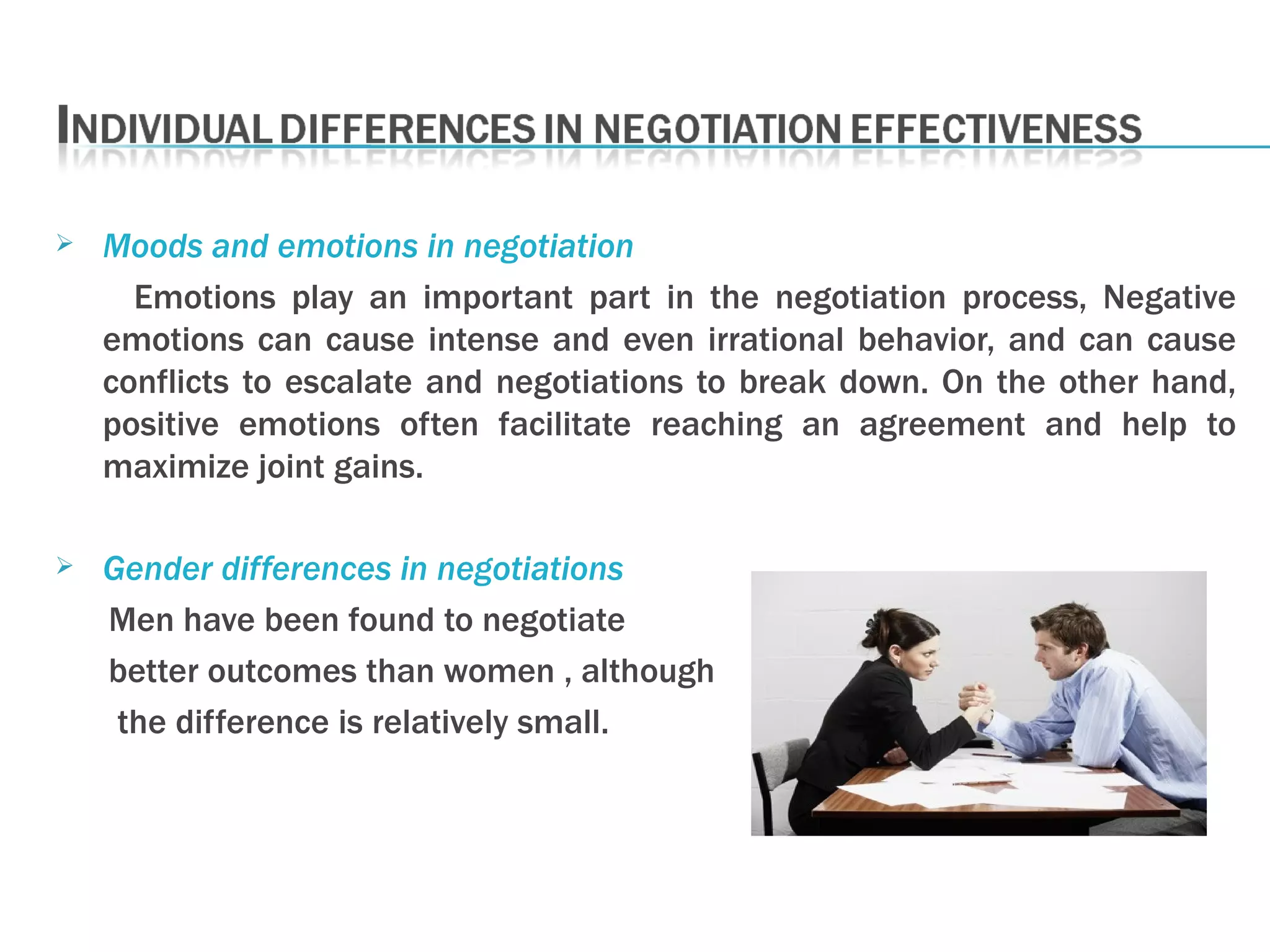
Moods and emotions in negotiation  Emotions play an important part in the negotiation process, Negative emotions can cause intense and even irrational behavior, and can cause conflicts to escalate and negotiations to break down. On the other hand, positive emotions often facilitate reaching an agreement and help to maximize joint gains. Gender differences in negotiations  Men have been found to negotiate  better outcomes than women , although the difference is relatively small.
There are 4 basic third party roles Mediator  Mediator is a neutral third party who facilitates  a negotiated solution by using reasons and persuasion , suggesting alternatives . Arbitrator   Arbitrator Is a third party with the authority to dictate an agreement. The big plus of arbitration over mediation is that it always results in a settlement .
Conciliator  Conciliator Is a trusted third party who provides an informal communication link between the negotiator and the opponent  . Consultant  Consultant is a skilled and impartial third party who attempts to facilitate problem solving through communication and analysis, aided by a knowledge of conflict management.
 

Conflicts and negotiation

  • 1.
  • 2.
    A process thatbegin when party perceives that another party has negatively affected, something that the first party cares about. Transitions in Conflict Thought Traditional View – Avoid Conflict. Human Relation View – Conflict is natural & inevitable outcome in any group Interactionist View – Conflict is absolutely necessary for group to perform effectively.
  • 3.
    Conflict was viewednegatively. It was used synonymously with violence – destruction irrationality -- Harmful and has to be avoided. Consistent with group behavior attitude in the 1930 & 1940 Conflict is dysfunctional outcome resulting from poor communication, lack of openness and trust between people, and the failure of managers to be responsive to the needs and aspirations of their employees. Conflict reduction results in high group of performance.
  • 4.
    Conflict was naturaloccurrence in all groups. Conflict cannot be eliminated, there are times when conflict may benefit a group’s performance. Human Relations view dominated conflict theory from 1940 – 1970. The Internactionist View of Conflict It encourages conflict. Functional conflict support the goal of the group and improve its performance Dysfunctional conflict hinders group performance
  • 5.
    There are 3types of conflict Task: relates to the content and goals of the work – Low to moderate level. Relationship: focus on interpersonal relationships - High level. Process: relates to how the work gets done – Low level.
  • 6.
    1. Potential Oppositionor Incompatibility. The first step is the presence of conditions that create opportunity for conflict to arise. Causes or sources of conflict: Communication: The potential for conflict increases when either too or too much communication takes place. Structure: It is used to include variable. Personal variable: Include personality, emotion, values 2. Cognition and Personalization .
  • 7.
  • 8.
    Is the appearanceof conditions that create opportunities for conflict to arise It divided into 3 categories Communication “ when too little or too much communication take in place” Structure “ Work nature , size , ambiguity “ Personal variable “ some people you don’t like with no reason “
  • 9.
    If one ormore of previous points raise up , we reach this stage Keep in mind 2 important things The point when the parties decides what the conflict is about The emotions play a major role in shaping perception
  • 10.
  • 11.
    It includes thestatement actions , and reactions made by the conflicting parties According to many conflict management techniques Problem solving Subordinate goals “ shared goals” Avoidance
  • 12.
    According to behavior, the outcomes may be : functional , if the conflict improves the group’s performance “ Low or moderate conflict” or dysfunctional , if it hinders performance Diversity can usually improve group performance and decision making
  • 13.
  • 14.
    Is a processthat occurs when two or more parties decide how to allocate scarce resources Bargaining Strategies There are two general approaches to negotiation : Distributive Bargaining The most identifying feature is that it operates under zero-sum conditions, that is any gain I make is at your expense and vice versa. So the essence of distributive bargaining is negotiating over who gets what share of a fixed pie. Integrative Bargaining Operates under the assumption that one or more settlements can create a win-win solution . Both parties must be engaged for it to work.
  • 15.
    Bargaining Characteristic Distributive bargaining Integrative bargaining Goal Get as much of the pie as possible Expand the pie so that both parties are satisfied Motivation Win-lose Win-win Focus Positions (I can’t go beyond this point on this issue) Interests ( can you explain why this issue is so important to you? ) Interests Opposed Congruent Information Sharing Low ( sharing information will only allow other party to take advantage) High ( Sharing information will allow each party to find ways to satisfy interests of each party) Duration of relationship Short term Long term
  • 16.
    5 steps ofthe negotiation process 1- preparation and planning Make sure that your goal stays paramount in your discussions Put your goals in writing and develop a range of outcomes to keep your attention focused. Assess what you think are the other party’s goals. Once you have gathered your information , use it to develop a strategy.
  • 17.
    2-Definition of groundrules: During this phase , the parties will exchange their initial proposals or demands. At this phase you are ready to begin defining with the other party the ground rules and procedures of the negotiation itself 3-Clarification and justification: At this phase both you and the other party will explain ,amplify , clarify and justify your original demands.
  • 18.
    4- Bargainingand problem solving: This is where both parties will undoubtedly need to make concessions. 5-Closure and implementation The final step in the negotiation process is formalizing the agreement that has been worked out and developing any procedures necessary for implementation and monitoring.
  • 19.
    Three factors influencehow effectively individuals negotiate : personality, mood & emotions , and gender. Personality traits in negotiation Negotiators who are agreeable or extraverted aren’t very successful in distributive bargaining as they are outgoing and friendly , they tend to share more information than they should . So the best distributive bargainer appears to be a disagreeable introvert , someone more interested in his or her own outcomes than in pleasing the other party and having a pleasant social exchange .
  • 20.
    Moods and emotionsin negotiation Emotions play an important part in the negotiation process, Negative emotions can cause intense and even irrational behavior, and can cause conflicts to escalate and negotiations to break down. On the other hand, positive emotions often facilitate reaching an agreement and help to maximize joint gains. Gender differences in negotiations Men have been found to negotiate better outcomes than women , although the difference is relatively small.
  • 21.
    There are 4basic third party roles Mediator Mediator is a neutral third party who facilitates a negotiated solution by using reasons and persuasion , suggesting alternatives . Arbitrator Arbitrator Is a third party with the authority to dictate an agreement. The big plus of arbitration over mediation is that it always results in a settlement .
  • 22.
    Conciliator ConciliatorIs a trusted third party who provides an informal communication link between the negotiator and the opponent . Consultant Consultant is a skilled and impartial third party who attempts to facilitate problem solving through communication and analysis, aided by a knowledge of conflict management.
  • 23.