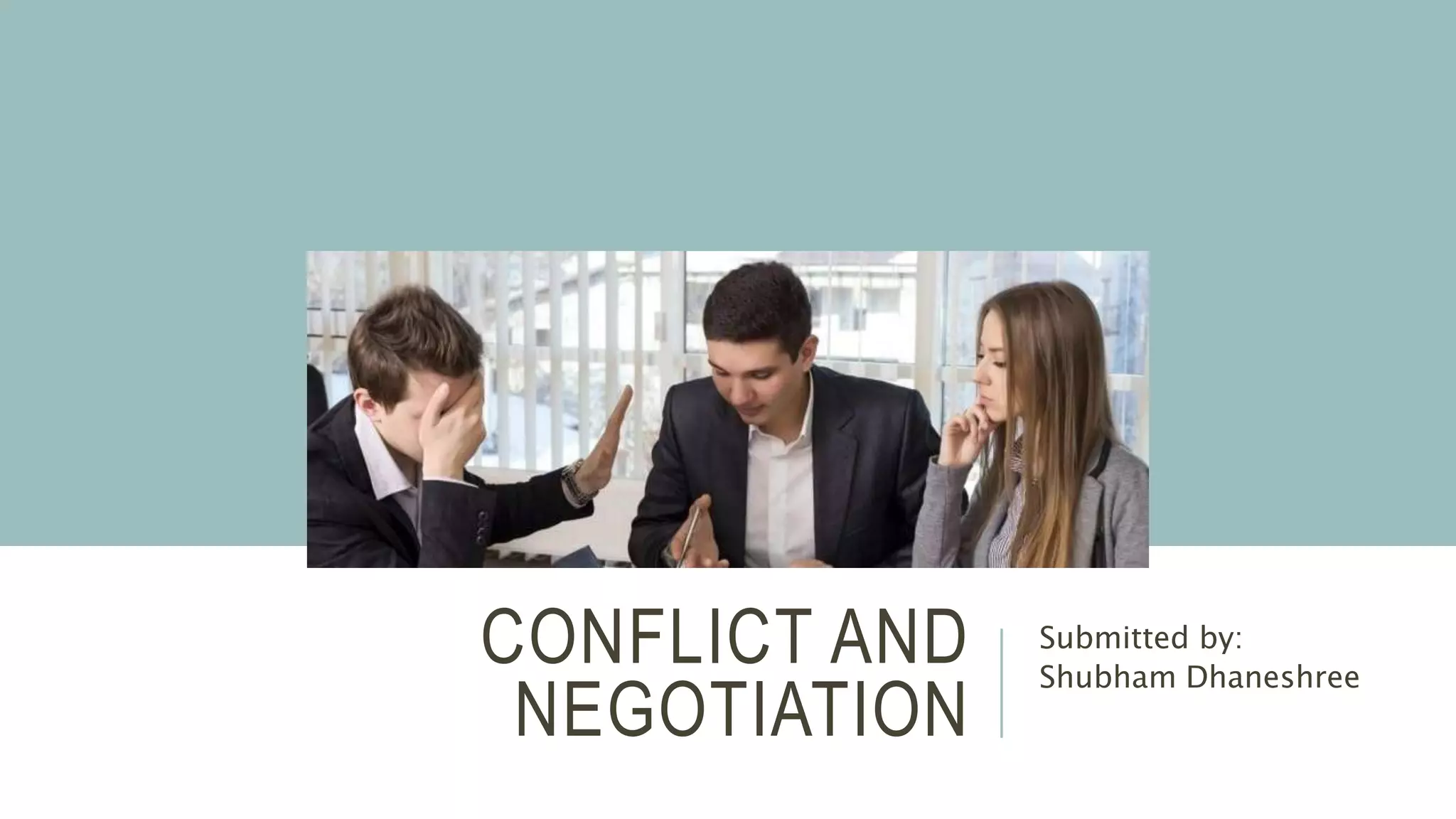
CONFLICT AND
NEGOTIATION
Submitted by:
Shubham Dhaneshree
CONFLICT DEFINITION
 A process that begins when one party perceives that another party
has negatively affected, or is about to negatively affect, something
that the first party cares about.
 Encompasses a wide range of conflicts that people experience in
organizations
– Incompatibility of goals
– Differences over interpretations of facts
– Disagreements based on behavioral expectations
TYPES OF CONFLICT
 Task Conflict
– Conflicts over content and goals of the work
– Low-to-moderate levels of this type are FUNCTIONAL
 Relationship Conflict
– Conflict based on interpersonal relationships
– Almost always DYSFUNCTIONAL
 Process Conflict
– Conflict over how work gets done
– Low levels of this type are FUNCTIONAL
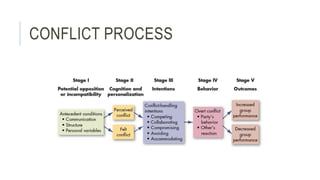
CONFLICT PROCESS
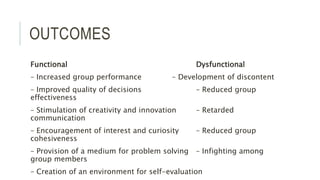
OUTCOMES
Functional Dysfunctional
– Increased group performance – Development of discontent
– Improved quality of decisions – Reduced group
effectiveness
– Stimulation of creativity and innovation – Retarded
communication
– Encouragement of interest and curiosity – Reduced group
cohesiveness
– Provision of a medium for problem solving – Infighting among
group members
– Creation of an environment for self-evaluation
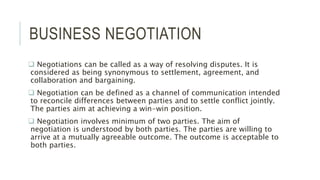
BUSINESS NEGOTIATION
 Negotiations can be called as a way of resolving disputes. It is
considered as being synonymous to settlement, agreement, and
collaboration and bargaining.
 Negotiation can be defined as a channel of communication intended
to reconcile differences between parties and to settle conflict jointly.
The parties aim at achieving a win-win position.
 Negotiation involves minimum of two parties. The aim of
negotiation is understood by both parties. The parties are willing to
arrive at a mutually agreeable outcome. The outcome is acceptable to
both parties.
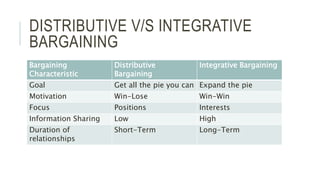
DISTRIBUTIVE V/S INTEGRATIVE
BARGAINING
Bargaining
Characteristic
Distributive
Bargaining
Integrative Bargaining
Goal Get all the pie you can Expand the pie
Motivation Win-Lose Win-Win
Focus Positions Interests
Information Sharing Low High
Duration of
relationships
Short-Term Long-Term
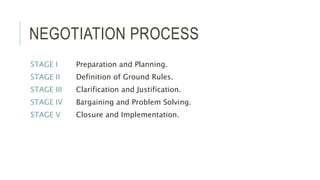
NEGOTIATION PROCESS
STAGE I Preparation and Planning.
STAGE II Definition of Ground Rules.
STAGE III Clarification and Justification.
STAGE IV Bargaining and Problem Solving.
STAGE V Closure and Implementation.
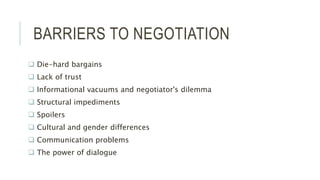
BARRIERS TO NEGOTIATION
 Die-hard bargains
 Lack of trust
 Informational vacuums and negotiator's dilemma
 Structural impediments
 Spoilers
 Cultural and gender differences
 Communication problems
 The power of dialogue
THANK YOU!
FOR KIND ATTENTION

Conflict and negotiation

  • 1.
  • 2.
    CONFLICT DEFINITION  Aprocess that begins when one party perceives that another party has negatively affected, or is about to negatively affect, something that the first party cares about.  Encompasses a wide range of conflicts that people experience in organizations – Incompatibility of goals – Differences over interpretations of facts – Disagreements based on behavioral expectations
  • 3.
    TYPES OF CONFLICT Task Conflict – Conflicts over content and goals of the work – Low-to-moderate levels of this type are FUNCTIONAL  Relationship Conflict – Conflict based on interpersonal relationships – Almost always DYSFUNCTIONAL  Process Conflict – Conflict over how work gets done – Low levels of this type are FUNCTIONAL
  • 4.
  • 5.
    OUTCOMES Functional Dysfunctional – Increasedgroup performance – Development of discontent – Improved quality of decisions – Reduced group effectiveness – Stimulation of creativity and innovation – Retarded communication – Encouragement of interest and curiosity – Reduced group cohesiveness – Provision of a medium for problem solving – Infighting among group members – Creation of an environment for self-evaluation
  • 6.
    BUSINESS NEGOTIATION  Negotiationscan be called as a way of resolving disputes. It is considered as being synonymous to settlement, agreement, and collaboration and bargaining.  Negotiation can be defined as a channel of communication intended to reconcile differences between parties and to settle conflict jointly. The parties aim at achieving a win-win position.  Negotiation involves minimum of two parties. The aim of negotiation is understood by both parties. The parties are willing to arrive at a mutually agreeable outcome. The outcome is acceptable to both parties.
  • 7.
    DISTRIBUTIVE V/S INTEGRATIVE BARGAINING Bargaining Characteristic Distributive Bargaining IntegrativeBargaining Goal Get all the pie you can Expand the pie Motivation Win-Lose Win-Win Focus Positions Interests Information Sharing Low High Duration of relationships Short-Term Long-Term
  • 8.
    NEGOTIATION PROCESS STAGE IPreparation and Planning. STAGE II Definition of Ground Rules. STAGE III Clarification and Justification. STAGE IV Bargaining and Problem Solving. STAGE V Closure and Implementation.
  • 9.
    BARRIERS TO NEGOTIATION Die-hard bargains  Lack of trust  Informational vacuums and negotiator's dilemma  Structural impediments  Spoilers  Cultural and gender differences  Communication problems  The power of dialogue
  • 10.